
BuddhistCatholicContemplativeEvangelicalGeneral ChristianHinduJewishLatter-day SaintMuslimNew VisionsProgressive Christian
Beliefs
- Buddhist
- Catholic
- Contemplative
- Evangelical
- General Christian
- Hindu
- Jewish
- Latter-day Saint
- More Voices
- Muslim
- New Visions
- Pagan
- Progressive Christian
Topics
- Religion News
- Food and Religion
- Sports and Religion
- Religious Art
- Religious Music and Entertainment
- Religious Events
- History and Religion
- Style and Religion
- Politics and Religion
- Women in Religion
- Recreation Outdoors and Religion
- Business Finance and Religion
- Careers Workplace and Religion
- Education and Religion
- Family Parenting and Religion
- Health Fitness and Religion
- Home and Religion
- Relationships and Religion
- Technology and Religion
- Travel and Religion
Columnists
- Buddhist Columnists
- Business Finance and Religion Columnists
- Careers Workplace and Religion Columnists
- Catholic Columnists
- Contemplative Columnists
- Education and Religion Columnists
- Evangelists Columnists
- Family Parenting and Religion Columnists
- General Christian Columnists
- Health Fitness and Religion Columnists
- Hindu Columnists
- History and Religion Columnists
- Home and Religion Columnists
- Jewish Columnists
- More Voices Columnists
- Latter Day Columnists
- Muslim Columnists
- New Visions Columnists
- Nonreligious Columnists
- Pagan Columnists
- Politics and Religion Columnists
- Progressive Columnists
- Recreation Outdoors and Religion Columnists
- Relationships and Religion Columnists
- Religion News Columnists
- Religious Art Columnists
- Religious Events Columnists
- Religious Music and Entertainment Columnists
- Sports and Religion Columnists
- Style and Religion Columnists
- Technology and Religion Columnists
- Travel and Religion Columnists
- Women in Religion Columnists
Resource Library
- 2026 Calendar
- Library of World Religions
- The 100 Most Holy Places on Earth
- Patheos Answers
- Podcasts
- Videos
- Faith Leaders Database
- Anglican Episcopalian
- Bahai
- Baptist
- Buddhism
- Christianity
- Confucianism
- Eastern Orthodoxy
- Hinduism
- Holiness and Pentecostal
- ISKCON
- Islam
- Judaism
- Lutheran
- Methodist
- The Church of Jesus Christ of Latter-day Saints
- New Age
- Paganism
- Presbytarian and Reformed
- Protestantism
- Religion Behind the Scenes
- Roman Catholic
- Scientology
- Shia Islam
- Sikhism
- Sufism
- Sunni Islam
- Taoism
- Zen
- See all religions
Research Tools
 Ad-Free & Subscriber Log-In Subscription Support
Ad-Free & Subscriber Log-In Subscription Support
Follow Patheos 

- Trending:
- Forgiveness
- |
- Marriage
- |
- Consciousness
- |
- Death Penalty
- |
- Election
- |
- Halloween
 Synapses of the Soul
- Home
- Catholic
- On spiritual friendship
On spiritual friendship
Last updated on: March 5, 2021 at 7:04 am by Synapses of the Soul
On spiritual friendship 2021-03-05T07:04:12-06:00 Synapses of the Soul
Patheos Explore the world's faith through different perspectives on religion and spirituality! Patheos has the views of the prevalent religions and spiritualities of the world.
Lately, I’ve been relying more heavily than usual on my friends – or at least, more attuned to my dependence on them. I’ve been blessed with incredible, unexpected friendships during my time at Notre Dame. And I need them. I need this companionship that I’ve been drawn into.
So I’ve been wondering, what exactly is our friendship? And why do I need it?
Two great accounts of spiritual friendship
Of the many eloquent accounts of friendship, two really stick out to me as insightful.
The first is from C.S. Lewis’ book The Four Loves:
“Friendship arises out of mere Companionship when two or more of the companions discover that they have in common some insight or interest or even taste which the others do not share and which, till that moment, each believed to be his own unique treasure (or burden). The typical expression of opening Friendship would be something like, “What? You too? I thought I was the only one.” … It is when two such persons discover one another, when, whether with immense difficulties and semi-articulate fumblings or with what would seem to us amazing and elliptical speed, they share their vision – it is then that Friendship is born. And instantly they stand together in an immense solitude.”
In other words, friendship grows out of companionship when the two individuals recognize a shared truth of experience. This sharing, their gaze is focused on the same object, and they journey toward it together.
The second is from Don Giussani’s Is it possible to live this way?:
Friendship in its minimal state, is the encounter of one person with another person whose destiny he or she desires more than his or her own life. I desire your destiny more than I desire my life. The other reciprocates this and desires my destiny more than his or her life.
This echoes the Summa of St. Thomas, in which he describes friendship as amor benevolentiae. This is a love that wills the good of the friend. This form of love rests on the companionship of shared life, and it is a self-giving love of the friend as oneself.
The benefits of friendship
On a cognitive level, we are profoundly shaped by friendship. Peer interactions are necessary for proper brain development and maintenance of cognitive and emotional health. Furthermore, supportive relationships help protect against the effects of toxic stress. Throughout the lifetime, interactions between peers coordinate heart rates and hormone release, and even promote synchrony between brain-waves. These forms of coordination promote feelings of connectedness and experiences of meaning, and motivate collaborative and social behavior. And when it comes to aging, the brain is much more resilient when it’s embedded in bonds of friendship.
Great friendships, though, demand hard work. Authentic intimacy requires vulnerability and sacrifice. It requires that you risk your heart by putting it into play. To enter into a great friendship, you must be willing to give of yourself even at the cost of your comfort, pride, and preference.
But these costs are worth it, because a great friendship is incredibly life giving. It provides a space of healing, intimacy, joy, and accompaniment. Spiritual friendships, in particular, provide companionship on life’s journey toward wholeness and holiness in Christ.
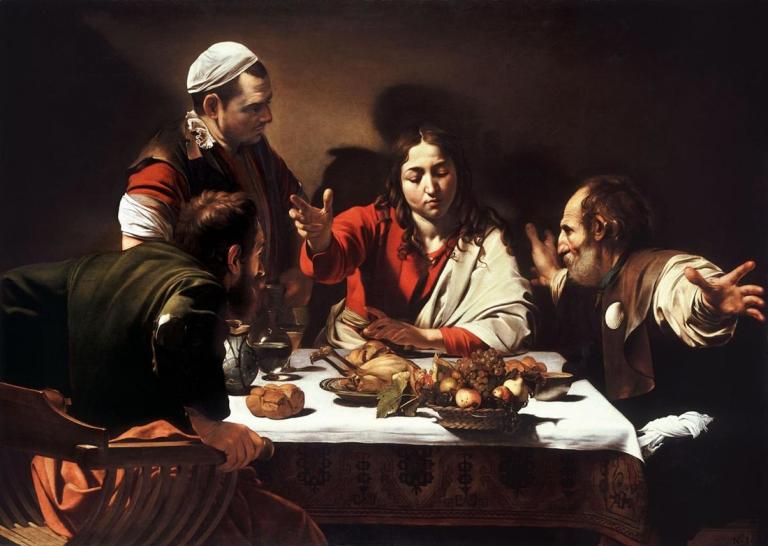
Supper at Emmaus, Caravaggio, National Gallery, London
Reductions of friendship
It can be hard to wait with patience for the gift of a great friendship. Often, we can settle into mediocrity out of desperation for intimacy and a desire to be known. But ultimately, this is not true friendship, because it’s not loving the other as yourself. Instead, it’s loving yourself in the other. This collapses friendship into self-love.
Often, our need for a spiritual friendship is ignored. We don’t feel the need for a great spiritual friendship if we have peers with a shared interest in religion, someone with whom we share a common hobby of religiosity. But this too is a reduction. Great spiritual friendship demands that you enter deeply into all areas of your life, that you share your experience as you seek God’s presence in it. Nothing is left aside, no matter how difficult or mundane! Everything is to be welcomed in a spiritual friendship with vulnerability and humility, for it all belongs to Christ.
How (not) to grow in friendship
Don’t try to force or control this love. You can’t create intimacy out of your own will. On the contrary, you need a certain level of detachment to receive the gift of a great friendship. Friendship is the opposite of possession.
Don’t seek friendship out of a fear of loneliness. Embrace your loneliness, for it’s a sign that you’re made for self-gift in companionship. This need points you to the fact that you’re made for love.
Don’t focus on the intensity of the feelings. This isn’t the foundation of your relationship. Focus on the Lord. Ground yourself in Christ, and you’ll grow in friendship. You don’t create or choose your friends, you find them. And if your relationship is to be sustained, the source must be Another.
Do not be afraid of adversity. As Don Giussani says, “The condition for being true in a relationship is sacrifice.” For, as Christ teaches us in John 15:
This is my commandment: love one another as I love you. No one has greater love than this, to lay down one’s life for one’s friends. You are my friends if you do what I command you… It was not you who chose me, but I who chose you and appointed you to go and bear fruit that will remain, so that whatever you ask the Father in my name he may give you. This I command you: love one another.
Further reading recommendations
Maurice and Thérèse is a collection of letters between St. Therese and a young seminarian, Maurice Belliere. Though they never met in person, their twenty-one letters are an incredibly moving example of spiritual friendship.

About Synapses of the Soul
You can contact Sofia at [email protected]. You can read more about the author here.
Previous Post

November 15, 2018
Why you should pray the Liturgy of the Hours
Next Post

November 25, 2018 Don't be afraid of your fear
Browse Our Archives
Select a Category Monthly Roundup Series: Habits Uncategorized
Select a Month November 2020 October 2020 September 2020 August 2020 July 2020 June 2020 May 2020 April 2020 January 2020 December 2019 November 2019 October 2019 September 2019 August 2019 March 2019 February 2019 January 2019 December 2018 November 2018 October 2018 September 2018 August 2018
TAKE THE
Religious Wisdom Quiz
What Christian tradition refers to its pastors as "elders"?
Select your answer to see how you score.
Catholic Presbyterian Orthodox Anglican
Related posts from Synapses of the Soul


Your Life Should Cause Cognitive Dissonance


Does Your Mind Extend Into the World?
TRENDING AT PATHEOS Catholic

Rejecting Doom: Christian Hope And Human Action
Christianity is a religion of hope. We are to have hope and...

It’s What Comes From Within Which Matters
One of the most difficult things for us to understand is why...

Why I Choose the Eucharist Over the Sermon
Choose the Eucharist, Not the Sermon What are we supposed to get...

5 Design Elements Found in Spiritually Rooted Homes
Putting Spirituality Into Home Decor Our homes are more than our living...

Credo: A Story of God Told with the...
About 10 years ago, I began to imagine a personal "Credo" that...

The Anatomy of Divine Revelation in Catholic Thought
The claim that God has made Himself known to human beings is...
view all Catholic blogs
Ad-Free & Subscriber Log-In Subscription Support
- About Us
- 2026 Calendar
- Videos
- Podcasts
- Library of World Religions
- Faith In Media Tracker
- Advertise With Us
- Write for Us
- Privacy Policy
- Terms of Service
- Do Not Sell My Data
- Contact Us
- Radiant Digital
- Manage Newsletter Subscriptions
- Unsubscribe From Notifications
- Sitemap
Copyright 2008-2026, Patheos. All rights reserved.
Subscription Support Ad-Free & Subscriber Log-In
Follow Patheos