
BuddhistCatholicContemplativeEvangelicalGeneral ChristianHinduJewishLatter-day SaintMuslimNew VisionsProgressive Christian
Beliefs
- Buddhist
- Catholic
- Contemplative
- Evangelical
- General Christian
- Hindu
- Jewish
- Latter-day Saint
- More Voices
- Muslim
- New Visions
- Pagan
- Progressive Christian
Topics
- Religion News
- Food and Religion
- Sports and Religion
- Religious Art
- Religious Music and Entertainment
- Religious Events
- History and Religion
- Style and Religion
- Politics and Religion
- Women in Religion
- Recreation Outdoors and Religion
- Business Finance and Religion
- Careers Workplace and Religion
- Education and Religion
- Family Parenting and Religion
- Health Fitness and Religion
- Home and Religion
- Relationships and Religion
- Technology and Religion
- Travel and Religion
Columnists
- Buddhist Columnists
- Business Finance and Religion Columnists
- Careers Workplace and Religion Columnists
- Catholic Columnists
- Contemplative Columnists
- Education and Religion Columnists
- Evangelists Columnists
- Family Parenting and Religion Columnists
- General Christian Columnists
- Health Fitness and Religion Columnists
- Hindu Columnists
- History and Religion Columnists
- Home and Religion Columnists
- Jewish Columnists
- More Voices Columnists
- Latter Day Columnists
- Muslim Columnists
- New Visions Columnists
- Nonreligious Columnists
- Pagan Columnists
- Politics and Religion Columnists
- Progressive Columnists
- Recreation Outdoors and Religion Columnists
- Relationships and Religion Columnists
- Religion News Columnists
- Religious Art Columnists
- Religious Events Columnists
- Religious Music and Entertainment Columnists
- Sports and Religion Columnists
- Style and Religion Columnists
- Technology and Religion Columnists
- Travel and Religion Columnists
- Women in Religion Columnists
Resource Library
- 2026 Calendar
- Library of World Religions
- The 100 Most Holy Places on Earth
- Patheos Answers
- Podcasts
- Videos
- Faith Leaders Database
- Anglican Episcopalian
- Bahai
- Baptist
- Buddhism
- Christianity
- Confucianism
- Eastern Orthodoxy
- Hinduism
- Holiness and Pentecostal
- ISKCON
- Islam
- Judaism
- Lutheran
- Methodist
- The Church of Jesus Christ of Latter-day Saints
- New Age
- Paganism
- Presbytarian and Reformed
- Protestantism
- Religion Behind the Scenes
- Roman Catholic
- Scientology
- Shia Islam
- Sikhism
- Sufism
- Sunni Islam
- Taoism
- Zen
- See all religions
Research Tools
 Ad-Free & Subscriber Log-In Subscription Support
Ad-Free & Subscriber Log-In Subscription Support
Follow Patheos 

- Trending:
- Forgiveness
- |
- Marriage
- |
- Consciousness
- |
- Death Penalty
- |
- Election
- |
- Halloween
 Synapses of the Soul
- Home
- Catholic
- On offering “thoughts and prayers”
On offering “thoughts and prayers”
Last updated on: March 5, 2021 at 7:04 am by Synapses of the Soul
On offering “thoughts and prayers” 2021-03-05T07:04:17-06:00 Synapses of the Soul
Patheos Explore the world's faith through different perspectives on religion and spirituality! Patheos has the views of the prevalent religions and spiritualities of the world.
In the wake of any tragedy or misfortune, Americans tend to offer vague sentiments of empathy. “My thoughts and prayers are with you,” we say. I don’t believe this is an empty platitude, but a genuine expression of concern and positive wishes. But I still don’t think we should say this. Here’s why.
1. Thoughts and prayers should not be categorized together
“Thoughts” may offer a secularized alternative to “prayers,” more palatable to the atheists in our midst. But thoughts are not prayers.
To understand this, look to the Bible. Prayer is calling upon the name of the Lord (Jeremiah 29:12) who hears the cry of His loved ones. It is not “babbling” many words (Matthew 6:7) but the rising of the heart before God like incense (Psalm 141:2). It renews our mind and fixes our sight on what is above (Romans 12:2). Importantly, Jesus says that only prayer and fasting can cast out evil (Mark 9). We do not know how to do this! But the Spirit intercedes for us to help us in our weakness (Romans 8:26). In this way, prayer opens your heart to the indwelling of the Holy Spirit, who alone can overturn the evil of the world. This is especially important in the wake of tragedy, when our response must be guided by understanding, love, courage, and wisdom – the gifts and fruits of the Holy Spirit.
Don’t get me wrong. Thinking about someone who is suffering can be beautiful. It helps you cultivate compassion and find the strength to take action. But bringing someone to your own mind is nothing compared to praying for her. The secular counterpart of a prayer is not a thought, it’s an action. In fact, it’s perhaps the most powerful action you can take.
In the Orthodox Church, this is understood through the concept of theosis, or participation in the divine nature of God. How does this divinization happen? Christ calls us to mind, making us present to the Father and inviting us to share in His Life. Because of our unity with each other in Christ, when you pray for another, she becomes present to you and to Christ in a new way.
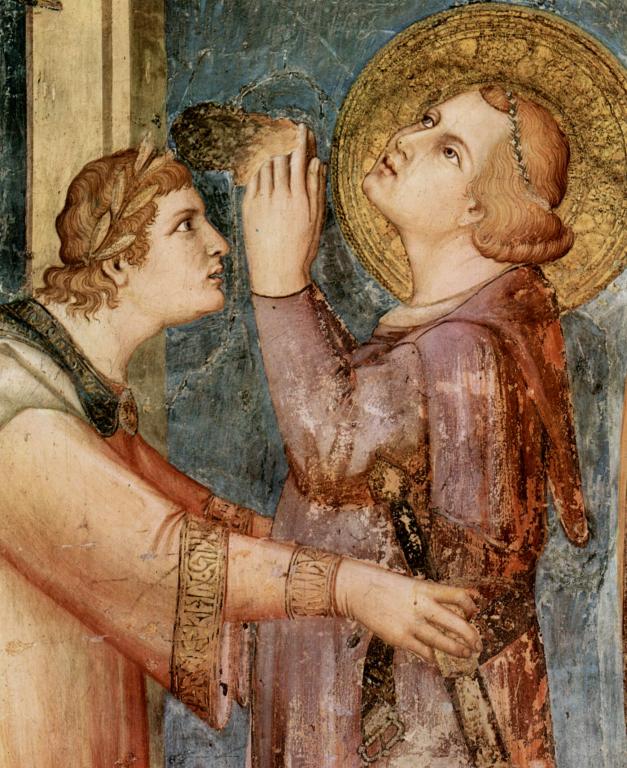
Simone Martini’s St. Martin. Image from Wikimedia Commons.
Okay, so offering prayers is clearly different from offering thoughts. But why not both? But what’s wrong with offering thoughts?
2. It favors inaction
Offering your “thoughts and prayers” for someone is self-serving. It favors inaction, because it gets you off the hook.
Often, in the wake of tragedy, we come to recognize that something must change. For instance, school shootings can help us understand the necessity of stringent gun control. In these moments, our conscience may tell us that we are complicit in the problem. This results in some cognitive dissonance, because you recognize your participation in injustice, and yet you are doing nothing.
So you say “my thoughts are with you” in order to check this cognitive box. It makes you feel better, because you can rest in the knowledge that you have responded to the promptings of your conscience. And you remain complicit in injustice.
Rather than checking that cognitive box, I invite you to sit with the discomfort. Better yet, pray with it. Don’t let it shut you down, but allow it to open you up. Let it show you concrete ways in which you can change and take action, so you can respond to the promptings of your conscience.
In the words of Saint John Paul II:
Prayer gives us strength for great ideals, for keeping up our faith, charity, purity, generosity, prayer gives us strength to rise up from indifference and guilt, if we have had the misfortune to give in to temptation and weakness. Prayer gives us light by which to see and to judge from God’s perspective and from eternity. That is why you must not give up on praying!
And if you still desire to offer some message of empathy, how about saying, “my prayers and actions are with you” instead of “thoughts and prayers”?
Further reading recommendations
Fr. Thomas Dubay’s Deep Conversion Deep Prayer offers an overview of the spiritual life and practical advice for developing a deep prayer life.
St. Francis de Sales writes about what it means to be a Christian in a secular world, and a testimony of God’s grace and love, in his Introduction to the Devout Life.

About Synapses of the Soul
You can contact Sofia at [email protected]. You can read more about the author here.
Previous Post

October 14, 2018
The psychology and spirituality of climate change (part two)
Next Post

October 25, 2018 Depression, death and new life in autumn
Recent Comments
Browse Our Archives
Select a Category Monthly Roundup Series: Habits Uncategorized
Select a Month November 2020 October 2020 September 2020 August 2020 July 2020 June 2020 May 2020 April 2020 January 2020 December 2019 November 2019 October 2019 September 2019 August 2019 March 2019 February 2019 January 2019 December 2018 November 2018 October 2018 September 2018 August 2018
TAKE THE
Religious Wisdom Quiz
Which high priest led in the reading and explaining of the Law to the people?
Select your answer to see how you score.
Ezra Eliashib Nehemiah Zerubbabel
Related posts from Synapses of the Soul


Your Life Should Cause Cognitive Dissonance


Does Your Mind Extend Into the World?
TRENDING AT PATHEOS Catholic

Rejecting Doom: Christian Hope And Human Action
Christianity is a religion of hope. We are to have hope and...

It’s What Comes From Within Which Matters
One of the most difficult things for us to understand is why...

Why I Choose the Eucharist Over the Sermon
Choose the Eucharist, Not the Sermon What are we supposed to get...

5 Design Elements Found in Spiritually Rooted Homes
Putting Spirituality Into Home Decor Our homes are more than our living...

Credo: A Story of God Told with the...
About 10 years ago, I began to imagine a personal "Credo" that...

The Anatomy of Divine Revelation in Catholic Thought
The claim that God has made Himself known to human beings is...
view all Catholic blogs
Ad-Free & Subscriber Log-In Subscription Support
- About Us
- 2026 Calendar
- Videos
- Podcasts
- Library of World Religions
- Faith In Media Tracker
- Advertise With Us
- Write for Us
- Privacy Policy
- Terms of Service
- Do Not Sell My Data
- Contact Us
- Radiant Digital
- Manage Newsletter Subscriptions
- Unsubscribe From Notifications
- Sitemap
Copyright 2008-2026, Patheos. All rights reserved.
Subscription Support Ad-Free & Subscriber Log-In
Follow Patheos