
BuddhistCatholicContemplativeEvangelicalGeneral ChristianHinduJewishLatter-day SaintMuslimNew VisionsProgressive Christian
Beliefs
- Buddhist
- Catholic
- Contemplative
- Evangelical
- General Christian
- Hindu
- Jewish
- Latter-day Saint
- More Voices
- Muslim
- New Visions
- Pagan
- Progressive Christian
Topics
- Religion News
- Food and Religion
- Sports and Religion
- Religious Art
- Religious Music and Entertainment
- Religious Events
- History and Religion
- Style and Religion
- Politics and Religion
- Women in Religion
- Recreation Outdoors and Religion
- Business Finance and Religion
- Careers Workplace and Religion
- Education and Religion
- Family Parenting and Religion
- Health Fitness and Religion
- Home and Religion
- Relationships and Religion
- Technology and Religion
- Travel and Religion
Columnists
- Buddhist Columnists
- Business Finance and Religion Columnists
- Careers Workplace and Religion Columnists
- Catholic Columnists
- Contemplative Columnists
- Education and Religion Columnists
- Evangelists Columnists
- Family Parenting and Religion Columnists
- General Christian Columnists
- Health Fitness and Religion Columnists
- Hindu Columnists
- History and Religion Columnists
- Home and Religion Columnists
- Jewish Columnists
- More Voices Columnists
- Latter Day Columnists
- Muslim Columnists
- New Visions Columnists
- Nonreligious Columnists
- Pagan Columnists
- Politics and Religion Columnists
- Progressive Columnists
- Recreation Outdoors and Religion Columnists
- Relationships and Religion Columnists
- Religion News Columnists
- Religious Art Columnists
- Religious Events Columnists
- Religious Music and Entertainment Columnists
- Sports and Religion Columnists
- Style and Religion Columnists
- Technology and Religion Columnists
- Travel and Religion Columnists
- Women in Religion Columnists
Resource Library
- 2026 Calendar
- Library of World Religions
- The 100 Most Holy Places on Earth
- Patheos Answers
- Podcasts
- Videos
- Faith Leaders Database
- Anglican Episcopalian
- Bahai
- Baptist
- Buddhism
- Christianity
- Confucianism
- Eastern Orthodoxy
- Hinduism
- Holiness and Pentecostal
- ISKCON
- Islam
- Judaism
- Lutheran
- Methodist
- The Church of Jesus Christ of Latter-day Saints
- New Age
- Paganism
- Presbytarian and Reformed
- Protestantism
- Religion Behind the Scenes
- Roman Catholic
- Scientology
- Shia Islam
- Sikhism
- Sufism
- Sunni Islam
- Taoism
- Zen
- See all religions
Research Tools
 Ad-Free & Subscriber Log-In Subscription Support
Ad-Free & Subscriber Log-In Subscription Support
Follow Patheos 

- Trending:
- Forgiveness
- |
- Marriage
- |
- Consciousness
- |
- Death Penalty
- |
- Election
- |
- Halloween
 Synapses of the Soul
- Home
- Catholic
- The psychology and spirituality of climate change (part two)
The psychology and spirituality of climate change (part two)
Last updated on: March 5, 2021 at 7:04 am by Synapses of the Soul
The psychology and spirituality of climate change (part two) 2021-03-05T07:04:18-06:00 Synapses of the Soul
Patheos Explore the world's faith through different perspectives on religion and spirituality! Patheos has the views of the prevalent religions and spiritualities of the world.
Last week, climate scientists from the UN’s Intergovernmental Panel on Climate Change (IPCC) released a special report on global warming (covered in Part I). With unprecedented urgency, these scientists urge us to take action against climate change.
When asked about the report, Trump told reporters “I want to look at who drew it. You know, which group drew it.” Given that the leader of the free world thinks climate change is a Chinese conspiracy, and has ravaged American environmental policy, it looks unlikely that we will make progress on national policy until he is out of office.
Aside from political action, what can we do? What does this report demand of us as individuals?
Dispel the myths
We have to dispel key misconceptions about climate change.

NASA’s Goddard Space Flight Center
First of all, the public misunderstands “scientific consensus.” This does not require unanimity, only general agreement. There can be dissent within the scientific community without threatening the conclusion that climate change is real. This is especially important in the age of social media, when one scientist’s opinion can be spread like wildfire. It’s also important to funding from corporations or partisan groups can bias scientific results.
Secondly, climate is not weather. Climate change does not mean there will not be cold days, or cold months. Therefore, a snow storm is not evidence against global warming. Climate change won’t make the world 72 and balmy; it generates extreme and erratic weather.

Third, a few degrees of change in climate is not “no big deal.” It has very dramatic effects. Already, we are seeing sea level rise and flooding, infectious disease, the destruction of coral reefs and species extinction, droughts, hurricanes and landslides.
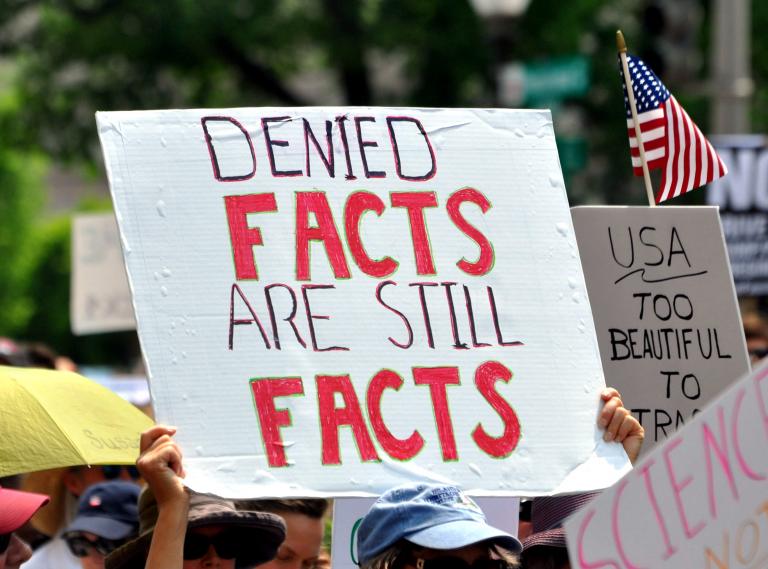
Image from Wikimedia Commons.
Finally, climate change is not just an issue for the Democratic party. Though it has become highly ideological, and is used as a weapon in the political sphere, climate change is not partisan. It’s a concern for all of humanity.
We must dispel these myths and rally support for climate action in our communities.
A call to conversion
Climate change is a moral and spiritual challenge, not just a political and economic one.
God’s creation has been entrusted to us as a gift; we are its stewards. As Pope Francis writes in Laudato Si:
Living our vocation to be protectors of God’s handiwork is essential to a life of virtue; it is not an optional or a secondary aspect of our Christian experience
We have a responsibility to care for and protect all of creation, which includes all people. This includes future generations! But in particular, this concerns the marginalized of our society. People living in poverty have contributed the least to climate change, and yet bear the burden disproportionately. We are called relationship with them, and to enter into solidarity with them. This demands that we reduce our consumption of resources and help poorer nations develop sustainably. These changes require conversion in our communities and our governments.
But ultimately, the conversion must begin in our own hearts. We must renew our relationships with God and with others, and with the created world. From this interior transformation, we will have the strength and wisdom to change our lifestyle and consumption, to live as stewards of creation. An inestimable gift has been given to us; we are asked t0 respond with gratitude.
Practical steps to take
On a practical level, what does this conversion look like? Here are some changes we can implement in our own lives:
- Support action against climate change in politics
- Eat less meat and choose seasonal and local food
- Reduce, reuse, and recycle
- Use public transportation, walk, or ride your bike
- Make changes at your church, school, or office
- Cultivate mindful awareness of your consumption

Image from Wikimedia Commons.
When this is difficult or overwhelming, turn to prayer for courage. Offer God thanks and praise for the inestimable gift of His creation, which reflects His Glory. From Job, Chapter 12:
But now ask the beasts to teach you,
the birds of the air to tell you;
Or speak to the earth to instruct you,
and the fish of the sea to inform you.
Which of all these does not know
that the hand of God has done this?
In his hand is the soul of every living thing,
and the life breath of all mortal flesh.
And from Psalm 95:
The Lord is God, the mighty God,
the great king over all the gods.
He holds in his hands the depths of the earth
and the highest mountains as well.
He made the sea; it belongs to him,
the dry land, too, for it was formed by his hands.
Come, then, let us bow down and worship,
bending the knee before the Lord, our maker.
Further reading recommendations
Pope Francis’ encyclical Laudato Si, On Care for our Common Home.
For more on Catholic Social Teaching, go here for a collection of the Church’s social doctrines.

About Synapses of the Soul
You can contact Sofia at [email protected]. You can read more about the author here.
Previous Post
October 11, 2018
The psychology and spirituality of climate change (part one)
Next Post

October 21, 2018 On offering "thoughts and prayers"
Browse Our Archives
Select a Category Monthly Roundup Series: Habits Uncategorized
Select a Month November 2020 October 2020 September 2020 August 2020 July 2020 June 2020 May 2020 April 2020 January 2020 December 2019 November 2019 October 2019 September 2019 August 2019 March 2019 February 2019 January 2019 December 2018 November 2018 October 2018 September 2018 August 2018
TAKE THE
Religious Wisdom Quiz
Who said, "Let not your hearts be troubled"?
Select your answer to see how you score.
Paul John Peter Jesus
Related posts from Synapses of the Soul


Your Life Should Cause Cognitive Dissonance


Does Your Mind Extend Into the World?
TRENDING AT PATHEOS Catholic

Rejecting Doom: Christian Hope And Human Action
Christianity is a religion of hope. We are to have hope and...

It’s What Comes From Within Which Matters
One of the most difficult things for us to understand is why...

Why I Choose the Eucharist Over the Sermon
Choose the Eucharist, Not the Sermon What are we supposed to get...

5 Design Elements Found in Spiritually Rooted Homes
Putting Spirituality Into Home Decor Our homes are more than our living...

Credo: A Story of God Told with the...
About 10 years ago, I began to imagine a personal "Credo" that...

The Anatomy of Divine Revelation in Catholic Thought
The claim that God has made Himself known to human beings is...
view all Catholic blogs
Ad-Free & Subscriber Log-In Subscription Support
- About Us
- 2026 Calendar
- Videos
- Podcasts
- Library of World Religions
- Faith In Media Tracker
- Advertise With Us
- Write for Us
- Privacy Policy
- Terms of Service
- Do Not Sell My Data
- Contact Us
- Radiant Digital
- Manage Newsletter Subscriptions
- Unsubscribe From Notifications
- Sitemap
Copyright 2008-2026, Patheos. All rights reserved.
Subscription Support Ad-Free & Subscriber Log-In
Follow Patheos