
BuddhistCatholicContemplativeEvangelicalGeneral ChristianHinduJewishLatter-day SaintMuslimNew VisionsProgressive Christian
Beliefs
- Buddhist
- Catholic
- Contemplative
- Evangelical
- General Christian
- Hindu
- Jewish
- Latter-day Saint
- More Voices
- Muslim
- New Visions
- Pagan
- Progressive Christian
Topics
- Religion News
- Food and Religion
- Sports and Religion
- Religious Art
- Religious Music and Entertainment
- Religious Events
- History and Religion
- Style and Religion
- Politics and Religion
- Women in Religion
- Recreation Outdoors and Religion
- Business Finance and Religion
- Careers Workplace and Religion
- Education and Religion
- Family Parenting and Religion
- Health Fitness and Religion
- Home and Religion
- Relationships and Religion
- Technology and Religion
- Travel and Religion
Columnists
- Buddhist Columnists
- Business Finance and Religion Columnists
- Careers Workplace and Religion Columnists
- Catholic Columnists
- Contemplative Columnists
- Education and Religion Columnists
- Evangelists Columnists
- Family Parenting and Religion Columnists
- General Christian Columnists
- Health Fitness and Religion Columnists
- Hindu Columnists
- History and Religion Columnists
- Home and Religion Columnists
- Jewish Columnists
- More Voices Columnists
- Latter Day Columnists
- Muslim Columnists
- New Visions Columnists
- Nonreligious Columnists
- Pagan Columnists
- Politics and Religion Columnists
- Progressive Columnists
- Recreation Outdoors and Religion Columnists
- Relationships and Religion Columnists
- Religion News Columnists
- Religious Art Columnists
- Religious Events Columnists
- Religious Music and Entertainment Columnists
- Sports and Religion Columnists
- Style and Religion Columnists
- Technology and Religion Columnists
- Travel and Religion Columnists
- Women in Religion Columnists
Resource Library
- 2026 Calendar
- Library of World Religions
- The 100 Most Holy Places on Earth
- Patheos Answers
- Podcasts
- Videos
- Faith Leaders Database
- Anglican Episcopalian
- Bahai
- Baptist
- Buddhism
- Christianity
- Confucianism
- Eastern Orthodoxy
- Hinduism
- Holiness and Pentecostal
- ISKCON
- Islam
- Judaism
- Lutheran
- Methodist
- The Church of Jesus Christ of Latter-day Saints
- New Age
- Paganism
- Presbytarian and Reformed
- Protestantism
- Religion Behind the Scenes
- Roman Catholic
- Scientology
- Shia Islam
- Sikhism
- Sufism
- Sunni Islam
- Taoism
- Zen
- See all religions
Research Tools
 Ad-Free & Subscriber Log-In Subscription Support
Ad-Free & Subscriber Log-In Subscription Support
Follow Patheos 

- Trending:
- Forgiveness
- |
- Marriage
- |
- Consciousness
- |
- Death Penalty
- |
- Election
- |
- Halloween
 Synapses of the Soul
- Home
- Catholic
- What clerical abuse does to the developing brain
What clerical abuse does to the developing brain
Last updated on: March 5, 2021 at 7:04 am by Synapses of the Soul
What clerical abuse does to the developing brain 2021-03-05T07:04:31-06:00 Synapses of the Soul
Patheos Explore the world's faith through different perspectives on religion and spirituality! Patheos has the views of the prevalent religions and spiritualities of the world.
I’m not prepared to share my words about the atrocities spelled out in the Pennsylvania report. For now, my aim is to enter into the suffering of the victims. In the words of Pope Francis, “may fasting and prayer open our ears to the hushed pain felt by children, young people and the disabled.”
In this process of listening, I cannot help but draw from my studies of trauma. As a scientist, I know the neurobiological and psychological consequences of the depraved actions of these priests. And the science is devastatingly clear about the gravity of the harm.
The neurobiology of childhood trauma
Severe stress triggers a massive biological process in a child’s body. This process, called the stress response system, elevates levels of hormones like adrenaline and cortisol.
These hormones are meant to keep us alive. They suppress nonessential functions (like digestion and reproduction) while preparing the body to take fight-or-flight action. Evolution built the human body to handle about 20 minutes of stress at a time, because this was usually sufficient when we happened to encounter a lion on the savannah.
Problems arise when the lion sticks around, because this chronically activates the stress response system.
This is the case for children who suffer Adverse Childhood Experiences (ACEs). These traumas include physical, sexual, and emotional abuse; household dysfunction; and physical and emotional neglect. Each ACE continues to activate the stress response system, releasing adrenaline and cortisol to the point that they become toxic. High blood levels of these stress hormones change the wiring of the child’s of brain architecture, and disrupt the development of her body systems.
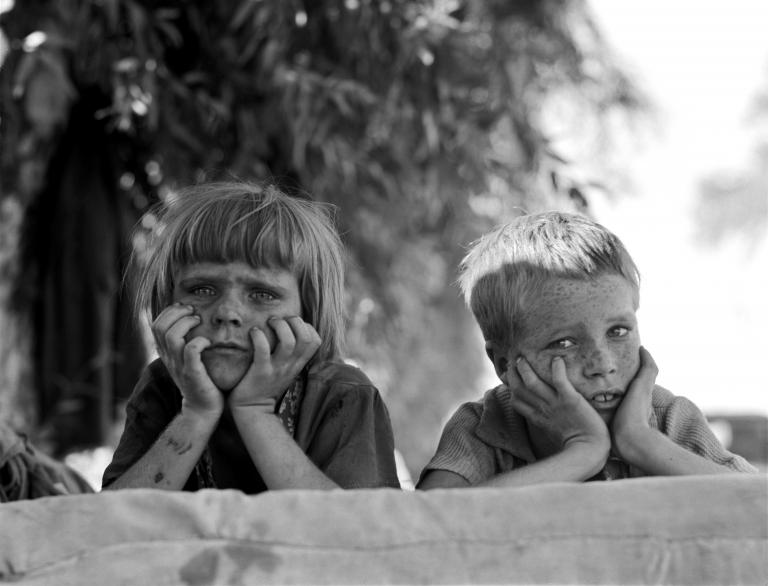
Photo by Dorothea Lange. 1936. Image from Wikimedia Commons.
In this way, early adversity can damage health and well-being for a lifetime. Research by the CDC shows that ACEs strongly predict low education and income. This links trauma to the intergenerational cycle of poverty. Furthermore, ACEs greatly increase the chance of diseases and health risks later in life, such as diabetes, heart disease, alcoholism, and depression.
This is heartbreaking. These priests had the power to destroy their victim’s health and flourishing for life.
The neurobiology of sex abuse
Sexual abuse triggers a specific set of changes in the developing brain. First, it alters the somatosensory cortex, the area that processes input from the body to create sensations and perceptions. Sexual abuse causes thinning in this area, which in turn reduces your ability to feel and desire interpersonal contact later in life.
Sexual abuse can also change patterns of communication between brain regions. In the long run, this can reduce connectivity between brain regions, such as the amygdala — which processes emotions — and prefrontal cortex — which is responsible for higher-level thought. This lack of connectivity can cause deficits in emotional processing, social skills, and self-control.
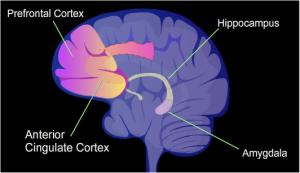
Image from the National Institutes of Health.
Clearly, sexual abuse is a singularly harmful ordeal that goes against the wiring of our bodies and the constitution of our souls.
The compound harm of clerical sex abuse
There is nothing more devastating than an act of sexual abuse committed by a priest, a man ordained to act in the person of Christ. As people of faith, we feel this down to our bones.
But science can tell us how:
- Priests, because of their authority in the Church, have immense spiritual power over children. Because of priest’s spiritual authority, victims are shamed into silence and feel helpless, which is a significant barrier to addressing the trauma, getting treatment, and attaining resolution (see this study). As a result, the trauma they inflict through abuse continues throughout the child’s lifetime.
- Religiosity is one of the most significant protective factors against trauma (see this study). In other words, one’s experience of God in community with others can protect the brain against the neural effects of trauma. For this reason, suffering sexual abuse at the hands of a religious authority, a spiritual servant, strips away a child’s protection against that very trauma.
Clerical sex abuse inflicts trauma, both at the time of abuse and throughout the lifetime. This trauma is compounded by the destruction of her relationship with God, an essential protective factor against the neural effects of that trauma.
What does this demand of us?
So what is asked of us in the face of such evil? I don’t mean institutionally, but on a personal level. How do we respond to the spiritual and biological suffering of a child after such an atrocity?
We are asked to love. We are asked to accompany.
Research from the Harvard tells us that, if a child is to develop resilience through trauma, she needs a relationship. She needs one stable, supportive relationship with a caring adult. The presence of this nurturing caregiver shuts off the biological stress response, and allows the child’s body and brain to resume their health and development.
This echoes the way the love of God, our Father, brings us to fullness of life (John 10:10). We are God’s children (Romans 8:14-16) and He created us in the image of His Trinitarian life, which is perfect love. Therefore, we flourish in the context of human relationships of love.
Let us listen to the victims, love the victims, suffer with the victims. Let us be present to their pain and so reflect the image of God, a God who took on our suffering and bore it to the Cross.
Further recommended reading
The original study on Adverse Childhood Experiences is well worth a read. You can also take the quiz here to find out your own ACE score.
Click here to report an abuse committed by a Catholic priest or religious.

About Synapses of the Soul
You can contact Sofia at [email protected]. You can read more about the author here.
Previous Post

August 30, 2018
How your mindset can shut out grace
Next Post
September 6, 2018 Does neuroscience disprove the soul? Tom Wolfe has some thoughts
Browse Our Archives
Select a Category Monthly Roundup Series: Habits Uncategorized
Select a Month November 2020 October 2020 September 2020 August 2020 July 2020 June 2020 May 2020 April 2020 January 2020 December 2019 November 2019 October 2019 September 2019 August 2019 March 2019 February 2019 January 2019 December 2018 November 2018 October 2018 September 2018 August 2018
TAKE THE
Religious Wisdom Quiz
Who was thrown into a muddy cistern for prophesying Jerusalem's fall?
Select your answer to see how you score.
Jeremiah Micah Baruch Isaiah
Related posts from Synapses of the Soul


Your Life Should Cause Cognitive Dissonance


Does Your Mind Extend Into the World?
TRENDING AT PATHEOS Catholic

The Parable Of The Sower And The Word...
One of Christ’s most famous parables is that of the sower who...

Rejecting Doom: Christian Hope And Human Action
Christianity is a religion of hope. We are to have hope and...

Why I Choose the Eucharist Over the Sermon
Choose the Eucharist, Not the Sermon What are we supposed to get...

5 Design Elements Found in Spiritually Rooted Homes
Putting Spirituality Into Home Decor Our homes are more than our living...

Credo: A Story of God Told with the...
About 10 years ago, I began to imagine a personal "Credo" that...

The Anatomy of Divine Revelation in Catholic Thought
The claim that God has made Himself known to human beings is...
view all Catholic blogs
Ad-Free & Subscriber Log-In Subscription Support
- About Us
- 2026 Calendar
- Videos
- Podcasts
- Library of World Religions
- Faith In Media Tracker
- Advertise With Us
- Write for Us
- Privacy Policy
- Terms of Service
- Do Not Sell My Data
- Contact Us
- Radiant Digital
- Manage Newsletter Subscriptions
- Unsubscribe From Notifications
- Sitemap
Copyright 2008-2026, Patheos. All rights reserved.
Subscription Support Ad-Free & Subscriber Log-In
Follow Patheos