
BuddhistCatholicContemplativeEvangelicalGeneral ChristianHinduJewishLatter-day SaintMuslimNew VisionsProgressive Christian
Beliefs
- Buddhist
- Catholic
- Contemplative
- Evangelical
- General Christian
- Hindu
- Jewish
- Latter-day Saint
- More Voices
- Muslim
- New Visions
- Pagan
- Progressive Christian
Topics
- Religion News
- Food and Religion
- Sports and Religion
- Religious Art
- Religious Music and Entertainment
- Religious Events
- History and Religion
- Style and Religion
- Politics and Religion
- Women in Religion
- Recreation Outdoors and Religion
- Business Finance and Religion
- Careers Workplace and Religion
- Education and Religion
- Family Parenting and Religion
- Health Fitness and Religion
- Home and Religion
- Relationships and Religion
- Technology and Religion
- Travel and Religion
Columnists
- Buddhist Columnists
- Business Finance and Religion Columnists
- Careers Workplace and Religion Columnists
- Catholic Columnists
- Contemplative Columnists
- Education and Religion Columnists
- Evangelists Columnists
- Family Parenting and Religion Columnists
- General Christian Columnists
- Health Fitness and Religion Columnists
- Hindu Columnists
- History and Religion Columnists
- Home and Religion Columnists
- Jewish Columnists
- More Voices Columnists
- Latter Day Columnists
- Muslim Columnists
- New Visions Columnists
- Nonreligious Columnists
- Pagan Columnists
- Politics and Religion Columnists
- Progressive Columnists
- Recreation Outdoors and Religion Columnists
- Relationships and Religion Columnists
- Religion News Columnists
- Religious Art Columnists
- Religious Events Columnists
- Religious Music and Entertainment Columnists
- Sports and Religion Columnists
- Style and Religion Columnists
- Technology and Religion Columnists
- Travel and Religion Columnists
- Women in Religion Columnists
Resource Library
- 2026 Calendar
- Library of World Religions
- The 100 Most Holy Places on Earth
- Patheos Answers
- Podcasts
- Videos
- Faith Leaders Database
- Anglican Episcopalian
- Bahai
- Baptist
- Buddhism
- Christianity
- Confucianism
- Eastern Orthodoxy
- Hinduism
- Holiness and Pentecostal
- ISKCON
- Islam
- Judaism
- Lutheran
- Methodist
- The Church of Jesus Christ of Latter-day Saints
- New Age
- Paganism
- Presbytarian and Reformed
- Protestantism
- Religion Behind the Scenes
- Roman Catholic
- Scientology
- Shia Islam
- Sikhism
- Sufism
- Sunni Islam
- Taoism
- Zen
- See all religions
Research Tools
 Ad-Free & Subscriber Log-In Subscription Support
Ad-Free & Subscriber Log-In Subscription Support
Follow Patheos 

- Trending:
- Forgiveness
- |
- Marriage
- |
- Consciousness
- |
- Death Penalty
- |
- Election
- |
- Halloween
 Synapses of the Soul
- Home
- Catholic
- Remember the beautiful
Remember the beautiful
Last updated on: March 5, 2021 at 7:04 am by Synapses of the Soul
Remember the beautiful 2021-03-05T07:04:28-06:00 Synapses of the Soul
Patheos Explore the world's faith through different perspectives on religion and spirituality! Patheos has the views of the prevalent religions and spiritualities of the world.
You could describe me as a beauty junkie. I crave it, and seek it out out at any cost. Yesterday, I endured a grueling 18.7 mile hike in the mountains in western Montana just to appreciate the view from the summit. I need beauty because it places everything in perspective. In the words of Shakespeare, beauty reminds me that there is “more in Heaven and Earth” than I could dream.

About 8 miles into the hike, I found this gorgeous lake.
It is through beauty that the human heart is led to truth. So to discover Christ, who is Truth, we must allow ourselves to be struck by His beauty.
The beauty of the brain
What does it mean that beauty leads us to truth?
Let’s turn to the founder of modern neuroscience, Santiago Ramon y Cajal. Born in Spain in the middle of the 19th century, Ramon y Cajal was an artist at heart. He spent his childhood compulsively drawing and painting everything he encountered.
But his father, an anatomy teacher, discouraged these pursuits and pushed him into medical school. An obedient son, Ramon y Cajal dedicated himself to the science. But throughout his prestigious career, Ramon y Cajal’s passion for art never left him. He produced volumes of intricate illustrations of the human body.
Eventually, Ramon y Cajal was drawn to the brain. For a whole year, Ramon y Cajal hunched over his old-fashioned microscope examining brain cells and drawing what he saw. Although Ramon y Cajal’s illustrations were skillful, his staining technique held him back.
Staining is the way you fill cells with color so you can see it under a microscope. The technique of the time produced confusing overlaps of color, limiting Ramon y Cajal’s understanding of what he observed.
A new method of staining neurons
But Ramón y Cajal’s life – and the discipline of neuroscience – changed in 1887, when one of his colleagues introduced him to a chemical reaction called the Golgi stain. In this technique, you immerse a slice of brain tissue in a metal called silver chromate. A few random brain cells (only about 0.5%) take up the color of the metal. This allows clear visualization of all the fine details of a neuron, because it doesn’t overlap with its neighbors.
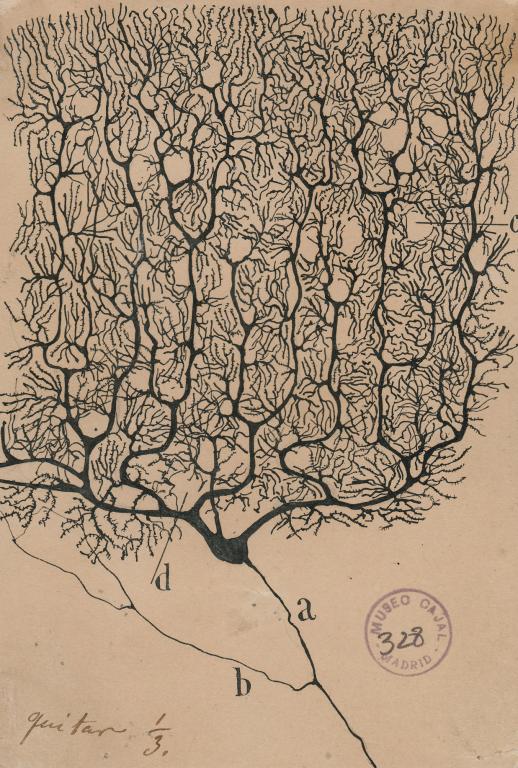
Drawing of purkinje cells in the cerebellum by Santiago Ramón y Cajal, 1899; Instituto Cajal, Madrid, Spain.
After fine-tuning this method, Ramon y Cajal began to produce crisp, clear images of the brain. What he saw captivated him.
From the Purkinje neurons of the cerebellum, which coordinate movement, to the pyramidal neurons of hippocampus, which form memories, no region of the brain failed to arouse Ramon y Cajal’s curiosity. Its beauty was irresistible.
A new theory of the nervous system
Ultimately, Ramon y Cajal’s wonder brought him to the truth of the brain.
Throughout the 19th century, scientists had understood the nervous system as a sort of web, in which neurons were totally continuous with one another. Ramon y Cajal, with the help of the Golgi stain, proposed an alternative: he suggested that neurons were actually discrete, individual cells. If this was the case, neurons must somehow pass information across small gaps—or synapses — between them. Although Ramon y Cajal couldn’t actually see such gaps, due to the low power of his microscope, he inferred their presence from his detailed drawings of brain structure. And he was persistent in advocating for this truth, even when his colleagues told him he was crazy.
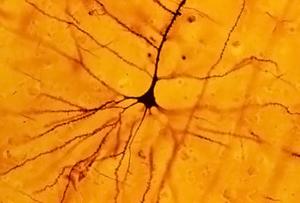
Golgi stained pyramidal neuron in the hippocampus. Photo by Bob Jacobs,Laboratory of Quantitative Neuromorphology Department of Psychology Colorado College.
With the advent in electron microscopy, almost 100 years later, the world discovered that Ramon y Cajal had been right. The theory that individual brain cells send and receive information across synapses is now called “the neuron doctrine.” It is the foundational doctrine of neuroscience, upon which all our progress rests.
Beauty leads to truth
What does Ramon y Cajal’s story tell us about truth? Ramon y Cajal was moved by wonder and attracted to beauty. By staying in front of that reality with patience, he was able to see the truth more clearly than what science could allow.
In today’s world, which has forgotten beauty and allowed the collapse of the transcendent, we must remember the beautiful.
The search for truth begins with beauty. In your studies, your relationships, your work and your rest, allow your heart to be struck by moments of beauty. When you are overtaken by wonder – even at something small – don’t stop there. Follow this beauty. Ask its source and seek its end, and it will lead you to the truth. It will lead you to discover where Christ is working in your life, what He desires for you, and who or how God has created you to love.
Ultimately, following beauty will lead you to discover Christ Himself, who is Truth. As St. Francis of Assisi saw it, the beautiful things of this world constitute a ladder.The beauty of art, the beauty of the saints, the beauty of forgiveness and the beauty of a sunrise all point to the beauty of Christ. By climbing this ladder you can arrive at Him who is utterly beautiful.
Further reading recommendations
“The Beautiful Brain” is a gorgeous collection of Ramon y Cajal’s drawings.
Evelyn Waugh’s Brideshead Revisited captures this dynamic, particularly though the way the architecture of Brideshead haunts Charles, the main character.
I highly recommend Pope Benedict XVI’s moving address on the encounter with beauty, which he composed for Communion and Liberation’s annual Meeting at Rimini in 2002.

About Synapses of the Soul
You can contact Sofia at [email protected]. You can read more about the author here.
Previous Post

September 9, 2018
What can neuroscience offer religious faith?
Next Post
September 15, 2018 How mirror neurons allow you to suffer with the sorrowful
Recent Comments
Browse Our Archives
Select a Category Monthly Roundup Series: Habits Uncategorized
Select a Month November 2020 October 2020 September 2020 August 2020 July 2020 June 2020 May 2020 April 2020 January 2020 December 2019 November 2019 October 2019 September 2019 August 2019 March 2019 February 2019 January 2019 December 2018 November 2018 October 2018 September 2018 August 2018
TAKE THE
Religious Wisdom Quiz
In Philemon, what does Paul call Onesimus?
Select your answer to see how you score.
My friend My helper My very heart My brother
Related posts from Synapses of the Soul


Your Life Should Cause Cognitive Dissonance


Does Your Mind Extend Into the World?
TRENDING AT PATHEOS Catholic

Rejecting Doom: Christian Hope And Human Action
Christianity is a religion of hope. We are to have hope and...

It’s What Comes From Within Which Matters
One of the most difficult things for us to understand is why...

Why I Choose the Eucharist Over the Sermon
Choose the Eucharist, Not the Sermon What are we supposed to get...

5 Design Elements Found in Spiritually Rooted Homes
Putting Spirituality Into Home Decor Our homes are more than our living...

Credo: A Story of God Told with the...
About 10 years ago, I began to imagine a personal "Credo" that...

The Anatomy of Divine Revelation in Catholic Thought
The claim that God has made Himself known to human beings is...
view all Catholic blogs
Ad-Free & Subscriber Log-In Subscription Support
- About Us
- 2026 Calendar
- Videos
- Podcasts
- Library of World Religions
- Faith In Media Tracker
- Advertise With Us
- Write for Us
- Privacy Policy
- Terms of Service
- Do Not Sell My Data
- Contact Us
- Radiant Digital
- Manage Newsletter Subscriptions
- Unsubscribe From Notifications
- Sitemap
Copyright 2008-2026, Patheos. All rights reserved.
Subscription Support Ad-Free & Subscriber Log-In
Follow Patheos