
BuddhistCatholicContemplativeEvangelicalGeneral ChristianHinduJewishLatter-day SaintMuslimNew VisionsProgressive Christian
Beliefs
- Buddhist
- Catholic
- Contemplative
- Evangelical
- General Christian
- Hindu
- Jewish
- Latter-day Saint
- More Voices
- Muslim
- New Visions
- Pagan
- Progressive Christian
Topics
- Religion News
- Food and Religion
- Sports and Religion
- Religious Art
- Religious Music and Entertainment
- Religious Events
- History and Religion
- Style and Religion
- Politics and Religion
- Women in Religion
- Recreation Outdoors and Religion
- Business Finance and Religion
- Careers Workplace and Religion
- Education and Religion
- Family Parenting and Religion
- Health Fitness and Religion
- Home and Religion
- Relationships and Religion
- Technology and Religion
- Travel and Religion
Columnists
- Buddhist Columnists
- Business Finance and Religion Columnists
- Careers Workplace and Religion Columnists
- Catholic Columnists
- Contemplative Columnists
- Education and Religion Columnists
- Evangelists Columnists
- Family Parenting and Religion Columnists
- General Christian Columnists
- Health Fitness and Religion Columnists
- Hindu Columnists
- History and Religion Columnists
- Home and Religion Columnists
- Jewish Columnists
- More Voices Columnists
- Latter Day Columnists
- Muslim Columnists
- New Visions Columnists
- Nonreligious Columnists
- Pagan Columnists
- Politics and Religion Columnists
- Progressive Columnists
- Recreation Outdoors and Religion Columnists
- Relationships and Religion Columnists
- Religion News Columnists
- Religious Art Columnists
- Religious Events Columnists
- Religious Music and Entertainment Columnists
- Sports and Religion Columnists
- Style and Religion Columnists
- Technology and Religion Columnists
- Travel and Religion Columnists
- Women in Religion Columnists
Resource Library
- 2026 Calendar
- Library of World Religions
- The 100 Most Holy Places on Earth
- Patheos Answers
- Podcasts
- Videos
- Faith Leaders Database
- Anglican Episcopalian
- Bahai
- Baptist
- Buddhism
- Christianity
- Confucianism
- Eastern Orthodoxy
- Hinduism
- Holiness and Pentecostal
- ISKCON
- Islam
- Judaism
- Lutheran
- Methodist
- The Church of Jesus Christ of Latter-day Saints
- New Age
- Paganism
- Presbytarian and Reformed
- Protestantism
- Religion Behind the Scenes
- Roman Catholic
- Scientology
- Shia Islam
- Sikhism
- Sufism
- Sunni Islam
- Taoism
- Zen
- See all religions
Research Tools
 Ad-Free & Subscriber Log-In Subscription Support
Ad-Free & Subscriber Log-In Subscription Support
Follow Patheos 

- Trending:
- Forgiveness
- |
- Marriage
- |
- Consciousness
- |
- Death Penalty
- |
- Election
- |
- Halloween
 Synapses of the Soul
- Home
- Catholic
- Does neuroscience disprove the soul? Tom Wolfe has some thoughts
Does neuroscience disprove the soul? Tom Wolfe has some thoughts
Last updated on: March 5, 2021 at 7:04 am by Synapses of the Soul
Does neuroscience disprove the soul? Tom Wolfe has some thoughts 2021-03-05T07:04:30-06:00 Synapses of the Soul
Patheos Explore the world's faith through different perspectives on religion and spirituality! Patheos has the views of the prevalent religions and spiritualities of the world.
I decided to read a Tom Wolfe novel recently. First of all, as a tribute to his life. Secondly, because I discovered he was fascinated by neuroscience (as all the best people are). I was curious to find out if he addressed the philosophical implications of brain research, so I picked up I Am Charlotte Simmons.
I Am Charlotte Simmons: the plot
The novel’s protagonist is a wholesome 18-year-old girl from Sparta, a tiny rural community in the mountains of North Carolina. Charlotte is not only an academic prodigy, having scored a perfect 1600 on the SAT, but a paragon of God-fearing small-town virtue.
The plot opens as Charlotte is finishing her senior year of high school as the valedictorian, and preparing to attend Dupont University – an elite institution evidently modeled after Duke. Upon her arrival, much to her disappointment, Charlotte discovers that Dupont is not the lofty center of intellectual life that she had expected.
Through Charlotte, Wolfe introduces his readers to his theory of college campus life: that it is dominated by the struggle for status, sex, and success.
Wolfe presents three different faces of student life at Dupont. First is collegiate athletic life, explored through the character of Jojo Johanssen, a starter on Dupont’s nationally-ranked basketball team. Next, there is Greek life, embodied by boys of the Saint Ray fraternity and their girlfriends. Finally, there are the misfits who embrace the intellectual life and left-wing politics. As Charlotte navigates this world jocks, frat boys, and dorks, she strays from her upbringing and – in true Tom Wolfe style – suffers repeated humiliation and failure.
My response
To be honest, I wasn’t a fan of the novel. Much of the it was nauseatingly hyperbolic. It also failed to explore its subject matter with enough depth. However, I do give Wolfe credit for presenting a fairly accurate picture of undergraduate life on an elite college campus.
The most interesting part of the novel was Charlotte’s wrestling with the darker side of neuroscience theory.
Neuroscience theory and the self
This theme is most explicit in Charlotte’s Introduction to Neuroscience course, taught by a fictional Dr. Starling.
The novel begins with a description of the experiment that won Dr. Starling a Nobel Prize. In this experiment, Starling removed the amygdala from thirty (out of sixty) cats. These “amygdalectomized” cats acted deranged, overwhelmed by sexual desire. Starling then showed that the thirty healthy cats, after observing the amygdalectomized cats, would act the same way.
The conclusion? An animal’s behavior is determined by its social and cultural atmosphere. The implication: so is human behavior.
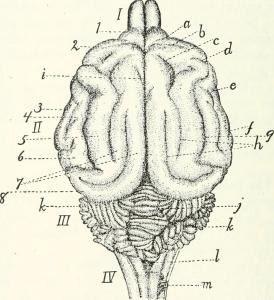
Anatomy of a cat brain. Image from Wikimedia Commons.
Later in the novel, Dr. Starling lectures on (real-life) neurobiologist Jose Delgado. Among other discoveries, Delgado is famous for mapping the brain through electrical stimulation. Starling highlights one experiment, in which Delgado eliminated the aggressive instinct of a charging bull by stimulating an electrode in its caudate nucleus.
Moving immediately from science to speculative philosophy (classic move), Starling claims that this experiment proves that “purpose and intentions are physical matters.” The human mind, according to Starling, is not at all how we conceive of it. The self a mere illusion. Free will is nonexistent.
This attitude is prevalent among modern theorists of neuroscientists. They take Descartes’ cogito and, failing to find any ghost in the machine, reject the existence of a self apart from the brain. Then, they take it a step further, theorizing that all aspects of the perceived “self” can be explained and even predicted by a system with sufficient computational power.
Taken together with genetic theory, this leads to a Nietzschean triumph over the soul. The result is a wholly postmodern culture: the self is a thing of the past, God is dead, and neuroscience reigns.
A defense of the self?
Needless to say, Tom Wolfe finds this attitude not only unappealing, but false. However, I am Charlotte Simmons does little to rebut it. Over the course of the novel, she shows no moral courage to resist peer pressure. Charlotte wholly abdicates to the pressures of her environment.
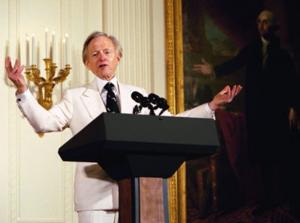
Tom Wolfe at the White House. Image from Wikimedia Commons.
So perhaps Wolfe’s rebuttal of scientific determinism occurs on a different plane. As Wolfe knows well, there is a dividing line between neuroscience and genetic theory. In an interview conducted by Michael Gazzaniga, father of cognitive neuroscience, Wolfe cites José Delgado as saying that the human brain is complicated beyond anything we can imagine.
“The human brain is enormously complicated. We have made only a few small steps in finding out how it works. All the rest is literature.”
All the rest is literature, indeed. Wolfe’s Dr. Starling – modeled after Dawkins and other theorists – may speculate on the basis of neuroscience discoveries, but his ideas remain exactly that: speculation. His philosophical conclusions from neuroscience experiments are not science. They are speculative theory. Even if Dr. Starling were right, and there were no soul and no self, scientific experimentation could not lead to this conclusion.
Further reading recommendations
On scientific determinism, check out Daniel Dennett (a compatibilist) and Sam Harris (an incompatibilist).
This study raises some issues with the experiments most cited as evidence against free will.
For more on the campus culture portrayed by I Am Charlotte Simmons, check out Mary Ann Glendon’s review of the novel in First Things.

About Synapses of the Soul
You can contact Sofia at [email protected]. You can read more about the author here.
Previous Post

September 2, 2018
What clerical abuse does to the developing brain
Next Post
September 9, 2018 What can neuroscience offer religious faith?
Recent Comments
Browse Our Archives
Select a Category Monthly Roundup Series: Habits Uncategorized
Select a Month November 2020 October 2020 September 2020 August 2020 July 2020 June 2020 May 2020 April 2020 January 2020 December 2019 November 2019 October 2019 September 2019 August 2019 March 2019 February 2019 January 2019 December 2018 November 2018 October 2018 September 2018 August 2018
TAKE THE
Religious Wisdom Quiz
According to 1 Timothy, what is a trustworthy saying deserving of full acceptance?
Select your answer to see how you score.
God is love Faith without works is dead The Lord is our shepherd Christ Jesus came into the world to save sinners
Related posts from Synapses of the Soul


Your Life Should Cause Cognitive Dissonance


Does Your Mind Extend Into the World?
TRENDING AT PATHEOS Catholic

Rejecting Doom: Christian Hope And Human Action
Christianity is a religion of hope. We are to have hope and...

It’s What Comes From Within Which Matters
One of the most difficult things for us to understand is why...

Why I Choose the Eucharist Over the Sermon
Choose the Eucharist, Not the Sermon What are we supposed to get...

5 Design Elements Found in Spiritually Rooted Homes
Putting Spirituality Into Home Decor Our homes are more than our living...

Credo: A Story of God Told with the...
About 10 years ago, I began to imagine a personal "Credo" that...

The Anatomy of Divine Revelation in Catholic Thought
The claim that God has made Himself known to human beings is...
view all Catholic blogs
Ad-Free & Subscriber Log-In Subscription Support
- About Us
- 2026 Calendar
- Videos
- Podcasts
- Library of World Religions
- Faith In Media Tracker
- Advertise With Us
- Write for Us
- Privacy Policy
- Terms of Service
- Do Not Sell My Data
- Contact Us
- Radiant Digital
- Manage Newsletter Subscriptions
- Unsubscribe From Notifications
- Sitemap
Copyright 2008-2026, Patheos. All rights reserved.
Subscription Support Ad-Free & Subscriber Log-In
Follow Patheos