
BuddhistCatholicContemplativeEvangelicalGeneral ChristianHinduJewishLatter-day SaintMuslimNew VisionsProgressive Christian
Beliefs
- Buddhist
- Catholic
- Contemplative
- Evangelical
- General Christian
- Hindu
- Jewish
- Latter-day Saint
- More Voices
- Muslim
- New Visions
- Pagan
- Progressive Christian
Topics
- Religion News
- Food and Religion
- Sports and Religion
- Religious Art
- Religious Music and Entertainment
- Religious Events
- History and Religion
- Style and Religion
- Politics and Religion
- Women in Religion
- Recreation Outdoors and Religion
- Business Finance and Religion
- Careers Workplace and Religion
- Education and Religion
- Family Parenting and Religion
- Health Fitness and Religion
- Home and Religion
- Relationships and Religion
- Technology and Religion
- Travel and Religion
Columnists
- Buddhist Columnists
- Business Finance and Religion Columnists
- Careers Workplace and Religion Columnists
- Catholic Columnists
- Contemplative Columnists
- Education and Religion Columnists
- Evangelists Columnists
- Family Parenting and Religion Columnists
- General Christian Columnists
- Health Fitness and Religion Columnists
- Hindu Columnists
- History and Religion Columnists
- Home and Religion Columnists
- Jewish Columnists
- More Voices Columnists
- Latter Day Columnists
- Muslim Columnists
- New Visions Columnists
- Nonreligious Columnists
- Pagan Columnists
- Politics and Religion Columnists
- Progressive Columnists
- Recreation Outdoors and Religion Columnists
- Relationships and Religion Columnists
- Religion News Columnists
- Religious Art Columnists
- Religious Events Columnists
- Religious Music and Entertainment Columnists
- Sports and Religion Columnists
- Style and Religion Columnists
- Technology and Religion Columnists
- Travel and Religion Columnists
- Women in Religion Columnists
Resource Library
- 2026 Calendar
- Library of World Religions
- The 100 Most Holy Places on Earth
- Patheos Answers
- Podcasts
- Videos
- Faith Leaders Database
- Anglican Episcopalian
- Bahai
- Baptist
- Buddhism
- Christianity
- Confucianism
- Eastern Orthodoxy
- Hinduism
- Holiness and Pentecostal
- ISKCON
- Islam
- Judaism
- Lutheran
- Methodist
- The Church of Jesus Christ of Latter-day Saints
- New Age
- Paganism
- Presbytarian and Reformed
- Protestantism
- Religion Behind the Scenes
- Roman Catholic
- Scientology
- Shia Islam
- Sikhism
- Sufism
- Sunni Islam
- Taoism
- Zen
- See all religions
Research Tools
 Ad-Free & Subscriber Log-In Subscription Support
Ad-Free & Subscriber Log-In Subscription Support
Follow Patheos 

- Trending:
- Forgiveness
- |
- Marriage
- |
- Consciousness
- |
- Death Penalty
- |
- Election
- |
- Halloween
 Synapses of the Soul
- Home
- Catholic
- How your mindset can shut out grace
How your mindset can shut out grace
Last updated on: March 14, 2021 at 1:23 am by Synapses of the Soul
How your mindset can shut out grace 2021-03-14T01:23:00-06:00 Synapses of the Soul
Patheos Explore the world's faith through different perspectives on religion and spirituality! Patheos has the views of the prevalent religions and spiritualities of the world.
Growing up, I was never the athletic one of the family. While my siblings excelled in all things sports, I was always the last one picked for the team in gym and the slowest one to finish the race, if I finished at all. I convinced myself that I was just “not built” for sports, and gave up before even trying.

Me as a teenager.
I think I’ve come pretty far now. I can keep up with my family on long bike rides, deadlift almost twice my bodyweight, and hike from sunrise to sunset. What changed? I started to adopt a growth mindset, a mentality that is not only helpful in achieving material goals but essential for the spiritual life. Although I have a long way to go, whenever I do embrace a growth mindset, the fruits are powerful.
Fixed vs. growth mindset
Our mindset shapes much of our daily thoughts and behavior. It’s the view we have of our personal qualities and abilities – where they come from and where they’re going.
Any given mindset lies on a spectrum between two extremes:
- A fixed mindset is the belief that our qualities and abilities are carved in stone, something we are born with rather than something we develop.
- A growth mindset is the belief that we can cultivate our qualities and abilities. Although everyone differs in innate talents and potential, we can all improve through effort.
Chances are, we don’t just have one or the other. We might have a growth mindset about artistic expression, but a fixed mindset about academics. For other qualities, we might land somewhere in between. Whichever mindset we have guides our thoughts and behavior in that particular area.
Most people struggle with a fixed mindset in at least one domain of their life. A fixed mindset works against us in a few different ways. First, it creates an urgency to prove ourselves over and over, because we see criticism as an attack on our character. It also reduces our drive for learning and practice, because we may implicitly doubt we can improve at all. Finally, it negatively impacts our self-worth, because we begin to see failure as a reflection of who we really are*.*
A growth mindset, on the other hand, gives us more drive to learn and practice. It helps us welcome feedback, embrace challenges, and view every experience as an opportunity to improve. With a growth mindset, we have the passion to stay the course, even when things are tough.
According to Carol Dweck’s research, a growth mindset favors both future success and hope in the present moment.
Why does a growth mindset help?
A growth mindset is powerful because it is in line with how the brain works.
Neuroplasticity is the brain’s ability to change. For a long time, scientists thought that a fully-formed brain didn’t change until it started degenerating with age. Then, in the second part of the 20th century, they discovered that brains are “plastic,” or can be altered. Connections between neurons are constantly remodeled, strengthened and weakened over time.
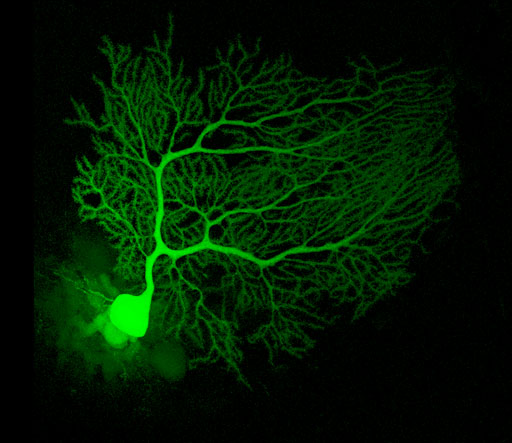
See those things that look like tree branches? That’s where this neuron receives info from other neurons. Image by Maryann Martone—CCDB/NCMIR/UC San Diego.
Whenever we learn something new, change a habit, of have a new experience, the structure of our brain changes. In other words, neuroplasticity underlies all learning and memory.
This is especially true for younger people; the developing brain shows an even greater degree of neuroplasticity. And this doesn’t just mean kids, as the prefrontal cortex – the region of the brain active in decision making and higher-level thought – doesn’t finish developing until your late twenties.
So a growth mindset is powerful because it reflects the reality of our underlying neurobiology, whereas a fixed mindset rejects that truth.
Believing that we can change allows us to harness the plasticity of our brain. Believing that we can improve helps us work hard to re-wire our neurons. Because our characteristics and abilities are set in plastic, not stone.
Growth mindset and the spiritual life
This isn’t just helpful for improving our fitness (as fun as that is). It also applies to the spiritual life.
All too often, we can get caught in a fixed mindset in our relationship with God. We think that our faith is something static that we were born with, so we take God’s graces for granted, and have little reason to try to strengthen our prayer life, our sacramental life, and our relationships with others. The habitual sins that we have struggled with for years may seem set in stone. So why should we even work for conversion?
What results is a spiritual paralysis.
A growth mindset is more important than ever when it comes to the spiritual life. Because we are all called to become saints.
Ultimately, believing that our relationship with God is set in stone is a rejection of His grace. If we don’t belief that you can change, that you can be made more holy, or that we can conquer habitual sin, we are doubting God’s power. Of course, none of these things can happen without the Christ’s saving gift of Himself. But they also demand an active participation. We have to be open to His radical power to transform.
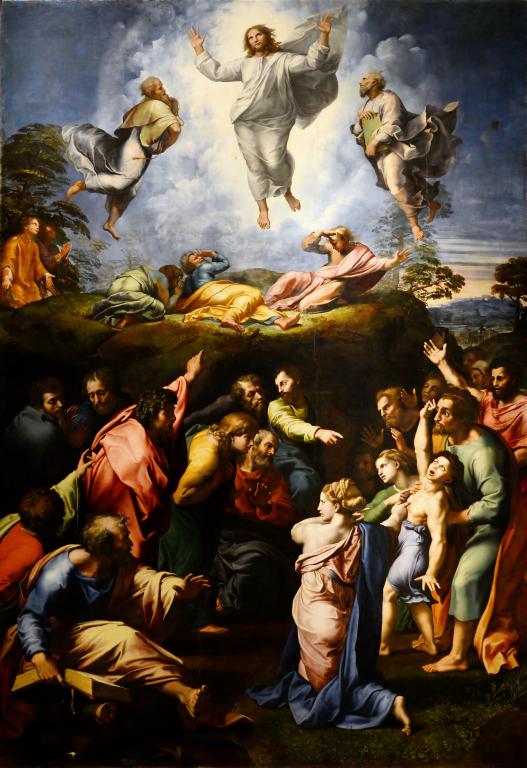
Raffaello, “The Transfiguration”, 1516-1520.
Let us remember Christ’s invitation, “Let the children come to me” (Matthew 19:14). We are to be childlike in our confidence in Him. We are to remain open and hopeful about the good His grace can accomplish in us. For His mercies are new every morning (Lamentations 3:22-23).
Further reading recommendations
On mindset, read Carol Dweck’s book Mindset: The Psychology of Success.
Flannery O’Connors works often portray the drama of our struggle to accept God’s grace. For a great introduction to her work, try Revelation.
On the universal call to sanctity, read Lumen Gentium, or Fr. Luigi Giussani’s “Morality: Memory and Desire.”

About Synapses of the Soul
You can contact Sofia at [email protected]. You can read more about the author here.
Previous Post

August 26, 2018
Embracing silence
Next Post

September 2, 2018 What clerical abuse does to the developing brain
Browse Our Archives
Select a Category Monthly Roundup Series: Habits Uncategorized
Select a Month November 2020 October 2020 September 2020 August 2020 July 2020 June 2020 May 2020 April 2020 January 2020 December 2019 November 2019 October 2019 September 2019 August 2019 March 2019 February 2019 January 2019 December 2018 November 2018 October 2018 September 2018 August 2018
TAKE THE
Religious Wisdom Quiz
Which book contains the story of Hosea's marriage to an unfaithful wife?
Select your answer to see how you score.
Joel Micah Hosea Jonah
Related posts from Synapses of the Soul


Your Life Should Cause Cognitive Dissonance


Does Your Mind Extend Into the World?
TRENDING AT PATHEOS Catholic

Rejecting Doom: Christian Hope And Human Action
Christianity is a religion of hope. We are to have hope and...

It’s What Comes From Within Which Matters
One of the most difficult things for us to understand is why...

Why I Choose the Eucharist Over the Sermon
Choose the Eucharist, Not the Sermon What are we supposed to get...

5 Design Elements Found in Spiritually Rooted Homes
Putting Spirituality Into Home Decor Our homes are more than our living...

Credo: A Story of God Told with the...
About 10 years ago, I began to imagine a personal "Credo" that...

The Anatomy of Divine Revelation in Catholic Thought
The claim that God has made Himself known to human beings is...
view all Catholic blogs
Ad-Free & Subscriber Log-In Subscription Support
- About Us
- 2026 Calendar
- Videos
- Podcasts
- Library of World Religions
- Faith In Media Tracker
- Advertise With Us
- Write for Us
- Privacy Policy
- Terms of Service
- Do Not Sell My Data
- Contact Us
- Radiant Digital
- Manage Newsletter Subscriptions
- Unsubscribe From Notifications
- Sitemap
Copyright 2008-2026, Patheos. All rights reserved.
Subscription Support Ad-Free & Subscriber Log-In
Follow Patheos