
BuddhistCatholicContemplativeEvangelicalGeneral ChristianHinduJewishLatter-day SaintMuslimNew VisionsProgressive Christian
Beliefs
- Buddhist
- Catholic
- Contemplative
- Evangelical
- General Christian
- Hindu
- Jewish
- Latter-day Saint
- More Voices
- Muslim
- New Visions
- Pagan
- Progressive Christian
Topics
- Religion News
- Food and Religion
- Sports and Religion
- Religious Art
- Religious Music and Entertainment
- Religious Events
- History and Religion
- Style and Religion
- Politics and Religion
- Women in Religion
- Recreation Outdoors and Religion
- Business Finance and Religion
- Careers Workplace and Religion
- Education and Religion
- Family Parenting and Religion
- Health Fitness and Religion
- Home and Religion
- Relationships and Religion
- Technology and Religion
- Travel and Religion
Columnists
- Buddhist Columnists
- Business Finance and Religion Columnists
- Careers Workplace and Religion Columnists
- Catholic Columnists
- Contemplative Columnists
- Education and Religion Columnists
- Evangelists Columnists
- Family Parenting and Religion Columnists
- General Christian Columnists
- Health Fitness and Religion Columnists
- Hindu Columnists
- History and Religion Columnists
- Home and Religion Columnists
- Jewish Columnists
- More Voices Columnists
- Latter Day Columnists
- Muslim Columnists
- New Visions Columnists
- Nonreligious Columnists
- Pagan Columnists
- Politics and Religion Columnists
- Progressive Columnists
- Recreation Outdoors and Religion Columnists
- Relationships and Religion Columnists
- Religion News Columnists
- Religious Art Columnists
- Religious Events Columnists
- Religious Music and Entertainment Columnists
- Sports and Religion Columnists
- Style and Religion Columnists
- Technology and Religion Columnists
- Travel and Religion Columnists
- Women in Religion Columnists
Resource Library
- 2026 Calendar
- Library of World Religions
- The 100 Most Holy Places on Earth
- Patheos Answers
- Podcasts
- Videos
- Faith Leaders Database
- Anglican Episcopalian
- Bahai
- Baptist
- Buddhism
- Christianity
- Confucianism
- Eastern Orthodoxy
- Hinduism
- Holiness and Pentecostal
- ISKCON
- Islam
- Judaism
- Lutheran
- Methodist
- The Church of Jesus Christ of Latter-day Saints
- New Age
- Paganism
- Presbytarian and Reformed
- Protestantism
- Religion Behind the Scenes
- Roman Catholic
- Scientology
- Shia Islam
- Sikhism
- Sufism
- Sunni Islam
- Taoism
- Zen
- See all religions
Research Tools
 Ad-Free & Subscriber Log-In Subscription Support
Ad-Free & Subscriber Log-In Subscription Support
Follow Patheos 

- Trending:
- Forgiveness
- |
- Marriage
- |
- Consciousness
- |
- Death Penalty
- |
- Election
- |
- Halloween
 Synapses of the Soul
- Home
- Catholic
- On evolution and the Catholic faith
On evolution and the Catholic faith
Last updated on: March 5, 2021 at 7:04 am by Synapses of the Soul
On evolution and the Catholic faith 2021-03-05T07:04:33-06:00 Synapses of the Soul
Patheos Explore the world's faith through different perspectives on religion and spirituality! Patheos has the views of the prevalent religions and spiritualities of the world.
When I agreed to write for Patheos, I didn’t think I would have to dive into the evolution debate. But, a couple weeks in, I’ve come to admit I was wrong. The compatibility of evolution and the Catholic faith is more contested than I had ever imagined.
In this post, I will provide an overview of a few reasons that the theory of evolution does not contradict the Catholic faith. In it, I link to works by a range of theologians and scientists (who are much smarter than I am). Though I do not agree with everything they say, I find these works quite valuable and recommend them highly.
Okay, here we go:
Evolution is not in contradiction with the Catholic understanding of God.
Here are a few (overlapping, mutually reinforcing) reasons why this is the case.
-
Noncompetitive transcendence.
God does not compete with causes in the natural order. God created all being and sustains all being. He is not a being among many, but being itself. He is not on the same ontological playing field as evolution. God transcends, and does not compete with, the natural order. Bishop Robert Barron gives an excellent explanation in the second part of his work, The Priority of Christ.
Saying evolution is the physical cause of the human person does not mean God didn’t create us. Rather, it means that God chose to use the natural mechanism of evolution to bring us into being.
2. Allegory in the Genesis.
The biblical creation account is not meant to be read as a literal, chronological, historical creation account. This is not a recent idea in the Church – look at St. Augustine or Origen if you are skeptical.
3. Ultimate vs. proximate questions.
Evolution may tell us how the human person came about through time. It does not tell us why the human person came about through time. Therefore, there can be an end to evolution that is chosen by God. This is not in competition with the mechanism of evolution. See Cardinal Schönborn’s article in the New York Times for some interesting thoughts about this distinction.
4. Chance vs. providence.
The fact that evolution occurred through natural selection does not mean that it wasn’t crafted by God. There can be a guiding purpose to an event that makes use of chance or randomness. Furthermore, as Christopher T. Baglow points out in his (very accessible) book “Faith, Science and Reason,” a world without chance would be a world without freedom.
5. Material and formal cause of the person.
We must distinguish between the level of material and efficient causality and the level of formal causality. The human person is composed of a unity of the physical body and spiritual soul. In order to make sense of this composite, we must not leave behind the soul (or formal cause) of the organism. It is the form that gives the body its human character. It is useless, unintelligible, to try to define human beings in terms of their body alone. Read Etienne Gilson’s book From Aristotle to Darwin and Back Again.
6. The infusion of the soul.
Similar to point 5. There is an ontological difference between body and soul. There is something about the human person that is of a different ontological order. Because of this, some say that the God brought about the body through evolution but created and infused the soul in the human person. See John Paul II’s 1996 message to the Pontifical Academy of the Sciences.
When does evolution present a challenge to Christianity?
Evolution does challenge faith that relies on a reductive or false understanding of God.
The irreducible complexity argument shrinks the domain of the divine. It reduces God’s power to fit down in the gaps of scientific explanation. But God is not a “God of the gaps.” He is over and above all of reality, sustaining all of reality.
The intelligent design argument implicitly rejects God’s power to operate in and through natural causes. It makes God a mere “watchmaker” who designed and set things in motion, but has no immanent presence in His creation. At the same time, it does not allow for a God who is outside of time.
In these cases, evolution can challenge faith. If you’re struggling with these arguments, read Finding Darwin’s God, in which Kenneth Miller critically investigates the common ground between God and evolution.
I also have an upcoming post on the role of science in the search for truth. In the mean time, read Stephen Barr’s “Retelling the Story of Science,” from First Things.
Why should we think about this?
For some people, it can be hard to understand how evolutionary theory fits in with Divine Creation. But it’s worth it! Evolutionary theory can be such a source of wonder and awe at God’s loving providence. Evolution is the mechanism through which He chose — in love — to bring us into being. As Pope Benedict XVI explains:
“We are not some casual and meaningless product of evolution. Each of us is the result of a thought of God. Each of us is willed, each of us is loved, each of us is necessary.”
Before you comment
Before you attack me or the Catholic Church or evolution, please do read the works linked in this post.

About Synapses of the Soul
You can contact Sofia at [email protected]. You can read more about the author here.
Previous Post
August 19, 2018
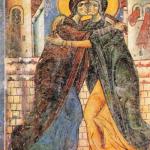
Why you should hug at the Sign of Peace
Next Post

August 26, 2018 Embracing silence
Recent Comments
Browse Our Archives
Select a Category Monthly Roundup Series: Habits Uncategorized
Select a Month November 2020 October 2020 September 2020 August 2020 July 2020 June 2020 May 2020 April 2020 January 2020 December 2019 November 2019 October 2019 September 2019 August 2019 March 2019 February 2019 January 2019 December 2018 November 2018 October 2018 September 2018 August 2018
TAKE THE
Religious Wisdom Quiz
What did Solomon ask God for when he became king?
Select your answer to see how you score.
Victory Riches Wisdom Long life
Related posts from Synapses of the Soul


Your Life Should Cause Cognitive Dissonance


Does Your Mind Extend Into the World?
TRENDING AT PATHEOS Catholic

Rejecting Doom: Christian Hope And Human Action
Christianity is a religion of hope. We are to have hope and...

It’s What Comes From Within Which Matters
One of the most difficult things for us to understand is why...

Why I Choose the Eucharist Over the Sermon
Choose the Eucharist, Not the Sermon What are we supposed to get...

5 Design Elements Found in Spiritually Rooted Homes
Putting Spirituality Into Home Decor Our homes are more than our living...

Credo: A Story of God Told with the...
About 10 years ago, I began to imagine a personal "Credo" that...

The Anatomy of Divine Revelation in Catholic Thought
The claim that God has made Himself known to human beings is...
view all Catholic blogs
Ad-Free & Subscriber Log-In Subscription Support
- About Us
- 2026 Calendar
- Videos
- Podcasts
- Library of World Religions
- Faith In Media Tracker
- Advertise With Us
- Write for Us
- Privacy Policy
- Terms of Service
- Do Not Sell My Data
- Contact Us
- Radiant Digital
- Manage Newsletter Subscriptions
- Unsubscribe From Notifications
- Sitemap
Copyright 2008-2026, Patheos. All rights reserved.
Subscription Support Ad-Free & Subscriber Log-In
Follow Patheos