
BuddhistCatholicContemplativeEvangelicalGeneral ChristianHinduJewishLatter-day SaintMuslimNew VisionsProgressive Christian
Beliefs
- Buddhist
- Catholic
- Contemplative
- Evangelical
- General Christian
- Hindu
- Jewish
- Latter-day Saint
- More Voices
- Muslim
- New Visions
- Pagan
- Progressive Christian
Topics
- Religion News
- Food and Religion
- Sports and Religion
- Religious Art
- Religious Music and Entertainment
- Religious Events
- History and Religion
- Style and Religion
- Politics and Religion
- Women in Religion
- Recreation Outdoors and Religion
- Business Finance and Religion
- Careers Workplace and Religion
- Education and Religion
- Family Parenting and Religion
- Health Fitness and Religion
- Home and Religion
- Relationships and Religion
- Technology and Religion
- Travel and Religion
Columnists
- Buddhist Columnists
- Business Finance and Religion Columnists
- Careers Workplace and Religion Columnists
- Catholic Columnists
- Contemplative Columnists
- Education and Religion Columnists
- Evangelists Columnists
- Family Parenting and Religion Columnists
- General Christian Columnists
- Health Fitness and Religion Columnists
- Hindu Columnists
- History and Religion Columnists
- Home and Religion Columnists
- Jewish Columnists
- More Voices Columnists
- Latter Day Columnists
- Muslim Columnists
- New Visions Columnists
- Nonreligious Columnists
- Pagan Columnists
- Politics and Religion Columnists
- Progressive Columnists
- Recreation Outdoors and Religion Columnists
- Relationships and Religion Columnists
- Religion News Columnists
- Religious Art Columnists
- Religious Events Columnists
- Religious Music and Entertainment Columnists
- Sports and Religion Columnists
- Style and Religion Columnists
- Technology and Religion Columnists
- Travel and Religion Columnists
- Women in Religion Columnists
Resource Library
- 2026 Calendar
- Library of World Religions
- The 100 Most Holy Places on Earth
- Patheos Answers
- Podcasts
- Videos
- Faith Leaders Database
- Anglican Episcopalian
- Bahai
- Baptist
- Buddhism
- Christianity
- Confucianism
- Eastern Orthodoxy
- Hinduism
- Holiness and Pentecostal
- ISKCON
- Islam
- Judaism
- Lutheran
- Methodist
- The Church of Jesus Christ of Latter-day Saints
- New Age
- Paganism
- Presbytarian and Reformed
- Protestantism
- Religion Behind the Scenes
- Roman Catholic
- Scientology
- Shia Islam
- Sikhism
- Sufism
- Sunni Islam
- Taoism
- Zen
- See all religions
Research Tools
 Ad-Free & Subscriber Log-In Subscription Support
Ad-Free & Subscriber Log-In Subscription Support
Follow Patheos 

- Trending:
- Forgiveness
- |
- Marriage
- |
- Consciousness
- |
- Death Penalty
- |
- Election
- |
- Halloween
 Synapses of the Soul
- Home
- Catholic
- Why you should hug at the Sign of Peace
Why you should hug at the Sign of Peace
Last updated on: March 5, 2021 at 7:04 am by Synapses of the Soul
Why you should hug at the Sign of Peace 2021-03-05T07:04:34-06:00 Synapses of the Soul
Patheos Explore the world's faith through different perspectives on religion and spirituality! Patheos has the views of the prevalent religions and spiritualities of the world.
This summer, I’ve been going to daily Mass at a parish down the street from my internship, where the youngest folks in attendance are baby boomers. Once the little old ladies got over their shock (“a young person! at daily Mass!!”) they began welcoming me with open arms – literally. During the Sign of Peace, a few walk over to my pew and embrace me with sincere affection. I’m not weirded out by this, because at Notre Dame it’s standard protocol to hug everyone within a 10-foot radius. It’s pretty aggressive.
Some days, though, I long to sit far away out of arms’ reach of these lovely grandmothers. When I am deep in prayer throughout the Liturgy of the Eucharist, human contact can feel like an intrusion, and I’d rather remain in unbroken spiritual profundity. When I experience moments of intimacy with God, I am frequently tempted to turn inwards and shut out the world.
But the Christian cannot retreat into individual experiences of the transcendent at the expense of communion with others. That’s antithetical to the Eucharist, which unites all the faithful to Christ as we become the Body of our Lord – the Church. As Giussani writes, our duty is to bring about communion in the world: “This is the law of the Christian, nothing more.”
So why is the Sign of Peace – the handshake, hug, or kiss before the Eucharist — so important? This moment of physical touch isn’t just a symbol or reminder of what the Eucharist accomplishes. It actually aligns our biological reality with the truth of the Eucharist.
The neurobiology of the Sign of Peace
Oxytocin is a peptide hormone frequently called the “love hormone.” Although its effects on the body are complex and should not be reduced to this simplistic moniker, oxytocin certainly can promote love. High levels of oxytocin reduce stress, improve social cohesion, and increase compassion. More particularly, oxytocin release facilitates nurturing interactions between mothers and their infants. Finally, it is essential to the formation of pair bonds, or monogamous relationships.
Interpersonal touch is one of the surest ways to increase your level of this hormone. Gestures like handshakes and hugs, particularly when accompanied by a smile and eye contact, boost oxytocin and decrease cortisol.
Christ Himself knew the power of physical touch: He embraced children and kissed lepers. His touch brought reconciliation and healing, particularly to those on the margins of society. St. Paul asks us to carry this forward, to “greet all the brothers and sisters with a holy kiss” (1 Thessalonians 5:26.) The Sign of Peace at Mass is the modern image of that ancient practice.
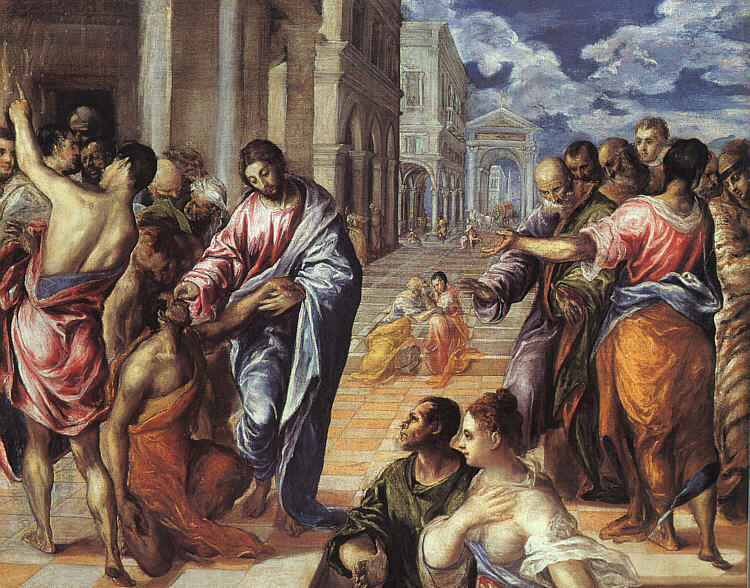
Christ Healing the Blind, by El Greco. Image from Wikimedia Commons.
So the Sign of Peace, through oxytocin, promotes biological unity among the faithful. It actually conforms your brain and body to the truth of the unity accomplished by the Eucharist.
Why is this so important?
Because, as Giussani explains, “It is not our experiences that build unity, but rather unity that is the foundation for our experiences.” Unity in the Body of Christ is not the consequence of your relationship with God. We do not build up His Church by our personal piety or our efforts at holiness. No, the unity of the Church was achieved by the death and resurrection of Christ. Christ invited us into unity when “in one Spirit we were all baptized into one body” (1 Corinthians 12:13). And now, this unity becomes the starting point for our experience of God.
The temptation to retreat into isolated experiences of the transcendent can be strong – especially if you have a mystical heart like mine. But we cannot overlook the importance of communion.
As Giussani writes:
“We are together because Christ died and rose again,” so “all your objections to those who don’t do anything, or who always want to be in charge, or who do as they please, or who you don’t get along with, or who leave you alone; all your objections, which are the reason you stay at the edges or the margins of the life of the community— where do they come from? From the fact that, for you, it’s not yet true that we’re together because Christ died and rose again. Because even if you killed my mother I would have to accept you in communion; even if you killed me I would have to accept you in communion— because even if you killed me, you cannot get rid of the fact that Christ died and rose again for our unity.”
So don’t give in to the temptation to retreat from community, and get stuck in your own head. When you’re at Mass, give the Sign of Peace! Your neurobiology will help you live according to the truth of our unity in Christ: oxytocin will make you more ready to receive the Eucharist of your Lord.
Further reading recommendations
Read Fr. Raniero Cantalamessa’s brief work The Eucharist, Our Sanctification, on the four ways the Eucharist makes the Church. For something even more accessible, his 3rd Lenten homily from 2014 is gorgeous.
All quotes from Giussani are from his biography, The Life of Luigi Giussani – recently translated into English.

About Synapses of the Soul
You can contact Sofia at [email protected]. You can read more about the author here.
Previous Post

August 16, 2018
On materialism, suffering, and the opioid crisis
Next Post
August 23, 2018 On evolution and the Catholic faith
Browse Our Archives
Select a Category Monthly Roundup Series: Habits Uncategorized
Select a Month November 2020 October 2020 September 2020 August 2020 July 2020 June 2020 May 2020 April 2020 January 2020 December 2019 November 2019 October 2019 September 2019 August 2019 March 2019 February 2019 January 2019 December 2018 November 2018 October 2018 September 2018 August 2018
TAKE THE
Religious Wisdom Quiz
What was the primary marriage arrangement type?
Select your answer to see how you score.
Divine intervention Bride selection Arranged by families Love marriage
Related posts from Synapses of the Soul


Your Life Should Cause Cognitive Dissonance


Does Your Mind Extend Into the World?
TRENDING AT PATHEOS Catholic

Rejecting Doom: Christian Hope And Human Action
Christianity is a religion of hope. We are to have hope and...

It’s What Comes From Within Which Matters
One of the most difficult things for us to understand is why...

Why I Choose the Eucharist Over the Sermon
Choose the Eucharist, Not the Sermon What are we supposed to get...

5 Design Elements Found in Spiritually Rooted Homes
Putting Spirituality Into Home Decor Our homes are more than our living...

Credo: A Story of God Told with the...
About 10 years ago, I began to imagine a personal "Credo" that...

The Anatomy of Divine Revelation in Catholic Thought
The claim that God has made Himself known to human beings is...
view all Catholic blogs
Ad-Free & Subscriber Log-In Subscription Support
- About Us
- 2026 Calendar
- Videos
- Podcasts
- Library of World Religions
- Faith In Media Tracker
- Advertise With Us
- Write for Us
- Privacy Policy
- Terms of Service
- Do Not Sell My Data
- Contact Us
- Radiant Digital
- Manage Newsletter Subscriptions
- Unsubscribe From Notifications
- Sitemap
Copyright 2008-2026, Patheos. All rights reserved.
Subscription Support Ad-Free & Subscriber Log-In
Follow Patheos