
BuddhistCatholicContemplativeEvangelicalGeneral ChristianHinduJewishLatter-day SaintMuslimNew VisionsProgressive Christian
Beliefs
- Buddhist
- Catholic
- Contemplative
- Evangelical
- General Christian
- Hindu
- Jewish
- Latter-day Saint
- More Voices
- Muslim
- New Visions
- Pagan
- Progressive Christian
Topics
- Religion News
- Food and Religion
- Sports and Religion
- Religious Art
- Religious Music and Entertainment
- Religious Events
- History and Religion
- Style and Religion
- Politics and Religion
- Women in Religion
- Recreation Outdoors and Religion
- Business Finance and Religion
- Careers Workplace and Religion
- Education and Religion
- Family Parenting and Religion
- Health Fitness and Religion
- Home and Religion
- Relationships and Religion
- Technology and Religion
- Travel and Religion
Columnists
- Buddhist Columnists
- Business Finance and Religion Columnists
- Careers Workplace and Religion Columnists
- Catholic Columnists
- Contemplative Columnists
- Education and Religion Columnists
- Evangelists Columnists
- Family Parenting and Religion Columnists
- General Christian Columnists
- Health Fitness and Religion Columnists
- Hindu Columnists
- History and Religion Columnists
- Home and Religion Columnists
- Jewish Columnists
- More Voices Columnists
- Latter Day Columnists
- Muslim Columnists
- New Visions Columnists
- Nonreligious Columnists
- Pagan Columnists
- Politics and Religion Columnists
- Progressive Columnists
- Recreation Outdoors and Religion Columnists
- Relationships and Religion Columnists
- Religion News Columnists
- Religious Art Columnists
- Religious Events Columnists
- Religious Music and Entertainment Columnists
- Sports and Religion Columnists
- Style and Religion Columnists
- Technology and Religion Columnists
- Travel and Religion Columnists
- Women in Religion Columnists
Resource Library
- 2026 Calendar
- Library of World Religions
- The 100 Most Holy Places on Earth
- Patheos Answers
- Podcasts
- Videos
- Faith Leaders Database
- Anglican Episcopalian
- Bahai
- Baptist
- Buddhism
- Christianity
- Confucianism
- Eastern Orthodoxy
- Hinduism
- Holiness and Pentecostal
- ISKCON
- Islam
- Judaism
- Lutheran
- Methodist
- The Church of Jesus Christ of Latter-day Saints
- New Age
- Paganism
- Presbytarian and Reformed
- Protestantism
- Religion Behind the Scenes
- Roman Catholic
- Scientology
- Shia Islam
- Sikhism
- Sufism
- Sunni Islam
- Taoism
- Zen
- See all religions
Research Tools
 Ad-Free & Subscriber Log-In Subscription Support
Ad-Free & Subscriber Log-In Subscription Support
Follow Patheos 

- Trending:
- Forgiveness
- |
- Marriage
- |
- Consciousness
- |
- Death Penalty
- |
- Election
- |
- Halloween

- Home
- General Christian
- Religion News
- Objections to Christianity by People who Deconvert: Why Language Matters
Objections to Christianity by People who Deconvert: Why Language Matters
Last updated on: May 1, 2023 at 8:18 pm by Joel Furches
Objections to Christianity by People who Deconvert: Why Language Matters 2023-05-01T20:18:09-04:00 Joel Furches
Patheos Explore the world's faith through different perspectives on religion and spirituality! Patheos has the views of the prevalent religions and spiritualities of the world.

Seen in this article is a graph I created while engaged in my case study research on deconversion. This study involved gathering autobiographical stories told by people who had once been avowedly Christian, but now identified quite publicly as atheists.
The oldest of these was the late Joseph McCabe who died in 1955. At the time during which McCabe lived, finding autobiographical details of deconversion was difficult, and the person would have had to be a very visible public figure with a platform. McCabe wrote 250 books and toured the world giving lectures, and so was a visible enough figure to yield such data.
In the modern era, autobiographical data on deconversion can be had on practically anyone due to the internet and social media. I focused my efforts on those individuals who clearly identified themselves as atheists, clearly stated that they used to be Christian, and gave an explicit account of how they went from one identity to the other.
Of the many items of interest in these accounts were the specific objections the people involved had to their Christian faith. I was most interested in the objections they said occurred to them while they were still believers. A person who identifies as an atheist will likely object to most if not all aspects of Christian belief and practice, but the problems they had while they were still believers might inform me on what contributed to their disbelief.
See the chart below
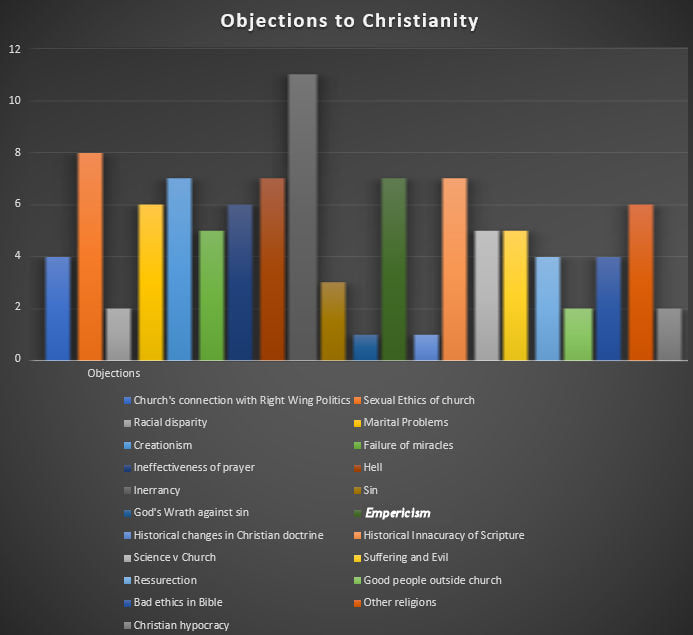
Overlapping Categories
As one examines the chart in this article, one may see what appear to be overlaps. For instance, “sin” is in a separate category from “God’s wrath against sin.” “Historical inaccuracies within the Bible” is in a separate category from “Inerrancy.” Why were these objections not simply lumped together into a single unit?
The way in which these data were coded was largely based on the language used in the testimonies given by these deconverts. Objections are reactionary, and the way in which the individuals react says a great deal about the expectations placed upon them by their religious environments in comparison to their lived experiences.
Examples
To take the examples given, an objection to “sin” differentiates itself from an objection to “God’s wrath against sin” in this way:
God’s wrath against sin is an objection related to God and his specific behavior. Why would God, for instance, drown the entire world in a flood as a response to sin rather than to simply forgive that sin.
As an objection to sin itself, consider the testimony of deconvert Maggie Sergent:
“So I’m teaching about sin, and a little girl raises her hand, and says ‘what is sin?’
“And I started bawling then and there, because I felt like I could not teach a kid that they were less than perfect. That there was sin in the world, and that separated them from God, and that sin existed, and I realized in that exact moment that I didn’t believe in sin, and I wasn’t going to teach this little girl that sin existed.”
What matters in these instances is the language being used by the person providing the narrative. The specific objections these individuals outright state within their autobiographies says a lot about what was causing the cognitive dissonance which contributed to the eventual deconversion. Had this person sat down and thought things through systematically, the objection to sin would likely be consistent with an objection to hell, but hell was not in her mind when she began to break down and sob. Sin was. Plenty of these deconversion stories do prominently mention hell as a primary objection, but as a researcher attempting to understand the experience of deconversion from the internal perspective of the person having that experience (called “phenomenology”) what matters is the concept playing through the person’s mind at the time.
A more intellectually robust example would be the difference between objections to the inerrancy of the Bible versus objections to the resurrection. In my research, people who came from church environments which insisted that either the Bible was entirely without error, or Christianity was untrue would understandably find errors within the Bible to be evidence of the falsehood of Christianity. Because this is what their religious environment told them.
On the other hand, there were others who might allow for errors in the Bible, but held the sensible notion that if Jesus did not rise from the dead, Christianity was untrue. When this latter category of people encountered evidence that the resurrection did not happen, it was not the inerrancy, but rather the lack of a resurrection which constituted reason to exit their Christian beliefs.
A perfect example of how this plays out in the mind of the believer struggling with her belief can be found in the words of the ex-Christian blogger Cassidy McGillicuddy:
“I’d already encountered–and discarded–belief in literal Creationism. My church officially held that as a doctrine, but even my then-husband Biff and I knew better than to buy into that belief. I knew people believed it, and I was uncomfortable about that belief even as I preached to my various evangelism prospects about the Bible being literally and inerrantly true. I compartmentalized those two beliefs to keep them from jarring, but when I deconverted I had to set them both together for the first time–and saw for the first time how totally crazy it was that I had totally believed both of these two contradictory things.”
Here, McGillicuddy describes the process of “compartmentalizing” objections and beliefs, wherein one thing (Creationism) became so unbelievable that it was discarded, but a contradictory idea (inerrancy) was maintained in tension.
This is why when I, as a researcher, hear a person raise a specific objection (“Why did God change his standards from Old Testament in the New Testament?”), I need to avoid placing it in too broad a category when I tally it. When the potential deconvert raises an objection, it is that very specific question, and not all of the associated consequences of that objection, which is causing the dissonance which contributes to the deconversion process.
My interest as a researcher is to discover the very specific kinds of questions which refuse to be compartmentalized or cannot be comfortably held in tension with similar problems, and thus force the person into the process of re-thinking the entire belief system rather than shrugging the question off and going about his or her business as usual.
This is why language matters and why one cannot be too presumptuous when categorizing objections, if one’s goal is to understand the deconversion process.

About Joel Furches
Joel Furches is a writer, educator, journalist, and researcher who has written extensively on subjects related to religion and Christianity specifically. Joel has a Master's Degree in education, academic training and experience in Applied Behavioral Psychology, and is pursuing a Ph.D. in psychology with his dissertation on religious deconversion. You can read more about the author here.
Previous Post
April 10, 2023
“You Lost Me,” A Snapshot of Young Millennial Deconversion
Next Post

April 24, 2023 Tales of Deconversion: The Monk Who Became an Atheist
Recent Comments
Browse Our Archives
Select a Category biography Conversion Stories Deconversion Stories Historical Religious Figures Psychology Uncategorized
Select a Month December 2024 November 2024 September 2024 August 2024 July 2024 March 2024 January 2024 December 2023 November 2023 October 2023 September 2023 August 2023 July 2023 June 2023 May 2023 April 2023 March 2023 February 2023 January 2023 December 2022 November 2022 October 2022 September 2022
Follow Us!
TAKE THE
Religious Wisdom Quiz
What is the biblical view of work?
Select your answer to see how you score.
Avoid work Work is a curse Only kings should work Work hard as for the Lord
Related posts from Switching Sides

Complex Simplicity - A Book Review

Book Review: Deconstructing, Leaving Church, Finding Faith

Consequences of Ideas: Philosophy and Deconversion
TRENDING AT PATHEOS General Christian

Seventy and Five Years Old: God Still Starts...
There is a small detail tucked into Genesis 12 that I skipped...

A Biblical Vision of Success in Christian Life...
The Concern and Quest Recent trends and tendencies I note around me...

Indigenous Peoples’ Day and the Church
Indigenous' Peoples Day or Columbus Day? Depending on where you live...

When Spiritual Growth Looks Like Losing Ground
Four Passive Spiritual Disciplines: An Introduction When I was a college freshman,...

Faith and Finding Your Current Season
“To everything there is a season,” Ecclesiastes tells us, “and a time...

Did Jesus Fear God's Wrath in Gethsemane?
That Time Jesus Was Terrified Before we begin, let me say at...
view all General Christian blogs
What Are Your Thoughts?leave a comment
Ad-Free & Subscriber Log-In Subscription Support
- About Us
- 2026 Calendar
- Videos
- Podcasts
- Library of World Religions
- Faith In Media Tracker
- Advertise With Us
- Write for Us
- Privacy Policy
- Terms of Service
- Do Not Sell My Data
- Contact Us
- Radiant Digital
- Manage Newsletter Subscriptions
- Unsubscribe From Notifications
- Sitemap
Copyright 2008-2026, Patheos. All rights reserved.
Subscription Support Ad-Free & Subscriber Log-In
Follow Patheos