
BuddhistCatholicContemplativeEvangelicalGeneral ChristianHinduJewishLatter-day SaintMuslimNew VisionsProgressive Christian
Beliefs
- Buddhist
- Catholic
- Contemplative
- Evangelical
- General Christian
- Hindu
- Jewish
- Latter-day Saint
- More Voices
- Muslim
- New Visions
- Pagan
- Progressive Christian
Topics
- Religion News
- Food and Religion
- Sports and Religion
- Religious Art
- Religious Music and Entertainment
- Religious Events
- History and Religion
- Style and Religion
- Politics and Religion
- Women in Religion
- Recreation Outdoors and Religion
- Business Finance and Religion
- Careers Workplace and Religion
- Education and Religion
- Family Parenting and Religion
- Health Fitness and Religion
- Home and Religion
- Relationships and Religion
- Technology and Religion
- Travel and Religion
Columnists
- Buddhist Columnists
- Business Finance and Religion Columnists
- Careers Workplace and Religion Columnists
- Catholic Columnists
- Contemplative Columnists
- Education and Religion Columnists
- Evangelists Columnists
- Family Parenting and Religion Columnists
- General Christian Columnists
- Health Fitness and Religion Columnists
- Hindu Columnists
- History and Religion Columnists
- Home and Religion Columnists
- Jewish Columnists
- More Voices Columnists
- Latter Day Columnists
- Muslim Columnists
- New Visions Columnists
- Nonreligious Columnists
- Pagan Columnists
- Politics and Religion Columnists
- Progressive Columnists
- Recreation Outdoors and Religion Columnists
- Relationships and Religion Columnists
- Religion News Columnists
- Religious Art Columnists
- Religious Events Columnists
- Religious Music and Entertainment Columnists
- Sports and Religion Columnists
- Style and Religion Columnists
- Technology and Religion Columnists
- Travel and Religion Columnists
- Women in Religion Columnists
Resource Library
- 2026 Calendar
- Library of World Religions
- The 100 Most Holy Places on Earth
- Patheos Answers
- Podcasts
- Videos
- Faith Leaders Database
- Anglican Episcopalian
- Bahai
- Baptist
- Buddhism
- Christianity
- Confucianism
- Eastern Orthodoxy
- Hinduism
- Holiness and Pentecostal
- ISKCON
- Islam
- Judaism
- Lutheran
- Methodist
- The Church of Jesus Christ of Latter-day Saints
- New Age
- Paganism
- Presbytarian and Reformed
- Protestantism
- Religion Behind the Scenes
- Roman Catholic
- Scientology
- Shia Islam
- Sikhism
- Sufism
- Sunni Islam
- Taoism
- Zen
- See all religions
Research Tools
 Ad-Free & Subscriber Log-In Subscription Support
Ad-Free & Subscriber Log-In Subscription Support
Follow Patheos 

- Trending:
- Forgiveness
- |
- Marriage
- |
- Consciousness
- |
- Death Penalty
- |
- Election
- |
- Halloween

- Home
- General Christian
- Religion News
- Testify! The Religious Testimony Versus the Deconversion Story
Testify! The Religious Testimony Versus the Deconversion Story
Last updated on: January 3, 2023 at 12:01 pm by Joel Furches
Testify! The Religious Testimony Versus the Deconversion Story 2023-01-03T12:01:06-05:00 Joel Furches
Patheos Explore the world's faith through different perspectives on religion and spirituality! Patheos has the views of the prevalent religions and spiritualities of the world.

CONVERSION NARRATIVES
Starbuck (1866-1947) and James (1902) were pioneers in the field of Conversion studies. Both of these relied on “conversion narratives” in their studies. Later, the Oxford Handbook of Religious Conversion would include a chapter exploring conversion in terms of narrative.
A “narrative” in this sense is simply a story which has a definite beginning point, rises to a narrative climax, and then has a definite conclusion.
In terms of conversion narratives, the standard format in people’s minds is what is called a “crisis conversion.”
CRISIS CONVERSIONS
Very simply, a crisis conversion is a story wherein there is some sudden moment of inspiration wherein the individual moves from a state of pre-conversion to post-conversion. It denotes a definite moment in time wherein the conversion occurs.
This crisis conversion narrative is typified by Saul of Tarsus who, in a single experience, went from a man who hated Christians to a man who was a Christian.
This same narrative exists within most other religions, as with the sudden enlightenment of the Buddha, the burning bush speaking to Moses, and the moment when Muhammad is seized by an angel and forced to recite.
This idea of a sudden, inspirational moment of “salvation” is still very much the standard model in the Evangelical mind, which uses markers such as the “sinner’s prayer,” alter calls, and speaking in tongues to identify a new convert.
Indeed, Christian fiction and folklore often uphold the crisis conversion as the standard. Instances include such stories as Pilgrim’s Progress when the central character lays eyes on the cross and releases his burden within a moment; or the well-read autobiography of former slave trader John Newton who fell on his knees in repentance of all his evils, and subsequently penned the celebrated hymn “Amazing Grace.”
Given that we do not have access to the hearts and minds of converts, there is no way to verify any moment in time when the individual goes from not religious to religious. However, in most models used in the field of conversion studies, the process of conversion is just that: a process.
Nevertheless, in the conversion narratives I have studied of Atheists who have converted to Christianity, there very much remains that moment of inspiration (although not necessarily the moment of “salvation”).
ATHEIST CONVERSION STORIES
- Warner Wallace tells of the night he lay awake tossing and turning as he went over and over all of the things he had been analyzing in the Gospels. Finally, he woke his wife and told her he thought it was all true.
- Francis Collins speaks of the moment he rounded the corner on a mountain walk, and saw the astounding crystalline display of a frozen waterfall rising above him. This became a profoundly spiritual experience for him and remains the central climax in his conversion narrative.
- For Peter Hitchens, that central point involves the viewing of medieval art depicting lost souls cast into hell. Although an unbeliever, Peter was somehow struck by the notion that this is the fate he actually deserved.
- C.S. Lewis speaks of a night of profound struggle wherein the proverbial “hounds of heaven” were nipping at his heals, and he was forced by intellect and spirit to concede that there was, indeed, a God in heaven, describing himself as being dragged wholly unwillingly into conversion.
- Tyler Vela’s conversion narrative includes as a defining feature this moment of dawning delight after he becomes a Christian: he listens to Christmas Carols he has heard all his life, and suddenly understands what the words of the carols mean.
The moments described above do not represent the entirety of these individuals’ conversion experiences. And with the possible exception of Lewis, they do not even represent the moment these people decided they were Christians. They represent mere dramatic instances within a much larger conversion narrative: where the rising action climaxes within the story.
Nevertheless, it is these dramatic incidents around which the narrative rotates, and perhaps merely because of the drama involved, they become the defining features that are repeated with every retelling of the conversion story.
DECONVERSION NARRATIVES
The question now becomes, can a deconversion experience be viewed through the same narrative lens as a conversion experience?
If actual crisis conversions are relatively rare, there is practically no such thing as a crisis deconversion. However, so long as one can say that a deconversion story can be framed with a beginning/middle/end format, then one can still construct a narrative for the incident.
While beginnings and endings are somewhat arbitrary and may move about depending on the age and experience of the teller, it is that central point with which I concern myself.
Meaning, do most deconversion narratives contain some defining moment around which they revolve, and which remains a fixed feature of the story through multiple re-tellings?
In the model I have developed for deconversions, the “narrative climax” is usually seen on one of four possible stages:
- Early Trauma – Early Trauma is not a feature common to all deconversion narratives. But it can be seen occasionally as one does a broad survey of these stories. Early Trauma can be anything from abuse at the hands of a church person to trauma brought on through some teaching or ideology (rapture anxiety being a common culprit).
When the trauma frames the person’s view of what religion is, it can be the driving force behind the narrative.
- Stressor – The stressor stage of the deconversion process is defined by any sort of sudden or significant change from the status quo. Stressors could be anything from the death of a loved one, the betrayal of a friend, or a move away from home (especially when the home was the only environment with which the person was familiar). In a deconversion narrative, the stressor may be an incidental feature of the story (often leaving the home for college falls into this category), or it could be central to the story, such as Hannah Timpson’s tale of the death of a well-loved church leader.
- Trigger – The most likely suspect for the narrative climax would be the “trigger event” present in every deconversion story. This is usually as close as a story gets to a “moment of inspiration.” The trigger event represents a specific question that gives the individual “permission” to begin questioning or deconstructing their faith. By way of random example, Rachael Slick’s trigger was the question “If God is unchanging, how have the moral rules in the Bible shifted so drastically from Old to New Testament?” Bart Ehrman’s trigger was a theology professor who suggested that a Gospel author might have made a mistake. Cassidy McGillicuddy’s trigger was intercessory prayer and how pointless and ineffective it seemed.
- Post-Deconversion Crisis – While one never sees a “crisis” deconversion, one sometimes sees a “post-deconversion crisis” (PDC).
What this means specifically is that after the person comes to realize that they no longer believe, they reach a point of crisis: what is their identity now, as an unbeliever? What will happen to their community of friends and family now that they no longer believe?
PDC’s are by no means a universal feature of the deconversion narrative. Frequently by the time a person decides they no longer believe, they have a sense of relief to be out from under the pressures and restrictions of that religion. Where one sees PDC the most is when the person was heavily involved in the ministry – frequently when the ministry is also their career.
Given that the ministry is their day-job, their personal identity, and their public identity, the loss of this tends to mark a dramatic shift for which they are not always prepared. This is typified by Pentecostal minister Jerry DeWitt who includes a very vivid description of his PDC when telling his “exitmony.”
DECONVERSION AS A NARRATIVE
As a deconvert attempts to make sense of their experience, their narrative typically begins with where they are rather than where they used to be.
Once the person describes their current situation, attitudes, and beliefs, the narrator begins to talk about their past in light of their current perspective.
At this point, the story tends to focus less on them, and more on the environment and influences which surrounded them.
After the narrator sets the scene, so to speak, they develop a timeline which tends to focus specifically on those inconsistencies and morally suspect beliefs and practices that typified their religious life.
Given that the person telling the story is aware throughout the narration that something is deeply wrong with the environment and beliefs – something that they, as a character in the story – do not know, the story then becomes a sort of “reverse enlightenment.” The story isn’t about a path that leads to truth, but rather a tale of discovering error.
So the narrative structure is typically this:
- Current beliefs and perspectives
- Description of religious people and environment
- Anecdotes to illustrate the nature of the religious background
- After the anecdotal portion, the narrative assumes a more temporal quality, wherein the narrative begins to focus around their “deconversion career.” They will typically begin with some kind of stressor or change of status quo. At this point, the trigger occurs, and after that, a period of quest and discovery at the end of which, they are no longer a believer.
- After the “deconversion career” is described, the narrative returns to their current situation, re-framed in light of the background and events they just described.
When a believer gives their “testimony,” it is almost always done to the end of showing how effective and important their beliefs have been in their life. In this respect, a testimony is less autobiography, and more an assessment of the belief system itself. By contrast, an “exitmony” always tends toward a critical assessment of the belief system in terms of its flaws and failings – especially as it has failed the narrator.

Next Post

October 31, 2022 Going off to College and Losing Faith
Browse Our Archives
Select a Category biography Conversion Stories Deconversion Stories Historical Religious Figures Psychology Uncategorized
Select a Month December 2024 November 2024 September 2024 August 2024 July 2024 March 2024 January 2024 December 2023 November 2023 October 2023 September 2023 August 2023 July 2023 June 2023 May 2023 April 2023 March 2023 February 2023 January 2023 December 2022 November 2022 October 2022 September 2022
Follow Us!
TAKE THE
Religious Wisdom Quiz
My hair held my strength, but a woman's betrayal led to my capture and blindness. Who am I?
Select your answer to see how you score.
Samson Absalom Saul Gideon
Related posts from Switching Sides

Complex Simplicity - A Book Review

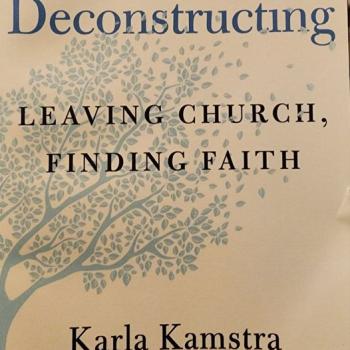
Book Review: Deconstructing, Leaving Church, Finding Faith

Consequences of Ideas: Philosophy and Deconversion
TRENDING AT PATHEOS General Christian

Seventy and Five Years Old: God Still Starts...
There is a small detail tucked into Genesis 12 that I skipped...

A Biblical Vision of Success in Christian Life...
The Concern and Quest Recent trends and tendencies I note around me...

Indigenous Peoples’ Day and the Church
Indigenous' Peoples Day or Columbus Day? Depending on where you live...

When Spiritual Growth Looks Like Losing Ground
Four Passive Spiritual Disciplines: An Introduction When I was a college freshman,...

Faith and Finding Your Current Season
“To everything there is a season,” Ecclesiastes tells us, “and a time...

Did Jesus Fear God's Wrath in Gethsemane?
That Time Jesus Was Terrified Before we begin, let me say at...
view all General Christian blogs
Ad-Free & Subscriber Log-In Subscription Support
- About Us
- 2026 Calendar
- Videos
- Podcasts
- Library of World Religions
- Faith In Media Tracker
- Advertise With Us
- Write for Us
- Privacy Policy
- Terms of Service
- Do Not Sell My Data
- Contact Us
- Radiant Digital
- Manage Newsletter Subscriptions
- Unsubscribe From Notifications
- Sitemap
Copyright 2008-2026, Patheos. All rights reserved.
Subscription Support Ad-Free & Subscriber Log-In
Follow Patheos