
BuddhistCatholicContemplativeEvangelicalGeneral ChristianHinduJewishLatter-day SaintMuslimNew VisionsProgressive Christian
Beliefs
- Buddhist
- Catholic
- Contemplative
- Evangelical
- General Christian
- Hindu
- Jewish
- Latter-day Saint
- More Voices
- Muslim
- New Visions
- Pagan
- Progressive Christian
Topics
- Religion News
- Food and Religion
- Sports and Religion
- Religious Art
- Religious Music and Entertainment
- Religious Events
- History and Religion
- Style and Religion
- Politics and Religion
- Women in Religion
- Recreation Outdoors and Religion
- Business Finance and Religion
- Careers Workplace and Religion
- Education and Religion
- Family Parenting and Religion
- Health Fitness and Religion
- Home and Religion
- Relationships and Religion
- Technology and Religion
- Travel and Religion
Columnists
- Buddhist Columnists
- Business Finance and Religion Columnists
- Careers Workplace and Religion Columnists
- Catholic Columnists
- Contemplative Columnists
- Education and Religion Columnists
- Evangelists Columnists
- Family Parenting and Religion Columnists
- General Christian Columnists
- Health Fitness and Religion Columnists
- Hindu Columnists
- History and Religion Columnists
- Home and Religion Columnists
- Jewish Columnists
- More Voices Columnists
- Latter Day Columnists
- Muslim Columnists
- New Visions Columnists
- Nonreligious Columnists
- Pagan Columnists
- Politics and Religion Columnists
- Progressive Columnists
- Recreation Outdoors and Religion Columnists
- Relationships and Religion Columnists
- Religion News Columnists
- Religious Art Columnists
- Religious Events Columnists
- Religious Music and Entertainment Columnists
- Sports and Religion Columnists
- Style and Religion Columnists
- Technology and Religion Columnists
- Travel and Religion Columnists
- Women in Religion Columnists
Resource Library
- 2026 Calendar
- Library of World Religions
- The 100 Most Holy Places on Earth
- Patheos Answers
- Podcasts
- Videos
- Faith Leaders Database
- Anglican Episcopalian
- Bahai
- Baptist
- Buddhism
- Christianity
- Confucianism
- Eastern Orthodoxy
- Hinduism
- Holiness and Pentecostal
- ISKCON
- Islam
- Judaism
- Lutheran
- Methodist
- The Church of Jesus Christ of Latter-day Saints
- New Age
- Paganism
- Presbytarian and Reformed
- Protestantism
- Religion Behind the Scenes
- Roman Catholic
- Scientology
- Shia Islam
- Sikhism
- Sufism
- Sunni Islam
- Taoism
- Zen
- See all religions
Research Tools
 Ad-Free & Subscriber Log-In Subscription Support
Ad-Free & Subscriber Log-In Subscription Support
Follow Patheos 

- Trending:
- Forgiveness
- |
- Marriage
- |
- Consciousness
- |
- Death Penalty
- |
- Election
- |
- Halloween

- Home
- General Christian
- Religion News
- Five Things that Motivate Deconversion
Five Things that Motivate Deconversion
Last updated on: September 26, 2022 at 8:28 am by Joel Furches
Five Things that Motivate Deconversion 2022-09-11T17:45:47-04:00 Joel Furches
Patheos Explore the world's faith through different perspectives on religion and spirituality! Patheos has the views of the prevalent religions and spiritualities of the world.
Imagine eating a bag of salty chips. Before you begin to munch on the chips, a frosty glass of cold water would only be mildly tempting. But with each chip you consume, the more attractive the glass of water becomes. The act of eating the chips increases the value of the glass of water. By the same principle, for every moment one spends in a stuffy auditorium with no air conditioning, the exit door becomes more and more attractive.
In psychology terms, we would call the eating of chips or the stuffiness of an auditorium “establishing operations.” These are the conditions which make a particular object or action increasingly attractive to the subject of these conditions.
There are doubtless a number of establishing operations which have made religious exit attractive, but there are five very specific features of churches which tend to produce deconverts. They are as follows:
- Performance Control
A common feature of religion throughout time and across the world is that it establishes rules for moral behavior, and forbids certain immoral behaviors. However, the power of the religion to enforce these rules is not as unlimited as the power of the state. Sometimes the government conforms its laws to the demands of the church, but most often the control of each person’s behavior is left to that person’s conscience.
But occasionally, churches will give the conscience a little shove. There exist religious environments wherein whenever a person says or does anything publicly which runs against the grain of the church’s standards, the entire community begins to treat that person differently due to their behavior. Such communities are frequently unrestrained in the spreading of rumors, and so a person’s private activities – or even suspicions of such activities – will quickly modify how the church treats them.
Of course, this treatment runs both ways, and the person who seems especially pious will be awarded with respect and verbal praise.
This cycle of honor and shame can be very rewarding to a certain kind of person, but extremely aversive to another. To a person unable or unwilling to live within the boundaries set by the church, exiting this church and being free of the feelings of guilt, shame, and social pressures becomes an increasingly attractive prospect.
- Textualism
“Textualism” is a legal term which refers to treating a text as literally as possible – not reading things into it which are not there, and not excluding things which are there. Most religious traditions treat their sacred texts with extreme respect, and award them with divine authority. Unfortunately, there is rarely universal agreement with what the texts mean.
Some church environments are flexible when it comes to different or controversial views, but others are not.
When a church environment teaches its followers that its views on scripture are absolute, unquestionable, and impervious to error, this places a black-and-white line which cannot be crossed. It reads like this, “Either scripture is flawless, or it is entirely false.”
There is a certain feeling of security in knowing that you have in your possession the absolute truth. However, when any serious questions about the accuracy of your truth are posed, it results in a genuine threat to your belief.
When a person is taught that scripture is true beyond a doubt, legitimate questions about scripture become powerful objections. In fact, in terms of frequency, Bible problems are the most commonly reported justifications given by deconverts.
- Isolationism
Among the attractive features of religion is the sense of community it provides. It is a very rewarding experience to enter an environment wherein one knows that everyone around shares one’s values such that one does not need to censor oneself, and can share one’s thoughts and convictions freely. The world outside seems like a scary place, and those in authority become increasingly concerned that the members – especially the youngsters – will reject their values and be corrupted by the many ideological threats “out there.”
As a result, religious environments will either intentionally or inadvertently discourage their members from interacting with the larger world outside of that religion. Perhaps the church tells members to avoid media – music and movies – which are not friendly to their values. Or at the extremes, members are discouraged from forming any kind of relationship with someone who is not a member of their “tribe.”
When a person is isolated within this religious “bubble,” and receives no exposure to the outside world, the person is unprepared for encounters with the standards or worldviews that exist in that outside realm. As a result, people who exit the church environment long enough to expose themselves to the larger world will frequently find the world outside the church far less constraining and stifling that the world inside. They may also find these novel ideas attractive and fulfilling in a way the church environment was not.
- Spiritualism
Church environments vary widely in their approaches to worship and teaching. Some take very practical approaches, some try to create a more heavenly, blissful repose, and some attempt to harness ecstatic spiritual experiences for the benefit of the believers.
On a spectrum of churches wherein one extreme represents and environment that says the world is fundamentally supernatural and the other end treating religion as a superficial social activity, the churches that exist on the spiritual extremes tend to see more radical deconversions. The churches at the other end do see a great deal of drop-off in membership, but these generally fall into the category of people simply losing interest in religion.
Hyper-spiritualism characterized by highly charismatic churches on one hand, or highly liturgical churches on the other can lead to deconversion in one of two ways. The first is when the church creates the impression that a person’s religious life should be filled with profound spiritual experiences. When the person fails to have such experiences on a regular basis, they may form the impression that either they are wrong, or the church is wrong.
Another way in which such environments can lead to deconversion is when the individual begins to encounter the fascinating and enticing world of empirical science. Suddenly the world of the religious seems less realistic, and the universe seems to make far more sense as a material mechanism than a supernatural one.
- Compulsory Certainty
Worldviews which encourage extreme levels of conviction often stray into dogmatism. This is the attitude which says that everything I believe is unquestionably true, and everyone who says otherwise is either deceived or an outright liar.
In certain church environments, members are told that their religious beliefs should amount to total certainty. Questions or doubts are signs of spiritual weakness, or perhaps downright sinful.
Ironically, this makes the act of questioning tantamount to evidence against the system. If I can doubt my religious beliefs, those beliefs are not above question. If they are not above question then, by their own admission, they must be wrong.
An extraordinary number of religious environments are not very uncomfortable with the idea that “I don’t know” is an acceptable response to questions they cannot answer. The impression is that if you don’t know the answer, then there is no answer.
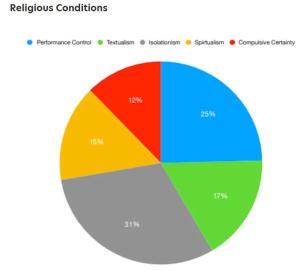
The five “establishing operations” listed above have been harvested from my research into 32 well-documented cases of deconversion. Everyone within my study had one or more of these conditions present in their religious backgrounds. The frequency with which these conditions were present are illustrated below.
Previous Post

September 19, 2022
Losing my Religion: Deconversion or Disaffiliation?
Next Post

October 3, 2022 Doubt and Deconversion
Browse Our Archives
Select a Category biography Conversion Stories Deconversion Stories Historical Religious Figures Psychology Uncategorized
Select a Month December 2024 November 2024 September 2024 August 2024 July 2024 March 2024 January 2024 December 2023 November 2023 October 2023 September 2023 August 2023 July 2023 June 2023 May 2023 April 2023 March 2023 February 2023 January 2023 December 2022 November 2022 October 2022 September 2022
Follow Us!
TAKE THE
Religious Wisdom Quiz
True or False: Elisha received a double portion of Elijah's spirit.
Select your answer to see how you score.
FALSE TRUE
Related posts from Switching Sides


Book Review: Deconstructing, Leaving Church, Finding Faith

Consequences of Ideas: Philosophy and Deconversion

Deconversion in the Ancient World: The Research
TRENDING AT PATHEOS General Christian

Seventy and Five Years Old: God Still Starts...
There is a small detail tucked into Genesis 12 that I skipped...

A Biblical Vision of Success in Christian Life...
The Concern and Quest Recent trends and tendencies I note around me...

Indigenous Peoples’ Day and the Church
Indigenous' Peoples Day or Columbus Day? Depending on where you live...

When Spiritual Growth Looks Like Losing Ground
Four Passive Spiritual Disciplines: An Introduction When I was a college freshman,...

Faith and Finding Your Current Season
“To everything there is a season,” Ecclesiastes tells us, “and a time...

Did Jesus Fear God's Wrath in Gethsemane?
That Time Jesus Was Terrified Before we begin, let me say at...
view all General Christian blogs
Ad-Free & Subscriber Log-In Subscription Support
- About Us
- 2026 Calendar
- Videos
- Podcasts
- Library of World Religions
- Faith In Media Tracker
- Advertise With Us
- Write for Us
- Privacy Policy
- Terms of Service
- Do Not Sell My Data
- Contact Us
- Radiant Digital
- Manage Newsletter Subscriptions
- Unsubscribe From Notifications
- Sitemap
Copyright 2008-2026, Patheos. All rights reserved.
Subscription Support Ad-Free & Subscriber Log-In
Follow Patheos