
BuddhistCatholicContemplativeEvangelicalGeneral ChristianHinduJewishLatter-day SaintMuslimNew VisionsProgressive Christian
Beliefs
- Buddhist
- Catholic
- Contemplative
- Evangelical
- General Christian
- Hindu
- Jewish
- Latter-day Saint
- More Voices
- Muslim
- New Visions
- Pagan
- Progressive Christian
Topics
- Religion News
- Food and Religion
- Sports and Religion
- Religious Art
- Religious Music and Entertainment
- Religious Events
- History and Religion
- Style and Religion
- Politics and Religion
- Women in Religion
- Recreation Outdoors and Religion
- Business Finance and Religion
- Careers Workplace and Religion
- Education and Religion
- Family Parenting and Religion
- Health Fitness and Religion
- Home and Religion
- Relationships and Religion
- Technology and Religion
- Travel and Religion
Columnists
- Buddhist Columnists
- Business Finance and Religion Columnists
- Careers Workplace and Religion Columnists
- Catholic Columnists
- Contemplative Columnists
- Education and Religion Columnists
- Evangelists Columnists
- Family Parenting and Religion Columnists
- General Christian Columnists
- Health Fitness and Religion Columnists
- Hindu Columnists
- History and Religion Columnists
- Home and Religion Columnists
- Jewish Columnists
- More Voices Columnists
- Latter Day Columnists
- Muslim Columnists
- New Visions Columnists
- Nonreligious Columnists
- Pagan Columnists
- Politics and Religion Columnists
- Progressive Columnists
- Recreation Outdoors and Religion Columnists
- Relationships and Religion Columnists
- Religion News Columnists
- Religious Art Columnists
- Religious Events Columnists
- Religious Music and Entertainment Columnists
- Sports and Religion Columnists
- Style and Religion Columnists
- Technology and Religion Columnists
- Travel and Religion Columnists
- Women in Religion Columnists
Resource Library
- 2026 Calendar
- Library of World Religions
- The 100 Most Holy Places on Earth
- Patheos Answers
- Podcasts
- Videos
- Faith Leaders Database
- Anglican Episcopalian
- Bahai
- Baptist
- Buddhism
- Christianity
- Confucianism
- Eastern Orthodoxy
- Hinduism
- Holiness and Pentecostal
- ISKCON
- Islam
- Judaism
- Lutheran
- Methodist
- The Church of Jesus Christ of Latter-day Saints
- New Age
- Paganism
- Presbytarian and Reformed
- Protestantism
- Religion Behind the Scenes
- Roman Catholic
- Scientology
- Shia Islam
- Sikhism
- Sufism
- Sunni Islam
- Taoism
- Zen
- See all religions
Research Tools
 Ad-Free & Subscriber Log-In Subscription Support
Ad-Free & Subscriber Log-In Subscription Support
Follow Patheos 

- Trending:
- Forgiveness
- |
- Marriage
- |
- Consciousness
- |
- Death Penalty
- |
- Election
- |
- Halloween
 suspended in her jar
- Home
- Catholic
- How Has the Pandemic Changed Us? Has It Changed Us Enough?
How Has the Pandemic Changed Us? Has It Changed Us Enough?
Last updated on: February 26, 2021 at 1:05 am by Rebecca Bratten Weiss
How Has the Pandemic Changed Us? Has It Changed Us Enough? 2021-02-26T01:05:34-04:00 Rebecca Bratten Weiss
Patheos Explore the world's faith through different perspectives on religion and spirituality! Patheos has the views of the prevalent religions and spiritualities of the world.
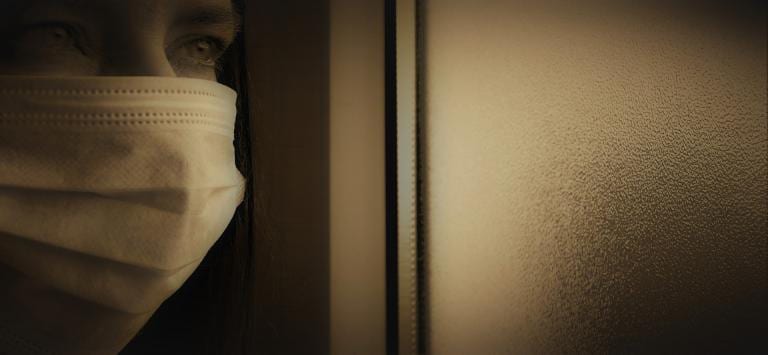
I’ve started a new exercise regimen, a high-intensity interval training thing which is supposed to be effective even with short sessions. Between working two jobs and homeschooling I don’t have time for lengthy workouts, especially if I’m going to get dinner ready on time and try to prep for this year’s gardens.
Maybe I need to come up with a better time management system. But something inside me resists making any more changes to my lifestyle, on top of all the other changes the past twelve months have brought. Looking back at this time a year ago, it seems a decade past. The pandemic had only just begun, and we weren’t yet sure what it would bring—though epidemiologists and public health experts were already warning us we’d be in for a long haul.
I expected that. I expected quarantine and lockdown periods to last much longer than the initial “stay inside and post fun selfies for three weeks.” I knew, with a corrupt and inept administration, not to expect much in the way of pandemic management from the White House, or from many state or local authorities.
I didn’t expect, however, that my own fellow citizens, member of my own community, especially my church community, would become the greatest obstacle to getting through the pandemic safely. The slew of conspiracy theories, the anti-maskers, the pandemic-deniers, the raging mobs protesting the lockdowns, the demands to open churches, and even the comparison of sensible mask mandates to the Holocaust—this all took me by surprise. I suppose I was more naïve than I realized.
When I entered the pandemic, I expected that it would change me. I had in mind the resilience of my grandmother who lived through World War I, the Great Depression, and World War II—who worked for a living long before this was routine for women, who planted her victory gardens and got involved in local politics. I wanted to become more resilient, as she was, and maybe I did, but I also became more cynical.
I’ve had ample opportunity to reflect on humanity’s weaker side, since the pandemic began, and what I see is a kind of terror in the face of any proposed change. I see people clinging to the familiar things, even the most basic and unimportant familiar things, because the prospect of alteration must seem, to them, like an impenetrable abyss. They can not imagine a world different from what they are accustomed to, even down to the logo on their maple syrup bottle and how a priest distributes ashes on their heads. In their fear of change they have become selfish, uprooted from reality, demanding that everything remain the same just to accommodate their feelings. It has not been an attractive vista.
Yet this is a condition of humanity in general, myself included. I don’t want to give up my beloved routines or coping mechanisms. It’s interesting that as much as Christianity stresses transformation, and conversion, most of us seem to imagine this happening in a very abstract manner. Or perhaps, ideally, to someone else.
My own recent conversions have consisted in turning away from ideologies I’d clung to for years, ideologies I now clearly understand to be harmful, even though I spent so long trying to reframe them for myself so that they looked benign. I say “conversions” because it’s not just one turning away. It’s a whole series. After a while it can almost make one dizzy.
How hard I worked to pretend that authoritarianism was freedom, that self-hating was morality, that discrimination was love. And ironically, at the same time, I resisted any idea that limiting certain of my own freedoms, for the sake of a common good, might be prudent and just. Instead of a theology of liberation, mine was a theology of privilege.
Plato talked about our resistance to change, when he depicted the denizens of the cave who refuse to be dragged away from the spectacle of shadows, refuse to be brought into reality. I see this characteristic especially in adherents to “traditionalist” religion, not just in Christianity, but in other religions as well. And this characteristic is deadly. A rigid refusal to meet the challenges of new discoveries, to be transformed by the truth and by the demands of justice, as the arc of history bends—this leads to inquisitions, jihads, and “holy wars.” When secular humanists decry religion, this is the kind of religion they are thinking of.
I think the pandemic ought to have changed us for the better, as a society, and certainly in many respects I’ve seen the best sides of humanity. I was touched by the kindness of my real and virtual communities when my father died, and their generosity when my son had to have emergency surgery. I’ve seen the tireless work of those helping the poor and immigrants during this time. And I’ve tried to do my part.
But I’ve also seen the foolish arrogance of those who have refused to change, and refused to be changed, when a dire situation demanded it of them. I don’t know that I can ever think well of them. At the same time, though, I see so many of my own past errors mirrored in their actions. I understand better, because of this, the harm I did in the past, and want to make amends, but how difficult it is to admit this.
I eagerly accept the proposition that my body needs to be changed—that’s why I’m working out. We have whole industries devoted to telling us to be more thin, more strong, more energetic, more positive, more successful, more youthful, better at sex, better at money-making, better at influencing people. Why are we so willing to accept that we need to change in these superficial ways? Is it because we are trying to flee from confronting those areas of our life where real change, change of heart and mind, is needed?
Unfortunately, I fear that as a collective society the pandemic has not sufficiently awakened us to how cruel and unsustainable our system is, even if it has shone a spotlight on how morally frail we are. I don’t know what it’s going to take to make us all pay attention, and I’m not sure I am ready to know.
Image credit: https://pixabay.com/photos/respiratory-protection-mask-5038663/
Previous Post

February 21, 2021
Rush Limbaugh Would Never Have Succeeded In an Ethical Society

Browse Our Archives
Select a Category abortion anti-semitism art Atwood Betrothed church clergy abuse coronavirus culture economics education environmentalism ethics faith family feminism gardening gun violence immigration Judaism literature MaddAddam New Pro Life Movement news pandemic personalism poem politics politics blue Pope Francis racism religion salvation sexuality social justice spirituality Station eleven Stephen King The Stand Trump Uncategorized war World Health Organization
Select a Month March 2021 February 2021 January 2021 December 2020 November 2020 October 2020 September 2020 August 2020 July 2020 June 2020 May 2020 April 2020 March 2020 February 2020 January 2020 December 2019 November 2019 October 2019 September 2019 August 2019 July 2019 June 2019 May 2019 April 2019 March 2019 February 2019 January 2019 December 2018 November 2018 October 2018 September 2018 August 2018 July 2018 June 2018 May 2018 April 2018 March 2018 February 2018 January 2018 December 2017 November 2017 October 2017 September 2017 August 2017 July 2017 June 2017 May 2017 April 2017 March 2017 February 2017 January 2017 December 2016 November 2016 October 2016 September 2016 August 2016 July 2016 June 2016 May 2016 April 2016 March 2016 February 2016
Follow Us!
TAKE THE
Religious Wisdom Quiz
Who interpreted the "writing on the wall" for King Belshazzar?
Select your answer to see how you score.
Jeremiah Isaiah Daniel Ezekiel
Support this
Column


Related posts from suspended in her jar

Immigrants: They Need Us, and We Need Them

Four Takeaways from Oprah’s Interview with the Duke...

Catholics Are De-Toxing From their Experiences With Traumatic...

Rush Limbaugh Would Never Have Succeeded In an...
TRENDING AT PATHEOS Catholic

Rejecting Doom: Christian Hope And Human Action
Christianity is a religion of hope. We are to have hope and...

It’s What Comes From Within Which Matters
One of the most difficult things for us to understand is why...

Why I Choose the Eucharist Over the Sermon
Choose the Eucharist, Not the Sermon What are we supposed to get...

5 Design Elements Found in Spiritually Rooted Homes
Putting Spirituality Into Home Decor Our homes are more than our living...

Credo: A Story of God Told with the...
About 10 years ago, I began to imagine a personal "Credo" that...

The Anatomy of Divine Revelation in Catholic Thought
The claim that God has made Himself known to human beings is...
view all Catholic blogs
Ad-Free & Subscriber Log-In Subscription Support
- About Us
- 2026 Calendar
- Videos
- Podcasts
- Library of World Religions
- Faith In Media Tracker
- Advertise With Us
- Write for Us
- Privacy Policy
- Terms of Service
- Do Not Sell My Data
- Contact Us
- Radiant Digital
- Manage Newsletter Subscriptions
- Unsubscribe From Notifications
- Sitemap
Copyright 2008-2026, Patheos. All rights reserved.
Subscription Support Ad-Free & Subscriber Log-In
Follow Patheos