
BuddhistCatholicContemplativeEvangelicalGeneral ChristianHinduJewishLatter-day SaintMuslimNew VisionsProgressive Christian
Beliefs
- Buddhist
- Catholic
- Contemplative
- Evangelical
- General Christian
- Hindu
- Jewish
- Latter-day Saint
- More Voices
- Muslim
- New Visions
- Pagan
- Progressive Christian
Topics
- Religion News
- Food and Religion
- Sports and Religion
- Religious Art
- Religious Music and Entertainment
- Religious Events
- History and Religion
- Style and Religion
- Politics and Religion
- Women in Religion
- Recreation Outdoors and Religion
- Business Finance and Religion
- Careers Workplace and Religion
- Education and Religion
- Family Parenting and Religion
- Health Fitness and Religion
- Home and Religion
- Relationships and Religion
- Technology and Religion
- Travel and Religion
Columnists
- Buddhist Columnists
- Business Finance and Religion Columnists
- Careers Workplace and Religion Columnists
- Catholic Columnists
- Contemplative Columnists
- Education and Religion Columnists
- Evangelists Columnists
- Family Parenting and Religion Columnists
- General Christian Columnists
- Health Fitness and Religion Columnists
- Hindu Columnists
- History and Religion Columnists
- Home and Religion Columnists
- Jewish Columnists
- More Voices Columnists
- Latter Day Columnists
- Muslim Columnists
- New Visions Columnists
- Nonreligious Columnists
- Pagan Columnists
- Politics and Religion Columnists
- Progressive Columnists
- Recreation Outdoors and Religion Columnists
- Relationships and Religion Columnists
- Religion News Columnists
- Religious Art Columnists
- Religious Events Columnists
- Religious Music and Entertainment Columnists
- Sports and Religion Columnists
- Style and Religion Columnists
- Technology and Religion Columnists
- Travel and Religion Columnists
- Women in Religion Columnists
Resource Library
- 2026 Calendar
- Library of World Religions
- The 100 Most Holy Places on Earth
- Patheos Answers
- Podcasts
- Videos
- Faith Leaders Database
- Anglican Episcopalian
- Bahai
- Baptist
- Buddhism
- Christianity
- Confucianism
- Eastern Orthodoxy
- Hinduism
- Holiness and Pentecostal
- ISKCON
- Islam
- Judaism
- Lutheran
- Methodist
- The Church of Jesus Christ of Latter-day Saints
- New Age
- Paganism
- Presbytarian and Reformed
- Protestantism
- Religion Behind the Scenes
- Roman Catholic
- Scientology
- Shia Islam
- Sikhism
- Sufism
- Sunni Islam
- Taoism
- Zen
- See all religions
Research Tools
 Ad-Free & Subscriber Log-In Subscription Support
Ad-Free & Subscriber Log-In Subscription Support
Follow Patheos 

- Trending:
- Forgiveness
- |
- Marriage
- |
- Consciousness
- |
- Death Penalty
- |
- Election
- |
- Halloween
 suspended in her jar
- Home
- Catholic
- Who Speaks for the Church? And Which Church?
Who Speaks for the Church? And Which Church?
Last updated on: January 31, 2021 at 9:35 pm by Rebecca Bratten Weiss
Who Speaks for the Church? And Which Church? 2021-01-31T21:35:42-04:00 Rebecca Bratten Weiss
Patheos Explore the world's faith through different perspectives on religion and spirituality! Patheos has the views of the prevalent religions and spiritualities of the world.
Staying in and speaking out
Over the weekend, an especially toxic social media conversation unfolded on the page of overt anti-Semite E. Michael Jones. Jones shared a link to my recent NCR piece on the Biden administration, with the bizarrely worded question, “why is this woman a spokesman for Catholics?” Leaving aside for the moment his bizarrely gendered language, and his history of anti-Jewish hate speech, the obvious answer is: I am not. I am not a spokesperson for the Catholic Church. No one has appointed me spokesperson. I have no special faculty granted by the Vatican.
Or…am I a spokesperson for the Catholic church? Is it possible to separate “being Catholic” or “the Catholic faith” from being inextricably connected with—and thus in a sense responsible for—the deeds of our authorities, and the structure of our institution?
This question came up in an online discussion among Catholics and former Catholics recovering from institutional abuse at far-right religious organizations. Can we separate the Catholic faith from the institutional church? As Catholics who practice the faith, keeping alive the traditions, moving through the liturgical year, abiding by the rituals that help us to find grace in the ordinary, how complicit are we in the deeds of the church authorities who have ruled with authoritarianism and fear, marginalized the vulnerable, backed colonialism, instituted oppression, and too often stayed silent in the face of horrific abuses?
As a Catholic of Jewish ethnicity, it is especially unsettling for me to understand what the Catholic Church meant to so many Jews throughout history: not a source of comfort or bastion of peace. Anything but. How can I remain in a faith tradition that, to my own people, represents oppression and bigotry?
In October 2018 I participated in an event in Rome, hosted by the international organization Catholic Women Speak. One of our themes, as we gathered in solidarity, shared our experiences, and protested the exclusion of women from voting in the Vatican synod, was “staying in and speaking out.”
That phrase has lingered with me ever since, as I have mulled over its significance. What does it mean to stay in the church? Does it mean complicity? It means engagement in an ongoing struggle, to be sure. There are many who would like us either to be silent or to leave. When we were protesting outside the CDC in Vatican City, someone called the Roman police on us. Several protesters were nearly arrested, and one was manhandled. We were told to be silent and leave. Afterwards several people remarked that the Vatican authorities called the cops on peaceful protesters but never on priests who raped children.
And what we mean when we speak of the Catholic Church at all?
Do we mean the institution itself? All who are baptized into it? The governing and teaching authorities of the church?
Self-appointed inquisitors like to say that people who fail to act Catholic in a certain way are not “real Catholics.” This is said repeatedly of any Catholic in public office who does not support extreme legislation as a method of preventing abortion. It’s been said about me, because of my feminism, and my fidelity to my Jewish heritage. What does this mean, “real Catholic”? If it means wielding fear to control others, fetishizing outmoded traditions that they scarcely understand, and co-opting the gospel to defend white nationalism—no, I suppose I am not a real Catholic. I don’t want to be on their team. I don’t want unity with them in any way.
Yet the actual magisterial teaching of the church is that we are Catholic by virtue of baptism—not through our opinions, our degrees of sinfulness, our sexual orientation, or how we vote. For a long time I have tried to hammer this point home, to remind people to drop the Grand Inquisitor cosplay. Today, however, I am feeling uneasy with this idea: that baptism into communion with the Church also means baptism into communion with those who would call a cop on a woman asking for equality, not for a child’s rapist; that I am in communion with those who think that “six million Jews were not enough.”
We can not speak truthfully about the church – because we are not allowed to.
To address these questions, I think we need to let our rhetoric approach the terrain of ugliness. We need to drop the emphasis on beauty that has dominated ecclesiological discourse for so long. I am sick of being told how beautiful it is, the church, in its brokenness. I am sick of being told to look for beauty in suffering. I want to be able to say, no this is not beautiful. This is a horror. We can not go coasting along through time refusing to fix this horror simply because we have been conditioned to call it beautiful.
Yet I write this as one who writes poetry and whose vocation it is to find beauty even in horror. I have written poems about decomposition, about the way flesh hangs in shreds when revenant skeletons teeter from the grave and embrace. So why am I so uneasy with talking about beauty in the church? I have spoken of the crucifixion as an aesthetic touchpoint for Christian artists. So why my discomfort with calling pain beautiful?
I think it’s because of our lack of truthfulness. We are still not willing to address with brutal honesty how gravely the church, our church, has erred. In each of the incidents that got me thinking about this, the theme of abuse was central–and the institutional church was the abuser. We are still not grappling sufficiently with the extent to which this has been the case throughout history.
So when we are instructed to see its beauty—or when it appropriates the beauty of its victims—this is too much like the abuser who whispers, “I hurt you because I love you.”
The body of Christ crucified, the beautiful horrifying broken body, is the body of the institution’s victims.
The institutional church demands complicity with its own misdeeds. It demands that we speak of the beauty of the church, and ignore its ugliness; failure to be complicit in this way means the church will not be a comfortable home for us. It will be made uncomfortable for us. Those who speak out are routinely oppressed. Many end up leaving the Church. Many leave the institutional church yet still consider themselves Catholic.
Those of us who stay may perhaps be spokespersons for a church in exile.
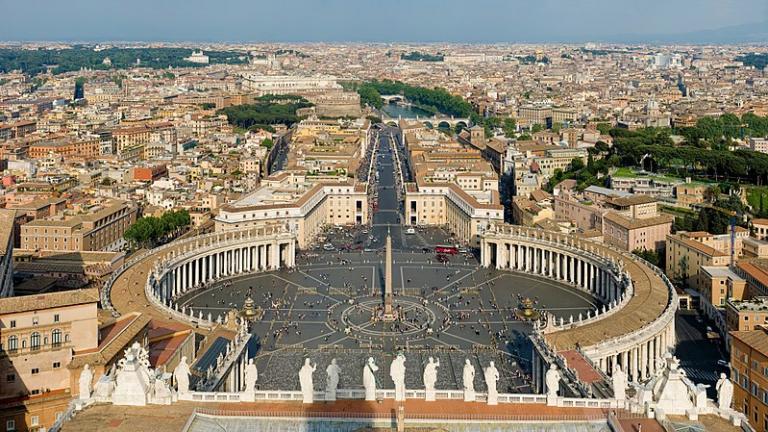
image credit: st-peters-square-wikipedia.jpg
Previous Post

January 19, 2021
Words for Those Feeling Disinherited
Next Post

February 10, 2021 We Need to Be Honest When We Talk about Abortion
Browse Our Archives
Select a Category abortion anti-semitism art Atwood Betrothed church clergy abuse coronavirus culture economics education environmentalism ethics faith family feminism gardening gun violence immigration Judaism literature MaddAddam New Pro Life Movement news pandemic personalism poem politics politics blue Pope Francis racism religion salvation sexuality social justice spirituality Station eleven Stephen King The Stand Trump Uncategorized war World Health Organization
Select a Month March 2021 February 2021 January 2021 December 2020 November 2020 October 2020 September 2020 August 2020 July 2020 June 2020 May 2020 April 2020 March 2020 February 2020 January 2020 December 2019 November 2019 October 2019 September 2019 August 2019 July 2019 June 2019 May 2019 April 2019 March 2019 February 2019 January 2019 December 2018 November 2018 October 2018 September 2018 August 2018 July 2018 June 2018 May 2018 April 2018 March 2018 February 2018 January 2018 December 2017 November 2017 October 2017 September 2017 August 2017 July 2017 June 2017 May 2017 April 2017 March 2017 February 2017 January 2017 December 2016 November 2016 October 2016 September 2016 August 2016 July 2016 June 2016 May 2016 April 2016 March 2016 February 2016
Follow Us!
TAKE THE
Religious Wisdom Quiz
Who was Abraham's firstborn son?
Select your answer to see how you score.
Esau Ishmael Isaac Jacob
Support this
Column


Related posts from suspended in her jar

Immigrants: They Need Us, and We Need Them

Four Takeaways from Oprah’s Interview with the Duke...

Catholics Are De-Toxing From their Experiences With Traumatic...

How Has the Pandemic Changed Us? Has It...
TRENDING AT PATHEOS Catholic

Rejecting Doom: Christian Hope And Human Action
Christianity is a religion of hope. We are to have hope and...

It’s What Comes From Within Which Matters
One of the most difficult things for us to understand is why...

Why I Choose the Eucharist Over the Sermon
Choose the Eucharist, Not the Sermon What are we supposed to get...

5 Design Elements Found in Spiritually Rooted Homes
Putting Spirituality Into Home Decor Our homes are more than our living...

Credo: A Story of God Told with the...
About 10 years ago, I began to imagine a personal "Credo" that...

The Anatomy of Divine Revelation in Catholic Thought
The claim that God has made Himself known to human beings is...
view all Catholic blogs
Ad-Free & Subscriber Log-In Subscription Support
- About Us
- 2026 Calendar
- Videos
- Podcasts
- Library of World Religions
- Faith In Media Tracker
- Advertise With Us
- Write for Us
- Privacy Policy
- Terms of Service
- Do Not Sell My Data
- Contact Us
- Radiant Digital
- Manage Newsletter Subscriptions
- Unsubscribe From Notifications
- Sitemap
Copyright 2008-2026, Patheos. All rights reserved.
Subscription Support Ad-Free & Subscriber Log-In
Follow Patheos