
BuddhistCatholicContemplativeEvangelicalGeneral ChristianHinduJewishLatter-day SaintMuslimNew VisionsProgressive Christian
Beliefs
- Buddhist
- Catholic
- Contemplative
- Evangelical
- General Christian
- Hindu
- Jewish
- Latter-day Saint
- More Voices
- Muslim
- New Visions
- Pagan
- Progressive Christian
Topics
- Religion News
- Food and Religion
- Sports and Religion
- Religious Art
- Religious Music and Entertainment
- Religious Events
- History and Religion
- Style and Religion
- Politics and Religion
- Women in Religion
- Recreation Outdoors and Religion
- Business Finance and Religion
- Careers Workplace and Religion
- Education and Religion
- Family Parenting and Religion
- Health Fitness and Religion
- Home and Religion
- Relationships and Religion
- Technology and Religion
- Travel and Religion
Columnists
- Buddhist Columnists
- Business Finance and Religion Columnists
- Careers Workplace and Religion Columnists
- Catholic Columnists
- Contemplative Columnists
- Education and Religion Columnists
- Evangelists Columnists
- Family Parenting and Religion Columnists
- General Christian Columnists
- Health Fitness and Religion Columnists
- Hindu Columnists
- History and Religion Columnists
- Home and Religion Columnists
- Jewish Columnists
- More Voices Columnists
- Latter Day Columnists
- Muslim Columnists
- New Visions Columnists
- Nonreligious Columnists
- Pagan Columnists
- Politics and Religion Columnists
- Progressive Columnists
- Recreation Outdoors and Religion Columnists
- Relationships and Religion Columnists
- Religion News Columnists
- Religious Art Columnists
- Religious Events Columnists
- Religious Music and Entertainment Columnists
- Sports and Religion Columnists
- Style and Religion Columnists
- Technology and Religion Columnists
- Travel and Religion Columnists
- Women in Religion Columnists
Resource Library
- 2026 Calendar
- Library of World Religions
- The 100 Most Holy Places on Earth
- Patheos Answers
- Podcasts
- Videos
- Faith Leaders Database
- Anglican Episcopalian
- Bahai
- Baptist
- Buddhism
- Christianity
- Confucianism
- Eastern Orthodoxy
- Hinduism
- Holiness and Pentecostal
- ISKCON
- Islam
- Judaism
- Lutheran
- Methodist
- The Church of Jesus Christ of Latter-day Saints
- New Age
- Paganism
- Presbytarian and Reformed
- Protestantism
- Religion Behind the Scenes
- Roman Catholic
- Scientology
- Shia Islam
- Sikhism
- Sufism
- Sunni Islam
- Taoism
- Zen
- See all religions
Research Tools
 Ad-Free & Subscriber Log-In Subscription Support
Ad-Free & Subscriber Log-In Subscription Support
Follow Patheos 

- Trending:
- Forgiveness
- |
- Marriage
- |
- Consciousness
- |
- Death Penalty
- |
- Election
- |
- Halloween
 suspended in her jar
- Home
- Catholic
- Should We Be Gatekeeping Feminism?
Should We Be Gatekeeping Feminism?
Last updated on: October 22, 2020 at 11:58 pm by Rebecca Bratten Weiss
Should We Be Gatekeeping Feminism? 2020-10-22T23:58:08-04:00 Rebecca Bratten Weiss
Patheos Explore the world's faith through different perspectives on religion and spirituality! Patheos has the views of the prevalent religions and spiritualities of the world.
Recently I wrote a piece for the National Catholic Reporter, arguing against the idea that Supreme Court nominee Amy Coney Barrett is any kind of feminist hero. Responses to this viewpoint were varied and, at times, vehement. While many readers, especially women readers, agreed strongly with my position that women are not automatically icons of equality simply by virtue of holding power, others accused me of gatekeeping feminism. “Who gets to decide who is and isn’t a feminist?” they asked.
The question posed this way functions as an enthymeme; the implication is that since there is no overarching authority we can’t really make this determination at all. And if we can’t decide who is or isn’t a feminist, anyone can be a feminist. Which means anyone can tack “this is feminist,” onto their argument – and argue that, in opposing them, we are de facto anti-feminist.
Of course this is illogical. And of course the whole thing is predicated on illogic, in an alternative world in which authority trumps reason, and might makes right. In the real world, we should not be worrying about which of us gets to decide. In one sense, all of us do. In another sense, none of us really can. The question should not be about “who gets to decide?” but rather “what principles should we use when we decide?”
When it comes to feminism, there are certain principles at play. And according to these principles, not every woman who assumes a position of influence is a feminist. Not every woman who calls herself a feminist is one, either.
Feminism has never been about women attaining power solely on the individual level. Even less collectivist forms of feminism, such as liberal feminism, strive for equality for women in general, even while emphasizing the importance of individual effort in achieving this goal. Liberal feminists may emphasize the potency of the individual to bring about change within a free and democratic society; this does not mean that liberal feminists point to isolated instances of women’s influence as proof of success.
Women who attain prestige within patriarchy while simultaneously propping up patriarchy are not feminists, for all their individual achievement. Many powerful women, such as Phyllis Schlafly for instance, have used their power to oppose women’s equality. No feminist, however liberal, would laud Schlafly as an icon of feminism.
It is widely recognized that there is no one feminism, but rather many feminisms. Feminists may have different ideas about how or why women are oppressed, and how best to achieve equality. They may have different ideas about what equality entails. But nonetheless there are set principles to which all feminists adhere.
Feminists recognize that oppression of women is a real factor in human history past and present. Feminists do not treat the concept of the patriarchy as a sham, nor minimize patriarchy’s harm, nor defend its structures, nor enable its agents. One can not truthfully claim to be a feminist while simultaneously making excuses for institutions that deny women full equality and representation.
Feminists recognize that the injustices wrought by patriarchal structures demand a response. Whether this response entails voting, marching, activism, protest, education, or personal influence may depend on the capacities and inclinations of the individual; only indifference and passivity in the face of patriarchal injustice are unacceptable. Feminism is as much an activism as it is a belief system. Any woman who claims to be a feminist should have a record to prove it. I discussed, in my NCR piece, Barrett’s failure in this regard, in her history of legal rulings. Not all of us have that kind of influence, of course, but every woman in any sector of society makes choices that have consequences for other women.
If any individual, regardless of gender, claims to be a feminist, consider their actions more closely than you consider their words. Have they advocated for victims? Have they stood up against injustice towards women less privileged than themselves? Have they voted for politicians with a record of supporting women’s equality? Or do they support policies that lead to fewer freedoms and opportunities for women?
Feminists may critique or even oppose certain trends within different feminist movements. Marxist feminists are likely to be at odds with liberal feminists. Black feminists rightly critique the shortcomings of white feminism. But feminists do not set themselves up against the whole collective of feminisms as such. Be wary of anyone, of any gender, who claims to be feminist while opposing every single movement for women’s equality that comes across their radar. Be especially wary when they claim to be the “real feminist” while throwing every other feminist activist under the bus.
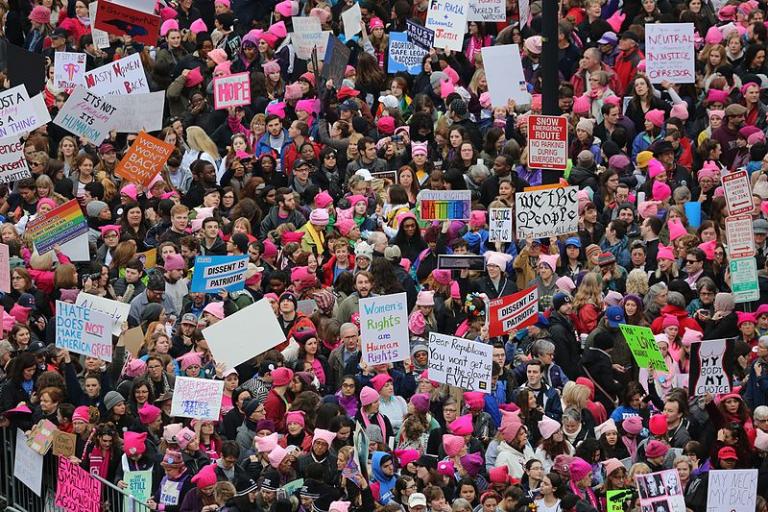
I saw this in real time with several self-styled “new feminists” who were loudly critical of the Women’s March. These were Catholic writers and activists who made a career out of posing as feminists, who took fees for speaking as feminists at women’s events, who posture as the true defenders of women’s dignity – but who couldn’t even mobilize with their sisters to protest the broad threat to women’s equality and safety, posed by the Trump regime.
At this point, I have no time for any woman who defends Trump and still claims to be a feminist. I don’t care how loudly anyone asserts their feminism; actions are what matter, and the act of supporting Trump is anti-feminist, anti-woman, sexist, and misogynistic. Trump’s personal acts are sexist and predatory. His public policies are sexist and anti-equality.
Of course, maybe you are white enough, privileged enough, rich enough, so that Trump’s policies don’t affect you directly? Very well. You still don’t get to call yourself a feminist while supporting an administration that has gravely harmed women less privileged than yourself. Women for Trump are not some new edgy kind of feminist. They are just the same old boring yet toxic props of a violent patriarchy.
I am not setting myself up as a gatekeeper of feminism. I am simply keeping fidelity to the fundamental principles on which feminists of all types, at all times, and in all cultures, have acted. It would be an act of stunning disrespect to appropriate the rhetoric of feminism in the service of misogyny, as well as a violation of my own integrity.
Is this gatekeeping? I really don’t care. The gatekeeping we should be worried about is the kind that bars people from equality, protection, and privilege – not the kind intended to keep people safe.
image credit: Womens_March_2017-01_04.jpg
Previous Post

October 15, 2020
Reality and Unreality: The Questioning of Amy Coney Barrett
Next Post

October 28, 2020 Does Voting "Pro-Life" Actually Save Lives?
Browse Our Archives
Select a Category abortion anti-semitism art Atwood Betrothed church clergy abuse coronavirus culture economics education environmentalism ethics faith family feminism gardening gun violence immigration Judaism literature MaddAddam New Pro Life Movement news pandemic personalism poem politics politics blue Pope Francis racism religion salvation sexuality social justice spirituality Station eleven Stephen King The Stand Trump Uncategorized war World Health Organization
Select a Month March 2021 February 2021 January 2021 December 2020 November 2020 October 2020 September 2020 August 2020 July 2020 June 2020 May 2020 April 2020 March 2020 February 2020 January 2020 December 2019 November 2019 October 2019 September 2019 August 2019 July 2019 June 2019 May 2019 April 2019 March 2019 February 2019 January 2019 December 2018 November 2018 October 2018 September 2018 August 2018 July 2018 June 2018 May 2018 April 2018 March 2018 February 2018 January 2018 December 2017 November 2017 October 2017 September 2017 August 2017 July 2017 June 2017 May 2017 April 2017 March 2017 February 2017 January 2017 December 2016 November 2016 October 2016 September 2016 August 2016 July 2016 June 2016 May 2016 April 2016 March 2016 February 2016
Follow Us!
TAKE THE
Religious Wisdom Quiz
"A cheerful heart is good medicine" is found in what book?
Select your answer to see how you score.
Psalms Matthew Genesis Proverbs
Support this
Column


Related posts from suspended in her jar

Immigrants: They Need Us, and We Need Them

Four Takeaways from Oprah’s Interview with the Duke...

How Has the Pandemic Changed Us? Has It...

Rush Limbaugh Would Never Have Succeeded In an...
TRENDING AT PATHEOS Catholic

Rejecting Doom: Christian Hope And Human Action
Christianity is a religion of hope. We are to have hope and...

It’s What Comes From Within Which Matters
One of the most difficult things for us to understand is why...

Why I Choose the Eucharist Over the Sermon
Choose the Eucharist, Not the Sermon What are we supposed to get...

5 Design Elements Found in Spiritually Rooted Homes
Putting Spirituality Into Home Decor Our homes are more than our living...

Credo: A Story of God Told with the...
About 10 years ago, I began to imagine a personal "Credo" that...

The Anatomy of Divine Revelation in Catholic Thought
The claim that God has made Himself known to human beings is...
view all Catholic blogs
Ad-Free & Subscriber Log-In Subscription Support
- About Us
- 2026 Calendar
- Videos
- Podcasts
- Library of World Religions
- Faith In Media Tracker
- Advertise With Us
- Write for Us
- Privacy Policy
- Terms of Service
- Do Not Sell My Data
- Contact Us
- Radiant Digital
- Manage Newsletter Subscriptions
- Unsubscribe From Notifications
- Sitemap
Copyright 2008-2026, Patheos. All rights reserved.
Subscription Support Ad-Free & Subscriber Log-In
Follow Patheos