
BuddhistCatholicContemplativeEvangelicalGeneral ChristianHinduJewishLatter-day SaintMuslimNew VisionsProgressive Christian
Beliefs
- Buddhist
- Catholic
- Contemplative
- Evangelical
- General Christian
- Hindu
- Jewish
- Latter-day Saint
- More Voices
- Muslim
- New Visions
- Pagan
- Progressive Christian
Topics
- Religion News
- Food and Religion
- Sports and Religion
- Religious Art
- Religious Music and Entertainment
- Religious Events
- History and Religion
- Style and Religion
- Politics and Religion
- Women in Religion
- Recreation Outdoors and Religion
- Business Finance and Religion
- Careers Workplace and Religion
- Education and Religion
- Family Parenting and Religion
- Health Fitness and Religion
- Home and Religion
- Relationships and Religion
- Technology and Religion
- Travel and Religion
Columnists
- Buddhist Columnists
- Business Finance and Religion Columnists
- Careers Workplace and Religion Columnists
- Catholic Columnists
- Contemplative Columnists
- Education and Religion Columnists
- Evangelists Columnists
- Family Parenting and Religion Columnists
- General Christian Columnists
- Health Fitness and Religion Columnists
- Hindu Columnists
- History and Religion Columnists
- Home and Religion Columnists
- Jewish Columnists
- More Voices Columnists
- Latter Day Columnists
- Muslim Columnists
- New Visions Columnists
- Nonreligious Columnists
- Pagan Columnists
- Politics and Religion Columnists
- Progressive Columnists
- Recreation Outdoors and Religion Columnists
- Relationships and Religion Columnists
- Religion News Columnists
- Religious Art Columnists
- Religious Events Columnists
- Religious Music and Entertainment Columnists
- Sports and Religion Columnists
- Style and Religion Columnists
- Technology and Religion Columnists
- Travel and Religion Columnists
- Women in Religion Columnists
Resource Library
- 2026 Calendar
- Library of World Religions
- The 100 Most Holy Places on Earth
- Patheos Answers
- Podcasts
- Videos
- Faith Leaders Database
- Anglican Episcopalian
- Bahai
- Baptist
- Buddhism
- Christianity
- Confucianism
- Eastern Orthodoxy
- Hinduism
- Holiness and Pentecostal
- ISKCON
- Islam
- Judaism
- Lutheran
- Methodist
- The Church of Jesus Christ of Latter-day Saints
- New Age
- Paganism
- Presbytarian and Reformed
- Protestantism
- Religion Behind the Scenes
- Roman Catholic
- Scientology
- Shia Islam
- Sikhism
- Sufism
- Sunni Islam
- Taoism
- Zen
- See all religions
Research Tools
 Ad-Free & Subscriber Log-In Subscription Support
Ad-Free & Subscriber Log-In Subscription Support
Follow Patheos 

- Trending:
- Forgiveness
- |
- Marriage
- |
- Consciousness
- |
- Death Penalty
- |
- Election
- |
- Halloween
 suspended in her jar
- Home
- Catholic
- White Privilege and Hypocrisy on Display in Catholic Opposition to Racial Justice Activists
White Privilege and Hypocrisy on Display in Catholic Opposition to Racial Justice Activists
Last updated on: September 26, 2020 at 12:14 am by Rebecca Bratten Weiss
White Privilege and Hypocrisy on Display in Catholic Opposition to Racial Justice Activists 2020-09-26T00:14:37-04:00 Rebecca Bratten Weiss
Patheos Explore the world's faith through different perspectives on religion and spirituality! Patheos has the views of the prevalent religions and spiritualities of the world.
San Francisco 49ers quarterback Colin Kaepernick’s silent protest against racial injustice began to gain national attention in late August of 2016. By early September of that year, other athletes were joining him in kneeling during the national anthem, sparking heated debate on social media. Many, while sympathetic to Kaepernick’s goals, express concern that his actions were disruptive. Others applauded as the protest gained momentum, hoping it would shine a necessary light on the problem of police brutality against Black persons in the United States.
But others had only contempt for the protesters, refusing to acknowledge any injustice. “If they don’t like the country, if they don’t like our flag, get the hell out,” said former Bears coach Mike Ditka. “I don’t see all the atrocities going on in this country that people say are going on.”
Within one month of the protest’s start, at least fifteen Black persons were killed by police in America. When Kaepernick received death threats on social media, police threatened not to protect him – thus proving his point.
Now, four years later, the police brutality to which Kaepernick quietly protested has escalated. Violence against non-white citizens by armed agents of the state can no longer be said to be “invisible”—if it ever could. Far-right organizations stand at the top of the list of perpetrators of acts of terrorism. And gestures of overt racism on the part of various white nationalist groups have become mainstream, enabled by the rhetoric of Donald Trump, who has solidified the identity of the Republican party as one of racism. If there was a mute button on far-right and racist movements in the United States, Trump has un-muted it.
No wonder, then, that the peaceful protests of four years ago have become increasingly more urgent. No wonder they have even occasionally generated violence. “Black Lives Matter” has become a national movement, as well as a hashtag and a rallying cry. And whenever critics of the Black Lives Matter protesters express their shock and disapproval at the methods of the protesters—whenever they say, “of course, it’s fine for them to protest, but not like that!”—we can point back to when Kaepernick knelt respectfully and, instead of respecting his right to protest or considering his reasons, they made the same noises of consternation they are making today.
Now that the police officers who brutally murdered Breonna Taylor in her own home have been acquitted—fifty-five years to the day since the murderers of Emmet Till were acquitted—it is evident to anyone who is looking that too little has changed in this nation that was founded on the backs and washed in the blood of the Black persons who were kidnapped and enslaved by White Christians. We are past the point at which conversations about condoning or not condoning the acts of protesters are appropriate. We need to look at the long, ugly history of our nation as a preface for what is happening now. And we need to stand in solidarity with Black Lives Matter.
How are Catholics doing, on racial issues?
In spite of our obligation to solidarity across national and racial boundaries, many Catholics are standing in active opposition to Black Lives Matter, spreading the same kind of racist propaganda about the group that was used to discredit Dr. King decades earlier. And, again, Catholic rejection of solidarity cannot be chalked up simply to uneasiness with the more aggressive forms of protest: four years ago, many Catholics regarded Kaepernick’s protest as unpatriotic and therefore unacceptable.
For instance, when “taking a knee” became a trend, the Diocese of Camden, NJ, threatened its players with suspension should any athletes under its jurisdiction join the coaches and players of local public schools in protesting. Diocesan superintendent Mary P. Boyle wrote:
“It is expected that our administration and coaches as well as our athletes will show respect during prayer, pledges and the playing or singing of the National Anthem. The best approach is helping our young people understand that blood was sacrificed so that we all can enjoy the gifts of our faith and our country…We are not public institutions and free speech in all of its demonstrations, including protests is not a guaranteed right.”
The cognitive dissonance in this situation was startling: public school students may use their right of free speech to protest, but Christian school students may not? Add to this dissonance: many of the Catholics who objected to these protests as anti-patriotic were quick to protest the Affordable Care Act, on the grounds of freedom of conscience.
Protest in America
Treating protest as un-patriotic is especially bizarre given that protest has a special role in American history. One could even say that the United States was founded on protest. Those who decry Black Lives Matter for unruliness would do well to recall the original American protest, when irate colonists senselessly destroyed forty-five tons of tea, legal property of the East India Company. Anyone who has a problem with racial justice protesters for damaging property should be just as appalled by this.
But apparently not all protests are seen as equal: the right to protest is a dimension of white privilege. The Boston Tea Party may be recast romantically, in popular history books, as a struggle against the oppressor by the oppressed, but really it was a struggle between two factions in a ruling class. Not every white settler in the Americas was enthusiastic about warring for independence from Britain; this was largely a rich man’s game. And of course neither the native peoples who were being colonized, nor the African slaves of the colonists, had a place in that struggle for dominance. Or, let me rephrase: they had a place as scapegoat. As every child’s picture book of American history details, the colonists disguised themselves as “Indians,” hoping to throw the blame on Native persons, the colonized.
It is significant that at the same time that Kaepernick’s protest was becoming national news, another protest was also going on, as members of the Standing Rock Sioux reservation came together to protect their land and water sources from the Dakota Access pipeline. The Native protesters were joined by many others, including members of Black Lives Matter. In retaliation, Homeland Security forcibly removed the protesters’ water tanks, and private security attacked protesters with dogs and pepper spray. Images of these attacks hauntingly reflect our long and shameful legacy of violence towards native peoples, and disregard for their sacred lands. And this kind of violence against protesters, on the part of police and government forces, has now become mainstream. Activists step out onto the streets knowing they need to prepare to defend themselves from violence. What is happening now is the kind of thing we always pointed to as a hallmark of authoritarianism in police states, while we congratulated ourselves on our freedom.
And what is happening now has happened before. It has happened here. But since it happened to people who were not white, were not citizens, the nation pretended it didn’t matter. The nation pretended that the atrocities of history were always happening somewhere else. The official line, here in the United States, is that we are so much better than those other countries. And it’s a line that is easily sold—to those of us who have enough white privilege to buy it.
Once upon a time, Catholics were viewed with suspicion in the United States because of the fear that we would owe our allegiance to the Vatican rather than to the Constitution. While there was always some validity to this concern, it ought at least to have highlighted this reality: that in Catholic morality, allegiance to one’s state can never be a priori. Nationalism should never be acceptable to a Catholic, yet in the previous century, as well as today, too often Catholics were willing to ally themselves with nationalists for the sake of power, in a stark rejection of the example and teachings of Jesus in the Gospels.
Right-wing Catholics in the United States who oppose protests on behalf of racial justice are being doubly hypocritical, rejecting both the social teachings of the church and the natural rights secured by the Constitution. The singular motivating factor behind this hypocrisy is obviously the sin of racism. Catholics are supposed to believe that sins should be confessed and that sinners should do penance, yet the sin of racism is, apparently, the one that one can never admit.
And as a final sad irony: the Catholics who are more offended by the burning of a flag than by the shooting of an unarmed Black woman in her own home dare to call themselves pro-life.
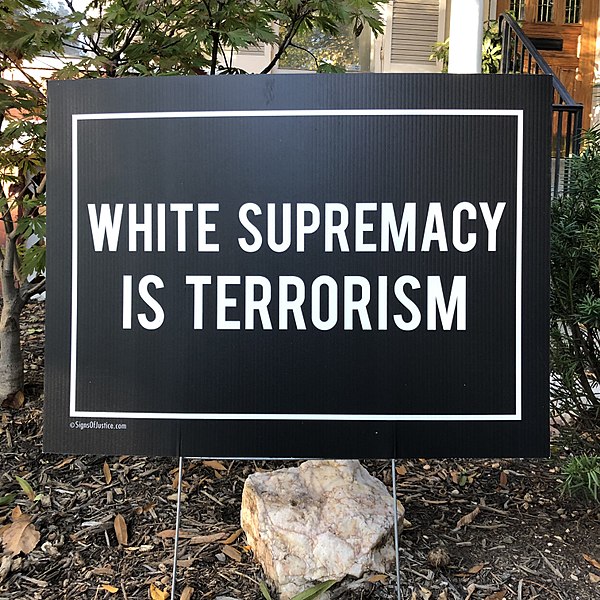
image credit: white-sup.jpg
Previous Post

September 21, 2020
We Shall Have Our Anger. We Shall Have Our Sorrow
Next Post

September 27, 2020 Theological Foundations, and the Importance of Tradition
Browse Our Archives
Select a Category abortion anti-semitism art Atwood Betrothed church clergy abuse coronavirus culture economics education environmentalism ethics faith family feminism gardening gun violence immigration Judaism literature MaddAddam New Pro Life Movement news pandemic personalism poem politics politics blue Pope Francis racism religion salvation sexuality social justice spirituality Station eleven Stephen King The Stand Trump Uncategorized war World Health Organization
Select a Month March 2021 February 2021 January 2021 December 2020 November 2020 October 2020 September 2020 August 2020 July 2020 June 2020 May 2020 April 2020 March 2020 February 2020 January 2020 December 2019 November 2019 October 2019 September 2019 August 2019 July 2019 June 2019 May 2019 April 2019 March 2019 February 2019 January 2019 December 2018 November 2018 October 2018 September 2018 August 2018 July 2018 June 2018 May 2018 April 2018 March 2018 February 2018 January 2018 December 2017 November 2017 October 2017 September 2017 August 2017 July 2017 June 2017 May 2017 April 2017 March 2017 February 2017 January 2017 December 2016 November 2016 October 2016 September 2016 August 2016 July 2016 June 2016 May 2016 April 2016 March 2016 February 2016
Follow Us!
TAKE THE
Religious Wisdom Quiz
My walls crumbled after seven days of marching, shouting, and trumpet blasts. What city am I?
Select your answer to see how you score.
Jericho Bethel Ai Jerusalem
Support this
Column


Related posts from suspended in her jar

Immigrants: They Need Us, and We Need Them

Four Takeaways from Oprah’s Interview with the Duke...

Catholics Are De-Toxing From their Experiences With Traumatic...

How Has the Pandemic Changed Us? Has It...
TRENDING AT PATHEOS Catholic

Rejecting Doom: Christian Hope And Human Action
Christianity is a religion of hope. We are to have hope and...

It’s What Comes From Within Which Matters
One of the most difficult things for us to understand is why...

Why I Choose the Eucharist Over the Sermon
Choose the Eucharist, Not the Sermon What are we supposed to get...

5 Design Elements Found in Spiritually Rooted Homes
Putting Spirituality Into Home Decor Our homes are more than our living...

Credo: A Story of God Told with the...
About 10 years ago, I began to imagine a personal "Credo" that...

The Anatomy of Divine Revelation in Catholic Thought
The claim that God has made Himself known to human beings is...
view all Catholic blogs
Ad-Free & Subscriber Log-In Subscription Support
- About Us
- 2026 Calendar
- Videos
- Podcasts
- Library of World Religions
- Faith In Media Tracker
- Advertise With Us
- Write for Us
- Privacy Policy
- Terms of Service
- Do Not Sell My Data
- Contact Us
- Radiant Digital
- Manage Newsletter Subscriptions
- Unsubscribe From Notifications
- Sitemap
Copyright 2008-2026, Patheos. All rights reserved.
Subscription Support Ad-Free & Subscriber Log-In
Follow Patheos