
BuddhistCatholicContemplativeEvangelicalGeneral ChristianHinduJewishLatter-day SaintMuslimNew VisionsProgressive Christian
Beliefs
- Buddhist
- Catholic
- Contemplative
- Evangelical
- General Christian
- Hindu
- Jewish
- Latter-day Saint
- More Voices
- Muslim
- New Visions
- Pagan
- Progressive Christian
Topics
- Religion News
- Food and Religion
- Sports and Religion
- Religious Art
- Religious Music and Entertainment
- Religious Events
- History and Religion
- Style and Religion
- Politics and Religion
- Women in Religion
- Recreation Outdoors and Religion
- Business Finance and Religion
- Careers Workplace and Religion
- Education and Religion
- Family Parenting and Religion
- Health Fitness and Religion
- Home and Religion
- Relationships and Religion
- Technology and Religion
- Travel and Religion
Columnists
- Buddhist Columnists
- Business Finance and Religion Columnists
- Careers Workplace and Religion Columnists
- Catholic Columnists
- Contemplative Columnists
- Education and Religion Columnists
- Evangelists Columnists
- Family Parenting and Religion Columnists
- General Christian Columnists
- Health Fitness and Religion Columnists
- Hindu Columnists
- History and Religion Columnists
- Home and Religion Columnists
- Jewish Columnists
- More Voices Columnists
- Latter Day Columnists
- Muslim Columnists
- New Visions Columnists
- Nonreligious Columnists
- Pagan Columnists
- Politics and Religion Columnists
- Progressive Columnists
- Recreation Outdoors and Religion Columnists
- Relationships and Religion Columnists
- Religion News Columnists
- Religious Art Columnists
- Religious Events Columnists
- Religious Music and Entertainment Columnists
- Sports and Religion Columnists
- Style and Religion Columnists
- Technology and Religion Columnists
- Travel and Religion Columnists
- Women in Religion Columnists
Resource Library
- 2026 Calendar
- Library of World Religions
- The 100 Most Holy Places on Earth
- Patheos Answers
- Podcasts
- Videos
- Faith Leaders Database
- Anglican Episcopalian
- Bahai
- Baptist
- Buddhism
- Christianity
- Confucianism
- Eastern Orthodoxy
- Hinduism
- Holiness and Pentecostal
- ISKCON
- Islam
- Judaism
- Lutheran
- Methodist
- The Church of Jesus Christ of Latter-day Saints
- New Age
- Paganism
- Presbytarian and Reformed
- Protestantism
- Religion Behind the Scenes
- Roman Catholic
- Scientology
- Shia Islam
- Sikhism
- Sufism
- Sunni Islam
- Taoism
- Zen
- See all religions
Research Tools
 Ad-Free & Subscriber Log-In Subscription Support
Ad-Free & Subscriber Log-In Subscription Support
Follow Patheos 

- Trending:
- Forgiveness
- |
- Marriage
- |
- Consciousness
- |
- Death Penalty
- |
- Election
- |
- Halloween
 suspended in her jar
- Home
- Catholic
- We Shall Have Our Anger. We Shall Have Our Sorrow
We Shall Have Our Anger. We Shall Have Our Sorrow
Last updated on: September 21, 2020 at 11:30 pm by Rebecca Bratten Weiss
We Shall Have Our Anger. We Shall Have Our Sorrow 2020-09-21T23:30:44-04:00 Rebecca Bratten Weiss
Patheos Explore the world's faith through different perspectives on religion and spirituality! Patheos has the views of the prevalent religions and spiritualities of the world.
A friend on social media posted today:
How are you?
Not a rhetorical question.
Be as honest as you feel comfortable.
I’m genuinely asking: how are you doing with everything?
It was a relief for me to see others answering “not so well.” It was a relief to have it acknowledged that not doing well is in fact a rational response to the current state of affairs.
The relentless pursuit of happiness was written into the founding of our nation’s culture. This is, from some angles, a good thing. It is good to pursue happiness when happiness, eudaimonia, has to do not only with a fleeting feeling but with the good life, the life of virtue and justice. Even the pursuit of good feeling, pure pleasure, is legitimate. I would rather live in a society that recognizes the validity of my desire to feel good than one that holds up suffering as a norm. And I have written before about the danger of fetishizing suffering, making it out to be a good when in fact it is evil.
Yet at the same time the drive to be happy, successful, upbeat is exhausting. The obsession with having an answer or solution means we churn out stupid answers and insufficient solutions, the kind of bland mantras that sell self-help books and inspirational manuals. Often the authors of these books and manuals end up coming to grief, mired in their own terrible advice. Or else they get lucky.
Our culture needs to give us space for saying that we do not know, that we haven’t found the solution yet, that we are working on it, that it is hard, that we may fail, that it is painful, and that this pain is not beautiful. We need to be given able to possess our grief.
Grief, I want to clarify, is distinct from suffering, especially the kind of suffering that is irrational, the suffering that we bear because something has been done to us. Grief, on the other hand, is an act. It is an act that is fundamental to life, precisely because suffering and death appear to be inextricably tangled with life. Failure to experience sorrow in the face of loss and privation is a failure of truth.
When one has experienced personal loss or pain, grief is necessary. To stave off the experience of sorrow is to cut off that aspect of one’s personality that was awakened to love and friendship. This is generally recognized. The value of collective mourning is recognized as well, when it comes to cataclysmic events to which we bear witness as a group. This is why we have set aside days appointed for the remembrance of certain great losses – such as loss of life in warfare.
Less generally recognized is the value of existential grief. This is not the same as personal grief, since it is not necessarily about a loss one has experienced directly. This year I mourned the death of my father. But I am also aware that two hundred thousand others died who should not have died, who could have, perhaps, been saved, had those in authority behaved responsibly. I mourn also for the refugee mothers separated from their children, their children incarcerated. I mourn for the families who have lost loved ones to state-sponsored violence. When I turn on the news I see homes battered by waves, in the Gulf, and homes devoured by fire on the west coast. And all of this unfolds before me with the garishness of an action movie, and we are expected simply to take it in, note it, carry on. There has been no national mourning for our dead. There is no collective ritual of sorrow for the loss of our eco-systems.
Our existential sorrow is compounded by the fact that so much loss goes unacknowledged. By the fact that we live in a political system calculated to make sure these losses go unacknowledged, for the sake of profit and power.
“It is what it is,” said Donald Trump, of the victims of the COVID-19 pandemic. This is our national shrug, the same shrug with which we routinely greet the news of yet another mass shooting, or the spectacle of homelessness. We have fumbled our way through this pandemic in search of the next distraction, washing our hands of responsibility.
That power in my soul that has rejoiced in times of triumph is the same that mourns in times of loss. I don’t believe that sorrowing is the only thing we can do, but it is a thing that we should do. We can only hope that this is not practice for a time when it is all we have left.
No man is an island, John Donne wrote. Ask not for whom the bell tolls. It tolls for you.
The loss of lives, destruction of communities, and desecration of eco-systems is our loss. All of ours. Even if some of us feel it less poignantly – or not at all. Some may even be complicit in it. But none of us are cut off from it.
Persons in vulnerable and oppressed communities often point out that, however “tired” the rest of us may be, of hearing about grim political realities, many of us can at least take a break from thinking about them. I can take a break from thinking about racial injustice or police brutality, when it starts making me angry to the point of exhaustion. Victims of these evils can not. Those who are directly affected by climate change can not opt out of worrying about it, as they flee fires or flooding.
Those of us who can still afford to opt out are fortunate. We may not be fortunate always. And no matter how hard we work to fight for racial justice, climate justice, economic justice – there is no guarantee that we will win. Hope, yes. Assurance, no.
The future is not necessarily bright. Things are not necessarily going to get better. Climate change, the disruptions of our eco-systems, and the normalization of extremist authoritarian regimes may truly be beyond our control. They may in fact be the common way of things, and what we think of as “normal” merely a blip of good luck we happened to have – for a time. If this is the case, the right response is not a shrug but a lament. We can not draw a line between the personal and the political, leaving the bad feelings over on the political arena, beyond, while keeping cheery and upbeat in some imaginary cordoned-off personal zone where none of that stuff really affects us. It is affecting hundreds of thousands now. And there is no rule that says it won’t affect me. There is no talisman for my singular protection.
I need to have my sorrow. I need to have my anger. People tell us that sorrow and anger are unproductive , and I don’t believe it. I think this is a lie that serves the narrative that no systemic change is needed, or that we should simply accept injustice. But supposing it is not a lie? Even if anger and sorrow produce nothing, accomplish nothing, they may still be necessary. They may be what keep us human.
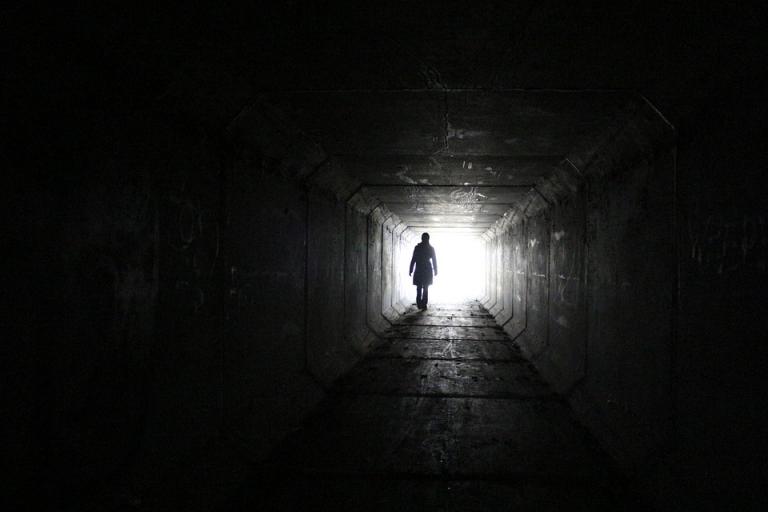
image credit: pixabay-photos-tunnel-silhouette-mysterious-899053.jpg
Previous Post

September 17, 2020
No, Flannery O'Connor Has Not Been Canceled

Browse Our Archives
Select a Category abortion anti-semitism art Atwood Betrothed church clergy abuse coronavirus culture economics education environmentalism ethics faith family feminism gardening gun violence immigration Judaism literature MaddAddam New Pro Life Movement news pandemic personalism poem politics politics blue Pope Francis racism religion salvation sexuality social justice spirituality Station eleven Stephen King The Stand Trump Uncategorized war World Health Organization
Select a Month March 2021 February 2021 January 2021 December 2020 November 2020 October 2020 September 2020 August 2020 July 2020 June 2020 May 2020 April 2020 March 2020 February 2020 January 2020 December 2019 November 2019 October 2019 September 2019 August 2019 July 2019 June 2019 May 2019 April 2019 March 2019 February 2019 January 2019 December 2018 November 2018 October 2018 September 2018 August 2018 July 2018 June 2018 May 2018 April 2018 March 2018 February 2018 January 2018 December 2017 November 2017 October 2017 September 2017 August 2017 July 2017 June 2017 May 2017 April 2017 March 2017 February 2017 January 2017 December 2016 November 2016 October 2016 September 2016 August 2016 July 2016 June 2016 May 2016 April 2016 March 2016 February 2016
Follow Us!
TAKE THE
Religious Wisdom Quiz
Who declared, "Choose for yourselves this day whom you will serve"?
Select your answer to see how you score.
Joshua Aaron Gideon Moses
Support this
Column


Related posts from suspended in her jar

Immigrants: They Need Us, and We Need Them

Four Takeaways from Oprah’s Interview with the Duke...

Catholics Are De-Toxing From their Experiences With Traumatic...

How Has the Pandemic Changed Us? Has It...
TRENDING AT PATHEOS Catholic

Rejecting Doom: Christian Hope And Human Action
Christianity is a religion of hope. We are to have hope and...

It’s What Comes From Within Which Matters
One of the most difficult things for us to understand is why...

Why I Choose the Eucharist Over the Sermon
Choose the Eucharist, Not the Sermon What are we supposed to get...

5 Design Elements Found in Spiritually Rooted Homes
Putting Spirituality Into Home Decor Our homes are more than our living...

Credo: A Story of God Told with the...
About 10 years ago, I began to imagine a personal "Credo" that...

The Anatomy of Divine Revelation in Catholic Thought
The claim that God has made Himself known to human beings is...
view all Catholic blogs
Ad-Free & Subscriber Log-In Subscription Support
- About Us
- 2026 Calendar
- Videos
- Podcasts
- Library of World Religions
- Faith In Media Tracker
- Advertise With Us
- Write for Us
- Privacy Policy
- Terms of Service
- Do Not Sell My Data
- Contact Us
- Radiant Digital
- Manage Newsletter Subscriptions
- Unsubscribe From Notifications
- Sitemap
Copyright 2008-2026, Patheos. All rights reserved.
Subscription Support Ad-Free & Subscriber Log-In
Follow Patheos