
BuddhistCatholicContemplativeEvangelicalGeneral ChristianHinduJewishLatter-day SaintMuslimNew VisionsProgressive Christian
Beliefs
- Buddhist
- Catholic
- Contemplative
- Evangelical
- General Christian
- Hindu
- Jewish
- Latter-day Saint
- More Voices
- Muslim
- New Visions
- Pagan
- Progressive Christian
Topics
- Religion News
- Food and Religion
- Sports and Religion
- Religious Art
- Religious Music and Entertainment
- Religious Events
- History and Religion
- Style and Religion
- Politics and Religion
- Women in Religion
- Recreation Outdoors and Religion
- Business Finance and Religion
- Careers Workplace and Religion
- Education and Religion
- Family Parenting and Religion
- Health Fitness and Religion
- Home and Religion
- Relationships and Religion
- Technology and Religion
- Travel and Religion
Columnists
- Buddhist Columnists
- Business Finance and Religion Columnists
- Careers Workplace and Religion Columnists
- Catholic Columnists
- Contemplative Columnists
- Education and Religion Columnists
- Evangelists Columnists
- Family Parenting and Religion Columnists
- General Christian Columnists
- Health Fitness and Religion Columnists
- Hindu Columnists
- History and Religion Columnists
- Home and Religion Columnists
- Jewish Columnists
- More Voices Columnists
- Latter Day Columnists
- Muslim Columnists
- New Visions Columnists
- Nonreligious Columnists
- Pagan Columnists
- Politics and Religion Columnists
- Progressive Columnists
- Recreation Outdoors and Religion Columnists
- Relationships and Religion Columnists
- Religion News Columnists
- Religious Art Columnists
- Religious Events Columnists
- Religious Music and Entertainment Columnists
- Sports and Religion Columnists
- Style and Religion Columnists
- Technology and Religion Columnists
- Travel and Religion Columnists
- Women in Religion Columnists
Resource Library
- 2026 Calendar
- Library of World Religions
- The 100 Most Holy Places on Earth
- Patheos Answers
- Podcasts
- Videos
- Faith Leaders Database
- Anglican Episcopalian
- Bahai
- Baptist
- Buddhism
- Christianity
- Confucianism
- Eastern Orthodoxy
- Hinduism
- Holiness and Pentecostal
- ISKCON
- Islam
- Judaism
- Lutheran
- Methodist
- The Church of Jesus Christ of Latter-day Saints
- New Age
- Paganism
- Presbytarian and Reformed
- Protestantism
- Religion Behind the Scenes
- Roman Catholic
- Scientology
- Shia Islam
- Sikhism
- Sufism
- Sunni Islam
- Taoism
- Zen
- See all religions
Research Tools
 Ad-Free & Subscriber Log-In Subscription Support
Ad-Free & Subscriber Log-In Subscription Support
Follow Patheos 

- Trending:
- Forgiveness
- |
- Marriage
- |
- Consciousness
- |
- Death Penalty
- |
- Election
- |
- Halloween
 suspended in her jar
- Home
- Catholic
- Why Are We Flying “Treason’s Flaunting Rag”? A Military Historian Considers
Why Are We Flying “Treason’s Flaunting Rag”? A Military Historian Considers
Last updated on: June 16, 2020 at 12:53 pm by Rebecca Bratten Weiss
Why Are We Flying “Treason’s Flaunting Rag”? A Military Historian Considers 2020-06-16T12:53:49-04:00 Rebecca Bratten Weiss
Patheos Explore the world's faith through different perspectives on religion and spirituality! Patheos has the views of the prevalent religions and spiritualities of the world.
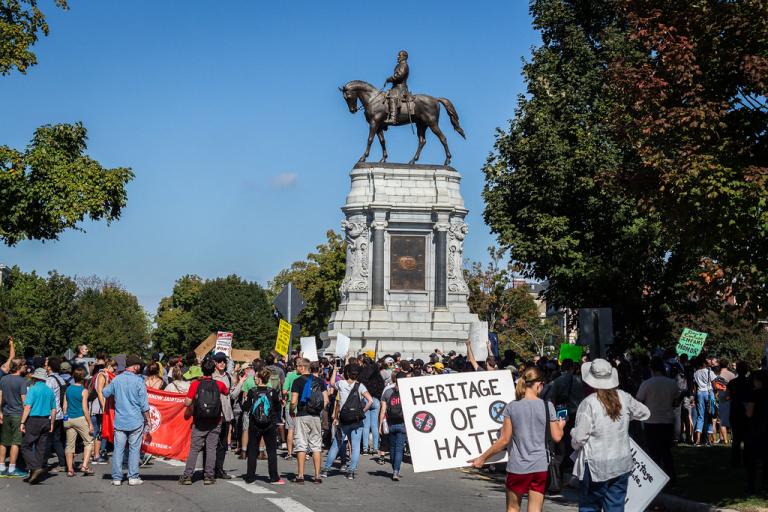
I am a Southerner by birth. When I was a child, my family moved north – to Ohio, to be precise, so not exactly Yankee country, but certainly a state that was instrumental in winning the war for the US against the slaver states. I can say “slaver states” now, but for many years I bought into the idea that the south’s cause was somehow legitimate, that it had really been only about state’s rights, and that slavery, a despicable practice, was just an unfortunate add-on, and would have ended anyway. I thought of myself as a proud southerner, transported to foreign ground.
(I should mention that this was not the way my family thought. I was just being pig-headed. And racist).
This notion that southern heritage equals confederate identity, and that confederate identity was not really about owning, torturing, and raping people, was unfortunately, coddled and fostered by my many years in higher education. I attended two different Catholic universities known for their “conservative values,” and at both some of my favorite professors were confederate sympathizers. For this reason, the deprogramming was long in coming. If I had gone to secular universities, or to any of the fine progressive Catholic universities in this nation, I would have gotten over my delusions far more rapidly. I am grateful that I can see clearly now, but also feel it my duty to do penance for advancing false and abusive narratives. It is my duty to speak up.
What changed my mind? Social media helped. I was able to hear Black voices speak out about what the confederate battle flag spells out for them. I realized that any good intentions I had in trying to pretend that confederate heritage isn’t exactly as evil as Nazi heritage – and as a Jewish woman, I have always been vehemently anti-Nazi – were eclipsed by reality. Facts, as they say, did not care about my feelings about the south.
Talking to other confederate sympathizers helped, too, in a negative way. I remember one conversation in which I was busily prettying-up the narrative and expounding on state’s rights, and then added something nice and mandatory about how awful slavery was. And the person I was talking to – educated at yet another Catholic college known for conservative values – disagreed. He didn’t think slavery was all that bad at all. I had a sudden moment of seeing my own face in a mirror, and not liking it. Was this who I wanted to be? Whom I wanted to align with?
Education helped. Once I was an educator myself I did not think that my obligation to keep learning was over. On the contrary, every semester I prepared for my courses by researching more, especially about the history of the texts I taught. My long journey from conservative to progressive certainly had its threshold on the classics, which tend to liberate one from narrow and prejudicial thinking, when read properly – but most of it was carried out while I was teaching at the self-same school where I had, years ago, had my white supremacist biases confirmed. I had to “unlearn what I had learned,” as Yoda might say, and learn anew how to think accurately about history, identity, sexuality, and race. This did not exactly endear me to the administration.
Sometimes I have to remind myself to be more gentle with others. I changed, they can too. So long as a person has a genuine interest in seeking the truth, conversion of heart is possible.
I have learned to think about southern heritage differently. What’s most glorious about southern heritage is Black southern culture – a rich diverse culture that endured even through generations of unspeakable oppression, and which produced heroes of justice and liberation. In this respect, as a white woman of southern heritage, I need to step back a pace or ten. But I can still appreciate southern food, southern music, fried green tomatoes and okra and Flannery O’Connor and James Baldwin and Dolly Parton and Charlie Pride (yes, we need to stop erasing Black artists and writers, stop acting like all Southern literature was written by white people).
And I realize now that the many times I advanced racist ideas and behaviors, and Black people didn’t call me out, it wasn’t because they were fine with what I said and did. It was because they were exhausted by dealing with our white nonsense. Because speaking out is often futile, and sometimes even dangerous. Knowing this, I feel all the more obligated to do penance by speaking out myself, when other white folks perpetuate the same lies I used to defend.
The fact that my brother is a military historian has been helpful. Mortifying though it is to say to a younger sibling “you were right,” I have to concede that my brother was right about the confederacy, and I was wrong, in our long-ago arguments. He, after all, has facts on his side. In an age of anti-expertise and anti-intellectualism, when any drunkard ranting in a bar considers his conspiracy theories on a par with the carefully elaborated theories of experts in a field, I wish to stress all the more the importance and value of learning from those who actually know what they are talking about.
With this in mind, I share here a long quotation from my brother, Jonathan Bratten, a professional historian and an officer in the Army National Guard:
A quote appropriate for both Flag Day and the Army birthday. From Lieut. Frank Haskell, July 3, 1863 – in the US lines at Gettysburg, on the preparations being made to receive the attack of the three rebel divisions against the US center.
“But along the lines in front the grand old ensign that first waved in battle at Saratoga in 1777, and which these people coming would rob of half its stars, stood up, and the west wind kissed it as the sergeants sloped its lance towards the enemy. I believe that not one above whom it then waved but blessed his God that he was loyal to it, and whose heart did not swell with pride towards it as the emblem of the Republic before that treason’s flaunting rag in front.”
I’ve not said anything for a long time, regarding the raging debate about Confederate flags, monuments, and names on US Army bases. But as a historian, I feel that I cannot stay silent any longer. I’d add that this is my personal opinion and not necessarily that of my employer.
It baffles me when I see “treason’s flaunting rag” anywhere in Maine; over 70,000 Mainers fought to suppress that flag and all the horrors of slave-empire that it stood for – with over 8,000 never returning to the Pine Tree State. As Ltc. Walter Stone Poor of Oxford County said in 1861, “War is bad, heaven knows, but slavery is far worse. If the doom of slavery is not sealed by the war, I shall curse the day I entered the Army, or lifted a finger in the preservation of the Union. Of the old Union we have had enough and more than enough.”
During the four years of the slaver’s rebellion, the country was divided by war. But it was not merely north versus south, as post-war ex-confederates sought to portray. It was, as William W Freehling points out, “The South Versus the South.” Every southern state sent regiments of volunteer troops into the US Army. Whole sections of the south refused to participate in the rebellion: western Virginia, the mountains of North Carolina, east Tennessee, and sections of Georgia. As an example, Ltc Walter Poor, mentioned above, fought with the 2nd North Carolina Volunteer Infantry – a US regiment. Not to mention that 3.5 million out of 8 million southerners adamantly opposed slavery, given that they were currently in it.
The damage done by the Lost Cause revisionism that was begun in the 1870s, burgeoned under so-called Reconciliation (there was no Reconciliation living under Jim Crow in the south – and zero between veterans as soon as the causes of the war came up, or the subject of Confederate monuments), and that continued with historians such as Shelby Foote in the 20th century is incalculable. It is as MG George H Thomas – a Virginian who remained loyal, just as thousands did – feared when he wrote to Grant in 1868:
“The greatest efforts made by the defeated insurgents since the close of the war have been to promulgate the idea that the cause of liberty, justice, humanity, equality, and all the calendar of the virtues of freedom, suffered violence and wrong when the effort for southern independence failed. This is, of course, intended as a species of political cant, whereby the crime of treason might be covered with a counterfeit varnish of patriotism, so that the precipitators of the rebellion might go down in history hand in hand with the defenders of the government, thus wiping out with their own hands their own stains; a species of self-forgiveness amazing in its effrontery, when it is considered that life and property—justly forfeited by the laws of the country, of war, and of nations, through the magnanimity of the government and people—was not exacted from them.”
The legacy of the slaver’s rebellion is one that haunts our nation to this day. The false narrative of southern hegemony has turned it into a regional divide that overlooks the truth of the matter – that 25% of the US military 1861-1865 was made up of southerners. That southern officers remained loyal in large numbers, including many members of Robert E Lee’s family. It has created a false “heritage” for southerners, which in turn created continued divisiveness and perpetuated the racism that is at the roots of the slaver’s rebellion: “What was the reason that induced Georgia to take the step of secession? This reason may be summed up in one single proposition. It was a conviction, a deep conviction on the part of Georgia, that a separation from the North-was the only thing that could prevent the abolition of her slavery.” (Henry L Benning, 1861, for whom Fort Benning, GA is named)
Monuments to this crime merely perpetuate the shame of it; they memorialize it. We can remember a great tragedy without glorifying it. We do not need their names on our bases – a legacy of the failed Reconciliation period. And their flag stands only for the legacy of “how you tried to pull down the old flag and how you failed.” (Elisha Hunt Rhodes, 1910)
Here’s to 245 years of the US Army – and to the “grand old ensign.” May we remain true to the values of loyalty, duty, honor, and respect, and never stop striving to make our nation’s birthright available to all. The American Revolution continues every day as we struggle to ensure that the words of the Declaration do not go stale: “We hold these truths to be self-evident, that all men are created equal, that they are endowed by their Creator with certain unalienable Rights, that among these are Life, Liberty and the pursuit of Happiness.”
image credit: https://www.flickr.com/photos/mobili/37109128732
Previous Post

June 8, 2020
On Retiring Happy and Still Perplexed
Next Post

June 18, 2020 History May Not Repeat, But It Rhymes: Trump's Tulsa Rally
Browse Our Archives
Select a Category abortion anti-semitism art Atwood Betrothed church clergy abuse coronavirus culture economics education environmentalism ethics faith family feminism gardening gun violence immigration Judaism literature MaddAddam New Pro Life Movement news pandemic personalism poem politics politics blue Pope Francis racism religion salvation sexuality social justice spirituality Station eleven Stephen King The Stand Trump Uncategorized war World Health Organization
Select a Month March 2021 February 2021 January 2021 December 2020 November 2020 October 2020 September 2020 August 2020 July 2020 June 2020 May 2020 April 2020 March 2020 February 2020 January 2020 December 2019 November 2019 October 2019 September 2019 August 2019 July 2019 June 2019 May 2019 April 2019 March 2019 February 2019 January 2019 December 2018 November 2018 October 2018 September 2018 August 2018 July 2018 June 2018 May 2018 April 2018 March 2018 February 2018 January 2018 December 2017 November 2017 October 2017 September 2017 August 2017 July 2017 June 2017 May 2017 April 2017 March 2017 February 2017 January 2017 December 2016 November 2016 October 2016 September 2016 August 2016 July 2016 June 2016 May 2016 April 2016 March 2016 February 2016
Follow Us!
TAKE THE
Religious Wisdom Quiz
What sign does Paul give in 2 Thessalonians as his authentic mark in every letter?
Select your answer to see how you score.
A special blessing His signature His seal His greeting in his own handwriting
Support this
Column


Related posts from suspended in her jar

Immigrants: They Need Us, and We Need Them

Four Takeaways from Oprah’s Interview with the Duke...

Catholics Are De-Toxing From their Experiences With Traumatic...

How Has the Pandemic Changed Us? Has It...
TRENDING AT PATHEOS Catholic

Rejecting Doom: Christian Hope And Human Action
Christianity is a religion of hope. We are to have hope and...

It’s What Comes From Within Which Matters
One of the most difficult things for us to understand is why...

Why I Choose the Eucharist Over the Sermon
Choose the Eucharist, Not the Sermon What are we supposed to get...

5 Design Elements Found in Spiritually Rooted Homes
Putting Spirituality Into Home Decor Our homes are more than our living...

Credo: A Story of God Told with the...
About 10 years ago, I began to imagine a personal "Credo" that...

The Anatomy of Divine Revelation in Catholic Thought
The claim that God has made Himself known to human beings is...
view all Catholic blogs
Ad-Free & Subscriber Log-In Subscription Support
- About Us
- 2026 Calendar
- Videos
- Podcasts
- Library of World Religions
- Faith In Media Tracker
- Advertise With Us
- Write for Us
- Privacy Policy
- Terms of Service
- Do Not Sell My Data
- Contact Us
- Radiant Digital
- Manage Newsletter Subscriptions
- Unsubscribe From Notifications
- Sitemap
Copyright 2008-2026, Patheos. All rights reserved.
Subscription Support Ad-Free & Subscriber Log-In
Follow Patheos