
BuddhistCatholicContemplativeEvangelicalGeneral ChristianHinduJewishLatter-day SaintMuslimNew VisionsProgressive Christian
Beliefs
- Buddhist
- Catholic
- Contemplative
- Evangelical
- General Christian
- Hindu
- Jewish
- Latter-day Saint
- More Voices
- Muslim
- New Visions
- Pagan
- Progressive Christian
Topics
- Religion News
- Food and Religion
- Sports and Religion
- Religious Art
- Religious Music and Entertainment
- Religious Events
- History and Religion
- Style and Religion
- Politics and Religion
- Women in Religion
- Recreation Outdoors and Religion
- Business Finance and Religion
- Careers Workplace and Religion
- Education and Religion
- Family Parenting and Religion
- Health Fitness and Religion
- Home and Religion
- Relationships and Religion
- Technology and Religion
- Travel and Religion
Columnists
- Buddhist Columnists
- Business Finance and Religion Columnists
- Careers Workplace and Religion Columnists
- Catholic Columnists
- Contemplative Columnists
- Education and Religion Columnists
- Evangelists Columnists
- Family Parenting and Religion Columnists
- General Christian Columnists
- Health Fitness and Religion Columnists
- Hindu Columnists
- History and Religion Columnists
- Home and Religion Columnists
- Jewish Columnists
- More Voices Columnists
- Latter Day Columnists
- Muslim Columnists
- New Visions Columnists
- Nonreligious Columnists
- Pagan Columnists
- Politics and Religion Columnists
- Progressive Columnists
- Recreation Outdoors and Religion Columnists
- Relationships and Religion Columnists
- Religion News Columnists
- Religious Art Columnists
- Religious Events Columnists
- Religious Music and Entertainment Columnists
- Sports and Religion Columnists
- Style and Religion Columnists
- Technology and Religion Columnists
- Travel and Religion Columnists
- Women in Religion Columnists
Resource Library
- 2026 Calendar
- Library of World Religions
- The 100 Most Holy Places on Earth
- Patheos Answers
- Podcasts
- Videos
- Faith Leaders Database
- Anglican Episcopalian
- Bahai
- Baptist
- Buddhism
- Christianity
- Confucianism
- Eastern Orthodoxy
- Hinduism
- Holiness and Pentecostal
- ISKCON
- Islam
- Judaism
- Lutheran
- Methodist
- The Church of Jesus Christ of Latter-day Saints
- New Age
- Paganism
- Presbytarian and Reformed
- Protestantism
- Religion Behind the Scenes
- Roman Catholic
- Scientology
- Shia Islam
- Sikhism
- Sufism
- Sunni Islam
- Taoism
- Zen
- See all religions
Research Tools
 Ad-Free & Subscriber Log-In Subscription Support
Ad-Free & Subscriber Log-In Subscription Support
Follow Patheos 

- Trending:
- Forgiveness
- |
- Marriage
- |
- Consciousness
- |
- Death Penalty
- |
- Election
- |
- Halloween
 suspended in her jar
- Home
- Catholic
- How to Stop Talking Nonsense: The Myth of Redemptive Suffering
How to Stop Talking Nonsense: The Myth of Redemptive Suffering
Last updated on: May 3, 2020 at 9:45 pm by Guest Contributor
How to Stop Talking Nonsense: The Myth of Redemptive Suffering 2020-05-03T21:45:29-04:00 Guest Contributor
Patheos Explore the world's faith through different perspectives on religion and spirituality! Patheos has the views of the prevalent religions and spiritualities of the world.
by guest writer Matthew G. Aragones
As part of our distance learning, I recently assigned a preaching project for my students where they would use the exegetical skills they learned in class to preach on a particular passage from Scripture. I’ve been really impressed with most of their work; it’s amazing what our students can produce when given ample time (a novel idea, but that’s by the by). Most of them applied their passages to our present circumstances, and I was struck by one theme that ran almost unanimously throughout each of my students’ thought. Each of them was confident in the belief that there was a reason for COVID-19. Each insisted there was a purpose in our present suffering.
Where on earth did we get the idea that suffering must always be redemptive? Why have we insisted that there is something epistemic and revelatory about the nature of suffering? More importantly, why do we believe that it is God who has a hand in our suffering, that the reason and purpose of sickness, crisis, and violence is because God has willed it?
Like most Catholics, I was born and bred on the exultation of suffering. I was steeped in the conviction that through suffering, humanity is able to obtain a kind of knowledge not possible without such painful experience. I have overheard and even been personally “comforted” by well-meaning people claiming that the struggle I was enduring was simply a test, certain that, in this suffering, God had a plan. The way we participate in this “redemptive” plan is told in the old Catholic adage: “offer it up.”
There are many reasons for why we are so inclined to make sense of suffering by giving it a divine purpose. How would we cope if our suffering were not God’s will? If in the end, the reality of pain was simply meaningless. Our need for explanation, even if it’s a cruel one, is somehow a greater comfort than no explanation at all. Or if you’re like me, this response to suffering is so seductive because it offers a means of reasserting control. If God can bring good from evil by requiring my suffering, then perhaps I might catch a glimpse or even participate in God’s glory. If there is purpose in human misery, then my pain is not in vain, but simply a moment in the grand scheme of God’s plan that ultimately will be justified.
St. Paul, Flannery O’Connor, Martin Luther King Jr., Pope John Paul II, and countless others have all attested to this seemingly understood truth. But what if we cannot look for the ground of suffering in God? What if, despite our efforts, we never know enough to say that our experience of suffering is God’s will? What if we in religious education do the actual work of theology, which Hebert McCabe described as a discipline “which stops us from talking nonsense.” In other words, what if we put aside our need for certainty and allowed ourselves to be overtaken by the unfathomable mystery of things?
Is suffering a part of God’s mysterious plan? I suppose it depends on what story we stake our lives on. For those who bear the name Christian, we are called to stake our lives on the story of Jesus. The challenge of the Jesus-story is not to permit the death of Jesus to obscure his life, and ministry. Too often we privilege Jesus’ suffering and crucifixion as God’s sole salvific work rather than understanding salvation within narrative of Jesus’ life, death, and resurrection. Jesus’ life and ministry reveal humanity fully alive, his death was the inevitability of such a life in a world of violence and suffering, and his resurrection is the embodied hope that “God’s cause is the human cause,” so a divine resistance to these powers of death and the final word, that God is about the business of Jesus’ life (and in turn our life) in abundance.
We learn to resist suffering, not because through suffering we have learned something, but because we know the whole of Jesus’ story. To say we can learn something from suffering is to give suffering too much value and meaning. Suffering does not transform. Suffering dehumanizes. Suffering is evil. Augustine and Aquinas both affirmed that suffering and evil have no meaning; they do not exist except in terms of the violence they do to what is created, that is, what is good. This is all to say that God has no part in suffering, nor any responsibility for evil. If God has had a hand in suffering it was a hand nailed to a tree. In this, God does not give us an intellectual response to evil. God give us a human response.
Was the death of Jesus God’s will? If we affirm this belief, we risk entering into dangerous theological territory that can reinforce a picture of God whose anger is punishment out of love, or at least a God who finds value in human pain. When William Sloane Coffin Jr. offered a sermon following the tragic death of his son, Alex, he preached this truth: “The one thing that should never be said when someone dies is, ‘It is the will of God.’ Never do we know enough to say that.” Never do we know enough to say that Jesus’ suffering or any person’s suffering for that matter, is God’s will. We are not in control. Suffering is a harsh and unwanted reality. Try as we might to give meaning to our pain, no amount of proof-texting can save us from the chaos and disorder that evil brings. This is because suffering and sin do not teach us about God. Rather, they blind us to Him.
Nevertheless, in the midst of our suffering we catch glimpses of humanity fully alive. Not because God has redeemed suffering, but because God has redeemed us. The cross is not redemptive in and of itself. Rather, it is a part of Jesus’ story of incarnational solidarity. We see this kind of solidarity practiced among human beings in times of crisis. But solidarity is not about giving meaning to suffering by giving it a purpose, as if to further hammer the nail into the cross. Solidarity is, to use Jon Sobrino’s phrase, about taking people down from their crosses.
We do this by resisting any attempt to provide answers, to secure order, or imbue purpose into the experiences of the crucified. During the civil war in El Salvador, four women were killed while performing their pastoral work of accompaniment with the Salvadoran people. One of them, Sister Ita Ford, wrote, “Can I say to my neighbors, I have no solutions to this situation; I don’t know the answers, but I will walk with you, search with you, be with you?” This is the kind of solidarity needed in times of profound suffering.
Over the past Christmas holiday, a student reached out to me about some of the struggles he had been enduring. In particular, was a friend of his who had been shot and killed. The student asked me, “Do people really suffer because someone else just chooses to or is it actually part of ‘God’s plan?’” He titled his email, “a question of life.” Far from being abstract or intellectual, this is a question that matters with great intensity and urgency. Especially when such suffering leads young people like my student to ask, “Does life really have anything else to offer besides this?”
Every educator at one time or another has had a student share their struggles and ask these kinds of questions. We must learn to speak words of peace that are not nonsense; words that are not a stumbling block to the little ones who believe. This means that we can no longer continue to assure our students (and ourselves) that some divine meaning drives our despair. Rather than soppy sentiments and pietistic platitudes, we might offer our students some faithful wisdom.
In Dostoevsky’s novel, Brothers Karamazov, Ivan describes to his brother Alyosha several heinous accounts of innocent children being tortured and killed. Particularly disturbing is the description of a young girl tortured by her parents. They beat her, lock her up in an outhouse in the freezing cold, and even force her to eat her own excrement because she would not ask to get up and go in the middle of the night. In the dark and cold, the little girl cries out in anguish to “dear God” to relieve her suffering. Ivan argues that if the peace of salvation is made possible through the suffering of children; if it is through suffering that mothers learn to forgive those who murdered their children, and thus glory in the justice of God, then Ivan declares, “for the love of humankind I don’t want it.” Neither harmony nor forgiveness, human happiness or even entrance to the Kingdom, none of it is worth the tears and pain of one small child. What Dostoevsky right teaches us is that we should not be frightened by the lack of intelligible or moral explanations for suffering. Rather, we should be disturbed by them.
It is the task of resurrected people during this present time of pandemic and at all times of violence and suffering to refrain from saying that these things happen for a reason. Instead, we must attempt to be mystery enfleshed, which is about telling the whole story of Jesus with our lives. Because the whole of Jesus’ story tells us that we are no longer threatened with death. Rather we are, as Julia Esquivel writes, “threatened with resurrection.” This is the reality of those who claim Jesus as Lord. This is the concreteness of the gospel in our times, namely that salvation can be articulated in counterpoint to the reality of suffering. For while our God endured suffering it was not because God had need of it, but because in the mystery of love, God will not forsake us.
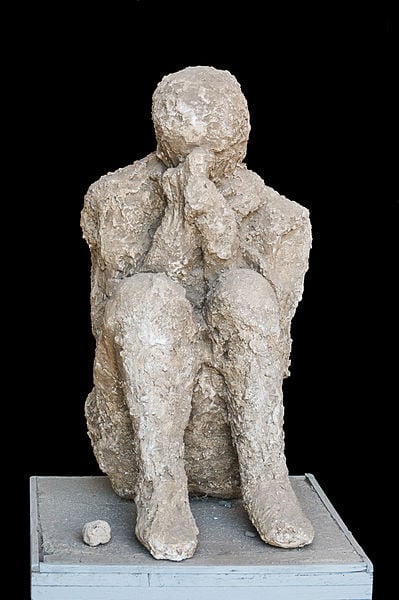
image credit: Cast_sitting_victim_Pompeii.jpg
Previous Post

April 27, 2020
What Unites Us? How Christians Can Learn From Jews
Next Post

May 11, 2020 How We Speak About Death
Browse Our Archives
Select a Category abortion anti-semitism art Atwood Betrothed church clergy abuse coronavirus culture economics education environmentalism ethics faith family feminism gardening gun violence immigration Judaism literature MaddAddam New Pro Life Movement news pandemic personalism poem politics politics blue Pope Francis racism religion salvation sexuality social justice spirituality Station eleven Stephen King The Stand Trump Uncategorized war World Health Organization
Select a Month March 2021 February 2021 January 2021 December 2020 November 2020 October 2020 September 2020 August 2020 July 2020 June 2020 May 2020 April 2020 March 2020 February 2020 January 2020 December 2019 November 2019 October 2019 September 2019 August 2019 July 2019 June 2019 May 2019 April 2019 March 2019 February 2019 January 2019 December 2018 November 2018 October 2018 September 2018 August 2018 July 2018 June 2018 May 2018 April 2018 March 2018 February 2018 January 2018 December 2017 November 2017 October 2017 September 2017 August 2017 July 2017 June 2017 May 2017 April 2017 March 2017 February 2017 January 2017 December 2016 November 2016 October 2016 September 2016 August 2016 July 2016 June 2016 May 2016 April 2016 March 2016 February 2016
Follow Us!
TAKE THE
Religious Wisdom Quiz
What separated the Holy Place from the Most Holy Place in the Tabernacle?
Select your answer to see how you score.
A curtain (veil) A stone wall A bronze door An incense altar
Support this
Column


Related posts from suspended in her jar

Immigrants: They Need Us, and We Need Them

Catholics Are De-Toxing From their Experiences With Traumatic...

How Has the Pandemic Changed Us? Has It...

Rush Limbaugh Would Never Have Succeeded In an...
TRENDING AT PATHEOS Catholic

The Parable Of The Sower And The Word...
One of Christ’s most famous parables is that of the sower who...

Rejecting Doom: Christian Hope And Human Action
Christianity is a religion of hope. We are to have hope and...

Why I Choose the Eucharist Over the Sermon
Choose the Eucharist, Not the Sermon What are we supposed to get...

5 Design Elements Found in Spiritually Rooted Homes
Putting Spirituality Into Home Decor Our homes are more than our living...

Credo: A Story of God Told with the...
About 10 years ago, I began to imagine a personal "Credo" that...

The Anatomy of Divine Revelation in Catholic Thought
The claim that God has made Himself known to human beings is...
view all Catholic blogs
Ad-Free & Subscriber Log-In Subscription Support
- About Us
- 2026 Calendar
- Videos
- Podcasts
- Library of World Religions
- Faith In Media Tracker
- Advertise With Us
- Write for Us
- Privacy Policy
- Terms of Service
- Do Not Sell My Data
- Contact Us
- Radiant Digital
- Manage Newsletter Subscriptions
- Unsubscribe From Notifications
- Sitemap
Copyright 2008-2026, Patheos. All rights reserved.
Subscription Support Ad-Free & Subscriber Log-In
Follow Patheos