
BuddhistCatholicContemplativeEvangelicalGeneral ChristianHinduJewishLatter-day SaintMuslimNew VisionsProgressive Christian
Beliefs
- Buddhist
- Catholic
- Contemplative
- Evangelical
- General Christian
- Hindu
- Jewish
- Latter-day Saint
- More Voices
- Muslim
- New Visions
- Pagan
- Progressive Christian
Topics
- Religion News
- Food and Religion
- Sports and Religion
- Religious Art
- Religious Music and Entertainment
- Religious Events
- History and Religion
- Style and Religion
- Politics and Religion
- Women in Religion
- Recreation Outdoors and Religion
- Business Finance and Religion
- Careers Workplace and Religion
- Education and Religion
- Family Parenting and Religion
- Health Fitness and Religion
- Home and Religion
- Relationships and Religion
- Technology and Religion
- Travel and Religion
Columnists
- Buddhist Columnists
- Business Finance and Religion Columnists
- Careers Workplace and Religion Columnists
- Catholic Columnists
- Contemplative Columnists
- Education and Religion Columnists
- Evangelists Columnists
- Family Parenting and Religion Columnists
- General Christian Columnists
- Health Fitness and Religion Columnists
- Hindu Columnists
- History and Religion Columnists
- Home and Religion Columnists
- Jewish Columnists
- More Voices Columnists
- Latter Day Columnists
- Muslim Columnists
- New Visions Columnists
- Nonreligious Columnists
- Pagan Columnists
- Politics and Religion Columnists
- Progressive Columnists
- Recreation Outdoors and Religion Columnists
- Relationships and Religion Columnists
- Religion News Columnists
- Religious Art Columnists
- Religious Events Columnists
- Religious Music and Entertainment Columnists
- Sports and Religion Columnists
- Style and Religion Columnists
- Technology and Religion Columnists
- Travel and Religion Columnists
- Women in Religion Columnists
Resource Library
- 2026 Calendar
- Library of World Religions
- The 100 Most Holy Places on Earth
- Patheos Answers
- Podcasts
- Videos
- Faith Leaders Database
- Anglican Episcopalian
- Bahai
- Baptist
- Buddhism
- Christianity
- Confucianism
- Eastern Orthodoxy
- Hinduism
- Holiness and Pentecostal
- ISKCON
- Islam
- Judaism
- Lutheran
- Methodist
- The Church of Jesus Christ of Latter-day Saints
- New Age
- Paganism
- Presbytarian and Reformed
- Protestantism
- Religion Behind the Scenes
- Roman Catholic
- Scientology
- Shia Islam
- Sikhism
- Sufism
- Sunni Islam
- Taoism
- Zen
- See all religions
Research Tools
 Ad-Free & Subscriber Log-In Subscription Support
Ad-Free & Subscriber Log-In Subscription Support
Follow Patheos 

- Trending:
- Forgiveness
- |
- Marriage
- |
- Consciousness
- |
- Death Penalty
- |
- Election
- |
- Halloween
 suspended in her jar
- Home
- Catholic
- Yes, This Is Who We Are: The United States and Our History of Injustice
Yes, This Is Who We Are: The United States and Our History of Injustice
Last updated on: February 2, 2020 at 12:58 am by Rebecca Bratten Weiss
Yes, This Is Who We Are: The United States and Our History of Injustice 2020-02-02T00:58:59-04:00 Rebecca Bratten Weiss
Patheos Explore the world's faith through different perspectives on religion and spirituality! Patheos has the views of the prevalent religions and spiritualities of the world.

Novelist Stephen King can usually be relied on to understand the intricacies of a moral and political situation better than many philosophers and theologians I have known, but even he has his missteps, and recently made one, regarding the dust-up over the novel American Dirt.
If you have not been following this situation, I’ll try to sum up: Jeanine Cummins is a U.S. writer who, though of Puerto Rican ancestry, identified as white until very recently – around the time she was awarded a seven-figure book contract for her novel about the struggles of Mexican refugees. Cummins’ novel, insufficiently researched, reiterates harmful stereotypes about Latinx immigrants and Mexican culture, depicting what some have called “trauma porn” in a style seemingly concocted with the expectation of an exclusively white audience. The issue is not, as some are saying, that of writing about perspectives not one’s own. The issue is the failure to do the work to get these perspectives right. Moreover, if a publisher needed to give a writer a million dollars for a book about immigrants, perhaps giving it to a writer who had actually been an immigrant might have been a good option?
But the publishing industry seems not to have marginalized or less advantaged writers on its radar.
The backlash against Cummins has been extreme. Many Latinx writers have justly excoriated her work in essays, articles, and social media posts, bringing up issues about privilege and perspective that the writing world would do well to note. The publishers ended up canceling the book tour. Unfortunately, instead of focusing on the systemic and institutional problems that this fiasco brought to light, the author herself has become the target of a campaign of harassment and even death threats.
It was about this that King tweeted:
“We don’t threaten writers with violence. Not in America.”
If only this were true. It is not, however, as many other Twitterers showed up to point out:
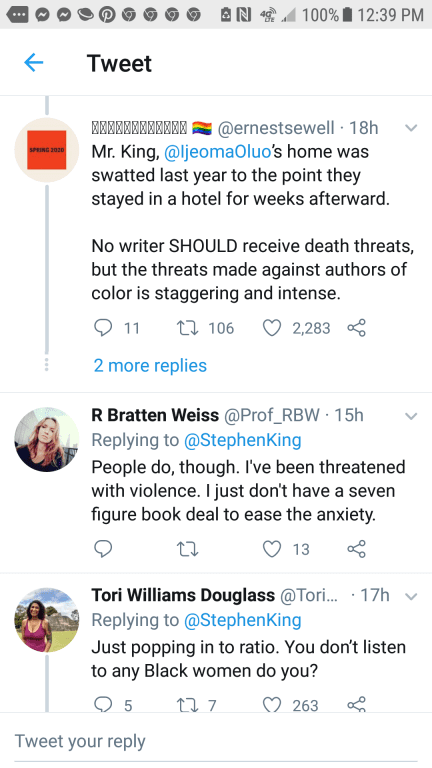
Unfortunately, we are a nation in which writers, especially women and writers of color, are targeted for harassment. It has happened to me. It has happened to writers of significantly higher profile. It just is not on the radar until it happens to the kind of writer who is usually sheltered from it – the kind of writer who gets the seven-figure book deal and the fancy book launches.
This situation highlights a broader issue with privilege, power, hegemony, and violence in our culture. “This is not who we are!” people often say, when news of a shooting or white supremacist terror attack happens. “This is not who we are!” the well-meaning white liberal say, about the rise of Trumpism, the yammering of hatred and prejudice and bigotry at Trump’s rallies.
But this is exactly who we are.
No, not all of us, and not all the time, but often enough. The U.S. exists because we committed genocide against the Native peoples – in some cases through thoughtlessness, but in other cases deliberately – so much so that Adolf Hitler took cues from the U.S. treatment of its indigenous populace, when he was concocting his scheme for wiping out the Jews.
This is who we are as a nation. White Europeans came to this continent, stole it from those who lived here, and claimed to have discovered it. They warred over the land, put down new roots, established a new nation claiming to be based on liberty – while their entire political economy depended on keeping their fellow humans as slaves. Slavery, like genocide, was explicit in the conditions of our real, as opposed to our theoretic founding. And even after finally slavery was legally ended, those who had been enslaved were still abused, segregated, beaten, tortured, and made slaves again, even if in subtler ways such as mass incarceration, or being repeatedly force into low-wage menial labor.
For most of us, this is not our native soil, yet we have repeatedly acted as though others seeking to come here are invaders, a threat to our sovereignty. Every wave of immigrants, unless they were white and genteel, faced discrimination. We put Japanese Americans in concentration camps. We even turned away Jewish refugees who fled the Nazis.
This is who we are.
We don’t want to admit it. We want to focus on the good things in our history. We like to focus on our emphases on freedom and natural rights, not on the many ways we have violated those rights. We like to imagine that our wars have all been for freedom, when usually they have been for money or power or colonial privilege. We pat ourselves on the back for ending segregation, as though white Americans hadn’t fought back, with anger and violence, against the Black civil rights activists and their allies who achieved it.
It is important to honor those in our history who have genuinely stood up for justice and peace, and to keep alive our movements of civil rights. We need to hold onto all that is good in our history so we can continue to build on the foundations laid by our saints and heroes. But it will be impossible to build on those foundations if we don’t at the same time acknowledge the other foundations that need to be dismantled.
image credit: https://en.wikipedia.org/wiki/Racial_segregation#/media/File:We_want_white_tenants.jpg
Next Post

February 8, 2020 Reclaiming Our Bodies As Subjects: Women and the Objectifying Gaze
Browse Our Archives
Select a Category abortion anti-semitism art Atwood Betrothed church clergy abuse coronavirus culture economics education environmentalism ethics faith family feminism gardening gun violence immigration Judaism literature MaddAddam New Pro Life Movement news pandemic personalism poem politics politics blue Pope Francis racism religion salvation sexuality social justice spirituality Station eleven Stephen King The Stand Trump Uncategorized war World Health Organization
Select a Month March 2021 February 2021 January 2021 December 2020 November 2020 October 2020 September 2020 August 2020 July 2020 June 2020 May 2020 April 2020 March 2020 February 2020 January 2020 December 2019 November 2019 October 2019 September 2019 August 2019 July 2019 June 2019 May 2019 April 2019 March 2019 February 2019 January 2019 December 2018 November 2018 October 2018 September 2018 August 2018 July 2018 June 2018 May 2018 April 2018 March 2018 February 2018 January 2018 December 2017 November 2017 October 2017 September 2017 August 2017 July 2017 June 2017 May 2017 April 2017 March 2017 February 2017 January 2017 December 2016 November 2016 October 2016 September 2016 August 2016 July 2016 June 2016 May 2016 April 2016 March 2016 February 2016
Follow Us!
TAKE THE
Religious Wisdom Quiz
Who took Jesus’ body and placed it in a tomb?
Select your answer to see how you score.
Joseph of Arimathea Nicodemus Peter John
Support this
Column


Related posts from suspended in her jar

Immigrants: They Need Us, and We Need Them

Four Takeaways from Oprah’s Interview with the Duke...

How Has the Pandemic Changed Us? Has It...

Rush Limbaugh Would Never Have Succeeded In an...
TRENDING AT PATHEOS Catholic

Rejecting Doom: Christian Hope And Human Action
Christianity is a religion of hope. We are to have hope and...

It’s What Comes From Within Which Matters
One of the most difficult things for us to understand is why...

Why I Choose the Eucharist Over the Sermon
Choose the Eucharist, Not the Sermon What are we supposed to get...

5 Design Elements Found in Spiritually Rooted Homes
Putting Spirituality Into Home Decor Our homes are more than our living...

Credo: A Story of God Told with the...
About 10 years ago, I began to imagine a personal "Credo" that...

The Anatomy of Divine Revelation in Catholic Thought
The claim that God has made Himself known to human beings is...
view all Catholic blogs
Ad-Free & Subscriber Log-In Subscription Support
- About Us
- 2026 Calendar
- Videos
- Podcasts
- Library of World Religions
- Faith In Media Tracker
- Advertise With Us
- Write for Us
- Privacy Policy
- Terms of Service
- Do Not Sell My Data
- Contact Us
- Radiant Digital
- Manage Newsletter Subscriptions
- Unsubscribe From Notifications
- Sitemap
Copyright 2008-2026, Patheos. All rights reserved.
Subscription Support Ad-Free & Subscriber Log-In
Follow Patheos