
BuddhistCatholicContemplativeEvangelicalGeneral ChristianHinduJewishLatter-day SaintMuslimNew VisionsProgressive Christian
Beliefs
- Buddhist
- Catholic
- Contemplative
- Evangelical
- General Christian
- Hindu
- Jewish
- Latter-day Saint
- More Voices
- Muslim
- New Visions
- Pagan
- Progressive Christian
Topics
- Religion News
- Food and Religion
- Sports and Religion
- Religious Art
- Religious Music and Entertainment
- Religious Events
- History and Religion
- Style and Religion
- Politics and Religion
- Women in Religion
- Recreation Outdoors and Religion
- Business Finance and Religion
- Careers Workplace and Religion
- Education and Religion
- Family Parenting and Religion
- Health Fitness and Religion
- Home and Religion
- Relationships and Religion
- Technology and Religion
- Travel and Religion
Columnists
- Buddhist Columnists
- Business Finance and Religion Columnists
- Careers Workplace and Religion Columnists
- Catholic Columnists
- Contemplative Columnists
- Education and Religion Columnists
- Evangelists Columnists
- Family Parenting and Religion Columnists
- General Christian Columnists
- Health Fitness and Religion Columnists
- Hindu Columnists
- History and Religion Columnists
- Home and Religion Columnists
- Jewish Columnists
- More Voices Columnists
- Latter Day Columnists
- Muslim Columnists
- New Visions Columnists
- Nonreligious Columnists
- Pagan Columnists
- Politics and Religion Columnists
- Progressive Columnists
- Recreation Outdoors and Religion Columnists
- Relationships and Religion Columnists
- Religion News Columnists
- Religious Art Columnists
- Religious Events Columnists
- Religious Music and Entertainment Columnists
- Sports and Religion Columnists
- Style and Religion Columnists
- Technology and Religion Columnists
- Travel and Religion Columnists
- Women in Religion Columnists
Resource Library
- 2026 Calendar
- Library of World Religions
- The 100 Most Holy Places on Earth
- Patheos Answers
- Podcasts
- Videos
- Faith Leaders Database
- Anglican Episcopalian
- Bahai
- Baptist
- Buddhism
- Christianity
- Confucianism
- Eastern Orthodoxy
- Hinduism
- Holiness and Pentecostal
- ISKCON
- Islam
- Judaism
- Lutheran
- Methodist
- The Church of Jesus Christ of Latter-day Saints
- New Age
- Paganism
- Presbytarian and Reformed
- Protestantism
- Religion Behind the Scenes
- Roman Catholic
- Scientology
- Shia Islam
- Sikhism
- Sufism
- Sunni Islam
- Taoism
- Zen
- See all religions
Research Tools
 Ad-Free & Subscriber Log-In Subscription Support
Ad-Free & Subscriber Log-In Subscription Support
Follow Patheos 

- Trending:
- Forgiveness
- |
- Marriage
- |
- Consciousness
- |
- Death Penalty
- |
- Election
- |
- Halloween
 suspended in her jar
- Home
- Catholic
- The Inevitable Impotence of Male-Only “Authority”
The Inevitable Impotence of Male-Only “Authority”
Last updated on: February 26, 2020 at 12:45 am by Guest Contributor
The Inevitable Impotence of Male-Only “Authority” 2020-02-26T00:45:59-04:00 Guest Contributor
Patheos Explore the world's faith through different perspectives on religion and spirituality! Patheos has the views of the prevalent religions and spiritualities of the world.
By guest writer H. Lillian Vogl
The terms “power” and “authority” have two rather different sets of connotations. The positive connotation is generative: potency to do something significant, and to be the source, the author, of new things. The negative connotation is destructive: control over other people in order to wage war, command slaves, or at least enforce social conformity. Of course wielders of destructive power and authority often claim that their control is ultimately exercised for constructive ends, but what they construct is Empire, which rewards a few with luxury, leisure, and honor, and crushes the many, in body and spirit, beneath its voracious demands for labor and natural resources. Only the generative type of power and authority can grow and expand without taking something away from another.
Generation requires male and female potency to combine together, and the sacrificial provision of material support to allow new things to develop into maturity. It requires a mother’s womb and milk, or Mother Earth, to become anything more than the frozen potential of a seed. Even male authors of ancient texts regularly invoked the assistance of the female Muses to birth their poetry. Masculine potency is quite incapable of generative power on its own.
It seems inevitable, then, that whenever and wherever the Church denies or submerges the manifestation of the power and authority of the Holy Spirit through the biologically female members of the Body of Christ, it renders itself impotent at best, and engorged with a destructive lust for control and empire-building at worst.
The Exclusion of Women From Church Authority
It’s a matter of extensive debate among historians, archaeologists, Scripture scholars, and theologians how soon after Jesus Christ’s ascension, and how extensively across different local church communities, this exclusion of women from positions of power and authority within the Church happened. The New Testament itself provides contradictory indicators, both repeating contemporary cultural expectations of women’s subordination and at the same time naming women as apostles, deacons, and missionaries. The exclusively-male authors of canonical texts and the “Early Church Fathers” do not name women as priests or bishops as such, but archaeological evidence seems to depict some women exercising these types of offices of authority. Less well-known ancient texts also contain evidence that women did, in fact, exercise authority in some Christian communities, and that powerful men have long disapproved of this.
Saint Perpetua’s prison diary, believed to have been written in 203 AD, preserves an actual feminine perspective of the early Christian faith worth dying for, one in which she made decisions for herself and her infant son without permission from her husband or father, and was rewarded for her faith with fantastic visions of heaven and conquering evil. “I became a man,” this well-educated nursing mother wrote about her vision of conquering the devil in the arena, shortly before she was brought naked and unashamed before the maddening crowd to meet her Maker. Later church officials did see fit to name her in the Litany of Saints, alongside her servant companion Felicity, but few know anything about these courageous young mothers besides the fact of their martyrdom. I have never seen it commented upon anywhere that Perpetua did not submit in any respect to her husband’s authority, nor that she and companion Saturus were implored in another vision to broker peace from heaven between a bishop and priest and their Christian followers who were at odds.
What is clear is that no Christian women were involved in the ecumenical councils that began in the 4th century AD, which established the canonical texts of the Bible, the Nicaean and Athanasian creeds, and other major points of Christian dogma. From this point until the emergence of certain Protestant sects over a thousand years later, the “official” Church only acknowledged the power and authority of the Holy Spirit working through the recipients of “Holy Orders.” Only priests could invoke the power of the Holy Spirit to make Christ present in the Eucharist, and only the men with the highest level of ordination, the Bishops and Patriarchs, were seen as legitimate agents of the Spirit’s teaching authority. Women were never granted these levels of ordination by the men who constructed this system of managing the Body of Christ through a formal hierarchical structure. Even when certain church communities rejected Holy Orders as a prerequisite to preaching or offering communion, they typically relied on a few verses from the New Testament to maintain the ban on women exercising these forms of power and authority.
The Blood Of the Martyrs?
For a millennium and a half at least, any potency the Holy Spirit gave to women was prophylactically separated from any potency given to men. During this time, the Church “spread” primarily by conquest and colonialism. “The blood of the martyrs is the seed of the Church,” Tertullian wrote a few years before Perpetua’s martyrdom. This “blood” might have held a double entendre, or at least an implication of innocent sacrifice, in an era when many of the martyrs were women who preferred to submit their bodies to God’s care in eternity rather than submit to marriages pressed upon them by their fathers and Roman law. This phrase took on entirely different connotations when overlaid onto crusading and colonialist Christendom, and bloody martyrdom became primarily a fate of men who were associated by indigenous peoples, rightly or wrongly, with their oppressive conquerors, or who were caught up in destructive power struggles between warring “Christian” sects or rulers.
The conversion of large portions of the surviving indigenous people of the Americas is attributable not to any martyr, but to a comforting, un-bloody display of female generative power and authority: Our Lady of Guadalupe. The Mother of God had to speak with such a miraculous display of divine power that even the Bishop could not deny her authenticity. This voice pregnant with life-giving tenderness drew millions of people to be baptized by water and the Spirit into her family, despite such baptisms being performed by the same coterie of men who were taking their land and exploiting their labor. To this day, the descendants of the indigenous people of the Americas are significantly more likely to profess an active Christian faith than the descendants of the European tribes that were subsumed into the Holy Roman Empire.
But Christendom is slowly losing its controlling authority over the minds of people all over the world, only faster in its long-favored haunts of Europe. The alarmingly frequent contemporary martyrdoms among “brown peoples” do not seem to have a general growth effect anymore (assuming they ever did). Europe got out of the empire expansion game after two devastating world wars in the last century, and has largely pulled out of missionary endeavors as well. The United States of America has tried to pick up the mantle of global empire and missionary leadership, but this too is sputtering today. Certain segments of Christian society seek to grow through natalism—focusing on the generative power of sexual reproduction between “good Christian spouses”—only to see many of their children drift or run away from a subculture they find oppressive. In the face of such rapid decline of Christian affiliation, some seem to have concluded that the Holy Spirit has given up on the Great Commission and consigned itself to preserving a remnant from the fires of hell.
But Jesus Christ did not come into the world to condemn most of it, but that all might be saved. His death and resurrection exposed the lie of Empire’s claims to power and authority. The power and authority of God is generative, not controlling. For the Holy Spirit to accomplish God’s good works through members of the Body of Christ, leaders of the Church must shed their control and repent of exercising power and authority in such a destructive way. They must remove the prophylatic of gender discrimination and segregation in the Church and allow the Holy Spirit to blow where it will. They must speak of power and authority in generative terms, like Jesus’s many agricultural parables, and show that they mean it by laying down their rhetorical and excommunicative swords.
When the “leaders” of the Church get out of God’s way, the prophecy of Joel can yet be realized (which also contains promises for a ravished environment, for which the most powerful leader in the Christian world claims to care deeply):
Then the Lord became jealous for his land, and had pity on his people.
In response to his people the Lord said:
I am sending you grain, wine, and oil, and you will be satisfied;
and I will no more make you a mockery among the nations.
I will remove the northern army far from you, and drive it into a parched and desolate land….
Do not fear, O soil; be glad and rejoice, for the Lord has done great things!
Do not fear, you animals of the field, for the pastures of the wilderness are green;
the tree bears its fruit, the fig tree and vine give their full yield.
O children of Zion, be glad and rejoice in the Lord your God;
for he has given the early rain for your vindication,
he has poured down for you abundant rain, the early and the later rain, as before.
The threshing floors shall be full of grain, the vats shall overflow with wine and oil.
I will repay you for the years that the swarming locust has eaten,
the hopper, the destroyer, and the cutter, my great army, which I sent against you.
You shall eat in plenty and be satisfied, and praise the name of the Lord your God, who has dealt wondrously with you.
…
Then afterward I will pour out my spirit on all flesh;
your sons and your daughters shall prophesy,
your old men shall dream dreams, and your young men shall see visions.
Even on the male and female slaves, in those days, I will pour out my spirit.
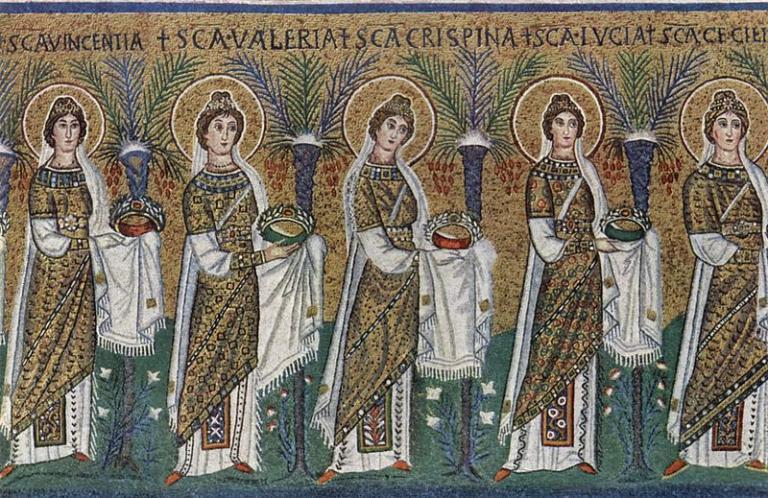
image credit: https://commons.wikimedia.org/wiki/File:Meister_von_San_Apollinare_Nuovo_in_Ravenna_002.jpg
Previous Post

February 19, 2020
Do Catholic Feminists Wish to Smash the Church's Patriarchy?
Next Post

March 1, 2020 Atheists and Christians: Are Atheists Deficient In Love?
Browse Our Archives
Select a Category abortion anti-semitism art Atwood Betrothed church clergy abuse coronavirus culture economics education environmentalism ethics faith family feminism gardening gun violence immigration Judaism literature MaddAddam New Pro Life Movement news pandemic personalism poem politics politics blue Pope Francis racism religion salvation sexuality social justice spirituality Station eleven Stephen King The Stand Trump Uncategorized war World Health Organization
Select a Month March 2021 February 2021 January 2021 December 2020 November 2020 October 2020 September 2020 August 2020 July 2020 June 2020 May 2020 April 2020 March 2020 February 2020 January 2020 December 2019 November 2019 October 2019 September 2019 August 2019 July 2019 June 2019 May 2019 April 2019 March 2019 February 2019 January 2019 December 2018 November 2018 October 2018 September 2018 August 2018 July 2018 June 2018 May 2018 April 2018 March 2018 February 2018 January 2018 December 2017 November 2017 October 2017 September 2017 August 2017 July 2017 June 2017 May 2017 April 2017 March 2017 February 2017 January 2017 December 2016 November 2016 October 2016 September 2016 August 2016 July 2016 June 2016 May 2016 April 2016 March 2016 February 2016
Follow Us!
TAKE THE
Religious Wisdom Quiz
What occupation did Peter, Andrew, James, and John have before following Jesus?
Select your answer to see how you score.
Tax collectors Scribes Politicians Fishermen
Support this
Column


Related posts from suspended in her jar

Four Takeaways from Oprah’s Interview with the Duke...

Catholics Are De-Toxing From their Experiences With Traumatic...

How Has the Pandemic Changed Us? Has It...

Rush Limbaugh Would Never Have Succeeded In an...
TRENDING AT PATHEOS Catholic

Creation, Preservation, and Teleology in Catholic Theology
As I write this, it is very early Monday morning. Like millions...

The Parable Of The Sower And The Word...
One of Christ’s most famous parables is that of the sower who...

Rejecting Doom: Christian Hope And Human Action
Christianity is a religion of hope. We are to have hope and...

Why I Choose the Eucharist Over the Sermon
Choose the Eucharist, Not the Sermon What are we supposed to get...

5 Design Elements Found in Spiritually Rooted Homes
Putting Spirituality Into Home Decor Our homes are more than our living...

Credo: A Story of God Told with the...
About 10 years ago, I began to imagine a personal "Credo" that...
view all Catholic blogs
Ad-Free & Subscriber Log-In Subscription Support
- About Us
- 2026 Calendar
- Videos
- Podcasts
- Library of World Religions
- Faith In Media Tracker
- Advertise With Us
- Write for Us
- Privacy Policy
- Terms of Service
- Do Not Sell My Data
- Contact Us
- Radiant Digital
- Manage Newsletter Subscriptions
- Unsubscribe From Notifications
- Sitemap
Copyright 2008-2026, Patheos. All rights reserved.
Subscription Support Ad-Free & Subscriber Log-In
Follow Patheos