
BuddhistCatholicContemplativeEvangelicalGeneral ChristianHinduJewishLatter-day SaintMuslimNew VisionsProgressive Christian
Beliefs
- Buddhist
- Catholic
- Contemplative
- Evangelical
- General Christian
- Hindu
- Jewish
- Latter-day Saint
- More Voices
- Muslim
- New Visions
- Pagan
- Progressive Christian
Topics
- Religion News
- Food and Religion
- Sports and Religion
- Religious Art
- Religious Music and Entertainment
- Religious Events
- History and Religion
- Style and Religion
- Politics and Religion
- Women in Religion
- Recreation Outdoors and Religion
- Business Finance and Religion
- Careers Workplace and Religion
- Education and Religion
- Family Parenting and Religion
- Health Fitness and Religion
- Home and Religion
- Relationships and Religion
- Technology and Religion
- Travel and Religion
Columnists
- Buddhist Columnists
- Business Finance and Religion Columnists
- Careers Workplace and Religion Columnists
- Catholic Columnists
- Contemplative Columnists
- Education and Religion Columnists
- Evangelists Columnists
- Family Parenting and Religion Columnists
- General Christian Columnists
- Health Fitness and Religion Columnists
- Hindu Columnists
- History and Religion Columnists
- Home and Religion Columnists
- Jewish Columnists
- More Voices Columnists
- Latter Day Columnists
- Muslim Columnists
- New Visions Columnists
- Nonreligious Columnists
- Pagan Columnists
- Politics and Religion Columnists
- Progressive Columnists
- Recreation Outdoors and Religion Columnists
- Relationships and Religion Columnists
- Religion News Columnists
- Religious Art Columnists
- Religious Events Columnists
- Religious Music and Entertainment Columnists
- Sports and Religion Columnists
- Style and Religion Columnists
- Technology and Religion Columnists
- Travel and Religion Columnists
- Women in Religion Columnists
Resource Library
- 2026 Calendar
- Library of World Religions
- The 100 Most Holy Places on Earth
- Patheos Answers
- Podcasts
- Videos
- Faith Leaders Database
- Anglican Episcopalian
- Bahai
- Baptist
- Buddhism
- Christianity
- Confucianism
- Eastern Orthodoxy
- Hinduism
- Holiness and Pentecostal
- ISKCON
- Islam
- Judaism
- Lutheran
- Methodist
- The Church of Jesus Christ of Latter-day Saints
- New Age
- Paganism
- Presbytarian and Reformed
- Protestantism
- Religion Behind the Scenes
- Roman Catholic
- Scientology
- Shia Islam
- Sikhism
- Sufism
- Sunni Islam
- Taoism
- Zen
- See all religions
Research Tools
 Ad-Free & Subscriber Log-In Subscription Support
Ad-Free & Subscriber Log-In Subscription Support
Follow Patheos 

- Trending:
- Forgiveness
- |
- Marriage
- |
- Consciousness
- |
- Death Penalty
- |
- Election
- |
- Halloween
 suspended in her jar
- Home
- Catholic
- Church As Empire? This Is Not the Catholicism I Signed Up For
Church As Empire? This Is Not the Catholicism I Signed Up For
Last updated on: October 27, 2019 at 6:04 pm by Rebecca Bratten Weiss
Church As Empire? This Is Not the Catholicism I Signed Up For 2019-10-27T18:04:51-04:00 Rebecca Bratten Weiss
Patheos Explore the world's faith through different perspectives on religion and spirituality! Patheos has the views of the prevalent religions and spiritualities of the world.
I grew up in what some might consider a “syncretic” religious culture. My mother was Jewish, though no longer practicing. My father had been brought up Methodist, but converted to Catholicism, though he wasn’t practicing, either. We kept certain Jewish feast days, made a big deal out of Christmas, prayed the “Hail Mary,” and sang old-timey Gospel songs in the co-op my mother founded with her hippie artsy Mormon friends. Some Sundays I went to the Episcopal church with my grandmother, and liked the quiet dignity of its ritual and music. Other Sundays my family went to a non-denominational charismatic church in an abandoned warehouse, where we were one of only a few white families.
In those days I didn’t yet understand that the area where we lived was a hotbed of racial injustice, or that being Jewish made me a target for the very active KKK. I didn’t know I couldn’t mix and match my religious practices. Eventually my whole family converted to Catholicism, at a time when I was more interested in horses, books, and boys than in religion, but after a brief period of dabbling in atheism, I started getting enthusiastic about Catholicism, in my freshman year of college. I was studying philosophy, and had been accepted in the then-exclusive Great Books program, where we reveled in what some might call the glories of Western Civilization, even though the classics are really more a testament to the vibrancy of diversity, the way multifarious influences come together in a polyphonic tradition.
The nature of the university being what it was, it was impossible for me not to imbibe a certain amount of unconscious white supremacy, ethno-nationalism, and general chauvinism as I breathed in the Great Books. Some would say that this is all an inevitable consequence of a classical education. I disagree; classical education properly undertook should open, rather than close the mind to revelations and insights from different cultures, and the best way to deal with the fetishization of the “western canon” by white nationalists and their sort is to reclaim it from them.
The Canon – Not Really All That “Western”
It also helps to remind them that east and west are mere constructs, and that works like the Bible and the Iliad emerged in a liminal zone between the cultures we designate “east” and “west.” And even if much of the canon involves drawing out and embellishing on tradition (i.e., fanfiction), much of it also involves revolutionary stances. Aquinas’ works, for instance, were looked askance in his day. And Dante, with his emphasis on the use of the vernacular, and on separation of church and state, as well as his appropriation of erotic literary traditions for religious purposes, ought to be recognized as cutting-edge and revolutionary, not as a staid fuddy-duddy repeating old tropes. What we call the tradition didn’t die. It simply kept on growing, branching out. It drew on other traditions, enabling us to connect with them and look back on other roots as deep and vital as the ones out of which the Western Canon was born.
While I did inherit a number of prejudices I have since spent several decades trying to shake off, I also was made aware, repeatedly, that this ability to appreciate and draw on many different cultures for Truth and Beauty was specifically Catholic. The literary arts of the pagan Greeks? We can use those! European folklore involving witches and trolls? This has its place as well! Medieval culture in particular seemed to me to be exceptionally vital and exuberant, blending as it did trends from the Hebrew and Roman roots of Christianity, pre-Christian folk traditions, and the ongoing philosophical dialogue coming down from the Greeks and Romans, through Muslim and Jewish philosophers, and into the scholastic practice.
Catholicism as Culturally Rich – And Culturally Diverse
For many years, I understood my Catholic tradition to be a tradition that celebrated art, culture, beauty, and scholarship from all sources. Unlike certain Puritan or Protestant traditions that rejected anything seemingly Other, or pagan, we embraced it – “baptized” it, was the term we usually used.
What I didn’t think about was how often, in baptizing other traditions, we were appropriating them. It didn’t occur to me how much of our melting-pot of religious art existed because of mission work that was just a squeak away from being pure colonialism. What i didn’t realize was that the “Christianity” of so many of my neighbors in the quiet Southern county I lived in as a child was really just white supremacy, with church bells on.
I know now that there are many problematic elements in our diverse religious and cultural traditions, thanks to a history in which the Church repeatedly mistook itself for Empire. But I still feel strongly that attraction to a religious sensibility that is multifarious, diverse, and unafraid. I love the old cathedrals for their artistic splendor, and Renaissance art for its daring. European Catholics whitewashed the Holy Family and the early church, yes – but that means that any other culture should be free to depict God become human according to their own traditions. While my own preference would be for an iconography that emphasizes the Jewish-ness of Jesus and Mary, it is appropriate for the sacramental imagination for them to be portrayed also as African, Asian, Indigenous American, and so forth.
This is the Catholicism I signed up for.
Catholicism as a Cult of Authority
But what I am seeing right now is a movement in Catholicism to make it a quasi-European cult of authority, militarism, sexual repression, and patriarchy. The reactions to the Amazonian Synod, culminating with the theft and desecration of two sacred images presented to the pope by indigenous Catholics, make it clear that there is a significant faction that wants the church to be more like a social club for little wannabe Emperor Octavians: us only, no foreigners, rule of law, obsessiveness over purity. Anything that seems different from the relatively modern form of European Christianity – if it can be called European, or Christian – they regard with suspicion and even terror. Their attitude is not one of philosophical inquiry or of Gospel openness, but rather of militarist cosplay: defending some imaginary boundaries of a church that was, supposedly, founded to be for the whole world.
This is not the Catholicism I signed up for. This hatred and distrust of anything foreign, repression of creative impulses, punishing of free speculation, celebration of authoritarian force, denigration of women, denigration of foreigners, denigration of anyone queer or other, fear of any cultural trends that didn’t occur within a very narrow swathe of white western modern Christianity – this is not my church.
Or so I want to say.
Yet at the same time I have to face the troubling reality that for centuries, even while the church was producing glorious art and music, as well as vibrant folk traditions across different cultures – while it was often a force for justice and liberation – it was also being used as an instrument of oppression, a validation for war and torture, an excuse for colonization and enslavement. I might have to face the fact that this is, more than I care to admit, the Catholicism I signed up for. And it would be irresponsible for me to celebrate the good and beautiful elements that have enriched my life without doing all I can to oppose the forces of injustice which have made other lives miserable.
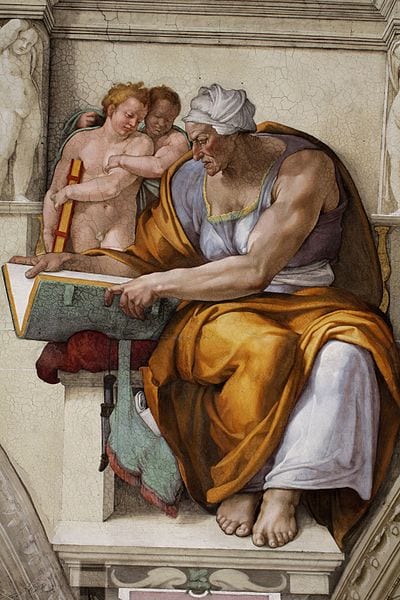
https://commons.wikimedia.org/wiki/File:%27Cumaean_Sibyl_Sistine_Chapel_ceiling%27_by_Michelangelo_JBU35.jpg
Previous Post

October 22, 2019
Ecological Atonement, Labor as Spirituality
Next Post
October 29, 2019 Is The Ban On Ordination of Women Based On A Heresy?
Browse Our Archives
Select a Category abortion anti-semitism art Atwood Betrothed church clergy abuse coronavirus culture economics education environmentalism ethics faith family feminism gardening gun violence immigration Judaism literature MaddAddam New Pro Life Movement news pandemic personalism poem politics politics blue Pope Francis racism religion salvation sexuality social justice spirituality Station eleven Stephen King The Stand Trump Uncategorized war World Health Organization
Select a Month March 2021 February 2021 January 2021 December 2020 November 2020 October 2020 September 2020 August 2020 July 2020 June 2020 May 2020 April 2020 March 2020 February 2020 January 2020 December 2019 November 2019 October 2019 September 2019 August 2019 July 2019 June 2019 May 2019 April 2019 March 2019 February 2019 January 2019 December 2018 November 2018 October 2018 September 2018 August 2018 July 2018 June 2018 May 2018 April 2018 March 2018 February 2018 January 2018 December 2017 November 2017 October 2017 September 2017 August 2017 July 2017 June 2017 May 2017 April 2017 March 2017 February 2017 January 2017 December 2016 November 2016 October 2016 September 2016 August 2016 July 2016 June 2016 May 2016 April 2016 March 2016 February 2016
Follow Us!
TAKE THE
Religious Wisdom Quiz
Which book of the Bible has only one chapter?
Select your answer to see how you score.
Habakkuk Zephaniah Obadiah Nahum
Support this
Column


Related posts from suspended in her jar

Immigrants: They Need Us, and We Need Them

Four Takeaways from Oprah’s Interview with the Duke...

Catholics Are De-Toxing From their Experiences With Traumatic...

How Has the Pandemic Changed Us? Has It...
TRENDING AT PATHEOS Catholic

Rejecting Doom: Christian Hope And Human Action
Christianity is a religion of hope. We are to have hope and...

It’s What Comes From Within Which Matters
One of the most difficult things for us to understand is why...

Why I Choose the Eucharist Over the Sermon
Choose the Eucharist, Not the Sermon What are we supposed to get...

5 Design Elements Found in Spiritually Rooted Homes
Putting Spirituality Into Home Decor Our homes are more than our living...

Credo: A Story of God Told with the...
About 10 years ago, I began to imagine a personal "Credo" that...

The Anatomy of Divine Revelation in Catholic Thought
The claim that God has made Himself known to human beings is...
view all Catholic blogs
Ad-Free & Subscriber Log-In Subscription Support
- About Us
- 2026 Calendar
- Videos
- Podcasts
- Library of World Religions
- Faith In Media Tracker
- Advertise With Us
- Write for Us
- Privacy Policy
- Terms of Service
- Do Not Sell My Data
- Contact Us
- Radiant Digital
- Manage Newsletter Subscriptions
- Unsubscribe From Notifications
- Sitemap
Copyright 2008-2026, Patheos. All rights reserved.
Subscription Support Ad-Free & Subscriber Log-In
Follow Patheos