
BuddhistCatholicContemplativeEvangelicalGeneral ChristianHinduJewishLatter-day SaintMuslimNew VisionsProgressive Christian
Beliefs
- Buddhist
- Catholic
- Contemplative
- Evangelical
- General Christian
- Hindu
- Jewish
- Latter-day Saint
- More Voices
- Muslim
- New Visions
- Pagan
- Progressive Christian
Topics
- Religion News
- Food and Religion
- Sports and Religion
- Religious Art
- Religious Music and Entertainment
- Religious Events
- History and Religion
- Style and Religion
- Politics and Religion
- Women in Religion
- Recreation Outdoors and Religion
- Business Finance and Religion
- Careers Workplace and Religion
- Education and Religion
- Family Parenting and Religion
- Health Fitness and Religion
- Home and Religion
- Relationships and Religion
- Technology and Religion
- Travel and Religion
Columnists
- Buddhist Columnists
- Business Finance and Religion Columnists
- Careers Workplace and Religion Columnists
- Catholic Columnists
- Contemplative Columnists
- Education and Religion Columnists
- Evangelists Columnists
- Family Parenting and Religion Columnists
- General Christian Columnists
- Health Fitness and Religion Columnists
- Hindu Columnists
- History and Religion Columnists
- Home and Religion Columnists
- Jewish Columnists
- More Voices Columnists
- Latter Day Columnists
- Muslim Columnists
- New Visions Columnists
- Nonreligious Columnists
- Pagan Columnists
- Politics and Religion Columnists
- Progressive Columnists
- Recreation Outdoors and Religion Columnists
- Relationships and Religion Columnists
- Religion News Columnists
- Religious Art Columnists
- Religious Events Columnists
- Religious Music and Entertainment Columnists
- Sports and Religion Columnists
- Style and Religion Columnists
- Technology and Religion Columnists
- Travel and Religion Columnists
- Women in Religion Columnists
Resource Library
- 2026 Calendar
- Library of World Religions
- The 100 Most Holy Places on Earth
- Patheos Answers
- Podcasts
- Videos
- Faith Leaders Database
- Anglican Episcopalian
- Bahai
- Baptist
- Buddhism
- Christianity
- Confucianism
- Eastern Orthodoxy
- Hinduism
- Holiness and Pentecostal
- ISKCON
- Islam
- Judaism
- Lutheran
- Methodist
- The Church of Jesus Christ of Latter-day Saints
- New Age
- Paganism
- Presbytarian and Reformed
- Protestantism
- Religion Behind the Scenes
- Roman Catholic
- Scientology
- Shia Islam
- Sikhism
- Sufism
- Sunni Islam
- Taoism
- Zen
- See all religions
Research Tools
 Ad-Free & Subscriber Log-In Subscription Support
Ad-Free & Subscriber Log-In Subscription Support
Follow Patheos 

- Trending:
- Forgiveness
- |
- Marriage
- |
- Consciousness
- |
- Death Penalty
- |
- Election
- |
- Halloween
 suspended in her jar
- Home
- Catholic
- To Reform the Church, We Must Rethink, Repair, or Replace Its Failed Institutions
To Reform the Church, We Must Rethink, Repair, or Replace Its Failed Institutions
Last updated on: September 7, 2019 at 11:03 pm by Guest Contributor
To Reform the Church, We Must Rethink, Repair, or Replace Its Failed Institutions 2019-09-07T23:03:50-04:00 Guest Contributor
Patheos Explore the world's faith through different perspectives on religion and spirituality! Patheos has the views of the prevalent religions and spiritualities of the world.
This is the eighth and last in the “Reform” series by guest writer William M. Shea
Responses to Four Objections:
- Do I intend to reform or to destroy the RCC? As Massimo Faggioli recently warned in Commonweal (7/20/19), some reformers are in fact institutional iconoclasts. You, Bill Shea, and others (James Carroll, Garry Wills, et al.) are saying that we don’t need institutions, that we can do away with institutions such as the priesthood, and still have the Catholic Church.
No, I’m not. Faggioli is mistaken and badly so. I’m saying that the Catholic church needs to rethink the institutions it has relied on, repair them or replace them. Those institutions historically have clearly failed the church, and not only in the abuse of children. The reason for that failure is that, conceived as “sacred,” male institutions, they have not seriously questioned themselves, changed, repented and considered being replaced with institutions that are not “sacred,” are not male only, and are made accountable to the whole church for their moral life. It’s not the sacramental ministry that I (and other ‘institutional iconoclasts’) want to “destroy.” Clericalism, hierarchism and their attendant abuses signal the decrepitude of the current institutions. I don’t know that they are now in range of cultural death, but they seem to be so. And I don’t believe, having watched carefully since 1985, that the Roman/episcopal clerical kingdom can reform itself. I will live and die under the current institutions if I must but I think it is simply foolish to refuse to see through the self-serving ideological blather that the hierarchy covered its failures and crimes with over the centuries. Let’s get on with the discussion of how best Christian churches can govern themselves, whether the current Roman institutions have some sort of divine seal that makes them irreformable, and how all the churches are, after all, one Body, one Catholic church with myriad institutions of government and ministry.
- The structure of authority in the RCC (bishops, priests, deacons, with a special emphasis on the unifying and commanding office of the bishop of Rome) is (a) ancient, as a fact dating back to the first generation of Christians and, even, it is claimed, to the Lord Himself; (b) determined in revelation and defined as irreformable doctrine.
Yes, it surely looks that way, namely that the Roman Catholic church as a whole, as a body, is committed to this precise structure of a celibate, male, hierarchical ministry. This certainly is what I was taught, “always and everywhere,” along with the attendant doctrine crucial to hierarchism that there is only One True Church. But take another look at the Body we should talking about! In the first place the Christian churches (note the plural) are far from universally committed to this particular form of ministry. It has been contested by Christians from the start. In the equally ancient eastern churches there have been significant differences from and, indeed, ‘irreformable’ dissent to the Roman model, and so it has been with the British churches, the continental Reformation churches, and the absurdly numerous churches which have sprung up since the founding of our republic in response to the clerical/hierarchical system. The result: near billions of Catholics (those churches are still Catholic in my view!) are just about barely communicating, spiritually as well as sacramentally.
- The failures of priests and bishops to adhere to celibacy is no reason to alter the hierarchical structure or drop the celibacy requirement. You, Shea, are throwing out the baby with the bathwater. There always were and always will be such failures in the priesthood as there are within marriage.
Of course one must distinguish between celibacy and the ordained priesthood! But priests themselves have to sort this problem, to be celibate or not. Christians claim it’s a charism, as did both Jesus and Paul, which the hierarchy turned into a legal binding requirement.The church leadership shouldn’t force priests to it, one way or another, but I am not interested in throwing out either the baby or the bathwater. Personally, I made the choice twice, once when I was ordained and once when I married. While I have never regretted the second choice, I came very much to regret the first. I understand and sympathize deeply with those who suffer through that first and second choice. But it is up to the men and the involved women to make the settlement. I don’t think the men in purple are going to change the celibacy requirement no matter the evidence, so many will continue to suffer and offer us another example of the bishops’ failure as leaders. Let me add this: No structural change is going to guarantee or even make more likely the state of grace. The problem that I’m talking about is an authority system that no longer works. Can the system of authority be reformed or replaced? What would be the benefits of change vs the benefit of retention? Can we be more intelligent and reasonable and responsible than we have been? Or shall we continue on the path which seems to me at least and some other ‘institutional iconoclasts,’ is now revealed to us to be stupid, unreasonable and irresponsible? As Christians we are called to freedom, not another set of chains. Brother Martin did have a point after all.
- The reforms advocated by Pope Francis will clear up the moral situation. He wants reform by conversion of heart. You, Shea, want it by radical structural change. But it is persons who sin, not structures.
Yes, but not quite. First, the pope is a preacher and a theologian and a leader. I am happily none of these. I affirm his aim and applaud his efforts. As far as I am concerned he is a living saint. There is no human voice I listen to, or ever have, as attentively because there is none in which I so clearly and so often hear the voice of the Holy Spirit. I think his hierarchical, clerical and lay critics are hobgoblins. But I disapprove of monarchy as a mode of authority in the church, and I am happy that he shows definite signs that he, too, disapproves of it. But can he change the structure on top of which it is his misfortune to sit? I doubt it. Dogmas forbid it. Second, we speak with good reason of sinful structures which are made so by the men who erect and direct and ‘man’ them. A simple example is the Nazi Schutzstaffel or SS, an evil institution and structure. The celibate priesthood is an institution. It is commonly estimated that fifty percent of celibate priests are at any one time not practicing celibacy. Something is rotten in Rome. Why isn’t that being addressed along with the abuse of children? Institutions and structures can be as dark as the human heart — or as light!
May the Holy Spirit take us all where we fear to go.
Thank you for reading.
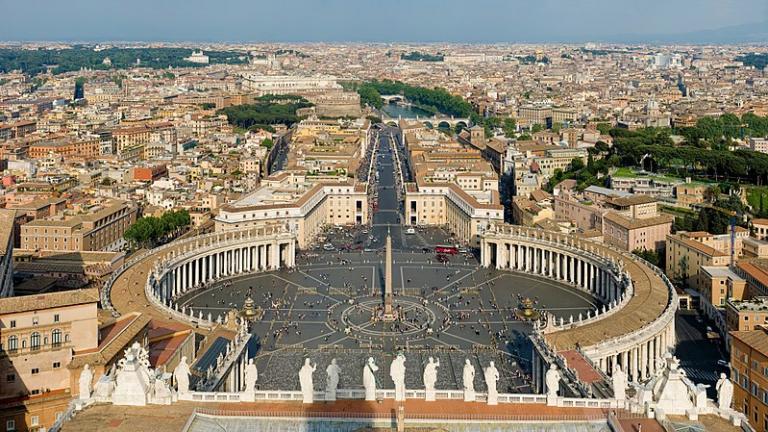
image credit: https://en.wikipedia.org/wiki/File:St_Peter%27s_Square,_Vatican_City_-_April_2007.jpg
Next Post

September 8, 2019 A Message to Bishop Rhoades: Take Notice, and Oppose Anti-Semitism
Browse Our Archives
Select a Category abortion anti-semitism art Atwood Betrothed church clergy abuse coronavirus culture economics education environmentalism ethics faith family feminism gardening gun violence immigration Judaism literature MaddAddam New Pro Life Movement news pandemic personalism poem politics politics blue Pope Francis racism religion salvation sexuality social justice spirituality Station eleven Stephen King The Stand Trump Uncategorized war World Health Organization
Select a Month March 2021 February 2021 January 2021 December 2020 November 2020 October 2020 September 2020 August 2020 July 2020 June 2020 May 2020 April 2020 March 2020 February 2020 January 2020 December 2019 November 2019 October 2019 September 2019 August 2019 July 2019 June 2019 May 2019 April 2019 March 2019 February 2019 January 2019 December 2018 November 2018 October 2018 September 2018 August 2018 July 2018 June 2018 May 2018 April 2018 March 2018 February 2018 January 2018 December 2017 November 2017 October 2017 September 2017 August 2017 July 2017 June 2017 May 2017 April 2017 March 2017 February 2017 January 2017 December 2016 November 2016 October 2016 September 2016 August 2016 July 2016 June 2016 May 2016 April 2016 March 2016 February 2016
Follow Us!
TAKE THE
Religious Wisdom Quiz
What does "Apocalypse" mean in Greek?
Select your answer to see how you score.
Revelation or unveiling Wrath End of world Redemption
Support this
Column


Related posts from suspended in her jar

Four Takeaways from Oprah’s Interview with the Duke...

Catholics Are De-Toxing From their Experiences With Traumatic...

How Has the Pandemic Changed Us? Has It...

Rush Limbaugh Would Never Have Succeeded In an...
TRENDING AT PATHEOS Catholic

The Parable Of The Sower And The Word...
One of Christ’s most famous parables is that of the sower who...

Rejecting Doom: Christian Hope And Human Action
Christianity is a religion of hope. We are to have hope and...

Why I Choose the Eucharist Over the Sermon
Choose the Eucharist, Not the Sermon What are we supposed to get...

5 Design Elements Found in Spiritually Rooted Homes
Putting Spirituality Into Home Decor Our homes are more than our living...

Credo: A Story of God Told with the...
About 10 years ago, I began to imagine a personal "Credo" that...

The Anatomy of Divine Revelation in Catholic Thought
The claim that God has made Himself known to human beings is...
view all Catholic blogs
Ad-Free & Subscriber Log-In Subscription Support
- About Us
- 2026 Calendar
- Videos
- Podcasts
- Library of World Religions
- Faith In Media Tracker
- Advertise With Us
- Write for Us
- Privacy Policy
- Terms of Service
- Do Not Sell My Data
- Contact Us
- Radiant Digital
- Manage Newsletter Subscriptions
- Unsubscribe From Notifications
- Sitemap
Copyright 2008-2026, Patheos. All rights reserved.
Subscription Support Ad-Free & Subscriber Log-In
Follow Patheos