
BuddhistCatholicContemplativeEvangelicalGeneral ChristianHinduJewishLatter-day SaintMuslimNew VisionsProgressive Christian
Beliefs
- Buddhist
- Catholic
- Contemplative
- Evangelical
- General Christian
- Hindu
- Jewish
- Latter-day Saint
- More Voices
- Muslim
- New Visions
- Pagan
- Progressive Christian
Topics
- Religion News
- Food and Religion
- Sports and Religion
- Religious Art
- Religious Music and Entertainment
- Religious Events
- History and Religion
- Style and Religion
- Politics and Religion
- Women in Religion
- Recreation Outdoors and Religion
- Business Finance and Religion
- Careers Workplace and Religion
- Education and Religion
- Family Parenting and Religion
- Health Fitness and Religion
- Home and Religion
- Relationships and Religion
- Technology and Religion
- Travel and Religion
Columnists
- Buddhist Columnists
- Business Finance and Religion Columnists
- Careers Workplace and Religion Columnists
- Catholic Columnists
- Contemplative Columnists
- Education and Religion Columnists
- Evangelists Columnists
- Family Parenting and Religion Columnists
- General Christian Columnists
- Health Fitness and Religion Columnists
- Hindu Columnists
- History and Religion Columnists
- Home and Religion Columnists
- Jewish Columnists
- More Voices Columnists
- Latter Day Columnists
- Muslim Columnists
- New Visions Columnists
- Nonreligious Columnists
- Pagan Columnists
- Politics and Religion Columnists
- Progressive Columnists
- Recreation Outdoors and Religion Columnists
- Relationships and Religion Columnists
- Religion News Columnists
- Religious Art Columnists
- Religious Events Columnists
- Religious Music and Entertainment Columnists
- Sports and Religion Columnists
- Style and Religion Columnists
- Technology and Religion Columnists
- Travel and Religion Columnists
- Women in Religion Columnists
Resource Library
- 2026 Calendar
- Library of World Religions
- The 100 Most Holy Places on Earth
- Patheos Answers
- Podcasts
- Videos
- Faith Leaders Database
- Anglican Episcopalian
- Bahai
- Baptist
- Buddhism
- Christianity
- Confucianism
- Eastern Orthodoxy
- Hinduism
- Holiness and Pentecostal
- ISKCON
- Islam
- Judaism
- Lutheran
- Methodist
- The Church of Jesus Christ of Latter-day Saints
- New Age
- Paganism
- Presbytarian and Reformed
- Protestantism
- Religion Behind the Scenes
- Roman Catholic
- Scientology
- Shia Islam
- Sikhism
- Sufism
- Sunni Islam
- Taoism
- Zen
- See all religions
Research Tools
 Ad-Free & Subscriber Log-In Subscription Support
Ad-Free & Subscriber Log-In Subscription Support
Follow Patheos 

- Trending:
- Forgiveness
- |
- Marriage
- |
- Consciousness
- |
- Death Penalty
- |
- Election
- |
- Halloween
 suspended in her jar
- Home
- Catholic
- When Did Jesus Call Anyone to a Secondary Role in the Church?
When Did Jesus Call Anyone to a Secondary Role in the Church?
Last updated on: June 5, 2019 at 11:12 am by Guest Contributor
When Did Jesus Call Anyone to a Secondary Role in the Church? 2019-06-05T11:12:41-04:00 Guest Contributor
Patheos Explore the world's faith through different perspectives on religion and spirituality! Patheos has the views of the prevalent religions and spiritualities of the world.
by guest writer Sean O’Conaill
That Jesus called people to ‘follow me’ in the Gospel is indisputable, but was he calling some to a primary role of ‘ministry’ and others to be merely receivers of that ministry – a secondary role?
All of the mainstream Christian churches are organised on that pattern – but what Gospel passages could be used to justify such an understanding?
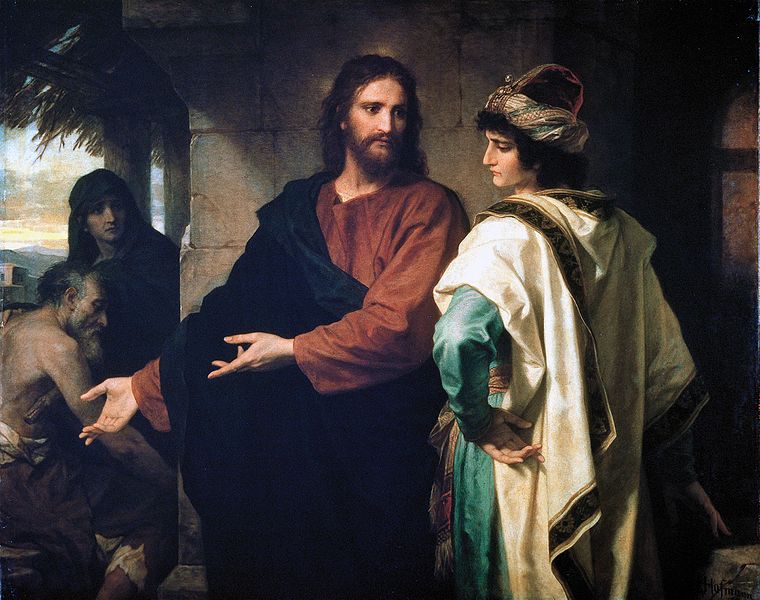
Aimed at promoting vocations to the ‘priesthood or religious life’, a recent pastoral letter by the Irish Catholic bishop of Down and Connor diocese, Dr Noel Treanor, begins with a retelling of the story of the ‘Rich Young Man’, (e.g. Mark 10: 17-31). This man ‘went away sorrowful’ rather than do as Jesus suggested: sell all he had and give it to the poor and then ‘come follow me’. The bishop concludes: ‘He could have been a great disciple, but instead of trusting Jesus he followed his own path’.
By implication this young man was turning down a call to the role that the Catholic priest now occupies. However, that man’s question to Jesus had simply been ‘what must I do to inherit eternal life?’ That is clearly a question that all of us would ask – including all women – and is therefore not evidence of a call to a differentiated and elevated role.
As for Jesus’s invitation to then ‘follow me’, this was a call to share a life of poverty and powerlessness, not a call to the pulpit or the altar – or to membership of a cadre housed and financially supported by others. Jesus later told all of those who followed him not to ‘lord it over’ one another, and they included women. The earliest Christians also followed the instruction to give away all they had without interpreting it as a call to belong to a superior priestly caste (Acts 4: 32-35).
So if that story of the ‘rich young man’ is singled out as an exemplary ‘priestly vocation story’ from the Gospel, what does that tell us about the weight of Gospel evidence that Jesus was bent on forming a two-level church of primary and secondary members?
Similarly, the passage in Luke Chapter 10, in which Jesus sends his disciples two-by-two to the surrounding villages, makes no mention of this as a call to a permanent and superior ministry. These disciples were to heal the sick and proclaim the message of peace – but these tasks required no complex theology, only a firm belief in Jesus himself. As these ‘70’ are never elsewhere mentioned there is no reason to believe that this was anything other than a single time-limited task that could be given to any disciple. There is therefore no justification for using this passage as proof of Jesus’s institution of a two-level church system of permanent ministers on the one hand, to be supported by mere permanent recipients of ministry on the other.
More importantly, nowhere in the Gospels does Jesus call anyone to a lifetime role of subordinated and passive reception of the wisdom and ministry of others.
All ‘callings’ fit the same single pattern : they are callings to obey the commandment of love and to an active role of spreading the message of the coming of the kingdom – and those closest to Jesus at the end are solemnly warned against a presumption of ‘lordship’. There is no insistence on a distinctive dress or lifestyle for a separate priestly caste, such as celibacy and solitude. Moreover, in the parable of the vineyard and the workers who start the day at different times, there is a clear warning to these first followers against any belief in their own superiority. Throughout the Gospel, and repeated especially in the epistle of James, there is an insistence upon equality and mutual service, and a warning against ‘class distinction’. When Jesus tells us that those who obey his teaching that he and his Father will make their home in us he is clearly not promising this just to a church elite.
Necessarily, of course, those attracted to Jesus will pass through different stages of understanding of his message, but this cannot justify a belief that some will acquire a deeper understanding that will always be denied to others. To take such a view is to tell the non-cleric, male or female, that there is after all not much point in coming to Mass in the expectation of learning anything of critical importance.
Jesus never claimed a priesthood distinct from that of all of the children of Israel – and he called all equally to follow him.
If only some of the baptized are called to ‘priesthood or religious life’, must this not imply that a majority of the baptized are called merely to a non-priestly and non-religious life? How can this be sensible, when the clear implication must be that it is especially Catholic non-celibates – including parents – who must occupy that negative niche?
Where in the Gospel does Jesus call anyone – and parents especially – to a non-priestly (i.e. non-sacrificial) or non-religious life?
And where is the evidence that baptism was ever intended as the entry point to such a state?
It was surely the official political status that the clerical church acquired in the fourth century that created the two-level church structure that was still normative at the start of the twentieth century – and collapsing at its end. If we are looking for the roots of Catholic clericalism – and the current crisis of the western church – it is that binary understanding of Christian responsibility we must especially question.
Why should Ireland’s young people be flocking to services addressed by ageing celibates who can never address directly the immediate issues those young people face – when their own parents have already mostly been alienated by the expectation that their only role is to sit there and absorb this non-wisdom – never in their lifetimes to be respected as intelligent Christian mentors in their own right? If the Holy Family is considered inspirational to parents, why is Christian parenting itself denied the status of ‘ministry’ – the pastoral (i.e. caring) ministry most likely to be informed by the Holy Spirit in the guidance of children and young people?
As St Paul insisted, all Christians are equally called to lives of love and sacrifice – and Jesus’s call to take up the cross was obviously not addressed just to some. ‘Vocational’ initiatives that continue to call only young men to priestly lives remote from the typically sacrificial challenge of parenting especially – are out of time, absurd and bound to fail. They belong to the 1950s, not to 2019. If only the ordained priest is called to be ‘in persona Christi’, to what ‘persona’ is every other baptised person called?
The continuing absence in every Irish Catholic diocese of a regular Church forum in which such obvious questions can be asked speaks for itself. The Irish Catholic clerical system has made itself unquestionable by – and therefore incomprehensible to – the very people it still expects to finance it.
Is it truly a mystery that so many are saying ‘enough already’ and walking away?
image credit: https://commons.wikimedia.org/wiki/File:Hoffman-ChristAndTheRichYoungRuler.jpg
Previous Post

May 26, 2019
Dear Pope Francis: This Kind of Language About Abortion is Not Helping

Browse Our Archives
Select a Category abortion anti-semitism art Atwood Betrothed church clergy abuse coronavirus culture economics education environmentalism ethics faith family feminism gardening gun violence immigration Judaism literature MaddAddam New Pro Life Movement news pandemic personalism poem politics politics blue Pope Francis racism religion salvation sexuality social justice spirituality Station eleven Stephen King The Stand Trump Uncategorized war World Health Organization
Select a Month March 2021 February 2021 January 2021 December 2020 November 2020 October 2020 September 2020 August 2020 July 2020 June 2020 May 2020 April 2020 March 2020 February 2020 January 2020 December 2019 November 2019 October 2019 September 2019 August 2019 July 2019 June 2019 May 2019 April 2019 March 2019 February 2019 January 2019 December 2018 November 2018 October 2018 September 2018 August 2018 July 2018 June 2018 May 2018 April 2018 March 2018 February 2018 January 2018 December 2017 November 2017 October 2017 September 2017 August 2017 July 2017 June 2017 May 2017 April 2017 March 2017 February 2017 January 2017 December 2016 November 2016 October 2016 September 2016 August 2016 July 2016 June 2016 May 2016 April 2016 March 2016 February 2016
Follow Us!
TAKE THE
Religious Wisdom Quiz
What sacred tent did God command the Israelites to build?
Select your answer to see how you score.
Temple Booth Tabernacle House of David
Support this
Column


Related posts from suspended in her jar

Four Takeaways from Oprah’s Interview with the Duke...

Catholics Are De-Toxing From their Experiences With Traumatic...

How Has the Pandemic Changed Us? Has It...

Rush Limbaugh Would Never Have Succeeded In an...
TRENDING AT PATHEOS Catholic

Creation, Preservation, and Teleology in Catholic Theology
As I write this, it is very early Monday morning. Like millions...

The Parable Of The Sower And The Word...
One of Christ’s most famous parables is that of the sower who...

Rejecting Doom: Christian Hope And Human Action
Christianity is a religion of hope. We are to have hope and...

Why I Choose the Eucharist Over the Sermon
Choose the Eucharist, Not the Sermon What are we supposed to get...

5 Design Elements Found in Spiritually Rooted Homes
Putting Spirituality Into Home Decor Our homes are more than our living...

Credo: A Story of God Told with the...
About 10 years ago, I began to imagine a personal "Credo" that...
view all Catholic blogs
Ad-Free & Subscriber Log-In Subscription Support
- About Us
- 2026 Calendar
- Videos
- Podcasts
- Library of World Religions
- Faith In Media Tracker
- Advertise With Us
- Write for Us
- Privacy Policy
- Terms of Service
- Do Not Sell My Data
- Contact Us
- Radiant Digital
- Manage Newsletter Subscriptions
- Unsubscribe From Notifications
- Sitemap
Copyright 2008-2026, Patheos. All rights reserved.
Subscription Support Ad-Free & Subscriber Log-In
Follow Patheos