
BuddhistCatholicContemplativeEvangelicalGeneral ChristianHinduJewishLatter-day SaintMuslimNew VisionsProgressive Christian
Beliefs
- Buddhist
- Catholic
- Contemplative
- Evangelical
- General Christian
- Hindu
- Jewish
- Latter-day Saint
- More Voices
- Muslim
- New Visions
- Pagan
- Progressive Christian
Topics
- Religion News
- Food and Religion
- Sports and Religion
- Religious Art
- Religious Music and Entertainment
- Religious Events
- History and Religion
- Style and Religion
- Politics and Religion
- Women in Religion
- Recreation Outdoors and Religion
- Business Finance and Religion
- Careers Workplace and Religion
- Education and Religion
- Family Parenting and Religion
- Health Fitness and Religion
- Home and Religion
- Relationships and Religion
- Technology and Religion
- Travel and Religion
Columnists
- Buddhist Columnists
- Business Finance and Religion Columnists
- Careers Workplace and Religion Columnists
- Catholic Columnists
- Contemplative Columnists
- Education and Religion Columnists
- Evangelists Columnists
- Family Parenting and Religion Columnists
- General Christian Columnists
- Health Fitness and Religion Columnists
- Hindu Columnists
- History and Religion Columnists
- Home and Religion Columnists
- Jewish Columnists
- More Voices Columnists
- Latter Day Columnists
- Muslim Columnists
- New Visions Columnists
- Nonreligious Columnists
- Pagan Columnists
- Politics and Religion Columnists
- Progressive Columnists
- Recreation Outdoors and Religion Columnists
- Relationships and Religion Columnists
- Religion News Columnists
- Religious Art Columnists
- Religious Events Columnists
- Religious Music and Entertainment Columnists
- Sports and Religion Columnists
- Style and Religion Columnists
- Technology and Religion Columnists
- Travel and Religion Columnists
- Women in Religion Columnists
Resource Library
- 2026 Calendar
- Library of World Religions
- The 100 Most Holy Places on Earth
- Patheos Answers
- Podcasts
- Videos
- Faith Leaders Database
- Anglican Episcopalian
- Bahai
- Baptist
- Buddhism
- Christianity
- Confucianism
- Eastern Orthodoxy
- Hinduism
- Holiness and Pentecostal
- ISKCON
- Islam
- Judaism
- Lutheran
- Methodist
- The Church of Jesus Christ of Latter-day Saints
- New Age
- Paganism
- Presbytarian and Reformed
- Protestantism
- Religion Behind the Scenes
- Roman Catholic
- Scientology
- Shia Islam
- Sikhism
- Sufism
- Sunni Islam
- Taoism
- Zen
- See all religions
Research Tools
 Ad-Free & Subscriber Log-In Subscription Support
Ad-Free & Subscriber Log-In Subscription Support
Follow Patheos 

- Trending:
- Forgiveness
- |
- Marriage
- |
- Consciousness
- |
- Death Penalty
- |
- Election
- |
- Halloween
 suspended in her jar
- Home
- Catholic
- What Makes a Religious Practice “Demonic”?
What Makes a Religious Practice “Demonic”?
Last updated on: June 13, 2019 at 1:37 pm by Rebecca Bratten Weiss
What Makes a Religious Practice “Demonic”? 2019-06-13T13:37:17-04:00 Rebecca Bratten Weiss
Patheos Explore the world's faith through different perspectives on religion and spirituality! Patheos has the views of the prevalent religions and spiritualities of the world.
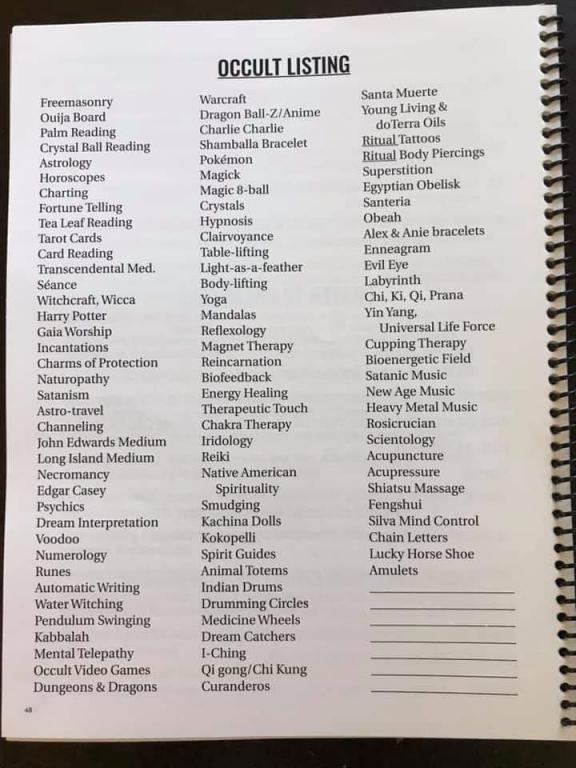
A group called Missionaries of the New Evangelization has circulated a list of “occult” practices that could lead to demonic influence. The list includes everything from freemasonry to tea leaves, dream interpretation to tarot. Some of the items on the list are the usual suspects: Harry Potter, yoga, heavy metal, and Dungeons and Dragons. Some items are simply silly, such as Pokemon.
Perhaps some of the listings could be regarded as questionable given the way historically hermetic or esoteric practices have been associated with methodologies of control, manipulation, cult behavior, violence, and even fascism. My own experience with Christian cult thinking has made me wary of many ritual practices that are intended to grant power or manipulate events, as well as with signs and wonders, or secret teachings.
Just because a practice is not per se demonic doesn’t mean it is wholesome or without the possibility of abuse. For a good humanist study on how hermetic practice can be dangerous, I refer you to Umberto Eco’s magnificent novel Foucault’s Pendulum.
Racist prejudice
My issue with lists like this is not that everything on it is in fact benevolent or harmless or just silly. It’s that there is invariably a racist dimension to the fear of “demonic influence” given that a disproportionate number of practices listed are specifically non-white, non-western, non-European.
Because many items on the demon-list are not arcane practices in the bizarre backwaters of religious decadence, not part of niche cults, but are actual central or mainstream religious traditions of cultures not our own. I’ve long noticed this with the fear of spiritual practices connected with yoga. Why should the religion of Eastern peoples be so especially dangerous? Why would it be automatically more fearsome than invoking the muse or goddess at the beginning of a Homeric epic, or depicting Christ as Apollo in Renaissance art? The main trend seems to be a racist reaction to the otherness, the non-whiteness, or eastern traditions,
And this particular list includes not only yoga, but also Native American spirituality, drumming circles, I-Ching, mediine wheels, mandalas, Yin-Yang, Fengshui, Chakra therapy, and even – to add a touch of anti-semitism – Kabbalah. As my friend and fellow Patheos columnist Mindy Selmys stated, “this isn’t about protecting yourself from demonic influences, it’s about maintaining a worldview that is Eurocentric while demonizing other cultures.”
And this is especially shameful considering how often Christian settlers in the Americas used their religion as an excuse to harm and persecute native peoples. Given our shameful colonial tradition and how implicated our religion is in acts of violent genocide, we should not be demonizing non-white American religious traditions today.
In general, a lot of what looks occult and freaky to an outsider is often simply religious ritual, a fundamentally sacramental approach to nature according to which certain physical actions and objects can be viewed as connecting us with the transcendent. Catholics do it all the time. Are our practices superstitious? Maybe. Burying a St. Joseph statue on property you hope to buy looks not only like superstition, but like spell-casting.
Christianity and Magic
And this brings up the – perhaps, to some, uncomfortable – reality that in our Christian tradition at times our practices have overlapped significantly with rituals that might today be considered occult or witchcraft. This is still true today with devotions like asking St. Therese to send a rose. And it was very true in the past, before the different disciplines became separated. The teacher of St. Thomas Aquinas, Albert the Great, is renowned not only in Catholic circles as a saint and doctor of the church, but is regarded by disciples of the arcane as a master. Yes, most of the works on magic attributed to him were not his own, but his actual writings do make evident his belief in alchemy and astrology. Similarly, much that was taught by St. Hildegard of Bingen and St. Brigid would also be regarded as “witchcraft” by the perpetually afraid, today.
Now, my point is not that all religious practices are harmless. Some are, I believe, intrinsically evil: human sacrifice, for instance. Or forced conversion on pain of death. Others are perhaps neutral, with a capacity to be either beneficial or harmful, depending on how they are used.
But it’s important to educate oneself in the history of world religions before making kneejerk responses that are born largely out of a racist and xenophobic fear of the other.
Religion can be harmful.
Perhaps all religions contain within them the capacity to become dangerous, violent, and therefore evil. And not just those freaky other religions not our own. When I look at what is happening within my own church, I see influences that could very well be called “demonic.” Religion is a powerful force, and as such it can give great comfort and bring people together in unity and healing – or, conversely, do terrible damage.
The fact that human sacrifice has been practiced by so many different religions – including the revered ancient Greek religion(s) – should remind us to be wary. Violence is often linked with the sacred, as Rene Girard has explored – and whether one agrees or disagrees with his assessments, history makes the point clear.
So yes, I do think we should ask whether a particular religious practice inclines towards the evil, the destructive, the abusive – call it the “demonic” if you like. And yes, I think we should be aware of the way this can happen even within Christianity. It has happened before, with our holy wars and inquisitions. With our persecutions. And it is happening again, before our eyes, as our religious leaders use their power not to heal victims but to protect abusers.
image from facebook

Browse Our Archives
Select a Category abortion anti-semitism art Atwood Betrothed church clergy abuse coronavirus culture economics education environmentalism ethics faith family feminism gardening gun violence immigration Judaism literature MaddAddam New Pro Life Movement news pandemic personalism poem politics politics blue Pope Francis racism religion salvation sexuality social justice spirituality Station eleven Stephen King The Stand Trump Uncategorized war World Health Organization
Select a Month March 2021 February 2021 January 2021 December 2020 November 2020 October 2020 September 2020 August 2020 July 2020 June 2020 May 2020 April 2020 March 2020 February 2020 January 2020 December 2019 November 2019 October 2019 September 2019 August 2019 July 2019 June 2019 May 2019 April 2019 March 2019 February 2019 January 2019 December 2018 November 2018 October 2018 September 2018 August 2018 July 2018 June 2018 May 2018 April 2018 March 2018 February 2018 January 2018 December 2017 November 2017 October 2017 September 2017 August 2017 July 2017 June 2017 May 2017 April 2017 March 2017 February 2017 January 2017 December 2016 November 2016 October 2016 September 2016 August 2016 July 2016 June 2016 May 2016 April 2016 March 2016 February 2016
Follow Us!
TAKE THE
Religious Wisdom Quiz
What did the Israelites carry through the wilderness that symbolized God's presence?
Select your answer to see how you score.
Golden Calf Ark of the Covenant Scroll of Moses Burning torch
Support this
Column


Related posts from suspended in her jar

Four Takeaways from Oprah’s Interview with the Duke...

Catholics Are De-Toxing From their Experiences With Traumatic...

How Has the Pandemic Changed Us? Has It...

Rush Limbaugh Would Never Have Succeeded In an...
TRENDING AT PATHEOS Catholic

Rejecting Doom: Christian Hope And Human Action
Christianity is a religion of hope. We are to have hope and...

It’s What Comes From Within Which Matters
One of the most difficult things for us to understand is why...

Why I Choose the Eucharist Over the Sermon
Choose the Eucharist, Not the Sermon What are we supposed to get...

5 Design Elements Found in Spiritually Rooted Homes
Putting Spirituality Into Home Decor Our homes are more than our living...

Credo: A Story of God Told with the...
About 10 years ago, I began to imagine a personal "Credo" that...

The Anatomy of Divine Revelation in Catholic Thought
The claim that God has made Himself known to human beings is...
view all Catholic blogs
Ad-Free & Subscriber Log-In Subscription Support
- About Us
- 2026 Calendar
- Videos
- Podcasts
- Library of World Religions
- Faith In Media Tracker
- Advertise With Us
- Write for Us
- Privacy Policy
- Terms of Service
- Do Not Sell My Data
- Contact Us
- Radiant Digital
- Manage Newsletter Subscriptions
- Unsubscribe From Notifications
- Sitemap
Copyright 2008-2026, Patheos. All rights reserved.
Subscription Support Ad-Free & Subscriber Log-In
Follow Patheos