
BuddhistCatholicContemplativeEvangelicalGeneral ChristianHinduJewishLatter-day SaintMuslimNew VisionsProgressive Christian
Beliefs
- Buddhist
- Catholic
- Contemplative
- Evangelical
- General Christian
- Hindu
- Jewish
- Latter-day Saint
- More Voices
- Muslim
- New Visions
- Pagan
- Progressive Christian
Topics
- Religion News
- Food and Religion
- Sports and Religion
- Religious Art
- Religious Music and Entertainment
- Religious Events
- History and Religion
- Style and Religion
- Politics and Religion
- Women in Religion
- Recreation Outdoors and Religion
- Business Finance and Religion
- Careers Workplace and Religion
- Education and Religion
- Family Parenting and Religion
- Health Fitness and Religion
- Home and Religion
- Relationships and Religion
- Technology and Religion
- Travel and Religion
Columnists
- Buddhist Columnists
- Business Finance and Religion Columnists
- Careers Workplace and Religion Columnists
- Catholic Columnists
- Contemplative Columnists
- Education and Religion Columnists
- Evangelists Columnists
- Family Parenting and Religion Columnists
- General Christian Columnists
- Health Fitness and Religion Columnists
- Hindu Columnists
- History and Religion Columnists
- Home and Religion Columnists
- Jewish Columnists
- More Voices Columnists
- Latter Day Columnists
- Muslim Columnists
- New Visions Columnists
- Nonreligious Columnists
- Pagan Columnists
- Politics and Religion Columnists
- Progressive Columnists
- Recreation Outdoors and Religion Columnists
- Relationships and Religion Columnists
- Religion News Columnists
- Religious Art Columnists
- Religious Events Columnists
- Religious Music and Entertainment Columnists
- Sports and Religion Columnists
- Style and Religion Columnists
- Technology and Religion Columnists
- Travel and Religion Columnists
- Women in Religion Columnists
Resource Library
- 2026 Calendar
- Library of World Religions
- The 100 Most Holy Places on Earth
- Patheos Answers
- Podcasts
- Videos
- Faith Leaders Database
- Anglican Episcopalian
- Bahai
- Baptist
- Buddhism
- Christianity
- Confucianism
- Eastern Orthodoxy
- Hinduism
- Holiness and Pentecostal
- ISKCON
- Islam
- Judaism
- Lutheran
- Methodist
- The Church of Jesus Christ of Latter-day Saints
- New Age
- Paganism
- Presbytarian and Reformed
- Protestantism
- Religion Behind the Scenes
- Roman Catholic
- Scientology
- Shia Islam
- Sikhism
- Sufism
- Sunni Islam
- Taoism
- Zen
- See all religions
Research Tools
 Ad-Free & Subscriber Log-In Subscription Support
Ad-Free & Subscriber Log-In Subscription Support
Follow Patheos 

- Trending:
- Forgiveness
- |
- Marriage
- |
- Consciousness
- |
- Death Penalty
- |
- Election
- |
- Halloween
 suspended in her jar
- Home
- Catholic
- It’s Not the Church That Has Let Me Down – It’s the Clergy
It’s Not the Church That Has Let Me Down – It’s the Clergy
Last updated on: June 30, 2019 at 12:31 am by Guest Contributor
It’s Not the Church That Has Let Me Down – It’s the Clergy 2019-06-30T00:31:21-04:00 Guest Contributor
Patheos Explore the world's faith through different perspectives on religion and spirituality! Patheos has the views of the prevalent religions and spiritualities of the world.
By guest writer William M. Shea
James Carroll’s recent essay on the priesthood in The Atlantic, the critical responses by Thomas Reese and James Martin (NCR), and the tempered comments by Donald Cozzens (NCR) indicate to me that the discussion of reform has taken a significant turn. We seem now to be asking questions about the structure of authority in the Roman Catholic church rather than only about sin and how to counter it. The pope and bishops, for all their admirable attempt to amplify the reporting and handling of changes of abuse and cover-up by bishops, are struggling to keep the reform urges inside the boundaries of the received structures of authority, i.e., there are to be no independent lay bodies to open and review cases. All is to remain under hierarchical control.
In my own reading experience it was Garry Wills’ book, Why Priests? A Failed Tradition (2013) that decisively kicked open the door on the dissolution of the clericalism and hierarchism that, in my view, plague the Catholic church and, one way or another, most of the Christian churches, none of which has found an ideal solution. This intensified discussion in the last decade is fraught with many dangers, I admit. Even I, a retired and increasingly breathless old man, have been accused of apostasy by the renowned archbishop of Philadelphia for my memoir, Judas Was a Bishop (2015).
A corrupt leadership
Strident attacks on the institutional and organizational side of the church is something I might be accused of, but my attacks are not on institution or organization (I’m unreservedly in favor of institutions and organizations) but on the office holders because they have been morally at fault in the horrendous case of child abuse and a good number of other things, including despicable and cowardly abuse of theologians over the last four decades.[1] Leaders, maybe even ordained leaders, are necessary, and much of the job description of a Catholic bishop meets real needs of the Catholic people. In the recent case of sexual abuse (and at many other points in Catholic history) they didn’t do the right thing, and this is but a confirmation of the corruptions of clericalism. What I might justly be accused of is egalitarianism, and if that virtue is apostatic, then I am an apostate.
Christopher Hitchens stands for those many critics who are outraged there is a church at all, bishops at all, priests at all. I think the church needs serious reform and re-making but I don’t think of it as Hitchens does. The society needs the church and the church needs a Patriarch of the West (or some such), dressed down and shorn of the adulatory blather heaped upon him by himself and other Catholics. Catholics need a coordinator and a mediator. Every diocese needs a bishop, or some such. The buck must stop somewhere. Papolatry must end, not the bishop of Rome. Episcopal pretensions to divine authority need to end, not necessarily bishops (or some such). Clericalism must end, not the ministry. Christendom and the clericalist church must end, not the church or the churches.
We have always been a church of sinners
The church is what it is and thus it has been and will be forever more, a church of the redeemed sinner in a community always sinning, always reaching for holiness, always loving God and its neighbors, always flopping on its face. Ecclesia semper reformanda est. And, with Brother Martin Luther (John Paul II called him “brother” on the 500th anniversary of his birth), Christians must say we are all simul justus et peccator. So also the church. The just man sins seven times daily, the Scriptures have it, and the pope and bishops probably seven times seventy. (Prov 24:16)
I am not a theological Protestant, though some would take me to be such. Theologically I think like a Catholic, with two basic assumptions. (1) that God is present to all of creation and to all human beings immediately, directly, silently, always, and that that Presence is experienced by us even when we don’t know it; (2) that the meaning of that immediate Presence is mediated to us through our experience in nature, history and culture, especially through Christ’s church (Revelation) – even through Dawkins, Hitchens and their tribe. This is the sacramental principle that forms the substance of Catholic religious experience, especially displayed in worship, sacrament and service to the poor. But neither The Church (i.e. the episcopal caste) nor the church (all of us together) has a monopoly on God’s grace. I had a greyhound friend, Bridget by name, who mediated God’s grace to me morning and evening and in between, and she was not even a Catholic much less a bishop. When I watched her sleep (she slept about twenty hours a day) I meditated on the glory of God shinning in her. She, too, was a gift of God meant to bring before my soul the giftedness of human and animal living and the beauty of the One who is not seen. Alas, I am too old now to have a friend who needs a walk and must be satisfied with the trees outside my window which don’t and the crucifix on my wall.
The church as a home – an imperfect home
For all its flaws, vicious as some of them are, the Catholic Church is the source of my thought and hopes, and remains my spiritual home. “To whom shall we go?” (Jn 6:68-69) ) To the well from which I have drawn for seventy years, with growing conviction that I find there the wisdom not only of Jesus but of the authentic disciples, pearls too often buried in a pile of ecclesiastical horse pucky. On Sunday I listened to the Scriptures, heard a sermon and received the Eucharist. I do not forget the saints, or my parents and grandparents as far back as anyone could wish, my friends, my teachers, my parish, the hundreds of admirable priests I have met. To be truthful I worry that I am more of a Catholic than I am a Christian. The church remains the source of the standards and values I cling to even when I do not meet and act on them.
The church has not let me down but popes and bishops have, too often and too deeply. I wish I could say that the difference between them and me is a minor matter of policy or practice but it is not. At bottom, they believe they are special instruments chosen and appointed by God and I don’t think they are special in the least. Surely they are no more special than Bridget, my greyhound. Perhaps had I the opportunity to watch a bishop nap I would catch a glimpse of the glory of God. I don’t when I see them parading in the vestments of a fourth century Roman governor. Too much of my church leadership seems now to be a production of Cecil B. D’Mille. There must be an end to it.
[1] Bradford Hinze, “A Decade of Disciplining Theologians,” Horizons: The Journal of the College Theology Society 37 (Spring 2010): 92-126. Benedict XVI was more interested in shutting up dissenting theologians than protecting children. SIZEMORE AND LAWLER
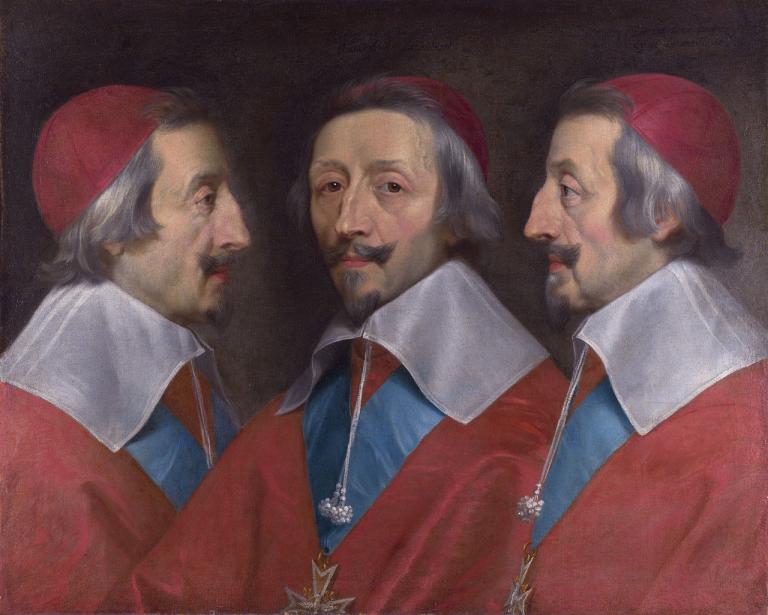
image credit: https://en.wikipedia.org/wiki/Cardinal_Richelieu#/media/File:Triple_Portrait_of_Cardinal_de_Richelieu_probably_1642,_Philippe_de_Champaigne.jpg
Previous Post
June 22, 2019
On the Need for Radical Moral Reform of the Clergy
Next Post
July 5, 2019 Is Reform Possible, Within the Current Institutional Structure of the Church?
Browse Our Archives
Select a Category abortion anti-semitism art Atwood Betrothed church clergy abuse coronavirus culture economics education environmentalism ethics faith family feminism gardening gun violence immigration Judaism literature MaddAddam New Pro Life Movement news pandemic personalism poem politics politics blue Pope Francis racism religion salvation sexuality social justice spirituality Station eleven Stephen King The Stand Trump Uncategorized war World Health Organization
Select a Month March 2021 February 2021 January 2021 December 2020 November 2020 October 2020 September 2020 August 2020 July 2020 June 2020 May 2020 April 2020 March 2020 February 2020 January 2020 December 2019 November 2019 October 2019 September 2019 August 2019 July 2019 June 2019 May 2019 April 2019 March 2019 February 2019 January 2019 December 2018 November 2018 October 2018 September 2018 August 2018 July 2018 June 2018 May 2018 April 2018 March 2018 February 2018 January 2018 December 2017 November 2017 October 2017 September 2017 August 2017 July 2017 June 2017 May 2017 April 2017 March 2017 February 2017 January 2017 December 2016 November 2016 October 2016 September 2016 August 2016 July 2016 June 2016 May 2016 April 2016 March 2016 February 2016
Follow Us!
TAKE THE
Religious Wisdom Quiz
According to Jesus, "Blessed are those who hunger and thirst for." what?
Select your answer to see how you score.
Money Righteousness Popularity Power
Support this
Column


Related posts from suspended in her jar

Four Takeaways from Oprah’s Interview with the Duke...

Catholics Are De-Toxing From their Experiences With Traumatic...

How Has the Pandemic Changed Us? Has It...

Rush Limbaugh Would Never Have Succeeded In an...
TRENDING AT PATHEOS Catholic

Rejecting Doom: Christian Hope And Human Action
Christianity is a religion of hope. We are to have hope and...

It’s What Comes From Within Which Matters
One of the most difficult things for us to understand is why...

Why I Choose the Eucharist Over the Sermon
Choose the Eucharist, Not the Sermon What are we supposed to get...

5 Design Elements Found in Spiritually Rooted Homes
Putting Spirituality Into Home Decor Our homes are more than our living...

Credo: A Story of God Told with the...
About 10 years ago, I began to imagine a personal "Credo" that...

The Anatomy of Divine Revelation in Catholic Thought
The claim that God has made Himself known to human beings is...
view all Catholic blogs
Ad-Free & Subscriber Log-In Subscription Support
- About Us
- 2026 Calendar
- Videos
- Podcasts
- Library of World Religions
- Faith In Media Tracker
- Advertise With Us
- Write for Us
- Privacy Policy
- Terms of Service
- Do Not Sell My Data
- Contact Us
- Radiant Digital
- Manage Newsletter Subscriptions
- Unsubscribe From Notifications
- Sitemap
Copyright 2008-2026, Patheos. All rights reserved.
Subscription Support Ad-Free & Subscriber Log-In
Follow Patheos