
BuddhistCatholicContemplativeEvangelicalGeneral ChristianHinduJewishLatter-day SaintMuslimNew VisionsProgressive Christian
Beliefs
- Buddhist
- Catholic
- Contemplative
- Evangelical
- General Christian
- Hindu
- Jewish
- Latter-day Saint
- More Voices
- Muslim
- New Visions
- Pagan
- Progressive Christian
Topics
- Religion News
- Food and Religion
- Sports and Religion
- Religious Art
- Religious Music and Entertainment
- Religious Events
- History and Religion
- Style and Religion
- Politics and Religion
- Women in Religion
- Recreation Outdoors and Religion
- Business Finance and Religion
- Careers Workplace and Religion
- Education and Religion
- Family Parenting and Religion
- Health Fitness and Religion
- Home and Religion
- Relationships and Religion
- Technology and Religion
- Travel and Religion
Columnists
- Buddhist Columnists
- Business Finance and Religion Columnists
- Careers Workplace and Religion Columnists
- Catholic Columnists
- Contemplative Columnists
- Education and Religion Columnists
- Evangelists Columnists
- Family Parenting and Religion Columnists
- General Christian Columnists
- Health Fitness and Religion Columnists
- Hindu Columnists
- History and Religion Columnists
- Home and Religion Columnists
- Jewish Columnists
- More Voices Columnists
- Latter Day Columnists
- Muslim Columnists
- New Visions Columnists
- Nonreligious Columnists
- Pagan Columnists
- Politics and Religion Columnists
- Progressive Columnists
- Recreation Outdoors and Religion Columnists
- Relationships and Religion Columnists
- Religion News Columnists
- Religious Art Columnists
- Religious Events Columnists
- Religious Music and Entertainment Columnists
- Sports and Religion Columnists
- Style and Religion Columnists
- Technology and Religion Columnists
- Travel and Religion Columnists
- Women in Religion Columnists
Resource Library
- 2026 Calendar
- Library of World Religions
- The 100 Most Holy Places on Earth
- Patheos Answers
- Podcasts
- Videos
- Faith Leaders Database
- Anglican Episcopalian
- Bahai
- Baptist
- Buddhism
- Christianity
- Confucianism
- Eastern Orthodoxy
- Hinduism
- Holiness and Pentecostal
- ISKCON
- Islam
- Judaism
- Lutheran
- Methodist
- The Church of Jesus Christ of Latter-day Saints
- New Age
- Paganism
- Presbytarian and Reformed
- Protestantism
- Religion Behind the Scenes
- Roman Catholic
- Scientology
- Shia Islam
- Sikhism
- Sufism
- Sunni Islam
- Taoism
- Zen
- See all religions
Research Tools
 Ad-Free & Subscriber Log-In Subscription Support
Ad-Free & Subscriber Log-In Subscription Support
Follow Patheos 

- Trending:
- Forgiveness
- |
- Marriage
- |
- Consciousness
- |
- Death Penalty
- |
- Election
- |
- Halloween
 suspended in her jar
- Home
- Catholic
- On the Need for Radical Moral Reform of the Clergy
On the Need for Radical Moral Reform of the Clergy
Last updated on: June 22, 2019 at 12:27 pm by Guest Contributor
On the Need for Radical Moral Reform of the Clergy 2019-06-22T12:27:17-04:00 Guest Contributor
Patheos Explore the world's faith through different perspectives on religion and spirituality! Patheos has the views of the prevalent religions and spiritualities of the world.
by guest writer William M. Shea
An argument about the present structure of Catholic Church leadership and ministerial forms often takes historical and doctrinal shape. But my primary argument about the Magisterium and its teaching on church structure is moral, though the argument certainly has historical and doctrinal roots and implications. They (the Magisters, the hierarchy) have failed us, in fact betrayed us, and sinned in ways that call seriously into question both their political leadership of the church and the sacrality in which they have decked themselves. Their leadership has been exposed in the past century and previous centuries as devoid of the Holy Spirit, of courage and even decency. I’m not speaking here of peccadillos or venial sin. They have decisively messed up the churches and the system that supports them needs to be eliminated.
Bishops and the popes live in a dream world of imperial power and control. They must be rescued from the dream world if they are to live as Christians and lead churches decently. The church must be rid of clericalism and the claimed divinity of the hierarchy. Pope Francis and Pope John XXIII of happy memory and his Council, for all my admiration of them, are a decent starting point for reform but far from an adequate solution.
Now what do I mean when I charge irreparable failures? I cite a very few. A series of books would be needed to paint the whole picture:
The war on the modern world
They, the popes and their dedicated followers fought a three century war on Modernity and the Enlightenment. Sixty years after the Council and they are still fighting their war, now on secularization, relativism and the expansion of understandings of family. Their culture wars over the centuries distorted the proper role of Christian churches in the life of cultures, for the war is really over who owns and runs the world, it seems to me. The popes and bishops utterly failed to see that the Holy Spirit acts outside Catholic sacraments and sacramentals, and they largely failed to contribute the church’s strength to the construction of the “modern world.” What a god-awful and deeply self-interested war! And the theologians who saw the war for what it was were thrown out into “exterior darkness.” (Mt. 25:30) The excommunication of the modernist theologians at the beginning of the twentieth century, the purging of seminary faculty, and the silencing of men of the quality of Teilhard de Chardin and John Courtney Murray are prime but far from the only examples.
The Jews
The Church’s and the churches’ millennium long religious hatred of Jews and Judaism was transformed into the racial anti-Semitism of the Nazis, and lent rhetorical substance to the effort to kill all the Jews in Europe. To boot, the churches in Germany and elsewhere, and the popes, in nearly complete silence watched as millions of Jews disappeared. It is the sin against the Holy Spirit. (Mk 3:28). Attack Jews and you attack Jesus, His mother and the Twelve. Who could miss that?
The children
Thousands of American children, tens, perhaps hundreds of thousands of Catholic children and young people worldwide, have been abused by Catholic priests and bishops. Some bishops have been abusers, perhaps many, and most kept a lid on the scandal for decades. If this is not the height of corruption, it would be hard to say what is (MT 18:1-9). The silence of the lower clergy in the face of perversion of many of their colleagues doesn’t mystify me. I was trained to be one of them for eight years and was among them for almost two decades. However, I don’t think you can call ignorance ‘deliberate silence’ unless the ignorance is willful. The high clergy, including the bishops of Rome, knew perfectly well what was going on with children, certainly for decades, probably always. That much is clear from the record. Google the work of Thomas Doyle among others such as Jason Berry.
This silence of those who knew, bishops especially, was born of (a) a cultivated tendency to protect the brethren from exposure (clerical class loyalty), (b) the unwritten law demanding the avoidance of any scandal injuring the good name of the Church, and (c) the conviction that pederasty is a sin rather than a crime or a psychological state, and so must be forgiven rather than reported and punished, and (d) simple and colossal moral blindness. Bing Crosby would never have turned Barry Fitzgerald in to the cops. Neither would Des Spellacy (Robert DiNero) have made a fuss over his favorite pastor (Burgess Meredith), had the latter been an abuser. I myself might have gone to the appropriate bishop in New York and left it on his desk, returning to the rectory feeling that I had discharged my duty. Never would going to the police have been a live option. Secret sins, including my own, were to be kept secret lest scandal ensue.
The lower clergy were genuinely ignorant, perhaps in some cases willfully so. As a priest for twenty years (1961-1980) during the peak years of pederasty and ephebophilia I knew nothing of it with a couple of exceptions: a widely publicized news story in 1969 about the incarceration of a New York diocesan priest for serial rape of children and clerical rumors that a couple of seminary classmates of mine were removed from their high school teaching positions for abuse of teenage boys. When I learned of the first I did not take it to be symptomatic of a wider problem. I spent four years in Cardinal Hayes High School as a student (1949-1953) and never heard a breath of scandal. I never met another kid who claimed to have been abused. Not until 2009 did I encounter online the list of New York priests who were suspended, laicized or on leave from the priesthood for abusing children.
Fourteen of them had been in seminary with me.
I had read that some priests had ongoing relationships with adult women, and I did not suspect at the time that even this was widespread in the U.S. I imagined I was in a tiny minority of sinners not living up to ideal of chastity. I didn’t even take the Father Gilbert Gauthe case (Louisiana, 1984) as a harbinger of a much larger and widespread condition until the problem had a second go round in the media in 2002 when the Boston Globe exposed abuse of hundreds of children by over seventy priests in Boston and Fall River. I ignored the expanding literature on the problem aside from a few articles in the National Catholic Reporter. Culpable ignorance? Probably. To borrow John Dean’s words to Richard Nixon, there was a cancer growing on the church and I paid it no heed as I struggled with my own problem with loneliness and celibacy.
But would I have kept my mouth shut had I known more? Surely the training I received would have kept me from raising questions even when the provocations were staring me in the face: you never do or say what can damage the reputation of the church. My own sins in regard to chastity would have made me the last person in the clergy in a position to point a finger. My strong tendency to introversion would keep me from engaging in any public action; I am an extrovert only on special occasions and when it is safe. Finally, I had reason to think that the bishops were doing the job they were appointed to do, looking after children and overseeing priests and religious.
Strident attacks on the institutional and organizational side of the church is something I might well be accused of, but my attacks are not on institution or organization (I’m in favor of institutions and organizations) but on the office holders and their blatant claims to sacrality, and surely not because they are “in charge” but because they have been morally at fault in the horrendous case of child abuse and a good number of other things. The gap between claims and actions is too wide to be borne in silence any longer. Keep the faith and reform the church!
I recognize that my views are vulnerable in at least these respects:
(1) Doctrinal: The dogmatic definitions of church structure which definitely favor the received version of authority, including those of Vatican II, are clear. My views just as clearly depart from them.
(2) Historical: My readings of the history of orders in the church are secondary rather than primary. I am not an historian for the church; rather I am an ordinary reader of some books.
(3) Prospective: I really do not have a clear idea of what might replace the hierarchical/clericalist culture of the church, meaning the baby might go out with the scummy bathwater.
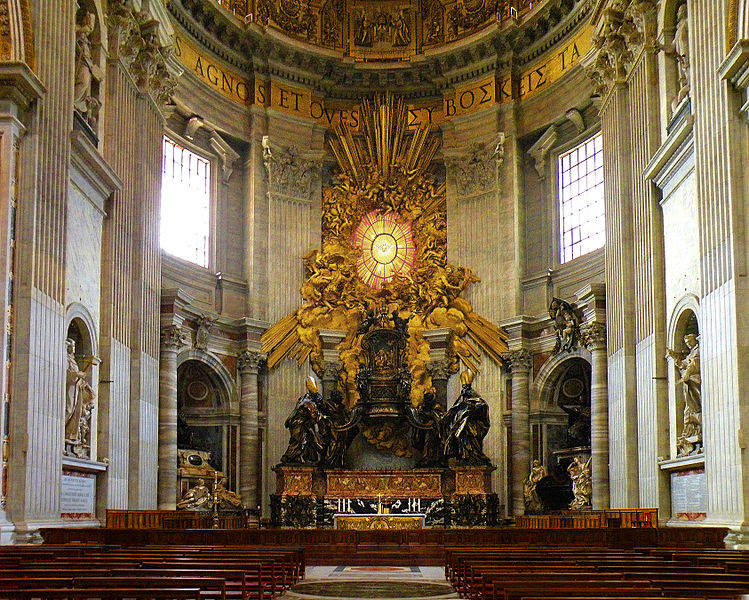
image credit: https://commons.wikimedia.org/wiki/File:The_Chair_of_Saint_Peter_adjusted.JPG
Next Post

June 30, 2019 It's Not the Church That Has Let Me Down - It's the Clergy
Browse Our Archives
Select a Category abortion anti-semitism art Atwood Betrothed church clergy abuse coronavirus culture economics education environmentalism ethics faith family feminism gardening gun violence immigration Judaism literature MaddAddam New Pro Life Movement news pandemic personalism poem politics politics blue Pope Francis racism religion salvation sexuality social justice spirituality Station eleven Stephen King The Stand Trump Uncategorized war World Health Organization
Select a Month March 2021 February 2021 January 2021 December 2020 November 2020 October 2020 September 2020 August 2020 July 2020 June 2020 May 2020 April 2020 March 2020 February 2020 January 2020 December 2019 November 2019 October 2019 September 2019 August 2019 July 2019 June 2019 May 2019 April 2019 March 2019 February 2019 January 2019 December 2018 November 2018 October 2018 September 2018 August 2018 July 2018 June 2018 May 2018 April 2018 March 2018 February 2018 January 2018 December 2017 November 2017 October 2017 September 2017 August 2017 July 2017 June 2017 May 2017 April 2017 March 2017 February 2017 January 2017 December 2016 November 2016 October 2016 September 2016 August 2016 July 2016 June 2016 May 2016 April 2016 March 2016 February 2016
Follow Us!
TAKE THE
Religious Wisdom Quiz
What does "Moses" mean?
Select your answer to see how you score.
Drawn Out (of water) Born Amid Trouble Gifted Rescued
Support this
Column


Related posts from suspended in her jar

Immigrants: They Need Us, and We Need Them

Four Takeaways from Oprah’s Interview with the Duke...

Catholics Are De-Toxing From their Experiences With Traumatic...

How Has the Pandemic Changed Us? Has It...
TRENDING AT PATHEOS Catholic

The Parable Of The Sower And The Word...
One of Christ’s most famous parables is that of the sower who...

Rejecting Doom: Christian Hope And Human Action
Christianity is a religion of hope. We are to have hope and...

Why I Choose the Eucharist Over the Sermon
Choose the Eucharist, Not the Sermon What are we supposed to get...

5 Design Elements Found in Spiritually Rooted Homes
Putting Spirituality Into Home Decor Our homes are more than our living...

Credo: A Story of God Told with the...
About 10 years ago, I began to imagine a personal "Credo" that...

The Anatomy of Divine Revelation in Catholic Thought
The claim that God has made Himself known to human beings is...
view all Catholic blogs
Ad-Free & Subscriber Log-In Subscription Support
- About Us
- 2026 Calendar
- Videos
- Podcasts
- Library of World Religions
- Faith In Media Tracker
- Advertise With Us
- Write for Us
- Privacy Policy
- Terms of Service
- Do Not Sell My Data
- Contact Us
- Radiant Digital
- Manage Newsletter Subscriptions
- Unsubscribe From Notifications
- Sitemap
Copyright 2008-2026, Patheos. All rights reserved.
Subscription Support Ad-Free & Subscriber Log-In
Follow Patheos