
BuddhistCatholicContemplativeEvangelicalGeneral ChristianHinduJewishLatter-day SaintMuslimNew VisionsProgressive Christian
Beliefs
- Buddhist
- Catholic
- Contemplative
- Evangelical
- General Christian
- Hindu
- Jewish
- Latter-day Saint
- More Voices
- Muslim
- New Visions
- Pagan
- Progressive Christian
Topics
- Religion News
- Food and Religion
- Sports and Religion
- Religious Art
- Religious Music and Entertainment
- Religious Events
- History and Religion
- Style and Religion
- Politics and Religion
- Women in Religion
- Recreation Outdoors and Religion
- Business Finance and Religion
- Careers Workplace and Religion
- Education and Religion
- Family Parenting and Religion
- Health Fitness and Religion
- Home and Religion
- Relationships and Religion
- Technology and Religion
- Travel and Religion
Columnists
- Buddhist Columnists
- Business Finance and Religion Columnists
- Careers Workplace and Religion Columnists
- Catholic Columnists
- Contemplative Columnists
- Education and Religion Columnists
- Evangelists Columnists
- Family Parenting and Religion Columnists
- General Christian Columnists
- Health Fitness and Religion Columnists
- Hindu Columnists
- History and Religion Columnists
- Home and Religion Columnists
- Jewish Columnists
- More Voices Columnists
- Latter Day Columnists
- Muslim Columnists
- New Visions Columnists
- Nonreligious Columnists
- Pagan Columnists
- Politics and Religion Columnists
- Progressive Columnists
- Recreation Outdoors and Religion Columnists
- Relationships and Religion Columnists
- Religion News Columnists
- Religious Art Columnists
- Religious Events Columnists
- Religious Music and Entertainment Columnists
- Sports and Religion Columnists
- Style and Religion Columnists
- Technology and Religion Columnists
- Travel and Religion Columnists
- Women in Religion Columnists
Resource Library
- 2026 Calendar
- Library of World Religions
- The 100 Most Holy Places on Earth
- Patheos Answers
- Podcasts
- Videos
- Faith Leaders Database
- Anglican Episcopalian
- Bahai
- Baptist
- Buddhism
- Christianity
- Confucianism
- Eastern Orthodoxy
- Hinduism
- Holiness and Pentecostal
- ISKCON
- Islam
- Judaism
- Lutheran
- Methodist
- The Church of Jesus Christ of Latter-day Saints
- New Age
- Paganism
- Presbytarian and Reformed
- Protestantism
- Religion Behind the Scenes
- Roman Catholic
- Scientology
- Shia Islam
- Sikhism
- Sufism
- Sunni Islam
- Taoism
- Zen
- See all religions
Research Tools
 Ad-Free & Subscriber Log-In Subscription Support
Ad-Free & Subscriber Log-In Subscription Support
Follow Patheos 

- Trending:
- Forgiveness
- |
- Marriage
- |
- Consciousness
- |
- Death Penalty
- |
- Election
- |
- Halloween
 suspended in her jar
- Home
- Catholic
- Racism in Our Stories: Getting Beyond the White Imagination
Racism in Our Stories: Getting Beyond the White Imagination
Last updated on: May 15, 2019 at 12:40 pm by Rebecca Bratten Weiss
Racism in Our Stories: Getting Beyond the White Imagination 2019-05-15T12:40:16-04:00 Rebecca Bratten Weiss
Patheos Explore the world's faith through different perspectives on religion and spirituality! Patheos has the views of the prevalent religions and spiritualities of the world.
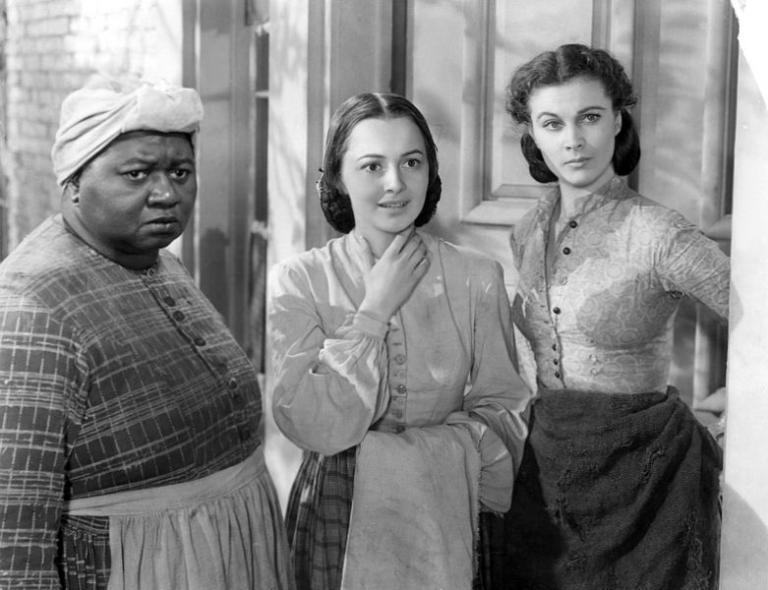
Coming in from planting sweet corn today, I glanced down at my dirty calloused hands with the jagged nails and torn cuticles, and immediately remembered that scene in Gone With the Wind, when Scarlett tries to trick Rhett into lending her money, but her work-worn hands give away the true desperation of her situation. My first thought was, “damn, I’d be screwed if I needed to convince anyone I was an idle lady.” My second thought was, “damn that scene was racist, wasn’t it?”
I’m not saying it was racist simply because Gone With the Wind is a story that presupposes and perpetuates racism.
The scene itself is racist in content as well as context, because the implication is that Scarlett, as a white “lady,” should have pristine delicate hands unmarred by labor. That labor should be done by slaves. In laboring the way a “field hand” does, Scarlett has lowered herself from her rightful place as a white woman in a plantation-owning family. The entire panoply of upper-class southern ladihood was an advertisement of status as non-laborer – a status achieved specifically due to her holding human chattel.
As a character in a Faulkner story points out, the pretty whiteness of the plantation house is made possible by the sweat of slaves.
Whiteness as Default
Ten years ago, I would have thought of that scene, and of my own work-roughened hands, only within the closed circle of the white imagination, in which the white experience is default, and even if one formally opposes racism, one remains blind to its many avenues. In the white imagination, all the main characters are white, and the introduction of a non-white character is cause for comment.
The reason that we don’t mention a character being white is that it has so long been the accepted standard that we no longer need to talk about it. Why talk about someone being white when we can talk about them slaying dragons instead? It makes sense, except when you see the opposite. If a character is black, Hispanic, Asian, Indian, or Arab, now we have to talk about it. We have to talk about their race and how that figures into their identity and the things that they do, how it affects their choices and their experiences. We refuse to talk about how being white or being heterosexual figure into your actions or decisions, and when a white person holds up a hospital, it doesn’t serve as a representation of white culture.
In Gone With the Wind, the Black characters are all slaves not only to the white slave-owners, but to the definitions and demands of the white narrator and the white audience. The white audience needs the Black characters to be appealing, lovable, sometimes even wise – and, also, absolutely devoted to their place in a white supremacist society.
Poet Claudia Rankine has written that “Blackness in the white imagination has nothing to do with black people,” and this is evident in so many of the stories generated by white society. Gone With the Wind is a pretty glaringly obvious example, as is Heart of Darkness.
Shrugging off racism
Racism, white supremacy, and anti-semitism are present in so many classics of the western canon, yet it’s easy for the white imagination to pass over them the way one would any minor irritant to be written off as a “product of the time.” Whether it’s the treatment of Jewishness in Oliver Twist, or of native peoples in the Little House books, white people are encouraged not to fuss over it. And if anyone does fuss over it, other people get mad, because we’re marring their own enjoyment of beloved stories. Stories that shaped their childhood.
It’s that shaping that’s so insidious. As long as it doesn’t directly affect us, we’re prepped from an early age to overlook rampant and systemic injustice as mere flaws. In the white imagination, oppression of the Other is simply not a huge issue, and we shouldn’t let it distract us from the conflict of the tormented heart, the heroism of the intrepid adventurer, the romance of the lost cause.
A white person in a story who does something bad to another white person becomes a villain. We like our heroes flawed, sure, but the flaws have to remain likable. Stealing someone’s inheritance? Raping a woman? Not lovable. Do this, and you’re the villain of the piece.
Unless, of course, the victim is non-white. Then the injustice done to them is merely a minor flaw. A “product of his time.”
Invisible racism
My own tenancy in the white imagination has always been unsure, because of my Jewish-ness, but I get a free pass to many of its rooms, all the same. In those rooms, the problem is not that we all overtly promote racism. It’s that we don’t notice it. And if we do we notice it specifically with a white – or white-ish – gaze. It becomes a curious problem to analyze, and more often than not the racists themselves, rather than their victims, end up being centered. We want desperately to believe that they aren’t all that bad, or if they were that they are an anomaly.
I’m reminded of one of the many semesters when I was teaching Beloved in an all-white classroom. The students, left to their own devices, would have spent the whole time trying to exonerate the white slaveowners, or even themselves. This was not conscious malice. It was simply dismay at being decentered from the story.
What if a non-white person were listening?
Conversations like that get a lot more interesting when one imagines: what if a non-white person were listening in, right now.
And then: what kind of culture is this, in which the only non-white person who could possibly be listening in is in my imagination?
And then: if the only non-white people I can hear are imaginary…
I’m sure that there are many respects in which my dominant framing of reality is still conditioned by my relative whiteness, but as a story-teller I am very grateful to the many non-white scholars and activists who have spoken out and given us the gift of enlarging and coloring our awareness. It may not be comfortable to have to look back on the stories that were dear to me as a child and engage with them on the level of the problematic rather than the satisfying, but it is necessary.
Look, I adored Gone with the Wind for years. I’ll never forget the first time I read it, how I started on the way home from the library, in the back of the car, and was too engrossed in the story even to get out. I just sat there, reading. And when it was over, I read it again, and again. But finally I had to face the reality about just how problematic the story is. How my enjoyment of it was only possible because of the privilege of my relative whiteness. Sure, I can decide to skip over the racist bits, and get on to the good stuff. But could a Black person?
It is necessary to ask this, because as long as we bracket out the realities of the non-white experience, our art is not truthful, not a genuine engagement with human reality in all its diverse complexity. We are telling one another pleasing lies, within an artificial space.
Within this artificial space, we are missing out on so much. We’re getting only a narrow vista on what it means to be human, missing out on the richness of cultures other than our own, missing out on the opportunities to find solutions to the problems that beset us.
And these lies we tell perpetuate injustice.
image credit: https://commons.wikimedia.org/wiki/File:Gone_With_The_Wind_featuring_McDaniel_%26_de_Havilland_%26_Leigh.jpg

Next Post

May 10, 2019 Women Deacons, Rachel Held Evans, and the Pushback of Patriarchy
Browse Our Archives
Select a Category abortion anti-semitism art Atwood Betrothed church clergy abuse coronavirus culture economics education environmentalism ethics faith family feminism gardening gun violence immigration Judaism literature MaddAddam New Pro Life Movement news pandemic personalism poem politics politics blue Pope Francis racism religion salvation sexuality social justice spirituality Station eleven Stephen King The Stand Trump Uncategorized war World Health Organization
Select a Month March 2021 February 2021 January 2021 December 2020 November 2020 October 2020 September 2020 August 2020 July 2020 June 2020 May 2020 April 2020 March 2020 February 2020 January 2020 December 2019 November 2019 October 2019 September 2019 August 2019 July 2019 June 2019 May 2019 April 2019 March 2019 February 2019 January 2019 December 2018 November 2018 October 2018 September 2018 August 2018 July 2018 June 2018 May 2018 April 2018 March 2018 February 2018 January 2018 December 2017 November 2017 October 2017 September 2017 August 2017 July 2017 June 2017 May 2017 April 2017 March 2017 February 2017 January 2017 December 2016 November 2016 October 2016 September 2016 August 2016 July 2016 June 2016 May 2016 April 2016 March 2016 February 2016
Follow Us!
TAKE THE
Religious Wisdom Quiz
What does Romans say is the result of justification by faith?
Select your answer to see how you score.
We become righteous We have peace with God We are saved from wrath We receive eternal life
Support this
Column


Related posts from suspended in her jar

Four Takeaways from Oprah’s Interview with the Duke...

Rush Limbaugh Would Never Have Succeeded In an...
Who Speaks for the Church? And Which Church?

Words for Those Feeling Disinherited
TRENDING AT PATHEOS Catholic

Rejecting Doom: Christian Hope And Human Action
Christianity is a religion of hope. We are to have hope and...

It’s What Comes From Within Which Matters
One of the most difficult things for us to understand is why...

Why I Choose the Eucharist Over the Sermon
Choose the Eucharist, Not the Sermon What are we supposed to get...

5 Design Elements Found in Spiritually Rooted Homes
Putting Spirituality Into Home Decor Our homes are more than our living...

Credo: A Story of God Told with the...
About 10 years ago, I began to imagine a personal "Credo" that...

The Anatomy of Divine Revelation in Catholic Thought
The claim that God has made Himself known to human beings is...
view all Catholic blogs
Ad-Free & Subscriber Log-In Subscription Support
- About Us
- 2026 Calendar
- Videos
- Podcasts
- Library of World Religions
- Faith In Media Tracker
- Advertise With Us
- Write for Us
- Privacy Policy
- Terms of Service
- Do Not Sell My Data
- Contact Us
- Radiant Digital
- Manage Newsletter Subscriptions
- Unsubscribe From Notifications
- Sitemap
Copyright 2008-2026, Patheos. All rights reserved.
Subscription Support Ad-Free & Subscriber Log-In
Follow Patheos