
BuddhistCatholicContemplativeEvangelicalGeneral ChristianHinduJewishLatter-day SaintMuslimNew VisionsProgressive Christian
Beliefs
- Buddhist
- Catholic
- Contemplative
- Evangelical
- General Christian
- Hindu
- Jewish
- Latter-day Saint
- More Voices
- Muslim
- New Visions
- Pagan
- Progressive Christian
Topics
- Religion News
- Food and Religion
- Sports and Religion
- Religious Art
- Religious Music and Entertainment
- Religious Events
- History and Religion
- Style and Religion
- Politics and Religion
- Women in Religion
- Recreation Outdoors and Religion
- Business Finance and Religion
- Careers Workplace and Religion
- Education and Religion
- Family Parenting and Religion
- Health Fitness and Religion
- Home and Religion
- Relationships and Religion
- Technology and Religion
- Travel and Religion
Columnists
- Buddhist Columnists
- Business Finance and Religion Columnists
- Careers Workplace and Religion Columnists
- Catholic Columnists
- Contemplative Columnists
- Education and Religion Columnists
- Evangelists Columnists
- Family Parenting and Religion Columnists
- General Christian Columnists
- Health Fitness and Religion Columnists
- Hindu Columnists
- History and Religion Columnists
- Home and Religion Columnists
- Jewish Columnists
- More Voices Columnists
- Latter Day Columnists
- Muslim Columnists
- New Visions Columnists
- Nonreligious Columnists
- Pagan Columnists
- Politics and Religion Columnists
- Progressive Columnists
- Recreation Outdoors and Religion Columnists
- Relationships and Religion Columnists
- Religion News Columnists
- Religious Art Columnists
- Religious Events Columnists
- Religious Music and Entertainment Columnists
- Sports and Religion Columnists
- Style and Religion Columnists
- Technology and Religion Columnists
- Travel and Religion Columnists
- Women in Religion Columnists
Resource Library
- 2026 Calendar
- Library of World Religions
- The 100 Most Holy Places on Earth
- Patheos Answers
- Podcasts
- Videos
- Faith Leaders Database
- Anglican Episcopalian
- Bahai
- Baptist
- Buddhism
- Christianity
- Confucianism
- Eastern Orthodoxy
- Hinduism
- Holiness and Pentecostal
- ISKCON
- Islam
- Judaism
- Lutheran
- Methodist
- The Church of Jesus Christ of Latter-day Saints
- New Age
- Paganism
- Presbytarian and Reformed
- Protestantism
- Religion Behind the Scenes
- Roman Catholic
- Scientology
- Shia Islam
- Sikhism
- Sufism
- Sunni Islam
- Taoism
- Zen
- See all religions
Research Tools
 Ad-Free & Subscriber Log-In Subscription Support
Ad-Free & Subscriber Log-In Subscription Support
Follow Patheos 

- Trending:
- Forgiveness
- |
- Marriage
- |
- Consciousness
- |
- Death Penalty
- |
- Election
- |
- Halloween
 suspended in her jar
- Home
- Catholic
- The Church Leaders Prioritize Their Own Authority Over Service to the People of God
The Church Leaders Prioritize Their Own Authority Over Service to the People of God
Last updated on: February 24, 2019 at 12:43 am by Rebecca Bratten Weiss
The Church Leaders Prioritize Their Own Authority Over Service to the People of God 2019-02-24T00:43:22-04:00 Rebecca Bratten Weiss
Patheos Explore the world's faith through different perspectives on religion and spirituality! Patheos has the views of the prevalent religions and spiritualities of the world.
Catholic News Service reported on the opening of the Vatican Summit:
Opening the Vatican summit on child protection and the clerical sexual abuse crisis, Pope Francis said, “The holy people of God are watching and are awaiting from us not simple, predictable condemnations, but concrete and effective measures” to stop abuse.
I don’t know that I am comfortable identifying as one of the “holy people of God,” but I am watching, along with millions of others. And I can’t say that I am watching with great hope or faith in our hierarchical leaders to sort this out.
This is not to say that I think bringing in laypersons would be kind of magical fix, because the cult of power and secrecy that we refer to as “clericalism” is enabled by many laypersons. I don’t even think that introducing women’s voices into the college of cardinals would itself be a guarantee of reform – though it is worth doing on its own right – because women can uphold and defend clericalism, and promote systems of supremacy, as well as men can.
Unless the culture of clericalism is toppled, one can guarantee that any woman selected to join the ranks of the elite would be carefully vetted to ensure that she would continue to promote the hierarchical agenda.
And unfortunately, to those of us who are watching – holy or not – the heart of that agenda has been made very clear. Over and over, in spite of lessons we should have learned from the past, the church’s leaders have prioritized ecclesial power over the good of persons. Victims and whistle-blowers have been accused of “causing scandal” – as though the true scandal were not the abuse itself.
Evidence Destroyed Deliberately
And now we hear from Germany’s Cardinal Marx that the church leaders actively destroyed files documenting abuses of children:
“Files that could have documented the terrible deeds and named those responsible were destroyed, or not even created,” said Marx, beginning a list of a number of practices that survivors have documented for years but church officials have long kept under secret.
“Instead of the perpetrators, the victims were regulated and silence imposed on them,” the cardinal continued. “The stipulated procedures and processes for the prosecution of offences were deliberately not complied with, but instead cancelled or overridden.”
The Institutional Disease
There is something about the nature of institution, especially those with an authoritarian structure, that tends towards a kind of disease of self-referentiality according to which its sole purpose in existence is simply that – to exist, to go on existing, and thus to defend itself harshly against any criticism. This is an essential condition of the nation state, as we see this in cases of nationalism and extreme patriotism, “my country, right or wrong.” You see it in white supremacy. You see it in corporatism, when a company ceases ot think of itself as existing to provide goods and services to the people, or to add something to the common good, but simply to be, to batten – to “provide value for its shareholders,” as they put it.
Persons, we understand in ethics, are ends in themselves. When institutions start regarding themselves this way, they cease to serve persons.
Latent beneath this trend towards self-referential justification, however, is a deep existential fear, which means the defenders of the institution must be forever circling the wagons, constantly ready to strike back even against legitimate criticism. Anything that could possibly make the institution look flawed must be shot down or hidden away.
The Ultimate End: Defending Its Own Authority
Fellow Patheos writer Mindy Selmys addressed this when writing about the Papal Birth Control Commission, at which it was determined that – against all the evidence to the contrary from married persons – that they needed to keep reiterating the existing teaching on contraception for fear of loss of credibility:
Frankly, I’m pretty well able to get my head around the idea that the involuntary sterilization of the disabled, the extermination of the Downs’ community in utero, and the impoverishment and isolation of women and children as a result of “sexual liberation,” are all much greater forms of suffering than struggling with NFP. And so long as I thought these were the issues at stake, I was okay with the idea of being told that I had to take my place on the front lines, and to hold my position for as long as was humanly possible. (I did, as I’ve noted earlier, have serious problems with the fact that the hierarchy sometimes seems to behave about this issue much like the high command does in Paths of Glory, but whatever.)
So, I wanted to get historical support for this thesis and naturally my research led me to the Papal Birth Control Commission.
And that’s when the I totally lost my shit.
Because the bottom line for the guys who seemed to be responsible for the decision to promulgate the teaching as it was promulgated wasn’t any of those important issues that I mentioned above. They got a mention, sure, but there were actually reasonably good arguments put forward on the other side to suggest that the Church’s ability to effectively combat the evils described above was actually going to be compromised by an overly absolutist approach to contraception.
The argument, basically, was that by reiterating a natural law argument that a) no longer corresponds to widely accepted notions of the nature of reality, b) is originally derived from faulty medical premises about how human sexuality actually works, and c) doesn’t actually make rational or logical sense, the Church’s witness would be weakened. By sticking their heels in on this point they would lose credibility and people would simply dismiss them on all points of sexual teaching. Which frankly, is in fact what has happened.
I don’t know if Paul VI could actually have prevented that by producing a different document. I do know that the critics of the approach taken in Humanae Vitae correctly predicted the outcome.
But that wasn’t the real problem. The real sticking point, the thing that made me angry, was that finally someone had said “Hey, let’s actually ask some married people…and even (shock horror) some women how this stuff works before we pontificate about it.” And they did. And the married people, especially the women, said “This does not work like you have always said it does. At all. This is ruining my life/my marriage/my children’s lives. It DOES NOT WORK!”
And they said it clearly, cogently and persuasively enough that the commission – a commission that was still dominated by clergy and theologians – voted overwhelmingly that the teaching both could change, and needed to change.
Out of 72 members, only 7 remained unconvinced. All of them were celibate clergy.
They spelled out the reason quite explicitly in their minority report:
If it should be declared that contraception is not evil in itself, then we should have to concede frankly that the Holy Spirit had been on the side of the Protestant churches in 1930 [when Casti Connubii was promulgated] and in 1951.
It should likewise have to be admitted that for a half a century the Spirit failed to protect Pius XI, Pius XII, and a large part of the Catholic hierarchy from a very serious error. This would mean that the leaders of the Church, acting with extreme imprudence, had condemned thousands of innocent human acts, forbidding, under pain of eternal damnation, a practice which would now be sanctioned. The fact can neither be denied nor ignored that these same acts would now be declared licit on the grounds of principles cited by the Protestants, which Popes and Bishops have either condemned, or at least not approved.
In other words: if we admitted that we were wrong it would make us look bad, it would make the Protestants look good, and it would undermine our authority.
That was the bottom line. Not abortion. Not the casual and irresponsible use of women for men’s sexual gratification outside of marriage. Not eugenics. But the authority of men who do not ever have to bear the brunt of the teaching.
More distressingly, many of the proponents of the traditional teaching, at one time or another, openly admitted that the natural law arguments they were using didn’t actually hold up to rational scrutiny. And we have records of private correspondence showing that they were more than willing to engage in a certain amount of Machiavellian political maneuvering in order to get their agenda pushed through.
“What If We Were Wrong?”
One of the most difficult tasks in one’s journey to moral maturity is developing the ability to say “we were wrong.” The church leaders have tied themselves up in a conundrum of self-referentiality according to which it can not say this, because this would undermine its own definition – a definition it has given itself. If the church were to turn out to have been wrong in its teaching, we are informed, she will cease to be the church. All our faith will vanish, poof.
But what if the church is the church – and is also, often, wrong in its hierarchical teachings?
It’s been wrong about slavery, racism, suicide, Judaism, and treatment of dissenters. It’s been wrong in its amassing of wealth and power. And now we find it has done terrible wrong to the least of these among us – and repeatedly covered up for itself precisely in order to maintain its untarnished image of pristine purity and divine authority.
Maybe we need to start considering the possibility that among the many errors of the hierarchy, one of the most fatal is the way in which it has defined and understood itself?
Perhaps we, the laity, need to speak up and say to the leaders: “it’s okay to admit you were wrong.”
Because our faith isn’t in them, after all. Or shouldn’t be.
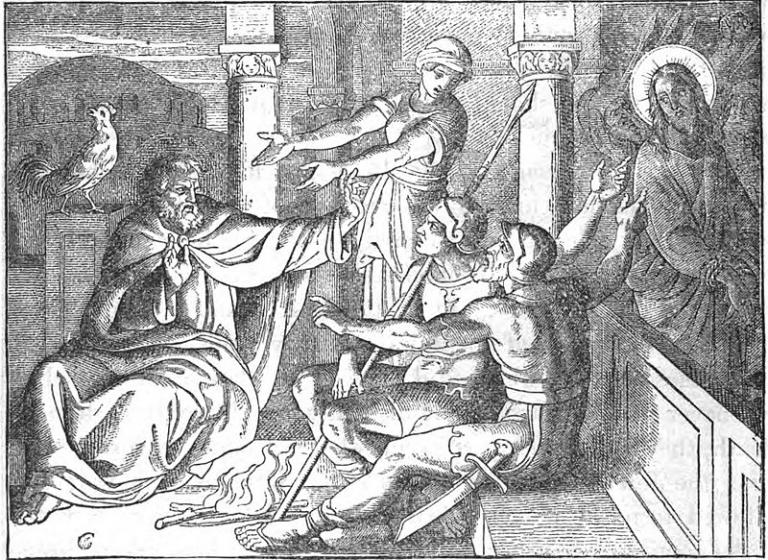
image credit: https://commons.wikimedia.org/wiki/File:Peter_denies_that_he_is_Jesus%27_disciple.jpg
Papal Birth Control Commission

Next Post

March 6, 2019 It's Okay to Base Your Friendships on Religious and Political Belief
Browse Our Archives
Select a Category abortion anti-semitism art Atwood Betrothed church clergy abuse coronavirus culture economics education environmentalism ethics faith family feminism gardening gun violence immigration Judaism literature MaddAddam New Pro Life Movement news pandemic personalism poem politics politics blue Pope Francis racism religion salvation sexuality social justice spirituality Station eleven Stephen King The Stand Trump Uncategorized war World Health Organization
Select a Month March 2021 February 2021 January 2021 December 2020 November 2020 October 2020 September 2020 August 2020 July 2020 June 2020 May 2020 April 2020 March 2020 February 2020 January 2020 December 2019 November 2019 October 2019 September 2019 August 2019 July 2019 June 2019 May 2019 April 2019 March 2019 February 2019 January 2019 December 2018 November 2018 October 2018 September 2018 August 2018 July 2018 June 2018 May 2018 April 2018 March 2018 February 2018 January 2018 December 2017 November 2017 October 2017 September 2017 August 2017 July 2017 June 2017 May 2017 April 2017 March 2017 February 2017 January 2017 December 2016 November 2016 October 2016 September 2016 August 2016 July 2016 June 2016 May 2016 April 2016 March 2016 February 2016
Follow Us!
TAKE THE
Religious Wisdom Quiz
What does 2 Peter say scoffers will say in the last days?
Select your answer to see how you score.
The world will never end Jesus will never return Where is this 'coming' he promised? There is no God
Support this
Column


Related posts from suspended in her jar

Four Takeaways from Oprah’s Interview with the Duke...

Catholics Are De-Toxing From their Experiences With Traumatic...

How Has the Pandemic Changed Us? Has It...

Rush Limbaugh Would Never Have Succeeded In an...
TRENDING AT PATHEOS Catholic

Rejecting Doom: Christian Hope And Human Action
Christianity is a religion of hope. We are to have hope and...

It’s What Comes From Within Which Matters
One of the most difficult things for us to understand is why...

Why I Choose the Eucharist Over the Sermon
Choose the Eucharist, Not the Sermon What are we supposed to get...

5 Design Elements Found in Spiritually Rooted Homes
Putting Spirituality Into Home Decor Our homes are more than our living...

Credo: A Story of God Told with the...
About 10 years ago, I began to imagine a personal "Credo" that...

The Anatomy of Divine Revelation in Catholic Thought
The claim that God has made Himself known to human beings is...
view all Catholic blogs
Ad-Free & Subscriber Log-In Subscription Support
- About Us
- 2026 Calendar
- Videos
- Podcasts
- Library of World Religions
- Faith In Media Tracker
- Advertise With Us
- Write for Us
- Privacy Policy
- Terms of Service
- Do Not Sell My Data
- Contact Us
- Radiant Digital
- Manage Newsletter Subscriptions
- Unsubscribe From Notifications
- Sitemap
Copyright 2008-2026, Patheos. All rights reserved.
Subscription Support Ad-Free & Subscriber Log-In
Follow Patheos