
BuddhistCatholicContemplativeEvangelicalGeneral ChristianHinduJewishLatter-day SaintMuslimNew VisionsProgressive Christian
Beliefs
- Buddhist
- Catholic
- Contemplative
- Evangelical
- General Christian
- Hindu
- Jewish
- Latter-day Saint
- More Voices
- Muslim
- New Visions
- Pagan
- Progressive Christian
Topics
- Religion News
- Food and Religion
- Sports and Religion
- Religious Art
- Religious Music and Entertainment
- Religious Events
- History and Religion
- Style and Religion
- Politics and Religion
- Women in Religion
- Recreation Outdoors and Religion
- Business Finance and Religion
- Careers Workplace and Religion
- Education and Religion
- Family Parenting and Religion
- Health Fitness and Religion
- Home and Religion
- Relationships and Religion
- Technology and Religion
- Travel and Religion
Columnists
- Buddhist Columnists
- Business Finance and Religion Columnists
- Careers Workplace and Religion Columnists
- Catholic Columnists
- Contemplative Columnists
- Education and Religion Columnists
- Evangelists Columnists
- Family Parenting and Religion Columnists
- General Christian Columnists
- Health Fitness and Religion Columnists
- Hindu Columnists
- History and Religion Columnists
- Home and Religion Columnists
- Jewish Columnists
- More Voices Columnists
- Latter Day Columnists
- Muslim Columnists
- New Visions Columnists
- Nonreligious Columnists
- Pagan Columnists
- Politics and Religion Columnists
- Progressive Columnists
- Recreation Outdoors and Religion Columnists
- Relationships and Religion Columnists
- Religion News Columnists
- Religious Art Columnists
- Religious Events Columnists
- Religious Music and Entertainment Columnists
- Sports and Religion Columnists
- Style and Religion Columnists
- Technology and Religion Columnists
- Travel and Religion Columnists
- Women in Religion Columnists
Resource Library
- 2026 Calendar
- Library of World Religions
- The 100 Most Holy Places on Earth
- Patheos Answers
- Podcasts
- Videos
- Faith Leaders Database
- Anglican Episcopalian
- Bahai
- Baptist
- Buddhism
- Christianity
- Confucianism
- Eastern Orthodoxy
- Hinduism
- Holiness and Pentecostal
- ISKCON
- Islam
- Judaism
- Lutheran
- Methodist
- The Church of Jesus Christ of Latter-day Saints
- New Age
- Paganism
- Presbytarian and Reformed
- Protestantism
- Religion Behind the Scenes
- Roman Catholic
- Scientology
- Shia Islam
- Sikhism
- Sufism
- Sunni Islam
- Taoism
- Zen
- See all religions
Research Tools
 Ad-Free & Subscriber Log-In Subscription Support
Ad-Free & Subscriber Log-In Subscription Support
Follow Patheos 

- Trending:
- Forgiveness
- |
- Marriage
- |
- Consciousness
- |
- Death Penalty
- |
- Election
- |
- Halloween
 suspended in her jar
- Home
- Catholic
- If We Were To Keep Silent: Holocaust Remembrance Day
If We Were To Keep Silent: Holocaust Remembrance Day
Last updated on: January 27, 2019 at 11:41 pm by Rebecca Bratten Weiss
If We Were To Keep Silent: Holocaust Remembrance Day 2019-01-27T23:41:22-04:00 Rebecca Bratten Weiss
Patheos Explore the world's faith through different perspectives on religion and spirituality! Patheos has the views of the prevalent religions and spiritualities of the world.
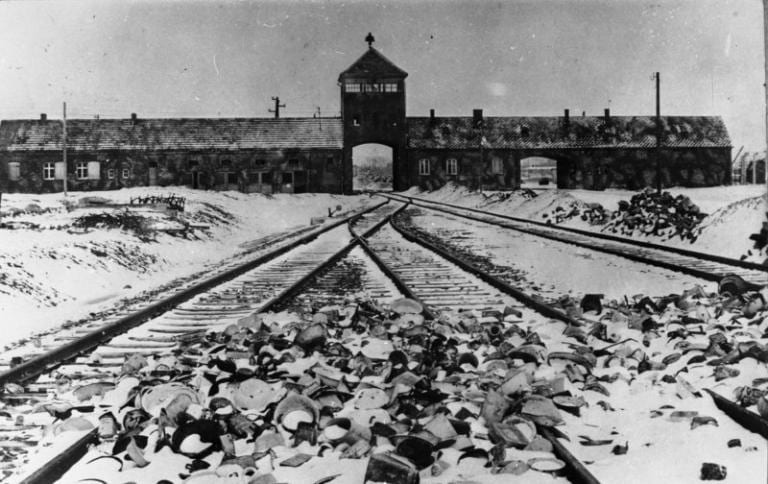
On January 27, we observe International Holocaust Remembrance Day. On this day in 1945, the Red Army liberated the prisoners held in Auschwitz-Birkenau, the largest of the Nazi death camps, but by no means the only one.
Throughout the duration of the Holocaust, an estimated six million Jews – that is, approximately one third the existing population of Jews in the world – were systematically murdered.
A meme circulating on the internet today states that if we were all to spend a moment in silence for every Jewish person murdered in the Holocaust, the world would be silent for eleven and ahalf years.
I have been thinking about silence and the Holocaust. About the millions of voices who were silenced and will never be heard, about the silence enforced by totalitarian regimes. About how silence in the face of injustice allows injustice to flourish. About the dangers of speaking out against atrocities.
One story I read told of a small child who survived Buchenwald. He was taken from his parents and put in the line of children and elderly people, to be killed, but his father was able to grab him out of the line, and hide him in a sack of tools, telling him to “be very quiet.” Reading this, I wondered, what would happen if a child were simply unable to be quiet? What remarkable freedom from fear we have, that we are able to raise children who don’t need to keep silent in order to survive.
But this freedom is precarious.
The world marked International Holocaust Remembrance Day on Sunday amid a revival of hate-inspired violence and signs that younger generations know less and less about the genocide of Jews, Roma and others during World War II.
In Poland, which was under Nazi German occupation during the war, a far-right activist who has been imprisoned for burning the effigy of a Jew gathered with other nationalists Sunday outside the former death camp of Auschwitz ahead of official ceremonies remembering the 1.1 million people murdered there.
Since last year’s observances, an 85-year-old French Holocaust survivor, Mireille Knoll, was fatally stabbed in Paris and 11 Jews were gunned down in a Pittsburgh synagogue during Shabbat services, the deadliest attack on Jews in U.S. history.
Human Rights First, a U.S. organization, recalled those killings and warned that “today’s threats do not come solely from the fringe.”
“In places such as Hungary and Poland, once proudly democratic nations, government leaders are traveling the road to authoritarianism,” said Ira Forman, the group’s senior adviser for combating anti-Semitism. “As they do so, they are distorting history to spin a fable about their nations and the Holocaust.”
As an ethnic Jew, I have watched the return of anti-semitism, mostly on the far right, but present on the far left as well, for several years. I saw it today, when I went on Twitter and saw Jewish writers and intellectuals bombarded with messages of hate.
The other thing I see is indifference. People don’t want to think about it, because it is unpleasant, or they think we’re all making too big a deal about something that is only on the fringe. They tell me the antisemites on the internet are just trolling.
But anti-semitism isn’t something new, created in the dark corners of the web among the bots and trolls. Its roots lie deep in our past, and what we see on Twitter or 4chan is just one of its branches. The formal anti-semitism of the Third Reich did not come out of nowhere, after all. It drew upon prejudices that fermented in the wake of the First World War, which themselves grew out of traditions of hatred and demonization centuries old. And Christianity, far from being a defender of the Jewish people, was often an instigator of violence, or even an aggressor. While the magisterial leaders of the church have formally distanced themselves from past prejudices, there remain many in the church who ignore the teachings in Nostra Aetate in favor of older, less tolerant ideas. Even today, a number of Catholic hard-right organizations and individuals continue to advance anti-semitic ideologies, such as Feeneyism.
According to the Holocaust Encyclopedia:
Sometimes called “the longest hatred,” antisemitism has persisted in many forms for over two thousand years. The racial antisemitism of the National Socialists (Nazis) took hatred of Jews to a genocidal extreme, yet the Holocaust began with words and ideas: stereotypes, sinister cartoons, and the gradual spread of hate.
In the first millennium of the Christian era, leaders in the European Christian (Catholic) hierarchy developed or solidified as doctrine ideas that: all Jews were responsible for the crucifixion of Christ; the destruction of the Temple by the Romans and the scattering of the Jewish people was punishment both for past transgressions and for continued failure to abandon their faith and accept Christianity.
In the tenth and eleventh centuries, these doctrines about Jews were hardened and unified in part because of the following: threat to the Church hierarchy from the impending split between Roman Catholicism and Greek Orthodoxy (1054); successive waves of Muslim conquest; end of millennium fervor; successes in converting the heathen ethnic groups of northern Europe; and military-spiritual zeal of the Crusades.
Seeking to retain their beliefs and culture, Jews became bearers of the only minority religion on a now Christian continent of Europe. In some countries, Jews were welcomed from time to time, but, at a time in which faith was perceived as the principal form of self-identity and intensely influenced both public and private life, Jews found themselves increasingly isolated as outsiders. Jews do not share the Christian belief that Jesus is the Son of God, and many Christians considered this refusal to accept Jesus’ divinity as arrogant. For centuries the Church taught that Jews were responsible for Jesus’ death, not recognizing, as most historians do today, that Jesus was executed by the Roman government because officials viewed him as a political threat to their rule. As outsiders, Jews were objects of violent stereotyping and subject to violence against their persons and property.
Among the myths about Jews that took hold in this period was the “blood libel,” a myth that Jews used the blood of Christian children for ritual purposes. Other myths included the idea that Jewish failure to convert to Christianity was a sign both of service to the anti-Christ as well as of innate disloyalty to European (read Christian) civilization. Conversely, the conversion of individual Jews was perceived as insincere and as having materialistic motives.
This teaching provided the grounds upon which a superstructure of hatred could be built. Theological antisemitism reached its height in the Middle Ages. Among the most common manifestations of antisemitism throughout the ages were what we now call pogroms (riots launched against Jews by local residents, and frequently encouraged by the authorities). Pogroms were often incited by rumors of blood libel. In desperate times, Jews often became scapegoats for many natural catastrophes. For example, some clerics preached and some parishioners believed that Jews brought on the “Black Death,” the plague that killed millions of people in Europe in the 14th Century, as divine retribution for their allegedly blasphemous and satanic practices.
We must not remain silent.
As far-right political groups increase their influence in European nations and the United States, the mantra “those who are ignorant of history are doomed to repeat it” comes to mind. Knowledge of the Holocaust is on the decline, and Holocaust denial on the rise. In this environment, and given the long history of anti-semitism, it is unwise to ignore its resurgence today, or to wave it off as the provenance of trolls or fringe groups.
If we were to keep silent for all the Jews who were killed in the Holocaust, we would be silent for eleven years. But instead of keeping silent, we must speak out.
Never again.
image credit: https://commons.wikimedia.org/wiki/File:Bundesarchiv_B_285_Bild-04413,_KZ_Auschwitz,_Einfahrt.jpg
Previous Post

January 24, 2019
We Owe The Covington Catholic Students An Apology
Next Post

February 7, 2019 Here's What We're Not Addressing in the "Late Term Abortion" Debate
Browse Our Archives
Select a Category abortion anti-semitism art Atwood Betrothed church clergy abuse coronavirus culture economics education environmentalism ethics faith family feminism gardening gun violence immigration Judaism literature MaddAddam New Pro Life Movement news pandemic personalism poem politics politics blue Pope Francis racism religion salvation sexuality social justice spirituality Station eleven Stephen King The Stand Trump Uncategorized war World Health Organization
Select a Month March 2021 February 2021 January 2021 December 2020 November 2020 October 2020 September 2020 August 2020 July 2020 June 2020 May 2020 April 2020 March 2020 February 2020 January 2020 December 2019 November 2019 October 2019 September 2019 August 2019 July 2019 June 2019 May 2019 April 2019 March 2019 February 2019 January 2019 December 2018 November 2018 October 2018 September 2018 August 2018 July 2018 June 2018 May 2018 April 2018 March 2018 February 2018 January 2018 December 2017 November 2017 October 2017 September 2017 August 2017 July 2017 June 2017 May 2017 April 2017 March 2017 February 2017 January 2017 December 2016 November 2016 October 2016 September 2016 August 2016 July 2016 June 2016 May 2016 April 2016 March 2016 February 2016
Follow Us!
TAKE THE
Religious Wisdom Quiz
What did the devil tempt Jesus to turn into bread?
Select your answer to see how you score.
Stones Fish Wood Sand
Support this
Column


Related posts from suspended in her jar

Rush Limbaugh Would Never Have Succeeded In an...

We Need to Be Honest When We Talk...
Who Speaks for the Church? And Which Church?
What Is Wrong With the Christian Religion?
TRENDING AT PATHEOS Catholic

Rejecting Doom: Christian Hope And Human Action
Christianity is a religion of hope. We are to have hope and...

It’s What Comes From Within Which Matters
One of the most difficult things for us to understand is why...

Why I Choose the Eucharist Over the Sermon
Choose the Eucharist, Not the Sermon What are we supposed to get...

5 Design Elements Found in Spiritually Rooted Homes
Putting Spirituality Into Home Decor Our homes are more than our living...

Credo: A Story of God Told with the...
About 10 years ago, I began to imagine a personal "Credo" that...

The Anatomy of Divine Revelation in Catholic Thought
The claim that God has made Himself known to human beings is...
view all Catholic blogs
Ad-Free & Subscriber Log-In Subscription Support
- About Us
- 2026 Calendar
- Videos
- Podcasts
- Library of World Religions
- Faith In Media Tracker
- Advertise With Us
- Write for Us
- Privacy Policy
- Terms of Service
- Do Not Sell My Data
- Contact Us
- Radiant Digital
- Manage Newsletter Subscriptions
- Unsubscribe From Notifications
- Sitemap
Copyright 2008-2026, Patheos. All rights reserved.
Subscription Support Ad-Free & Subscriber Log-In
Follow Patheos