
BuddhistCatholicContemplativeEvangelicalGeneral ChristianHinduJewishLatter-day SaintMuslimNew VisionsProgressive Christian
Beliefs
- Buddhist
- Catholic
- Contemplative
- Evangelical
- General Christian
- Hindu
- Jewish
- Latter-day Saint
- More Voices
- Muslim
- New Visions
- Pagan
- Progressive Christian
Topics
- Religion News
- Food and Religion
- Sports and Religion
- Religious Art
- Religious Music and Entertainment
- Religious Events
- History and Religion
- Style and Religion
- Politics and Religion
- Women in Religion
- Recreation Outdoors and Religion
- Business Finance and Religion
- Careers Workplace and Religion
- Education and Religion
- Family Parenting and Religion
- Health Fitness and Religion
- Home and Religion
- Relationships and Religion
- Technology and Religion
- Travel and Religion
Columnists
- Buddhist Columnists
- Business Finance and Religion Columnists
- Careers Workplace and Religion Columnists
- Catholic Columnists
- Contemplative Columnists
- Education and Religion Columnists
- Evangelists Columnists
- Family Parenting and Religion Columnists
- General Christian Columnists
- Health Fitness and Religion Columnists
- Hindu Columnists
- History and Religion Columnists
- Home and Religion Columnists
- Jewish Columnists
- More Voices Columnists
- Latter Day Columnists
- Muslim Columnists
- New Visions Columnists
- Nonreligious Columnists
- Pagan Columnists
- Politics and Religion Columnists
- Progressive Columnists
- Recreation Outdoors and Religion Columnists
- Relationships and Religion Columnists
- Religion News Columnists
- Religious Art Columnists
- Religious Events Columnists
- Religious Music and Entertainment Columnists
- Sports and Religion Columnists
- Style and Religion Columnists
- Technology and Religion Columnists
- Travel and Religion Columnists
- Women in Religion Columnists
Resource Library
- 2026 Calendar
- Library of World Religions
- The 100 Most Holy Places on Earth
- Patheos Answers
- Podcasts
- Videos
- Faith Leaders Database
- Anglican Episcopalian
- Bahai
- Baptist
- Buddhism
- Christianity
- Confucianism
- Eastern Orthodoxy
- Hinduism
- Holiness and Pentecostal
- ISKCON
- Islam
- Judaism
- Lutheran
- Methodist
- The Church of Jesus Christ of Latter-day Saints
- New Age
- Paganism
- Presbytarian and Reformed
- Protestantism
- Religion Behind the Scenes
- Roman Catholic
- Scientology
- Shia Islam
- Sikhism
- Sufism
- Sunni Islam
- Taoism
- Zen
- See all religions
Research Tools
 Ad-Free & Subscriber Log-In Subscription Support
Ad-Free & Subscriber Log-In Subscription Support
Follow Patheos 

- Trending:
- Forgiveness
- |
- Marriage
- |
- Consciousness
- |
- Death Penalty
- |
- Election
- |
- Halloween
 suspended in her jar
- Home
- Catholic
- Why Do People Keep Saying “Both Sides Are The Same”?
Why Do People Keep Saying “Both Sides Are The Same”?
Last updated on: January 5, 2019 at 11:49 pm by Rebecca Bratten Weiss
Why Do People Keep Saying “Both Sides Are The Same”? 2019-01-05T23:49:54-04:00 Rebecca Bratten Weiss
Patheos Explore the world's faith through different perspectives on religion and spirituality! Patheos has the views of the prevalent religions and spiritualities of the world.
When I was seventeen and reading Aristotle for the first time, I remember initially being confused by his idea of virtue as a kind of moderation. Virtue, I thought, should be pursued with passion. A lot of virtue is better than merely a moderate amount. And if presented with a pair of extremes such as courage and cowardice, finding the “mean between the extremes” is not especially praiseworthy.
Quickly I figured out what Aristotle actually meant: that the virtues themselves exist as a right balancing between actions that err either in excess or deficiency. It might not be the best account of the virtues ever, but there are plenty of areas in which this makes sense. Courage can be viewed as the mean between cowardice and rashness; temperance is the mean between prudish self-denial and piggish self-indulgence; humility the mean between arrogance and self-loathing.
Somehow, however, this popular idea has emerged that an Aristotelian “golden mean” means that taking a middle ground is always the better stance. Given two opposing “sides”, the virtuous party chooses neither. And brags about it.
In plenty of disputes, I’m with the virtuous party. Or, rather, I’m just not interested at all. If it’s a small-end-of-the-egg versus a big-end-of-the-egg contest, count me out of the fray. Does this make me necessarily more virtuous, or is it part of a pose of bland sophisticated ennui? Maybe a bit of both.
But not all disputes are like this.
There is no set guarantee that any time two ideas come into conflict, one must automatically look for the middle ground in order to find the truth. If I say “rape is bad” and another person says “rape is fine,” it’s not virtuous to say “rape is sometimes okay.”
Nor is there any guarantee that any time two material groups of individuals come into conflict, they are automatically equally right and wrong, or automatically guaranteed to use the same ploys.
So, in the Civil War, one could say that yes, both sides used similarly violent tactics in war, similarly brutal methods against prisoners of war, but only one side was fighting because it believed a state’s rights extend to a right to enslave, abuse, and sell other human beings. No, both sides did not do it. Both sides were not the same.
Yes, both the Allies and the Axis powers employed actions in war that were heinously unjust, especially in the matter of bombing civilians – but only one side was fighting for an end that was not just. Only one side was committing deliberate, systemic genocide. Both sides were not hauling Jews off to be exploited, tortured, and exterminated.
And even when both sides are similarly violent, there are issues of existing hegemonies to consider. In the French Revolution, for instance, the aristocracy behaved atrociously towards the peasants, and the peasants then behaved atrociously towards the aristocracy. But I can understand why the peasants, downtrodden and starving, unleashed their rage so brutally. I can not understand how the wealthy and powerful would be so utterly without humanity as to treat the lower classes the way they did.
Saying “both sides are the same” and “both sides do it” is typically a lazy fall-back, because it involves massive assumptions made without any regard for the actual facts and statistics. It’s an easy way for people to flaunt a moral and intellectual superiority they only think they possess. Yes, it might sometimes be accurate. It might be accurate in certain respects, though not of others, of a given case. But it is not some kind of guaranteed constant. I think it’s actually fairly rare for both sides ever to be equally weighted. Probably World War I is the best case I can think of, in which both sides were equally, tragically wrong. But in most cases it’s easy at least to see who’s the aggressor.
So why do people do it? Is it just intellectual laziness? Is it just the desire to appear superior, above all the noisy outrage of the side-takers?
There are positive reasons why people might fall back on this. It might be a reluctance to have one’s beliefs and loves tied to any particular material movement in history. It could be an entirely sensible resistance to group-think and club-joining. This can be especially the case for profoundly spiritual people, who resist the reduction of faith to politics. And to a point I think this is correct. Christianity, for instance, should never be boiled down to any particular human movement or political party or ideology. But we can see that there are some movements and ideologies that are informed by the spirit of Christianity, others that are inimical to it. Yes, every movement is flawed and imperfect. But there also are movements that are profoundly evil, and must be opposed, even if this means banding together imperfectly.
It could also be that, for many marginalized peoples, power struggles imply having power in the first place. For those who are radically disenfranchised, often neither side in a struggle adequately acknowledges or recognizes their needs. The quote from Treebeard I alluded to in my most recent piece is relevant here.
But it often seems to be driven, instead, by something more pernicious, even if it masks itself as sophistication. It often seems to be driven by a fear of what happens when we take up our moral responsibility to defend the vulnerable and oppose destruction. Doing this means, often, annoying powerful people. It may even mean losing friends, or dissolving old associations.
When I took a stand recently regarding the cover-ups of sexual assault at the university where I was a student and later a teacher, I lost friends over it. It was unpleasant, and disappointing, but it would have been unconscionable for me to refuse support for victims and truth-tellers. I would have failed them.
When silence is complicity.
There are many times when staying silent, keeping a middle ground, gives tacit support to whichever group is already in power or achieving dominance. In which case, one is not really taking a middle ground at all.
To quote Elie Wiesel:
We must take sides. Neutrality helps the oppressor, never the victim. Silence encourages the tormentor, never the tormented.
I’ve often thought about how easy it is to praise our heroes after the fact. Everyone admires Dr. Martin Luther King now – but how many who now praise him would have abhorred him as “divisive” at the time? How many who today praise Sophie Scholl might, in her day, have told her to use less inflammatory rhetoric, advised her to build bridges with her Nazi neighbors?
What would you say, in 1942, if you had read the leaflets distributed by the White Rose? Would you deplore their divisive rhetoric? What would you say when they advocated sabotage? Would you shake your heads and sigh that “both sides” are so violent, so uncivil?
Fascism is on the rise again. Nazis have marched in our cities. Jews have been brutally murdered at worship. In Brazil, a new president has been elected who openly advocates genocide.
Are you going to take a side?
In every nation in which fascism is rising, we should take to heart these words from the Fourth Leaflet:
If a person cannot even summon the strength to demand his rights, then there is nothing left for him but destruction. We will have deserved to be scattered to all corners of the globe, as dust before the wind, if we do not pull ourselves together in this eleventh hour and finally summon the courage that we have been lacking till now. Do not hide your cowardice under the cloak of cleverness! Because every day that you delay, every day that you do not resist this spawn of hell, your guilt is steadily increasing, like a parabolic curve.
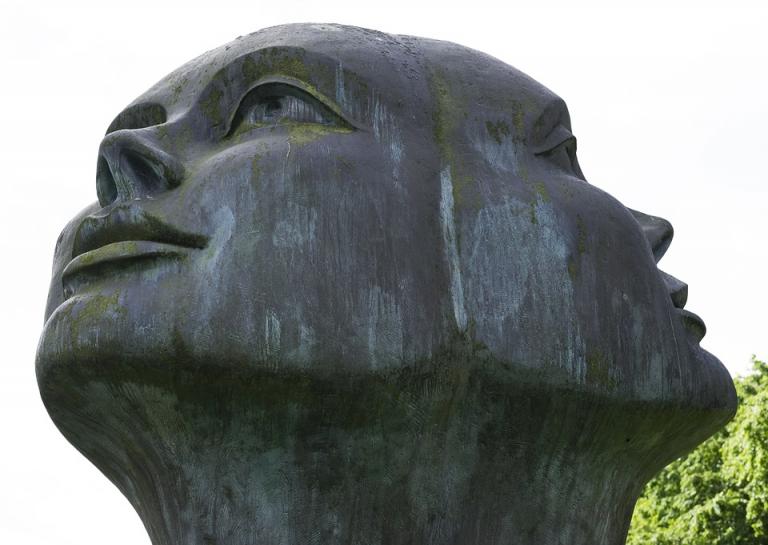
image credit: www.maxpixel.net/Bruges-Belgium-Church-Art-Both-Sides-Sculpture-1540103
Previous Post

December 31, 2018
Catholics Ought To Have a Zero Tolerance Policy for Anti-Semitism
Next Post

January 10, 2019 Here's What You Need to Understand About Catholic Media Conflicts
Browse Our Archives
Select a Category abortion anti-semitism art Atwood Betrothed church clergy abuse coronavirus culture economics education environmentalism ethics faith family feminism gardening gun violence immigration Judaism literature MaddAddam New Pro Life Movement news pandemic personalism poem politics politics blue Pope Francis racism religion salvation sexuality social justice spirituality Station eleven Stephen King The Stand Trump Uncategorized war World Health Organization
Select a Month March 2021 February 2021 January 2021 December 2020 November 2020 October 2020 September 2020 August 2020 July 2020 June 2020 May 2020 April 2020 March 2020 February 2020 January 2020 December 2019 November 2019 October 2019 September 2019 August 2019 July 2019 June 2019 May 2019 April 2019 March 2019 February 2019 January 2019 December 2018 November 2018 October 2018 September 2018 August 2018 July 2018 June 2018 May 2018 April 2018 March 2018 February 2018 January 2018 December 2017 November 2017 October 2017 September 2017 August 2017 July 2017 June 2017 May 2017 April 2017 March 2017 February 2017 January 2017 December 2016 November 2016 October 2016 September 2016 August 2016 July 2016 June 2016 May 2016 April 2016 March 2016 February 2016
Follow Us!
TAKE THE
Religious Wisdom Quiz
What separated the Holy Place from the Most Holy Place in the Tabernacle?
Select your answer to see how you score.
A stone wall A curtain (veil) An incense altar A bronze door
Support this
Column


Related posts from suspended in her jar

Immigrants: They Need Us, and We Need Them

Four Takeaways from Oprah’s Interview with the Duke...

How Has the Pandemic Changed Us? Has It...

Rush Limbaugh Would Never Have Succeeded In an...
TRENDING AT PATHEOS Catholic

Rejecting Doom: Christian Hope And Human Action
Christianity is a religion of hope. We are to have hope and...

It’s What Comes From Within Which Matters
One of the most difficult things for us to understand is why...

Why I Choose the Eucharist Over the Sermon
Choose the Eucharist, Not the Sermon What are we supposed to get...

5 Design Elements Found in Spiritually Rooted Homes
Putting Spirituality Into Home Decor Our homes are more than our living...

Credo: A Story of God Told with the...
About 10 years ago, I began to imagine a personal "Credo" that...

The Anatomy of Divine Revelation in Catholic Thought
The claim that God has made Himself known to human beings is...
view all Catholic blogs
Ad-Free & Subscriber Log-In Subscription Support
- About Us
- 2026 Calendar
- Videos
- Podcasts
- Library of World Religions
- Faith In Media Tracker
- Advertise With Us
- Write for Us
- Privacy Policy
- Terms of Service
- Do Not Sell My Data
- Contact Us
- Radiant Digital
- Manage Newsletter Subscriptions
- Unsubscribe From Notifications
- Sitemap
Copyright 2008-2026, Patheos. All rights reserved.
Subscription Support Ad-Free & Subscriber Log-In
Follow Patheos