
BuddhistCatholicContemplativeEvangelicalGeneral ChristianHinduJewishLatter-day SaintMuslimNew VisionsProgressive Christian
Beliefs
- Buddhist
- Catholic
- Contemplative
- Evangelical
- General Christian
- Hindu
- Jewish
- Latter-day Saint
- More Voices
- Muslim
- New Visions
- Pagan
- Progressive Christian
Topics
- Religion News
- Food and Religion
- Sports and Religion
- Religious Art
- Religious Music and Entertainment
- Religious Events
- History and Religion
- Style and Religion
- Politics and Religion
- Women in Religion
- Recreation Outdoors and Religion
- Business Finance and Religion
- Careers Workplace and Religion
- Education and Religion
- Family Parenting and Religion
- Health Fitness and Religion
- Home and Religion
- Relationships and Religion
- Technology and Religion
- Travel and Religion
Columnists
- Buddhist Columnists
- Business Finance and Religion Columnists
- Careers Workplace and Religion Columnists
- Catholic Columnists
- Contemplative Columnists
- Education and Religion Columnists
- Evangelists Columnists
- Family Parenting and Religion Columnists
- General Christian Columnists
- Health Fitness and Religion Columnists
- Hindu Columnists
- History and Religion Columnists
- Home and Religion Columnists
- Jewish Columnists
- More Voices Columnists
- Latter Day Columnists
- Muslim Columnists
- New Visions Columnists
- Nonreligious Columnists
- Pagan Columnists
- Politics and Religion Columnists
- Progressive Columnists
- Recreation Outdoors and Religion Columnists
- Relationships and Religion Columnists
- Religion News Columnists
- Religious Art Columnists
- Religious Events Columnists
- Religious Music and Entertainment Columnists
- Sports and Religion Columnists
- Style and Religion Columnists
- Technology and Religion Columnists
- Travel and Religion Columnists
- Women in Religion Columnists
Resource Library
- 2026 Calendar
- Library of World Religions
- The 100 Most Holy Places on Earth
- Patheos Answers
- Podcasts
- Videos
- Faith Leaders Database
- Anglican Episcopalian
- Bahai
- Baptist
- Buddhism
- Christianity
- Confucianism
- Eastern Orthodoxy
- Hinduism
- Holiness and Pentecostal
- ISKCON
- Islam
- Judaism
- Lutheran
- Methodist
- The Church of Jesus Christ of Latter-day Saints
- New Age
- Paganism
- Presbytarian and Reformed
- Protestantism
- Religion Behind the Scenes
- Roman Catholic
- Scientology
- Shia Islam
- Sikhism
- Sufism
- Sunni Islam
- Taoism
- Zen
- See all religions
Research Tools
 Ad-Free & Subscriber Log-In Subscription Support
Ad-Free & Subscriber Log-In Subscription Support
Follow Patheos 

- Trending:
- Forgiveness
- |
- Marriage
- |
- Consciousness
- |
- Death Penalty
- |
- Election
- |
- Halloween
 suspended in her jar
- Home
- Catholic
- The Nihilistic Idolatry of Cruelty
The Nihilistic Idolatry of Cruelty
Last updated on: December 15, 2018 at 12:04 am by Rebecca Bratten Weiss
The Nihilistic Idolatry of Cruelty 2018-12-15T00:04:47-04:00 Rebecca Bratten Weiss
Patheos Explore the world's faith through different perspectives on religion and spirituality! Patheos has the views of the prevalent religions and spiritualities of the world.

It’s practically a truism, among Christians, that Jesus did not call his followers to an easy walk. Yes, we have televangelists hawking a prosperity gospel, but it doesn’t take much dipping into the early writings of the church to see that what they offer is really more like an anti-Gospel.
Serious Christians, from the early church to modern times, have recognized that there is something essentially disruptive and unsettling about the call to discipleship. The first disciples of Jesus nearly all ended up martyred, after all. And although the institutional leaders of the church may have constantly betrayed and violated the ethos of Christ, the saints and sages all along the way have been there to remind us: this is not supposed to be easy.
It’s not that being Christian always means being persecuted or martyred. After all, many people are attracted to Christ-like qualities. It’s easy to act like an asshole and say “I’m being persecuted for being a Christian” when actually one is just being given a taste of one’s own medicine. Being a Christian MAY mean being martyred – when we follow the commandments of Jesus that demand that we care for the outcast and the poor, especially. It will not win us friends and influence in the high places where people jostle for power. But it will win us friends where people seek for beauty and justice.
No, the hard part about Christianity, it seems to me, is that it requires that we give up our idols.
While the history of the early church indicates that no, people did not have to give up literally all their possessions and connections in order to follow Jesus, they did need to give up whatever had a stronger hold on them than the call of Jesus. In one Gospel account, we find a rich young man who is capable of following all the commandments, but too attached to his wealth to follow Christ.
It’s customary for priests in homilies to warn their congregation about that one little thing you’re holding onto, that comes between you and God. It’s customary to hear the usual list of sexual sins so many homilists like to fixate on, of course – less customary to hear a Christ-like sermon against love of riches, maybe because it’s easy to scapegoat the sexual transgressor while cozying up to the wealthy donor.
Even if we aren’t rich, material possessions can become idols. But they can also become sacramental.
It might be something one clings to for the sake of nostalgia, or it might be pleasures one can’t do without. But the goods of the earth don’t have to be idols: they can also be images and channels of grace. The primordial goodness of created reality is given to us directly through physical beauty and pleasure. The fire of divine love is communicated to us through our small earthly loves, sometimes even our imperfect and morbid ones.
So much of what we meet in creation is always on the verge of becoming sacramental, the divine lurking around the edges of things.
But what if the thing coming between a person and Christ is that person’s attachment to cruelty?
Because this is what I am seeing in so much of American culture today. Not just a love of pleasure or power, not just the distraction of entertainment or the somnolence of satiety. I’m talking about a deadly nihilism, an infatuation with violence.
That’s what our present border policies are: pointless cruelty. There is no fleeting imperfect figment of justice to be seen there, nor even a cold utilitarianism. It’s just an infliction of pain for no reason at all.
The same could be said for torture and capital punishment. It doesn’t matter how often we demonstrate that torture is not only unnecessary and ineffectual, but anti-effectual: people will still defend it. They will defend tear gassing refugee children, and separating families. Do they think this makes them look tough? If so they need to re-acquaint themselves with the toughness of the martyrs, who endured suffering – who didn’t dole it out.
In my other writing-life, I write poems. And the task of writing poems often means coming up against the double edged nature of material things, where everything is both poison and medicine, distraction and meditation, a call to divine love or a lure away from it. Does love call us to or away from the things of this world? Both, I’d say.
But there is none of this double-edged weird sacramentality in the defense of suffering. It is pure nihilism. It is, in the most literal possible sense, anti-Christ.
I think we might be easily forgiven if the thing that came between us and God was the kind of thing that has the good cracks in it, where the light shines through. But the Gospels have some pretty hard words for those who deal out suffering to innocents. If divine judgment is a thing, America had better watch out. Between our prosperity gospellers, and our idolatry of cruelty – as well as our racism, our imperialism, our disdain for the environment – we are so far from being a “Christian nation” (if such a thing is even possible) that it’s a little scary.
image credit: https://commons.wikimedia.org/wiki/File:The_Worship_of_the_Golden_Calf_sc165.jpg
Previous Post
December 9, 2018
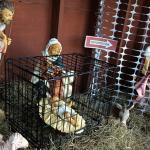
Baby Jesus In a Cage? Yes, It's Political
Next Post

December 16, 2018 Are We Trying To be So Awful That No One Will Want To Come Here?
Browse Our Archives
Select a Category abortion anti-semitism art Atwood Betrothed church clergy abuse coronavirus culture economics education environmentalism ethics faith family feminism gardening gun violence immigration Judaism literature MaddAddam New Pro Life Movement news pandemic personalism poem politics politics blue Pope Francis racism religion salvation sexuality social justice spirituality Station eleven Stephen King The Stand Trump Uncategorized war World Health Organization
Select a Month March 2021 February 2021 January 2021 December 2020 November 2020 October 2020 September 2020 August 2020 July 2020 June 2020 May 2020 April 2020 March 2020 February 2020 January 2020 December 2019 November 2019 October 2019 September 2019 August 2019 July 2019 June 2019 May 2019 April 2019 March 2019 February 2019 January 2019 December 2018 November 2018 October 2018 September 2018 August 2018 July 2018 June 2018 May 2018 April 2018 March 2018 February 2018 January 2018 December 2017 November 2017 October 2017 September 2017 August 2017 July 2017 June 2017 May 2017 April 2017 March 2017 February 2017 January 2017 December 2016 November 2016 October 2016 September 2016 August 2016 July 2016 June 2016 May 2016 April 2016 March 2016 February 2016
Follow Us!
TAKE THE
Religious Wisdom Quiz
Which brother's descendants would be kings according to Jacob's blessing?
Select your answer to see how you score.
Dan Judah Reuben Levi
Support this
Column


Related posts from suspended in her jar

Immigrants: They Need Us, and We Need Them

Four Takeaways from Oprah’s Interview with the Duke...

Catholics Are De-Toxing From their Experiences With Traumatic...

How Has the Pandemic Changed Us? Has It...
TRENDING AT PATHEOS Catholic

Rejecting Doom: Christian Hope And Human Action
Christianity is a religion of hope. We are to have hope and...

It’s What Comes From Within Which Matters
One of the most difficult things for us to understand is why...

Why I Choose the Eucharist Over the Sermon
Choose the Eucharist, Not the Sermon What are we supposed to get...

5 Design Elements Found in Spiritually Rooted Homes
Putting Spirituality Into Home Decor Our homes are more than our living...

Credo: A Story of God Told with the...
About 10 years ago, I began to imagine a personal "Credo" that...

The Anatomy of Divine Revelation in Catholic Thought
The claim that God has made Himself known to human beings is...
view all Catholic blogs
Ad-Free & Subscriber Log-In Subscription Support
- About Us
- 2026 Calendar
- Videos
- Podcasts
- Library of World Religions
- Faith In Media Tracker
- Advertise With Us
- Write for Us
- Privacy Policy
- Terms of Service
- Do Not Sell My Data
- Contact Us
- Radiant Digital
- Manage Newsletter Subscriptions
- Unsubscribe From Notifications
- Sitemap
Copyright 2008-2026, Patheos. All rights reserved.
Subscription Support Ad-Free & Subscriber Log-In
Follow Patheos