
BuddhistCatholicContemplativeEvangelicalGeneral ChristianHinduJewishLatter-day SaintMuslimNew VisionsProgressive Christian
Beliefs
- Buddhist
- Catholic
- Contemplative
- Evangelical
- General Christian
- Hindu
- Jewish
- Latter-day Saint
- More Voices
- Muslim
- New Visions
- Pagan
- Progressive Christian
Topics
- Religion News
- Food and Religion
- Sports and Religion
- Religious Art
- Religious Music and Entertainment
- Religious Events
- History and Religion
- Style and Religion
- Politics and Religion
- Women in Religion
- Recreation Outdoors and Religion
- Business Finance and Religion
- Careers Workplace and Religion
- Education and Religion
- Family Parenting and Religion
- Health Fitness and Religion
- Home and Religion
- Relationships and Religion
- Technology and Religion
- Travel and Religion
Columnists
- Buddhist Columnists
- Business Finance and Religion Columnists
- Careers Workplace and Religion Columnists
- Catholic Columnists
- Contemplative Columnists
- Education and Religion Columnists
- Evangelists Columnists
- Family Parenting and Religion Columnists
- General Christian Columnists
- Health Fitness and Religion Columnists
- Hindu Columnists
- History and Religion Columnists
- Home and Religion Columnists
- Jewish Columnists
- More Voices Columnists
- Latter Day Columnists
- Muslim Columnists
- New Visions Columnists
- Nonreligious Columnists
- Pagan Columnists
- Politics and Religion Columnists
- Progressive Columnists
- Recreation Outdoors and Religion Columnists
- Relationships and Religion Columnists
- Religion News Columnists
- Religious Art Columnists
- Religious Events Columnists
- Religious Music and Entertainment Columnists
- Sports and Religion Columnists
- Style and Religion Columnists
- Technology and Religion Columnists
- Travel and Religion Columnists
- Women in Religion Columnists
Resource Library
- 2026 Calendar
- Library of World Religions
- The 100 Most Holy Places on Earth
- Patheos Answers
- Podcasts
- Videos
- Faith Leaders Database
- Anglican Episcopalian
- Bahai
- Baptist
- Buddhism
- Christianity
- Confucianism
- Eastern Orthodoxy
- Hinduism
- Holiness and Pentecostal
- ISKCON
- Islam
- Judaism
- Lutheran
- Methodist
- The Church of Jesus Christ of Latter-day Saints
- New Age
- Paganism
- Presbytarian and Reformed
- Protestantism
- Religion Behind the Scenes
- Roman Catholic
- Scientology
- Shia Islam
- Sikhism
- Sufism
- Sunni Islam
- Taoism
- Zen
- See all religions
Research Tools
 Ad-Free & Subscriber Log-In Subscription Support
Ad-Free & Subscriber Log-In Subscription Support
Follow Patheos 

- Trending:
- Forgiveness
- |
- Marriage
- |
- Consciousness
- |
- Death Penalty
- |
- Election
- |
- Halloween
 suspended in her jar
- Home
- Catholic
- Baby Jesus In a Cage? Yes, It’s Political
Baby Jesus In a Cage? Yes, It’s Political
Last updated on: December 9, 2018 at 1:28 am by Rebecca Bratten Weiss
Baby Jesus In a Cage? Yes, It’s Political 2018-12-09T01:28:24-04:00 Rebecca Bratten Weiss
Patheos Explore the world's faith through different perspectives on religion and spirituality! Patheos has the views of the prevalent religions and spiritualities of the world.
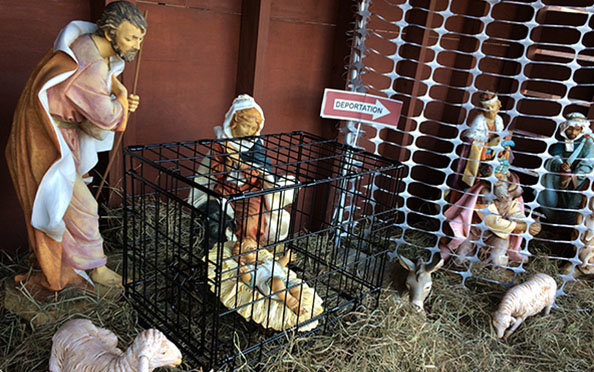
A Catholic church in Massachusetts has become the focus of national debate, and considerable hand-wringing from the Right, on account of its unusual nativity display.
According to a report in the Huffington Post, St. Susanna’s Parish in Denham “is mixing faith and politics in its nativity display this year ― placing a baby Jesus figurine in a cage to provoke conversations about America’s immigration policies.”
In the display, Baby Jesus lies in his traditional manger – but inside a black wire cage, a kind often used for containing animals. A plastic barrier fence separates the Wise Men from the rest of the scene, and a banner overhead reads “Peace on Earth?”
Right-wing media personality Sean Hannity has bewailed this as “Christmas under siege,” while other commenters have called the display “blasphemous.” Parishioners are even leaving St. Susanna’s because of this.
Reverend Steve Josoma of St. Susanna’s has said that the inappropriate and jarring nature of this nativity scene is the point:
“People think children in diapers getting tear-gassed is OK, but this [Nativity scene] is totally sacrilegious?” Josoma said in response to the criticism. “All we’re trying to do is put the two together.”
“What you do to somebody else is what you do to Christ,” he said, referring to a Bible passage that claims those who welcome strangers are in effect welcoming Christ himself. “You can’t separate the two.”
Josoma is simply presenting fundamental Gospel morality.
And yes, fundamental Gospel morality has not always been comfortable: look at how many people, in the New Testament accounts, turned away from Jesus because of his hard sayings.
We’re used to coming to church during the Advent and Christmas seasons in search of hope and joy. We want to feel settled, cozy even. Our repetition of family traditions helps us to cultivate this sense of belonging, of being at home, of the customary and comfortable. We light candles, keep the house warm, string lights over trees, play music.
But what if we’re doing it wrong?
Advent, after all, is not about being settled. It’s about a tension of waiting, and not just waiting for a happy surprise – waiting for a deliverer, for justice, for renewal. What is promised with the coming of the deliverer is peace, yes – but it’s a peace that is only possible through radical disruption of customs and norms, of governments and powers, even of the earth itself. It’s a comfort that is far from comfortable.
The old tradition of telling ghost stories as part of the Advent and Christmas season serves to enhance our sense of the unheimlich, the uncanny, of being on the verge of something undiscovered and strange. The deliverer who comes is not the one you expected. The place where the unseen world blurs into the world of flesh and blood is not where you expected a god to arrive.
Lighting candles isn’t just a way to make a room warm and inviting. It’s also a way to summon spirits.
The Christmas story is one that can be both comforting and unsettling.
On one hand, the presence of the Divine is manifest in such an ordinary human way, within a woman’s body. On the other hand, there’s nothing comfortable about pregnancy or giving birth. On one hand, the stable is warm and inviting, the animals innocent. On the other hand the stable is a place where we are the strangers, the weird naked animals who do not belong, the speaking things among the beasts that can communicate by instinct alone.
And so, it seems right and proper for a nativity display to be unsettling. We ought to be unsettled, especially with this world Jesus entered, the world of our making. We ought especially be unsettled when we are reminded that what we have done to the least of these, we have done to Jesus – and not just grown man Jesus, the one with the hairy body and the muscles. He can take it – right? We know he can, since he was resurrected. But what about the baby Jesus? Yes, whatever we do to the Honduran immigrant child, or to the Syrian orphan, or to the starving Yemeni child, we have done also to the baby in the manger. If Jesus is in a cage it is because we put him there. How dare we try to find comfort in that?
But it was always political.
It’s not just the image of the baby in the cage that makes a strong political statement about our complicity in evil. Just having the figure of the baby in a manger, surrounded by animals, is political enough. Because Mary should never have had to be there, in Bethlehem. She and Joseph were forced to travel there because of the census taken by Octavian (self-styled Augustus), dictator of the occupying Roman imperial forces. The young couple in Nazareth were not merely working-class peasants. They were terrorized citizens of a colonized region. Traveling to Bethlehem was an unjust imposition on the residents of Judea who could be taxed by Rome, without representation or citizenship – who were forbidden even to arm themselves – who, when a “guilty” verdict was leveled against them, were executed by means of a most gruesome torture.
The wood of the manger prefigures the wood of the cross. And the manger, like a cage, is a place where no baby belonged.
Whether the nativity narrative is historically accurate or not, it’s clear that one point of the story is to accentuate just how homeless and vulnerable – just how victimized – Mary and Joseph were, the lowest of the low.
Nativity scenes are made pleasant and inviting, the straw all soft and golden, the animals clean and gentle. What’s missing is the extreme poverty. The smells. The fear for tomorrow. The darkness. The disrupted, stomping cattle. The fact that you could be on the verge of giving birth and no one would care – that you would be turned away from the inn, with no better shelter than a rude barn or cave. That you are a nobody in a tiny country brutalized by a powerful empire. That even your own religious leaders don’t care about you. What’s missing is that childbirth is painful, messy, noisy, terrifying – even in the best of situations.
So, really, there’s nothing especially new and out of the ordinary about depicting the Holy Family in a condition of instability and danger.
The people who complain about the politicization of a Nativity scene in which Jesus is placed in a cage should stop and consider how politicized the original story already was – how revolutionary. And how very far from cozy.
image credit: https://www.huffingtonpost.com/entry/church-baby-jesus-cage-immigration_us_5c0968ade4b0de79357ad474
Next Post

December 15, 2018 The Nihilistic Idolatry of Cruelty
Browse Our Archives
Select a Category abortion anti-semitism art Atwood Betrothed church clergy abuse coronavirus culture economics education environmentalism ethics faith family feminism gardening gun violence immigration Judaism literature MaddAddam New Pro Life Movement news pandemic personalism poem politics politics blue Pope Francis racism religion salvation sexuality social justice spirituality Station eleven Stephen King The Stand Trump Uncategorized war World Health Organization
Select a Month March 2021 February 2021 January 2021 December 2020 November 2020 October 2020 September 2020 August 2020 July 2020 June 2020 May 2020 April 2020 March 2020 February 2020 January 2020 December 2019 November 2019 October 2019 September 2019 August 2019 July 2019 June 2019 May 2019 April 2019 March 2019 February 2019 January 2019 December 2018 November 2018 October 2018 September 2018 August 2018 July 2018 June 2018 May 2018 April 2018 March 2018 February 2018 January 2018 December 2017 November 2017 October 2017 September 2017 August 2017 July 2017 June 2017 May 2017 April 2017 March 2017 February 2017 January 2017 December 2016 November 2016 October 2016 September 2016 August 2016 July 2016 June 2016 May 2016 April 2016 March 2016 February 2016
Follow Us!
TAKE THE
Religious Wisdom Quiz
What did Peter see in his vision on the rooftop in Joppa?
Select your answer to see how you score.
A large sheet with unclean animals A burning bush A ladder reaching to heaven An angel with a sword
Support this
Column


Related posts from suspended in her jar

Immigrants: They Need Us, and We Need Them

Four Takeaways from Oprah’s Interview with the Duke...

Catholics Are De-Toxing From their Experiences With Traumatic...

How Has the Pandemic Changed Us? Has It...
TRENDING AT PATHEOS Catholic

Rejecting Doom: Christian Hope And Human Action
Christianity is a religion of hope. We are to have hope and...

It’s What Comes From Within Which Matters
One of the most difficult things for us to understand is why...

Why I Choose the Eucharist Over the Sermon
Choose the Eucharist, Not the Sermon What are we supposed to get...

5 Design Elements Found in Spiritually Rooted Homes
Putting Spirituality Into Home Decor Our homes are more than our living...

Credo: A Story of God Told with the...
About 10 years ago, I began to imagine a personal "Credo" that...

The Anatomy of Divine Revelation in Catholic Thought
The claim that God has made Himself known to human beings is...
view all Catholic blogs
Ad-Free & Subscriber Log-In Subscription Support
- About Us
- 2026 Calendar
- Videos
- Podcasts
- Library of World Religions
- Faith In Media Tracker
- Advertise With Us
- Write for Us
- Privacy Policy
- Terms of Service
- Do Not Sell My Data
- Contact Us
- Radiant Digital
- Manage Newsletter Subscriptions
- Unsubscribe From Notifications
- Sitemap
Copyright 2008-2026, Patheos. All rights reserved.
Subscription Support Ad-Free & Subscriber Log-In
Follow Patheos