
BuddhistCatholicContemplativeEvangelicalGeneral ChristianHinduJewishLatter-day SaintMuslimNew VisionsProgressive Christian
Beliefs
- Buddhist
- Catholic
- Contemplative
- Evangelical
- General Christian
- Hindu
- Jewish
- Latter-day Saint
- More Voices
- Muslim
- New Visions
- Pagan
- Progressive Christian
Topics
- Religion News
- Food and Religion
- Sports and Religion
- Religious Art
- Religious Music and Entertainment
- Religious Events
- History and Religion
- Style and Religion
- Politics and Religion
- Women in Religion
- Recreation Outdoors and Religion
- Business Finance and Religion
- Careers Workplace and Religion
- Education and Religion
- Family Parenting and Religion
- Health Fitness and Religion
- Home and Religion
- Relationships and Religion
- Technology and Religion
- Travel and Religion
Columnists
- Buddhist Columnists
- Business Finance and Religion Columnists
- Careers Workplace and Religion Columnists
- Catholic Columnists
- Contemplative Columnists
- Education and Religion Columnists
- Evangelists Columnists
- Family Parenting and Religion Columnists
- General Christian Columnists
- Health Fitness and Religion Columnists
- Hindu Columnists
- History and Religion Columnists
- Home and Religion Columnists
- Jewish Columnists
- More Voices Columnists
- Latter Day Columnists
- Muslim Columnists
- New Visions Columnists
- Nonreligious Columnists
- Pagan Columnists
- Politics and Religion Columnists
- Progressive Columnists
- Recreation Outdoors and Religion Columnists
- Relationships and Religion Columnists
- Religion News Columnists
- Religious Art Columnists
- Religious Events Columnists
- Religious Music and Entertainment Columnists
- Sports and Religion Columnists
- Style and Religion Columnists
- Technology and Religion Columnists
- Travel and Religion Columnists
- Women in Religion Columnists
Resource Library
- 2026 Calendar
- Library of World Religions
- The 100 Most Holy Places on Earth
- Patheos Answers
- Podcasts
- Videos
- Faith Leaders Database
- Anglican Episcopalian
- Bahai
- Baptist
- Buddhism
- Christianity
- Confucianism
- Eastern Orthodoxy
- Hinduism
- Holiness and Pentecostal
- ISKCON
- Islam
- Judaism
- Lutheran
- Methodist
- The Church of Jesus Christ of Latter-day Saints
- New Age
- Paganism
- Presbytarian and Reformed
- Protestantism
- Religion Behind the Scenes
- Roman Catholic
- Scientology
- Shia Islam
- Sikhism
- Sufism
- Sunni Islam
- Taoism
- Zen
- See all religions
Research Tools
 Ad-Free & Subscriber Log-In Subscription Support
Ad-Free & Subscriber Log-In Subscription Support
Follow Patheos 

- Trending:
- Forgiveness
- |
- Marriage
- |
- Consciousness
- |
- Death Penalty
- |
- Election
- |
- Halloween
 suspended in her jar
- Home
- Catholic
- So You Didn’t Like Political Correctness (Or: What Would Nietzsche Say?)
So You Didn’t Like Political Correctness (Or: What Would Nietzsche Say?)
Last updated on: June 29, 2018 at 12:19 am by Rebecca Bratten Weiss
So You Didn’t Like Political Correctness (Or: What Would Nietzsche Say?) 2018-06-29T00:19:42-04:00 Rebecca Bratten Weiss
Patheos Explore the world's faith through different perspectives on religion and spirituality! Patheos has the views of the prevalent religions and spiritualities of the world.
Let me clarify that there are two distinct ways of understanding “political correctness.” One is the expectation that one’s statements will be in line with the accepted politics of your milieu. Different circles have different accepted politics. In some circles, it might be politically correct to to refer to trans persons by their preferred pronouns. In other circles, it is politically correct – that is, satisfies the expectations of the dominant hegemony – to make a point of not doing so. A person at a conservative university who preens himself on not caving to the demands of political correctness is, in fact, being as politically correct as possible, under this understanding. Such a person is doing what he knows will earn him applause. He’s taking no risks. This form of political correctness has to do with codes, and tribes. I guess the honorability of this corresponds with the moral decency of the respective tribe.
But the other understanding of political correctness is simply of standards that allow us to co-exist politically. Civility, politeness, tolerance, manners, respect: all of these get lumped into the perhaps unfortunate moniker “political correctness.” Like the term or not, the idea is that we get along more smoothly, and more justly, as a political unit, when we treat one another according to the golden rule.
In the 90s it was fashionable, among right-wingers, to mock political correctness by emphasizing what we then perceived as extremes. Renaming garbage men – or women – as waste disposal management persons, ha ha ha.
But we forgot, in our rather puerile laughter, that garbage collectors are also persons of inestimable worth and dignity. Collecting garbage isn’t something we should mock: it’s needed work, real work, that provides a clear benefit for society. So, even if there’s something a bit pretentious and forced about “waste disposal management person” the idea behind it is that it’s better to emphasize the value of a person, and of their work, than to emphasize their vulnerabilities..
A blessed relief, really, after the bullying 80s.
Proponents of political correctness recently have simply been emphasizing that in a pluralistic society we need to practice basic courtesy, and that this often means taking the time to find out about one another: about our culture, religion, sexuality, and background. It’s rooted in the same concept of courtesy as was present in Newman’s definition of a gentleman. One wishes never, deliberately, to cause harm.
It’s ironic that the people who spent several decades trashing political correctness are now demanding civility towards themselves alone. If Milo calls for reporters to be shot, it’s just a joke, but if Sarah Huckabee Sanders is quietly asked to leave a restaurant it’s an assault on human dignity. Trump can mock a disabled reporter, but heaven help us if we mock Trump.
This is the classic, and rather boring, illogic of the bully – the one who can dish it out, but can’t take it. It’s rooted not in strength, but in weakness. The morally strong and courageous person shrugs off insults, but tries to avoid harming others, and rises always to the defense of the marginalized. This was what Nietzsche, for all his perception, didn’t get about the Christian charitable ethos: that it arises not from weakness and fear, but from moral fortitude – as Max Scheler eloquently argued in his work, Ressentiment.
Ressentiment, as explored by Nietzsche and further clarified by Scheler, goes beyond mere resentment or revenge. There’s a crude honesty about resentment, and a courage in revenge. Ressentiment has to do with a deep spiritual rancor against goodness itself, a rancor which blossoms and blooms in the false flowers of a topsy-turvy and nihilistic value system.
Those who feel threatened by the existence of moral or aesthetic value systems themselves retaliate by turning against them. But they don’t say “hey, I’m sick of this morality stuff; I’m going to be a hedonist.” There would be a certain swashbuckling glamour in that.
But instead, they invent an alternative value system. Ugliness becomes beauty. Pain becomes joy. Hurting others becomes virtuous. The dishonesty at the heart of ressentiment goes deeper than lying, too: people overcome by ressentiment actually believe their own fabrications.
One instance of ressentiment I see today is when white persons respond not with generous magnanimity, but with spiritual rancor, to the cries for justice from black communities. Here is a value system in which we white people no longer get to be enthroned in the center – in which we need to take a step back, even admit our wrong. Lacking the guts to do this, we respond by attacking the whole structure of justice itself, and upending it, so that the oppressor class itself becomes – in the ressentiment-laden mind – the victim.
Nietzsche mistakenly identified ressentiment as a trait exclusively of the victim class lashing back, failing to see how feeble those who occupy positions of power can often be: what we now might term “affluenza.” He also mistakenly identified ressentiment in the Christian emphasis on the cross, thanks partially to the tendency of Christians to cast our own theology in unfortunately sado-masochistic terms. In correcting Mietzsche’s error, Scheler may have run a bit too far in the opposite direction, especially in his lumping in Christian values with “knightly” values. But Nietzsche did the field of ethics an inestimable service by identifying the phenomenon of ressentiment as a source for false and nihilistic value-systems, and Scheler did our theology a service by recalling us from nihilism.
Nietzsche is misread by many thinkers, even thinkers I esteem. They misunderstand his emphasis on power as a lust for political power, when in reality it’s more spiritual or aesthetic power, vitality, life-force, that he reveres.
Nietzsche receovered from his Wagnerian phase, and went on to prefer Bizet’s Carmen, incidentally. He scorned political force, loathed boorishness, and mocked nationalism – especially the proto-Nazism of his fellow Germans. Those who think Trump is exercising anything like a Nietzschean will to power haven’t read closely enough. Obsession with power over others – bullying power – is the last resort of the weakling. The magnanimous one, the artist, the dancer – she doesn’t need to force others or inflict pain.
If he were alive today, I think Nietzsche would see the most pristine instance of ressentiment in the case of the Trumpian upending of values – and in the fundamental moral spinelessness of those who defend this. All the while claiming the privilege to bully, abuse, and attack, but crying victim whenever anyone serves them back a dose of what they’ve been giving. Those who thought they didn’t like political correctness, until they got a taste of their own poison.
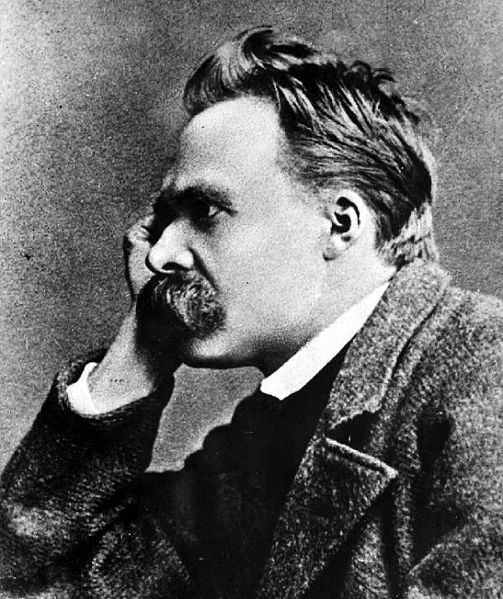
image credit: https://am.wikipedia.org/wiki/%E1%88%B5%E1%8B%95%E1%88%8D:Nietzsche.jpg
Previous Post

June 24, 2018
Whatever Happened to Parental Rights? Alfie Evans and Immigrant Children
Next Post

July 4, 2018 I Won't Be Trying To Say God Next Year: #MeToo and Catholic Writers - UPDATED
Browse Our Archives
Select a Category abortion anti-semitism art Atwood Betrothed church clergy abuse coronavirus culture economics education environmentalism ethics faith family feminism gardening gun violence immigration Judaism literature MaddAddam New Pro Life Movement news pandemic personalism poem politics politics blue Pope Francis racism religion salvation sexuality social justice spirituality Station eleven Stephen King The Stand Trump Uncategorized war World Health Organization
Select a Month March 2021 February 2021 January 2021 December 2020 November 2020 October 2020 September 2020 August 2020 July 2020 June 2020 May 2020 April 2020 March 2020 February 2020 January 2020 December 2019 November 2019 October 2019 September 2019 August 2019 July 2019 June 2019 May 2019 April 2019 March 2019 February 2019 January 2019 December 2018 November 2018 October 2018 September 2018 August 2018 July 2018 June 2018 May 2018 April 2018 March 2018 February 2018 January 2018 December 2017 November 2017 October 2017 September 2017 August 2017 July 2017 June 2017 May 2017 April 2017 March 2017 February 2017 January 2017 December 2016 November 2016 October 2016 September 2016 August 2016 July 2016 June 2016 May 2016 April 2016 March 2016 February 2016
Follow Us!
TAKE THE
Religious Wisdom Quiz
Which book of the Bible contains the Ten Commandments?
Select your answer to see how you score.
Genesis Numbers Exodus Leviticus
Support this
Column


Related posts from suspended in her jar

Immigrants: They Need Us, and We Need Them

Four Takeaways from Oprah’s Interview with the Duke...

How Has the Pandemic Changed Us? Has It...

Rush Limbaugh Would Never Have Succeeded In an...
TRENDING AT PATHEOS Catholic

Rejecting Doom: Christian Hope And Human Action
Christianity is a religion of hope. We are to have hope and...

It’s What Comes From Within Which Matters
One of the most difficult things for us to understand is why...

Why I Choose the Eucharist Over the Sermon
Choose the Eucharist, Not the Sermon What are we supposed to get...

5 Design Elements Found in Spiritually Rooted Homes
Putting Spirituality Into Home Decor Our homes are more than our living...

Credo: A Story of God Told with the...
About 10 years ago, I began to imagine a personal "Credo" that...

The Anatomy of Divine Revelation in Catholic Thought
The claim that God has made Himself known to human beings is...
view all Catholic blogs
Ad-Free & Subscriber Log-In Subscription Support
- About Us
- 2026 Calendar
- Videos
- Podcasts
- Library of World Religions
- Faith In Media Tracker
- Advertise With Us
- Write for Us
- Privacy Policy
- Terms of Service
- Do Not Sell My Data
- Contact Us
- Radiant Digital
- Manage Newsletter Subscriptions
- Unsubscribe From Notifications
- Sitemap
Copyright 2008-2026, Patheos. All rights reserved.
Subscription Support Ad-Free & Subscriber Log-In
Follow Patheos