
BuddhistCatholicContemplativeEvangelicalGeneral ChristianHinduJewishLatter-day SaintMuslimNew VisionsProgressive Christian
Beliefs
- Buddhist
- Catholic
- Contemplative
- Evangelical
- General Christian
- Hindu
- Jewish
- Latter-day Saint
- More Voices
- Muslim
- New Visions
- Pagan
- Progressive Christian
Topics
- Religion News
- Food and Religion
- Sports and Religion
- Religious Art
- Religious Music and Entertainment
- Religious Events
- History and Religion
- Style and Religion
- Politics and Religion
- Women in Religion
- Recreation Outdoors and Religion
- Business Finance and Religion
- Careers Workplace and Religion
- Education and Religion
- Family Parenting and Religion
- Health Fitness and Religion
- Home and Religion
- Relationships and Religion
- Technology and Religion
- Travel and Religion
Columnists
- Buddhist Columnists
- Business Finance and Religion Columnists
- Careers Workplace and Religion Columnists
- Catholic Columnists
- Contemplative Columnists
- Education and Religion Columnists
- Evangelists Columnists
- Family Parenting and Religion Columnists
- General Christian Columnists
- Health Fitness and Religion Columnists
- Hindu Columnists
- History and Religion Columnists
- Home and Religion Columnists
- Jewish Columnists
- More Voices Columnists
- Latter Day Columnists
- Muslim Columnists
- New Visions Columnists
- Nonreligious Columnists
- Pagan Columnists
- Politics and Religion Columnists
- Progressive Columnists
- Recreation Outdoors and Religion Columnists
- Relationships and Religion Columnists
- Religion News Columnists
- Religious Art Columnists
- Religious Events Columnists
- Religious Music and Entertainment Columnists
- Sports and Religion Columnists
- Style and Religion Columnists
- Technology and Religion Columnists
- Travel and Religion Columnists
- Women in Religion Columnists
Resource Library
- 2026 Calendar
- Library of World Religions
- The 100 Most Holy Places on Earth
- Patheos Answers
- Podcasts
- Videos
- Faith Leaders Database
- Anglican Episcopalian
- Bahai
- Baptist
- Buddhism
- Christianity
- Confucianism
- Eastern Orthodoxy
- Hinduism
- Holiness and Pentecostal
- ISKCON
- Islam
- Judaism
- Lutheran
- Methodist
- The Church of Jesus Christ of Latter-day Saints
- New Age
- Paganism
- Presbytarian and Reformed
- Protestantism
- Religion Behind the Scenes
- Roman Catholic
- Scientology
- Shia Islam
- Sikhism
- Sufism
- Sunni Islam
- Taoism
- Zen
- See all religions
Research Tools
 Ad-Free & Subscriber Log-In Subscription Support
Ad-Free & Subscriber Log-In Subscription Support
Follow Patheos 

- Trending:
- Forgiveness
- |
- Marriage
- |
- Consciousness
- |
- Death Penalty
- |
- Election
- |
- Halloween
 suspended in her jar
- Home
- Catholic
- Some Dead White Males on the Topic of “Not Taking Sides”
Some Dead White Males on the Topic of “Not Taking Sides”
Last updated on: June 22, 2018 at 12:01 am by Rebecca Bratten Weiss
Some Dead White Males on the Topic of “Not Taking Sides” 2018-06-22T00:01:03-04:00 Rebecca Bratten Weiss
Patheos Explore the world's faith through different perspectives on religion and spirituality! Patheos has the views of the prevalent religions and spiritualities of the world.
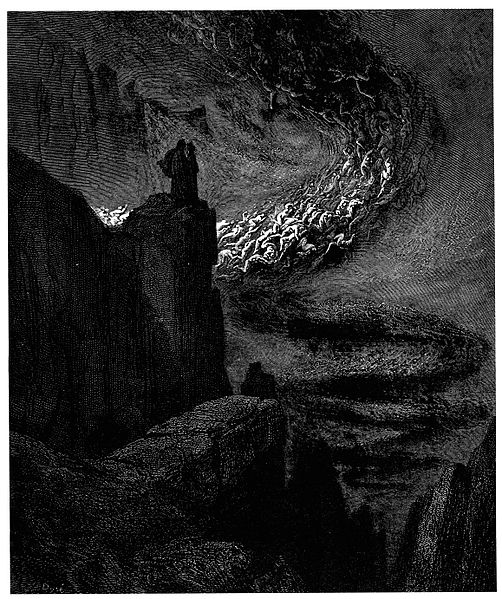
In Canto 3 of Dante’s Inferno, the pilgrim arrives at the brink of Hell, and encounters the shades of the lukewarm or indifferent: those who, in life, never chose a side, or took a stand, and now are condemned to rush round and round after a blank banner.
“So many, I had not thought death had undone so many,” the poet writes – and five hundred years later these words would be echoed by another poet, T.S. Eliot, describing London crowds in The Waste Land. Eliot’s darkest work is part of his early “infernal” phase in which the characters seem to move through dreamlike, foggy urban hellscapes, repeating endless and mindless patterns, on futile quests that have no goal.
In a poem just a little bit earlier, Eliot presented us with the memorable-for-being-unmemorable J. Alfred Prufrock, a damned soul who takes all the sexiness out of damnation. Prufrock wanders through the “muttering retreats” of that same London, with the evening spread out against the sky above him “like a patient etherized upon a table.” Paralysis, amnesia, and stagnation are themes in Prufrock. The protagonist sees himself as an insect pinned and wriggling, as one who might as well be dead already. He sees himself grown old, walking the beach, where the mermaids do not sing to him. Like one of the hollow men from another infernal Eliot poem, and like Dante’s damned, Prufrock is condemned to go round and round, to the same tea parties, hearing the same voices – but never the ones he wishes to hear. These characters drift through a dreary inferno in which the end of the world comes not with a bang but a whimper, where the cycles of history draw us through the same empty patterns.
Dante’s portrayal of the lukewarm and uncommitted is alluded to by another but very different Anglican writer of the same period: C.S. Lewis, at the end of The Last Battle, portrays one group of dwarves as refusing to take sides, but rather egging both the Narnians and their enemies on to destroy one another, even entering into the killing from time to time, to keep things even. “The Dwarves for the Dwarves.” The scene in which they shoot all the talking horses still makes me angry and sad, even if it didn’t really happen. Never kill a talking horse.
The dwarves who refuse to take sides find themselves in their own dim liminal inferno, too, trapped forever in their minds in a dark stable with no light or clean water or room to move, a physical space that images the spiritual space they occupy, a space without magnanimity or generosity or daring – even if, in reality, or if they were to shift their mental space, they would find themselves in a green and luxurious paradise.
I’ve been thinking of these stories and images a lot lately, because I keep encountering so many people who take pride in their refusal to take sides, in their commitment to the “pox on both their houses!” narrative. Like the dwarves, they seem content to sit on the sidelines, hoping that Left and Right will destroy one another. “Both sides are bad,” they say.
And for many years I was in that camp. I’m not a joiner. I distrust slogans, and loathe culture wars. I have been a registered independent for most of my voting years, and up until recently just sort of hoped the Democrats and Republicans would destroy one another. I still do think that loyalty to a political ideology or side can be dangerous, and that “taking sides” shouldn’t usually mean signing onto a political team.
Look what happened to the Republicans, after all. Two years ago, I thought that the prospect of Trump as a candidate would be a challenge to blind party loyalty – but, no. Many seemed to think they had to support anyone the party elected. And so they did. And contrary to their assertions, they did not proceed to correct and control Trump, but rather to defend his every word and deed, so that they quickly morphed into his toadies and bootlickers. So by now, whatever one may think of the Democrats, the Republicans have become the party one must stand against, if one cares about ethics and human decency.
It is no longer morally reasonable to say “both sides are equally bad,” when one side is stripping the land of its protection, cutting away safety nets, rejecting principles of human dignity, and now kidnapping infants and keeping them in cages. It’s not about Democrats vs. Republicans anymore, nor Left vs. Right. You might be a progressive liberal, or a radical leftist, or a paleo-conservative, or an anarchist, or eschew labels wholly. Whatever you are, this is one of those times in history in which refusing to take a stand gets one lumped in, not with an Aristotelian “golden mean,” but with Dante’s too-bland-even-for-hell-to-want.
I’ve been thinking of another character who didn’t want to take sides: Treebeard, from The Lord of The Rings, tells the Hobbits that he is not altogether on anyone’s side, because no one is altogether on his. I know how he feels…well, a little bit, since I’m not a tree-herd, exactly. But I know what it is to feel that no one in power has one’s well-being truly in mind. As a tree-herd, Treebeard sees that in the wars among elves, dwarves, orcs, and men, nature itself is often the most devastated victim. The “Brown Lands” have never recovered from the war in which Sauron was first defeated. The Entwives are gone forever. The “good guys” are not, after all, especially good. They just happen to be trying to stop the spread of annihilating evil.
Treebeard sees which powers are devoted to senseless destruction, and even if he doesn’t exactly join up with the armies allying against Sauron, he knows which side is is “altogether not on.” And he rises up against it, not because of a lust for destruction or love of violence or adulation of power, but simply to protect what he knows to be good.
T.S. Eliot’s diagnosis of the sickness of modernity had to do with an enervation, and emptiness, masked sometimes as bourgeois respectability. Just a few years after The Waste Land, this sickness would erupt into a widespread spiritual and ethical plague, as fascism began to rise in Europe – and the nice people did nothing about it. Who is Prufrock to struggle with a demon, after all? Even a shabby demon, like the one in Crime and Punishment? We’re post-modern, now, and not modern anymore, supposedly, but the sickness continues. Maybe it’s really a sickness of humanity, the moral sloth or apathy once termed “acedia” by the old moralists.
There are times when sitting on the sidelines and taking a middle ground are no longer virtuous options, and this is one of those times. Don’t be a nameless dead soul running around after a blank banner on the outskirts of hell. Don’t be Prufrock. Be Treebeard.
image credit: https://commons.wikimedia.org/wiki/File:Gustave_Dor%C3%A9_-_Dante_Alighieri_-_Inferno_-_Plate_14_(Canto_V_-_The_hurricane_of_souls).jpg
Previous Post

June 15, 2018
Legality is Not Morality: We Need To Protect Families
Next Post

June 22, 2018 What Does the Gospel Teach Us About Property and Illegal Immigration?
Browse Our Archives
Select a Category abortion anti-semitism art Atwood Betrothed church clergy abuse coronavirus culture economics education environmentalism ethics faith family feminism gardening gun violence immigration Judaism literature MaddAddam New Pro Life Movement news pandemic personalism poem politics politics blue Pope Francis racism religion salvation sexuality social justice spirituality Station eleven Stephen King The Stand Trump Uncategorized war World Health Organization
Select a Month March 2021 February 2021 January 2021 December 2020 November 2020 October 2020 September 2020 August 2020 July 2020 June 2020 May 2020 April 2020 March 2020 February 2020 January 2020 December 2019 November 2019 October 2019 September 2019 August 2019 July 2019 June 2019 May 2019 April 2019 March 2019 February 2019 January 2019 December 2018 November 2018 October 2018 September 2018 August 2018 July 2018 June 2018 May 2018 April 2018 March 2018 February 2018 January 2018 December 2017 November 2017 October 2017 September 2017 August 2017 July 2017 June 2017 May 2017 April 2017 March 2017 February 2017 January 2017 December 2016 November 2016 October 2016 September 2016 August 2016 July 2016 June 2016 May 2016 April 2016 March 2016 February 2016
Follow Us!
TAKE THE
Religious Wisdom Quiz
Who was the tax collector that Jesus called to follow Him?
Select your answer to see how you score.
Zacchaeus Nicodemus Levi Matthew
Support this
Column


Related posts from suspended in her jar

Words for Those Feeling Disinherited

Yes, It's About the White Supremacy

Reflections on the Epiphany Insurrection
Conspiracy Theories, Alternate Reality, and the Perils of...
TRENDING AT PATHEOS Catholic

Rejecting Doom: Christian Hope And Human Action
Christianity is a religion of hope. We are to have hope and...

It’s What Comes From Within Which Matters
One of the most difficult things for us to understand is why...

Why I Choose the Eucharist Over the Sermon
Choose the Eucharist, Not the Sermon What are we supposed to get...

5 Design Elements Found in Spiritually Rooted Homes
Putting Spirituality Into Home Decor Our homes are more than our living...

Credo: A Story of God Told with the...
About 10 years ago, I began to imagine a personal "Credo" that...

The Anatomy of Divine Revelation in Catholic Thought
The claim that God has made Himself known to human beings is...
view all Catholic blogs
Ad-Free & Subscriber Log-In Subscription Support
- About Us
- 2026 Calendar
- Videos
- Podcasts
- Library of World Religions
- Faith In Media Tracker
- Advertise With Us
- Write for Us
- Privacy Policy
- Terms of Service
- Do Not Sell My Data
- Contact Us
- Radiant Digital
- Manage Newsletter Subscriptions
- Unsubscribe From Notifications
- Sitemap
Copyright 2008-2026, Patheos. All rights reserved.
Subscription Support Ad-Free & Subscriber Log-In
Follow Patheos