
BuddhistCatholicContemplativeEvangelicalGeneral ChristianHinduJewishLatter-day SaintMuslimNew VisionsProgressive Christian
Beliefs
- Buddhist
- Catholic
- Contemplative
- Evangelical
- General Christian
- Hindu
- Jewish
- Latter-day Saint
- More Voices
- Muslim
- New Visions
- Pagan
- Progressive Christian
Topics
- Religion News
- Food and Religion
- Sports and Religion
- Religious Art
- Religious Music and Entertainment
- Religious Events
- History and Religion
- Style and Religion
- Politics and Religion
- Women in Religion
- Recreation Outdoors and Religion
- Business Finance and Religion
- Careers Workplace and Religion
- Education and Religion
- Family Parenting and Religion
- Health Fitness and Religion
- Home and Religion
- Relationships and Religion
- Technology and Religion
- Travel and Religion
Columnists
- Buddhist Columnists
- Business Finance and Religion Columnists
- Careers Workplace and Religion Columnists
- Catholic Columnists
- Contemplative Columnists
- Education and Religion Columnists
- Evangelists Columnists
- Family Parenting and Religion Columnists
- General Christian Columnists
- Health Fitness and Religion Columnists
- Hindu Columnists
- History and Religion Columnists
- Home and Religion Columnists
- Jewish Columnists
- More Voices Columnists
- Latter Day Columnists
- Muslim Columnists
- New Visions Columnists
- Nonreligious Columnists
- Pagan Columnists
- Politics and Religion Columnists
- Progressive Columnists
- Recreation Outdoors and Religion Columnists
- Relationships and Religion Columnists
- Religion News Columnists
- Religious Art Columnists
- Religious Events Columnists
- Religious Music and Entertainment Columnists
- Sports and Religion Columnists
- Style and Religion Columnists
- Technology and Religion Columnists
- Travel and Religion Columnists
- Women in Religion Columnists
Resource Library
- 2026 Calendar
- Library of World Religions
- The 100 Most Holy Places on Earth
- Patheos Answers
- Podcasts
- Videos
- Faith Leaders Database
- Anglican Episcopalian
- Bahai
- Baptist
- Buddhism
- Christianity
- Confucianism
- Eastern Orthodoxy
- Hinduism
- Holiness and Pentecostal
- ISKCON
- Islam
- Judaism
- Lutheran
- Methodist
- The Church of Jesus Christ of Latter-day Saints
- New Age
- Paganism
- Presbytarian and Reformed
- Protestantism
- Religion Behind the Scenes
- Roman Catholic
- Scientology
- Shia Islam
- Sikhism
- Sufism
- Sunni Islam
- Taoism
- Zen
- See all religions
Research Tools
 Ad-Free & Subscriber Log-In Subscription Support
Ad-Free & Subscriber Log-In Subscription Support
Follow Patheos 

- Trending:
- Forgiveness
- |
- Marriage
- |
- Consciousness
- |
- Death Penalty
- |
- Election
- |
- Halloween
 suspended in her jar
- Home
- Catholic
- “I’ll Eat You Up, I Love You So”: Religion Where The Wild Things Are
“I’ll Eat You Up, I Love You So”: Religion Where The Wild Things Are
Last updated on: May 17, 2018 at 1:56 pm by Rebecca Bratten Weiss
“I’ll Eat You Up, I Love You So”: Religion Where The Wild Things Are 2018-05-17T13:56:28-04:00 Rebecca Bratten Weiss
Patheos Explore the world's faith through different perspectives on religion and spirituality! Patheos has the views of the prevalent religions and spiritualities of the world.
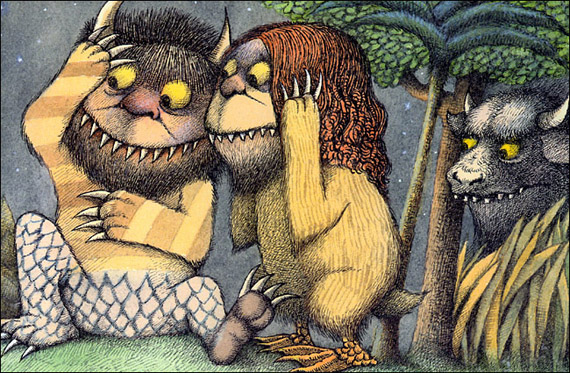 My two younger children are going through an entirely understandable Maurice Sendak phase, which means I find lines like “we’ll eat you up, we love you so!” shouted through the house, while I go about my work.
I was scrubbing down the bathroom listening to recitations from the “Night Kitchen” when I noticed the obvious anthropophagous theme running through these beloved children’s stories. The Wild Things love Max so much they want to eat him (which puts a new perspective on his earlier threat to eat his own mother); the anthropomorphic lion eats Pierre and then, after the child is rescued, becomes a family friend. Mickey is almost baked into a cake by the chefs in the Night Kitchen.
This draws upon a much older horror theme winding through fairy tale and myth: being eaten, even eaten by other humans – even by one’s own parents. The terrifying and grotesque act of baking children into a pie and serving them to the unsuspecting parent is a motif of revenge narratives, from ancient Greece to modern fantasy. In European fairy tales, one fears the old witch partially because she is likely to eat you (young witches eat you, too, in a different sense). In “The Juniper Tree” the Wicked Stepmother figure takes things a step further, by not only oppressing her stepson but ultimately killing him and making him into blood puddings which his unaware father devours with relish.
Sendak’s stories draw on this archetypal fear, and render it palatable, comical even. This is not quite a case of fairy tales showing us dragons so that we learn that they may be defeated: it’s more like drawing the dragon into the household and learning to live with it – as Pierre’s family befriended the lion who had eaten their son.
The puritanical imagination probably frowns on this as a blurring of the lines between good and evil, but the Catholic imagination is rather different. That’s why there’s a long tradition of Catholics being accused of cannibalism, eating our own God, and of morbidity, collecting dried fingers and shriveled hearts, building chapels out of bones of dead monks. That which we most fear is somehow incorporated into our sacramental life, and transformed into something we not only live with, but live on.
This is religion where the wild things are. And whenever I find myself frustrated with rigid authoritarianism from church leaders, sad attempts to misuse philosophy to explain away mystery, I realize that in spite of all that, this is where I belong. Gnashing my terrible teeth, and rolling my terrible eyes. Where someone loves me best of all.
image credit: cruciality.files.wordpress.com/2010/10/where-the-wild-things-are1.jpg
Previous Post

May 14, 2018
Where Are the Poor in the Spectacle of the Church?
Next Post

May 22, 2018 "Don't Talk Politics!" - A Privilege That Perpetuates Injustice
Browse Our Archives
Select a Category abortion anti-semitism art Atwood Betrothed church clergy abuse coronavirus culture economics education environmentalism ethics faith family feminism gardening gun violence immigration Judaism literature MaddAddam New Pro Life Movement news pandemic personalism poem politics politics blue Pope Francis racism religion salvation sexuality social justice spirituality Station eleven Stephen King The Stand Trump Uncategorized war World Health Organization
Select a Month March 2021 February 2021 January 2021 December 2020 November 2020 October 2020 September 2020 August 2020 July 2020 June 2020 May 2020 April 2020 March 2020 February 2020 January 2020 December 2019 November 2019 October 2019 September 2019 August 2019 July 2019 June 2019 May 2019 April 2019 March 2019 February 2019 January 2019 December 2018 November 2018 October 2018 September 2018 August 2018 July 2018 June 2018 May 2018 April 2018 March 2018 February 2018 January 2018 December 2017 November 2017 October 2017 September 2017 August 2017 July 2017 June 2017 May 2017 April 2017 March 2017 February 2017 January 2017 December 2016 November 2016 October 2016 September 2016 August 2016 July 2016 June 2016 May 2016 April 2016 March 2016 February 2016
Follow Us!
TAKE THE
Religious Wisdom Quiz
Who taught Apollos about the gospel of Jesus Christ.
Select your answer to see how you score.
Timothy Paul Barnabas Aquila and Priscilla
Support this
Column


Related posts from suspended in her jar

Immigrants: They Need Us, and We Need Them

Four Takeaways from Oprah’s Interview with the Duke...

Catholics Are De-Toxing From their Experiences With Traumatic...

How Has the Pandemic Changed Us? Has It...
TRENDING AT PATHEOS Catholic

Rejecting Doom: Christian Hope And Human Action
Christianity is a religion of hope. We are to have hope and...

It’s What Comes From Within Which Matters
One of the most difficult things for us to understand is why...

Why I Choose the Eucharist Over the Sermon
Choose the Eucharist, Not the Sermon What are we supposed to get...

5 Design Elements Found in Spiritually Rooted Homes
Putting Spirituality Into Home Decor Our homes are more than our living...

Credo: A Story of God Told with the...
About 10 years ago, I began to imagine a personal "Credo" that...

The Anatomy of Divine Revelation in Catholic Thought
The claim that God has made Himself known to human beings is...
view all Catholic blogs
Ad-Free & Subscriber Log-In Subscription Support
- About Us
- 2026 Calendar
- Videos
- Podcasts
- Library of World Religions
- Faith In Media Tracker
- Advertise With Us
- Write for Us
- Privacy Policy
- Terms of Service
- Do Not Sell My Data
- Contact Us
- Radiant Digital
- Manage Newsletter Subscriptions
- Unsubscribe From Notifications
- Sitemap
Copyright 2008-2026, Patheos. All rights reserved.
Subscription Support Ad-Free & Subscriber Log-In
Follow Patheos