
BuddhistCatholicContemplativeEvangelicalGeneral ChristianHinduJewishLatter-day SaintMuslimNew VisionsProgressive Christian
Beliefs
- Buddhist
- Catholic
- Contemplative
- Evangelical
- General Christian
- Hindu
- Jewish
- Latter-day Saint
- More Voices
- Muslim
- New Visions
- Pagan
- Progressive Christian
Topics
- Religion News
- Food and Religion
- Sports and Religion
- Religious Art
- Religious Music and Entertainment
- Religious Events
- History and Religion
- Style and Religion
- Politics and Religion
- Women in Religion
- Recreation Outdoors and Religion
- Business Finance and Religion
- Careers Workplace and Religion
- Education and Religion
- Family Parenting and Religion
- Health Fitness and Religion
- Home and Religion
- Relationships and Religion
- Technology and Religion
- Travel and Religion
Columnists
- Buddhist Columnists
- Business Finance and Religion Columnists
- Careers Workplace and Religion Columnists
- Catholic Columnists
- Contemplative Columnists
- Education and Religion Columnists
- Evangelists Columnists
- Family Parenting and Religion Columnists
- General Christian Columnists
- Health Fitness and Religion Columnists
- Hindu Columnists
- History and Religion Columnists
- Home and Religion Columnists
- Jewish Columnists
- More Voices Columnists
- Latter Day Columnists
- Muslim Columnists
- New Visions Columnists
- Nonreligious Columnists
- Pagan Columnists
- Politics and Religion Columnists
- Progressive Columnists
- Recreation Outdoors and Religion Columnists
- Relationships and Religion Columnists
- Religion News Columnists
- Religious Art Columnists
- Religious Events Columnists
- Religious Music and Entertainment Columnists
- Sports and Religion Columnists
- Style and Religion Columnists
- Technology and Religion Columnists
- Travel and Religion Columnists
- Women in Religion Columnists
Resource Library
- 2026 Calendar
- Library of World Religions
- The 100 Most Holy Places on Earth
- Patheos Answers
- Podcasts
- Videos
- Faith Leaders Database
- Anglican Episcopalian
- Bahai
- Baptist
- Buddhism
- Christianity
- Confucianism
- Eastern Orthodoxy
- Hinduism
- Holiness and Pentecostal
- ISKCON
- Islam
- Judaism
- Lutheran
- Methodist
- The Church of Jesus Christ of Latter-day Saints
- New Age
- Paganism
- Presbytarian and Reformed
- Protestantism
- Religion Behind the Scenes
- Roman Catholic
- Scientology
- Shia Islam
- Sikhism
- Sufism
- Sunni Islam
- Taoism
- Zen
- See all religions
Research Tools
 Ad-Free & Subscriber Log-In Subscription Support
Ad-Free & Subscriber Log-In Subscription Support
Follow Patheos 

- Trending:
- Forgiveness
- |
- Marriage
- |
- Consciousness
- |
- Death Penalty
- |
- Election
- |
- Halloween
 suspended in her jar
- Home
- Catholic
- Our Lady of Righteous Anger
Our Lady of Righteous Anger
Last updated on: January 22, 2018 at 10:30 pm by Rebecca Bratten Weiss
Our Lady of Righteous Anger 2018-01-22T22:30:26-04:00 Rebecca Bratten Weiss
Patheos Explore the world's faith through different perspectives on religion and spirituality! Patheos has the views of the prevalent religions and spiritualities of the world.
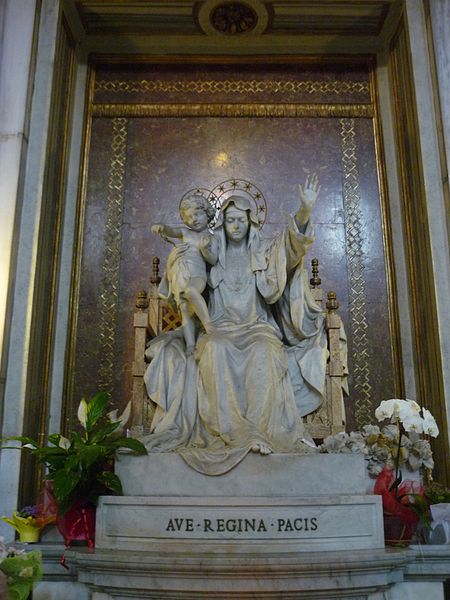
On Facebook yesterday, a number of Catholic friends were sharing around an image of Mary the Mother of Jesus, modeled after the famous Polish icon, Our Lady of Czestochowa. While the art style may not be to everyone’s taste, what I liked about the image was that Mary is presented as strong, cool – possibly staring down an opponent, certainly keeping her thoughts to herself, while holding her baby close. All we see of the face of baby Jesus is that he is looking up at his mother and protector. It’s an expression I wish I could emulate, any time I feel I need to take a stand to protect my family. And insofar as I have a devotion to Mary as Mother, there is reassurance in knowing that she might be facing down my enemies, too.
Mary of Nazareth bore her child into uncertain political and economic circumstances, a poor young woman in a marginalized group oppressed by Imperial powers. That she had to travel long miles while pregnant to register for Augustus’ census is a reminder of the cruelty and heartlessness of such imperial regimes, the disdain for the poor, for mothers and children. The indifference to families unless they are “good Roman families” such as Augustus liked to praise.
She bore her child in a stable, and shortly after had to flee as a refugee from state-sanctioned violence, into a foreign land. She may have saved her child, but what about all the other babies who were killed? This might be one of the things Mary pondered in her heart: why the others couldn’t have been saved. Why she was singled out. What would it feel like, returning to Nazareth and raising a child among women whose sons of the same age had been slaughtered?
It makes sense to portray Mary, at this point in her young life, as angry or defensive. If Jesus could fly into a rage and kick over tables because of economic injustice, why shouldn’t his mother be able to rage against the injustice of a violent regime? Maybe it was a family trait.
But the commentary on this image, mostly from males of a more conservative background, was hugely negative. She doesn’t look meek was the most common response. Or, she doesn’t look humble, she doesn’t look loving. Even: her neckline is immodest. Or, worst of all, she looks like a whore.
Forget about the fact that in the history of art we often see Mary with her breast completely bare, nursing Jesus. Or even squirting milk into the mouth of a male saint. Yes, that’s right. St. Bernard of Clairvaux had a vision in which Mary appeared, lactating, and squirted milk from her breast into his mouth: thus, the story goes, he acquired his great eloquence. Okay, Bernard.
Forget about the fact that we have images of Jesus in which he is more like a judgmental Apollo than gentle Messiah. Why is it acceptable to portray different facets of Jesus, but not of Mary? If Mary is indeed supposed to be “queen of heaven” and the “woman clothed with the sun” who strikes at the serpent, we should see her fierce side, too. She herself sang the revolutionary Magnificat, rejoicing in the casting down of the mighty from their thrones.
The men who object to Mary’s representation as other than the meek, pink-and-white maiden of countless kitschy holy cards seem to be objecting not out of an adherence to Biblical accuracy or artistic tradition. They’re objecting because this is not “their” Mary, the Mary they are willing to venerate. Theirs is an idealized image of the feminine, not even a real woman anymore, but an airy Platonic ideal. Pure, meek, humble. Giving birth to her baby through her ear. Usually silent, unless she says “obey him” – or appears to chastise children about immodest clothing, or not praying enough.
But Mary was not an ideal. She is portrayed in Scripture as a real woman, and one with quite a bit to say, in the few scenes where we see her. She questions an angel, sings revolutionary hymns, sets off on journeys alone, even chastises her son when he slips away from them. If, as the teaching says, she was devoid of sin, being devoid of sin does not mean being confined to just a few virtues, the ones that men have deemed “feminine.” And obedience to God does not mean obedience to men, or to the laws of men. Usually, in the lives of memorable women, it means quite the reverse. And they suffer for it. They don’t emerge looking pink and docile, until after those who rewrite their stories have rendered them fit for a holy card.
Back in 2016, I wrote about the fact that, whenever we object to sexism in the church, someone is sure to remind us that “we have Mary. So what are you complaining about?” We’ve elevated a woman as queen of heaven; a woman was chosen to bear God in the world – so, move on, no sexism here!
Some of the views I expressed in that earlier piece have changed since then, but I still stand by this assertion: that until women are the ones leading the conversation about sex, gender, and equality in the church, we don’t “have” Mary. Men do. Or, rather, they have an idealized, fetishized image of her, one they can comfortably put on pedestals – or even fantasize about suckling from – without feeling guilt, or feeling obligated to give a space to real, living, inferior women at all. They’ve parceled off the virtues, designating any that might be associated with obedience of subordination as “feminine” and assigning those to the mother of God.
In this cultural context, seeing Mary as representing emotions or virtues that have been reserved for select males – white males, the ones who call the shots – is an affront to their authority, specifically their authority to define and limit women. To tell us how we must dress, lest we lead them astray. To tell us what to think, since they are the ones attuned to the voice of God. To tell us how to use our bodies. We’re allowed to stand very, very still on pedestals or in holy cards, and only speak when echoing.
If Mary looks angry in the painting, she has every right to be. Look at what she lived through. Look at what Christians have done in her son’s name – and what men have done with her, too, turning her into a weapon to be used against her daughters.
Here at the beginning of 2018, when a megalomaniacal demagogue – elected with the wild approval of right-wing American “family value” Christians – is tweeting nuclear violence at another megalomaniac on the other side of the globe, I fear for my children, and the world they will have to navigate. Looking at the face of a mother who is also a protector is encouraging. Okay, I say to her. You’re with me. We’re in this together.
Previous Post
December 28, 2017
"Fake News" and the Silencing of Women
Next Post

January 5, 2018 Sexual Moral Relativism from the Religious Right?
Browse Our Archives
Select a Category abortion anti-semitism art Atwood Betrothed church clergy abuse coronavirus culture economics education environmentalism ethics faith family feminism gardening gun violence immigration Judaism literature MaddAddam New Pro Life Movement news pandemic personalism poem politics politics blue Pope Francis racism religion salvation sexuality social justice spirituality Station eleven Stephen King The Stand Trump Uncategorized war World Health Organization
Select a Month March 2021 February 2021 January 2021 December 2020 November 2020 October 2020 September 2020 August 2020 July 2020 June 2020 May 2020 April 2020 March 2020 February 2020 January 2020 December 2019 November 2019 October 2019 September 2019 August 2019 July 2019 June 2019 May 2019 April 2019 March 2019 February 2019 January 2019 December 2018 November 2018 October 2018 September 2018 August 2018 July 2018 June 2018 May 2018 April 2018 March 2018 February 2018 January 2018 December 2017 November 2017 October 2017 September 2017 August 2017 July 2017 June 2017 May 2017 April 2017 March 2017 February 2017 January 2017 December 2016 November 2016 October 2016 September 2016 August 2016 July 2016 June 2016 May 2016 April 2016 March 2016 February 2016
Follow Us!
TAKE THE
Religious Wisdom Quiz
How many chapters does the book of Judges have?
Select your answer to see how you score.
21 25 23 19
Support this
Column


Related posts from suspended in her jar

Immigrants: They Need Us, and We Need Them

Four Takeaways from Oprah’s Interview with the Duke...

Catholics Are De-Toxing From their Experiences With Traumatic...

How Has the Pandemic Changed Us? Has It...
TRENDING AT PATHEOS Catholic

Rejecting Doom: Christian Hope And Human Action
Christianity is a religion of hope. We are to have hope and...

It’s What Comes From Within Which Matters
One of the most difficult things for us to understand is why...

Why I Choose the Eucharist Over the Sermon
Choose the Eucharist, Not the Sermon What are we supposed to get...

5 Design Elements Found in Spiritually Rooted Homes
Putting Spirituality Into Home Decor Our homes are more than our living...

Credo: A Story of God Told with the...
About 10 years ago, I began to imagine a personal "Credo" that...

The Anatomy of Divine Revelation in Catholic Thought
The claim that God has made Himself known to human beings is...
view all Catholic blogs
Ad-Free & Subscriber Log-In Subscription Support
- About Us
- 2026 Calendar
- Videos
- Podcasts
- Library of World Religions
- Faith In Media Tracker
- Advertise With Us
- Write for Us
- Privacy Policy
- Terms of Service
- Do Not Sell My Data
- Contact Us
- Radiant Digital
- Manage Newsletter Subscriptions
- Unsubscribe From Notifications
- Sitemap
Copyright 2008-2026, Patheos. All rights reserved.
Subscription Support Ad-Free & Subscriber Log-In
Follow Patheos