
BuddhistCatholicContemplativeEvangelicalGeneral ChristianHinduJewishLatter-day SaintMuslimNew VisionsProgressive Christian
Beliefs
- Buddhist
- Catholic
- Contemplative
- Evangelical
- General Christian
- Hindu
- Jewish
- Latter-day Saint
- More Voices
- Muslim
- New Visions
- Pagan
- Progressive Christian
Topics
- Religion News
- Food and Religion
- Sports and Religion
- Religious Art
- Religious Music and Entertainment
- Religious Events
- History and Religion
- Style and Religion
- Politics and Religion
- Women in Religion
- Recreation Outdoors and Religion
- Business Finance and Religion
- Careers Workplace and Religion
- Education and Religion
- Family Parenting and Religion
- Health Fitness and Religion
- Home and Religion
- Relationships and Religion
- Technology and Religion
- Travel and Religion
Columnists
- Buddhist Columnists
- Business Finance and Religion Columnists
- Careers Workplace and Religion Columnists
- Catholic Columnists
- Contemplative Columnists
- Education and Religion Columnists
- Evangelists Columnists
- Family Parenting and Religion Columnists
- General Christian Columnists
- Health Fitness and Religion Columnists
- Hindu Columnists
- History and Religion Columnists
- Home and Religion Columnists
- Jewish Columnists
- More Voices Columnists
- Latter Day Columnists
- Muslim Columnists
- New Visions Columnists
- Nonreligious Columnists
- Pagan Columnists
- Politics and Religion Columnists
- Progressive Columnists
- Recreation Outdoors and Religion Columnists
- Relationships and Religion Columnists
- Religion News Columnists
- Religious Art Columnists
- Religious Events Columnists
- Religious Music and Entertainment Columnists
- Sports and Religion Columnists
- Style and Religion Columnists
- Technology and Religion Columnists
- Travel and Religion Columnists
- Women in Religion Columnists
Resource Library
- 2026 Calendar
- Library of World Religions
- The 100 Most Holy Places on Earth
- Patheos Answers
- Podcasts
- Videos
- Faith Leaders Database
- Anglican Episcopalian
- Bahai
- Baptist
- Buddhism
- Christianity
- Confucianism
- Eastern Orthodoxy
- Hinduism
- Holiness and Pentecostal
- ISKCON
- Islam
- Judaism
- Lutheran
- Methodist
- The Church of Jesus Christ of Latter-day Saints
- New Age
- Paganism
- Presbytarian and Reformed
- Protestantism
- Religion Behind the Scenes
- Roman Catholic
- Scientology
- Shia Islam
- Sikhism
- Sufism
- Sunni Islam
- Taoism
- Zen
- See all religions
Research Tools
 Ad-Free & Subscriber Log-In Subscription Support
Follow Patheos 

- Trending:
- Advent
- |
- Forgiveness
- |
- Thanksgiving
- |
- Election
- |
- Seasonal Holidays
- |
- Marriage
 suspended in her jar
- Home
- Catholic
- the cultural ambiguity in our honoring of mothers
the cultural ambiguity in our honoring of mothers
Last updated on: May 18, 2017 at 4:57 pm by Rebecca Bratten Weiss
the cultural ambiguity in our honoring of mothers 2017-05-18T16:57:19-04:00 Rebecca Bratten Weiss
Patheos Explore the world's faith through different perspectives on religion and spirituality! Patheos has the views of the prevalent religions and spiritualities of the world.
Mother’s Day has come and gone again, and again I have had the opportunity to muse on the array of reactions to it. Some women simply enjoy having a day off with their families (I didn’t: I was grading papers and working); others are given the royal treatment, prompting a few eyerolls. Some post cute photos of the lopsided cakes their kids made, or the bouquets of wildflowers. Some women don’t really pay much attention to it.
And for others, it is deeply problematic, politically – or troubling, personally.
It is certainly a day that serves to highlight privilege. Who is financially secure enough to take the day off? Who has a caring, loving, living partner who will pick up the slack so she can relax? Who has children who are healthy and happy and at home? Who has a mother still living? Who is able to look back on a deceased mother with fondness and affection?
I don’t think most people who are less privileged want to rain on the parades of those who are, but it is hard for many women, when everyone else is throwing flowers in the air with joy at the very idea of motherhood, and they’re not feeling it. It’s even harder when they feel that they are expected to rein in their feelings of pain, loss, and abuse, simply in order not to cast a pall onto the fun times of the moms who are queens for the day. There’s this constant cultural pressure to keep things happy, keep things upbeat, and above all keep things FUN. When we’re suffering we’re not much fun, so we’re expected just to disappear until the party is over.
But if this is what Mother’s Day has become, then it is failing in its purpose. Because, the origin of the celebration lies not with the luxuriation of the middle-class, but with women’s activist and pacifist movements. Women took a stand against the war that was devouring their husbands and sons, and gathered together to work to improve the conditions of poor women and their families. Anna Jarvis, who officially initiated the celebration, did so to honor her mother, who had been involved in the pacifist activism of the prior century. It was never intended to be a commercial holiday: Jarvis actually staged boycotts to protest the usurpation of the day for material ends.
Anyone who objects to the politicization needs to be aware that the day was, in its roots, political. And if we are to honor our “foremothers” who worked so hard to create better living conditions for our families, and to stand up against the engines of war that sent their men to die, we need to take into our sphere of consideration those women whose experiences don’t fit the pretty “mother” narrative.
Women who have lost their mothers, especially if they died young, or through some difficult disease or terrible accident, find this a day of mourning, bereft and solitary. Women who have lost a child, or children, in any way, may awaken to a day of pain made more painful, a reminder of loss and heartbreak. Women who gave children up for adoption may find their own experience of motherhood denied and disregarded, as though they were not “real mothers.” And those who have suffered infertility may find this day a reminder of something they hoped for but are realizing they may never have, the loss of a dream of who they would be.
And it isn’t just women who may have a hard time: anyone, male or female, who has experienced abandonment or abuse from a mother might shudder at the very word. Kitschy statements about a mother’s love turn to sardonic, sadistic reminders of past horror. If a mother’s love is where we experience God’s love, what do we say to these victims of abuse? How can we hold it against them if they don’t throw flowers in the air?
Then there are those who are not mothers because of life choices. No, honoring mothers does not mean (or should not mean) excluding non-mothers, and it seems narcissistic for non-mothers to object to a day that isn’t about them…but, in a culture where motherhood is romanticized and fetishized, where women who don’t marry and bear children are pitied as somehow having missed their vocation, Mother’s Day reminds us all too sharply that something is amiss. Even those of us who are mothers can sense this. So no wonder non-mothers may feel excluded. They’re already being excluded, every day of the week – and this is especially true in more traditional religious circles, where the idea of a flourishing, mature, single woman is either non-existent or terrifying.
What is amiss, especially in these religious circles, is that we are not honoring women in their many, varied capabilities – one of which is motherhood – but instead placing on a pedestal an abstract feminine ideal that has little to do with messy lived reality. Anna Jarvis wanted this to be a day for honoring one’s own mother, not “motherhood” pe se. To honor an individual mother, quietly, at home, without commercial fanfare, is a choice one can make or not make, and it is a choice to honor a unique human being, not an effervescent notion. And it should certainly not imply that other women are any way less women.
I am uncomfortable, however, with objections to Mother’s Day that imply a sort of erasure of motherhood as unimportant. What preens itself as anti-essentialist is actually anti-female: anti-female-body, a capitalist and utilitarian prejudice against that which is as messy and inconvenient as our bodies are. We who have become mothers, whether by choice or not, have experienced something intense and personal, for some beautiful, for others traumatic, but certainly not just a casual jaunt. We have torn and bled. We’ve been chewed on, leaked out life. We have lain awake night after night, bounding up in the darkness at the sound of a cry. Sometimes we have felt a deep peace with this, amidst the exhuastion, sometimes terror, sometimes despair. And without us, humanity would not have gone on.
I am actually okay with revering motherhood, if it is done with ritual power, and not with bracketing fetishization.
To revere motherhood should involve a reverence towards the act of creation itself, the thing that happens in the mother’s body, associated with fertility, the earth, the principles of generation and fruitfulness. This reverence should make itself known in our cultural and religious rituals. But instead of honoring the power and potency of female birthing, we honor a set of airy principles that are either not actually very important (like, being sweet) or are virtues that should be pursued by everyone, man or woman (such as being courageous). If we revere motherhood so much, and see it as so vital and powerful, mothers as such fonts of virtue, then why do we use this as an argument for keeping women secreted in small corners, when we should be set up to give counsel and pass judgment in the public places?
Of course, lots of mothers aren’t actually such fonts of virtue. Lots of us are kind of straggling along, doing our best. But this is true of fathers and paternity, too, while the idea of paternity is still employed to justify male rule. Meanwhile, the idea of maternity is elevated, but females themselves told to keep to our proper places: in the home, looking pretty, mouths shut, etc.
I don’t have a lot of stake in the idea of Mother’s Day itself, but I do think that a closer look at what it was intended to be, versus what it is today, can help us correct some of the misconceptions in the way our culture and our religious communities regard women, and to do better at offering support to those women for whom the very idea of “motherhood” can be painful or problematic.
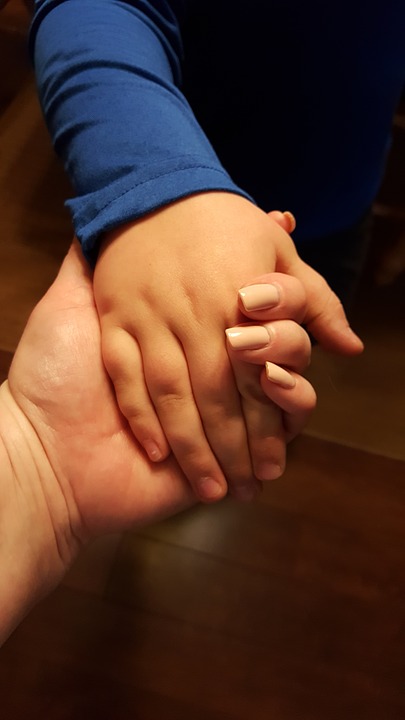
image credit: http://maxpixel.freegreatpicture.com/Hands-Mother-And-Child-Holding-Hands-Mother-Love-1815145
Previous Post
May 8, 2017
the power of negative thinking
Next Post

May 18, 2017 When You Say You're Not a Racist
Browse Our Archives
Select a Category abortion anti-semitism art Atwood Betrothed church clergy abuse coronavirus culture economics education environmentalism ethics faith family feminism gardening gun violence immigration Judaism literature MaddAddam New Pro Life Movement news pandemic personalism poem politics politics blue Pope Francis racism religion salvation sexuality social justice spirituality Station eleven Stephen King The Stand Trump Uncategorized war World Health Organization
Select a Month March 2021 February 2021 January 2021 December 2020 November 2020 October 2020 September 2020 August 2020 July 2020 June 2020 May 2020 April 2020 March 2020 February 2020 January 2020 December 2019 November 2019 October 2019 September 2019 August 2019 July 2019 June 2019 May 2019 April 2019 March 2019 February 2019 January 2019 December 2018 November 2018 October 2018 September 2018 August 2018 July 2018 June 2018 May 2018 April 2018 March 2018 February 2018 January 2018 December 2017 November 2017 October 2017 September 2017 August 2017 July 2017 June 2017 May 2017 April 2017 March 2017 February 2017 January 2017 December 2016 November 2016 October 2016 September 2016 August 2016 July 2016 June 2016 May 2016 April 2016 March 2016 February 2016
Follow Us!
TAKE THE
Religious Wisdom Quiz
How many specific prophecies about Messiah?
Select your answer to see how you score.
200 250 300+ 150
Support this
Column


Related posts from suspended in her jar
Immigrants: They Need Us, and We Need Them

Four Takeaways from Oprah’s Interview with the Duke...

Catholics Are De-Toxing From their Experiences With Traumatic...
How Has the Pandemic Changed Us? Has It...
TRENDING AT PATHEOS Catholic

The Kingdom Of God In Ordinary Life And...
The kingdom of God is all around us; it is in us...

How Discretion Guides Us Away From Extremes
Prudence is an important virtue for all of us. While we should...

If Baptism Washes Away Sin, Why Do Catholics...
The seven sacraments stand as the foundation of Catholic ecclesial life. The...

The Power of Setting a Good Example
Remember last August when the Chicago White Sox hosted a "Pope Hat...

A Catholic Critique of Biblical Unitarianism
If the statistics are to be believed, Unitarianism is rising worldwide. Although...

How Grandma Tourism Helps Grandparents Live Their Vocation
Grandma, The New Travel Influencer What started as a nostalgia-inspired social media...
view all Catholic blogs
Ad-Free & Subscriber Log-In Subscription Support
- About Us
- 2026 Calendar
- Videos
- Podcasts
- Library of World Religions
- Faith In Media Tracker
- Advertise With Us
- Write for Us
- Privacy Policy
- Terms of Service
- Do Not Sell My Data
- Contact Us
- Radiant Digital
- Manage Newsletter Subscriptions
- Unsubscribe From Notifications
- Sitemap
Copyright 2008-2026, Patheos, part of the Radiant Digital network of media brands. All rights reserved.
Subscription Support Ad-Free & Subscriber Log-In
Follow Patheos