
BuddhistCatholicContemplativeEvangelicalGeneral ChristianHinduJewishLatter-day SaintMuslimNew VisionsProgressive Christian
Beliefs
- Buddhist
- Catholic
- Contemplative
- Evangelical
- General Christian
- Hindu
- Jewish
- Latter-day Saint
- More Voices
- Muslim
- New Visions
- Pagan
- Progressive Christian
Topics
- Religion News
- Food and Religion
- Sports and Religion
- Religious Art
- Religious Music and Entertainment
- Religious Events
- History and Religion
- Style and Religion
- Politics and Religion
- Women in Religion
- Recreation Outdoors and Religion
- Business Finance and Religion
- Careers Workplace and Religion
- Education and Religion
- Family Parenting and Religion
- Health Fitness and Religion
- Home and Religion
- Relationships and Religion
- Technology and Religion
- Travel and Religion
Columnists
- Buddhist Columnists
- Business Finance and Religion Columnists
- Careers Workplace and Religion Columnists
- Catholic Columnists
- Contemplative Columnists
- Education and Religion Columnists
- Evangelists Columnists
- Family Parenting and Religion Columnists
- General Christian Columnists
- Health Fitness and Religion Columnists
- Hindu Columnists
- History and Religion Columnists
- Home and Religion Columnists
- Jewish Columnists
- More Voices Columnists
- Latter Day Columnists
- Muslim Columnists
- New Visions Columnists
- Nonreligious Columnists
- Pagan Columnists
- Politics and Religion Columnists
- Progressive Columnists
- Recreation Outdoors and Religion Columnists
- Relationships and Religion Columnists
- Religion News Columnists
- Religious Art Columnists
- Religious Events Columnists
- Religious Music and Entertainment Columnists
- Sports and Religion Columnists
- Style and Religion Columnists
- Technology and Religion Columnists
- Travel and Religion Columnists
- Women in Religion Columnists
Resource Library
- 2026 Calendar
- Library of World Religions
- The 100 Most Holy Places on Earth
- Patheos Answers
- Podcasts
- Videos
- Faith Leaders Database
- Anglican Episcopalian
- Bahai
- Baptist
- Buddhism
- Christianity
- Confucianism
- Eastern Orthodoxy
- Hinduism
- Holiness and Pentecostal
- ISKCON
- Islam
- Judaism
- Lutheran
- Methodist
- The Church of Jesus Christ of Latter-day Saints
- New Age
- Paganism
- Presbytarian and Reformed
- Protestantism
- Religion Behind the Scenes
- Roman Catholic
- Scientology
- Shia Islam
- Sikhism
- Sufism
- Sunni Islam
- Taoism
- Zen
- See all religions
Research Tools
 Ad-Free & Subscriber Log-In Subscription Support
Follow Patheos 

- Trending:
- Advent
- |
- Forgiveness
- |
- Thanksgiving
- |
- Election
- |
- Seasonal Holidays
- |
- Marriage
 suspended in her jar
- Home
- Catholic
- my family did the benedict option before it was cool – and here’s why it doesn’t work
my family did the benedict option before it was cool – and here’s why it doesn’t work
Last updated on: April 5, 2017 at 11:17 pm by Rebecca Bratten Weiss
my family did the benedict option before it was cool – and here’s why it doesn’t work 2017-04-05T23:17:34-04:00 Rebecca Bratten Weiss
Patheos Explore the world's faith through different perspectives on religion and spirituality! Patheos has the views of the prevalent religions and spiritualities of the world.
A few years ago, I started writing a novel that was loosely based on my recollections of having grown up in and out of a series of attempted religious communities. As I wrote, I collected material from others with similar experiences, and the anecdotes piled high. Eventually I realized that some of the stories were so over-the-top, mere realism would be insufficient to convey the bizarre intensity of life on the “outside” of the ordinary parameters of modern American experience, and a sort of magical realist/ gothic mashup would be better. Magical realism as a sub-genre has a special place in tale-telling of post-colonial or marginalized communities. And there is something post-colonial, something of the feel of the immigrant, when you come out of community life and dwell in the mainstream. As my collection of anecdotes piled high, I found myself thinking, repeatedly, “damn, this is good. I HAVE to use this one.” Of course, in the ethos of the storyteller, “good” usually means excruciatingly bad, painful, embarrassing, tragic.
So, yes, escapees from intentional community have stories to tell, and many are painful. My own experiences verge more on the grotesquely humorous, and some of my memories are happy ones, so even now, when the experiments are over, I still can understand why something like the Benedict Option would appeal to people. In a way, it is a beautiful dream.
Because, you see, the Benedict Option – though not by that name – was around for a good forty years before Dreher sat down to write. My father was one of several who came up with the idea. While running a raucous bar in Chapel Hill, NC, he was also reading Thomas Merton and Louis Bromfield and Ralph Waldo Emerson, and eventually came to the conclusion that the best bet for Christians in the modern world was to come out and “be set apart.” He even drew on his understanding of St. Benedict’s communities, with a special stress on the notion of “ora et labora.”
Because my father opted actually to do the thing, instead of sitting in an office writing a book about it, you have never heard of him. Which means, I suppose, that his attempt was fairly successful. But these attempts are never all that successful.
My novel – The Serpent Motif – ended up being 180,00 words long, which means too long to interest agents for hard-copy publications, so I’m trimming it down a bit while I work on another, shorter project. And from a theoretical standpoint I could also wax overly verbose, on the idea of intentional religious community, why it is attractive, and why it won’t work. I have had first-hand experience of just how things can go wrong, and lots of second-hand stories about other ways they can go even more wrong.
And there’s something touchingly tragic about it: because on a fundamental level, one can see the appeal of the idea, and many of those who attempted it did so with the noblest of intentions.
Sam Rocha’s recent review of The Benedict Option details some of the areas in which Dreher’s conceptualization fails. Rocha, like me, has first-hand experience of what an attempt at community feels like. Fr. Stephanos Pedrano, guest-writing for Steel Magnificat, details why the Option isn’t especially Benedictine.
And there are other problems: when you try to come Out (or In?), whatever you feared in the World comes in with you, into your microcosm. It’s ironic that my father’s first community was called “New Eden.” Into every Eden, a serpent will come. We tend to bring it in with us. Want to escape from overweening tyrannical power? Too bad, you probably brought it with you, and you will find the community dominated by whichever leader (usually male) has the loudest voice and the least empathy. Want to escape from sexual perversion? Ha. Have I got some stories! It’s amazing just how perverse people can be, on the land, when no one is looking. Want to escape from a welfare system in which those who don’t work won’t eat? I can assure you, you will be shelling beans or building a cabin while nearby some hanger-on rambles on forever about how misunderstood he is. Tired of nitpicking bureaucracy? Your community will be filled with nitpickers, happy to call you out if your daughters’ skirts are too short, or if your sons have been listening to evil music like (gasp) Simon and Garfunkel.
Communities like this tend to attract those who are unable to get along in the ordinary world, and whatever it was that made them unable to get along, they will bring in with them.
But the main thing I want to touch on, here, is why the idea of radical separation into intentional community is delusional from the start. And that has to do with money.
Money creates systemic dependence. That’s why agrarianism is a needed component in any marginally successful effort. Independence from the System means creating an alternative inter-dependence on the land. Back in the early nineties, my family and others were involved in ongoing discussions about this, with others involved in Caelum et Terra, the brainchild of Daniel Nichols. Nichols, like my father, gets the hipster cred here: he came up with the Benedict Option before it was cool. Too bad they didn’t patent it.
Now, today, David Russell Mosley writes about Michael Martin’s “Sophia Option,” as an alternative to Dreher’s approach. Martin is a biodynamic farmer (I have him to thank for my fine horseradish planting), and understands better than a journalist what is entailed in creating a network of interconnections that differ from those in the neo-liberal capitalist system. I would suggest that any attempt at intentional community that neglects agrarianism is already problematic, because it means that one remains absolutely dependent on money, and therefore on capitalism, and therefore on industry, and therefore on the whole global military industrial complex. Which means, if you think you’re “set apart,” you’re just fooling yourself. You are living immersed in structural evil, and limply virtue-signalling.
But even with agrarianism, it’s impossible to avoid money. We tried. We lived on someone else’s land, so there were no taxes. My parents had no money-earning work outside the home, but we lived almost entirely on garden produce. We had electricity, but no running water, no telephone, certainly no television. We heated our home with a wood stove, and my father spent all day every day all winter just cutting wood, with a bowsaw and axe (no noisy chainsaws to disturb the tranquility of nature), in order to keep one room of the house livable.
But we still needed a little money, and relied heavily on donations from those who remained complicit in the system. Which means we were complicit in the system, even if we pretended not to be.
The Onion had a funny piece, recently, about how Noam Chomsky trying just to enjoy a normal day, but everything he sees reminds him of our dependence on neoliberal global imperialsm. I sympathize. I would like to create a culture in which I know that nothing I use is made by slave labor or via environmental despoilment. I would like to rely entirely on hand-tools that don’t depend on fossil fuels, and derive my energy from renewable resources. Forget about the incredible challenges of going off-grid in our society. The challenge even buying work clothes that don’t tie me in with slave labor is so great, I occasionally have what my husband jokingly refers to as “Noam Chomsky moments.”
Unless we run off into the wild and live by foraging, and clad ourselves in natural fibers, we are locked into the System.
And even if we were to do this, the System would go on.
Unless, of course, it collapses: this was what I was raised to believe would happen, and now I regard with amusement the feverish attempts of Preppers to prepare for it.
In the Prepper mind, once the System collapses, we’ll all be living like survivalists, foraging and hunting, growing things from open-pollinated seed. But this is again sheer fantasy. We have so depleted our natural resources, the only way a nation of Preppers would survive off the land is if most of them were killed off in the apocalyptic event, first. As it stands, an America full of trigger-happy survivalists out there bagging game for their families will wipe out the deer population in no time at all. I suppose eventually the Preppers will get around to eating one another. Radial inter-dependence on community, indeed.
So what we have to admit is that no matter how diligently we attempt to distance ourselves from the System, we are still locked into it. Or else living on a mountain dressed in goat-hide, eating one another.
So as Christians who take a serious moral stance in relation to structural evil (though we may differ in our ideas of what structural evil is: what I fear is not at all the things Dreher fears) – what do we do? There have to be a range of middle grounds between total acceptance of a system that generates destruction, and the sort of radical self-sufficiency that leads to degradation, failure of community, and ultimately cannibalism (metaphorical, if not literal). I hope that, at least, the publication of Dreher’s book will open up more space for these conversations. But in order to sort out what is and isn’t possible, we need to start by being honest with ourselves about just how dependent we really are.
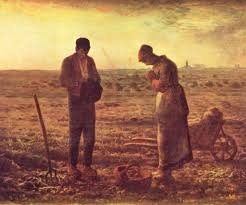
Image credit: https://commons.wikimedia.org/wiki/File:Jean-Fran%C3%A7ois_Millet_(II)_001.jpg
(This painting of The Angelus by Millet was iconic in my upbringing, an image of the dream my father had of the life of work and prayer on the land)

Next Post

April 10, 2017 Jesus was not an alpha
Browse Our Archives
Select a Category abortion anti-semitism art Atwood Betrothed church clergy abuse coronavirus culture economics education environmentalism ethics faith family feminism gardening gun violence immigration Judaism literature MaddAddam New Pro Life Movement news pandemic personalism poem politics politics blue Pope Francis racism religion salvation sexuality social justice spirituality Station eleven Stephen King The Stand Trump Uncategorized war World Health Organization
Select a Month March 2021 February 2021 January 2021 December 2020 November 2020 October 2020 September 2020 August 2020 July 2020 June 2020 May 2020 April 2020 March 2020 February 2020 January 2020 December 2019 November 2019 October 2019 September 2019 August 2019 July 2019 June 2019 May 2019 April 2019 March 2019 February 2019 January 2019 December 2018 November 2018 October 2018 September 2018 August 2018 July 2018 June 2018 May 2018 April 2018 March 2018 February 2018 January 2018 December 2017 November 2017 October 2017 September 2017 August 2017 July 2017 June 2017 May 2017 April 2017 March 2017 February 2017 January 2017 December 2016 November 2016 October 2016 September 2016 August 2016 July 2016 June 2016 May 2016 April 2016 March 2016 February 2016
Follow Us!
TAKE THE
Religious Wisdom Quiz
True or False: Proverbs 31 describes the characteristics of a godly husband.
Select your answer to see how you score.
FALSE TRUE
Support this
Column


Related posts from suspended in her jar

Immigrants: They Need Us, and We Need Them

Four Takeaways from Oprah’s Interview with the Duke...

Catholics Are De-Toxing From their Experiences With Traumatic...

How Has the Pandemic Changed Us? Has It...
TRENDING AT PATHEOS Catholic

The Kingdom Of God In Ordinary Life And...
The kingdom of God is all around us; it is in us...

How Discretion Guides Us Away From Extremes
Prudence is an important virtue for all of us. While we should...

If Baptism Washes Away Sin, Why Do Catholics...
The seven sacraments stand as the foundation of Catholic ecclesial life. The...

The Power of Setting a Good Example
Remember last August when the Chicago White Sox hosted a "Pope Hat...

A Catholic Critique of Biblical Unitarianism
If the statistics are to be believed, Unitarianism is rising worldwide. Although...

How Grandma Tourism Helps Grandparents Live Their Vocation
Grandma, The New Travel Influencer What started as a nostalgia-inspired social media...
view all Catholic blogs
Ad-Free & Subscriber Log-In Subscription Support
- About Us
- 2026 Calendar
- Videos
- Podcasts
- Library of World Religions
- Faith In Media Tracker
- Advertise With Us
- Write for Us
- Privacy Policy
- Terms of Service
- Do Not Sell My Data
- Contact Us
- Radiant Digital
- Manage Newsletter Subscriptions
- Unsubscribe From Notifications
- Sitemap
Copyright 2008-2026, Patheos, part of the Radiant Digital network of media brands. All rights reserved.
Subscription Support Ad-Free & Subscriber Log-In
Follow Patheos