
BuddhistCatholicContemplativeEvangelicalGeneral ChristianHinduJewishLatter-day SaintMuslimNew VisionsProgressive Christian
Beliefs
- Buddhist
- Catholic
- Contemplative
- Evangelical
- General Christian
- Hindu
- Jewish
- Latter-day Saint
- More Voices
- Muslim
- New Visions
- Pagan
- Progressive Christian
Topics
- Religion News
- Food and Religion
- Sports and Religion
- Religious Art
- Religious Music and Entertainment
- Religious Events
- History and Religion
- Style and Religion
- Politics and Religion
- Women in Religion
- Recreation Outdoors and Religion
- Business Finance and Religion
- Careers Workplace and Religion
- Education and Religion
- Family Parenting and Religion
- Health Fitness and Religion
- Home and Religion
- Relationships and Religion
- Technology and Religion
- Travel and Religion
Columnists
- Buddhist Columnists
- Business Finance and Religion Columnists
- Careers Workplace and Religion Columnists
- Catholic Columnists
- Contemplative Columnists
- Education and Religion Columnists
- Evangelists Columnists
- Family Parenting and Religion Columnists
- General Christian Columnists
- Health Fitness and Religion Columnists
- Hindu Columnists
- History and Religion Columnists
- Home and Religion Columnists
- Jewish Columnists
- More Voices Columnists
- Latter Day Columnists
- Muslim Columnists
- New Visions Columnists
- Nonreligious Columnists
- Pagan Columnists
- Politics and Religion Columnists
- Progressive Columnists
- Recreation Outdoors and Religion Columnists
- Relationships and Religion Columnists
- Religion News Columnists
- Religious Art Columnists
- Religious Events Columnists
- Religious Music and Entertainment Columnists
- Sports and Religion Columnists
- Style and Religion Columnists
- Technology and Religion Columnists
- Travel and Religion Columnists
- Women in Religion Columnists
Resource Library
- 2026 Calendar
- Library of World Religions
- The 100 Most Holy Places on Earth
- Patheos Answers
- Podcasts
- Videos
- Faith Leaders Database
- Anglican Episcopalian
- Bahai
- Baptist
- Buddhism
- Christianity
- Confucianism
- Eastern Orthodoxy
- Hinduism
- Holiness and Pentecostal
- ISKCON
- Islam
- Judaism
- Lutheran
- Methodist
- The Church of Jesus Christ of Latter-day Saints
- New Age
- Paganism
- Presbytarian and Reformed
- Protestantism
- Religion Behind the Scenes
- Roman Catholic
- Scientology
- Shia Islam
- Sikhism
- Sufism
- Sunni Islam
- Taoism
- Zen
- See all religions
Research Tools
 Ad-Free & Subscriber Log-In Subscription Support
Ad-Free & Subscriber Log-In Subscription Support
Follow Patheos 

- Trending:
- Forgiveness
- |
- Marriage
- |
- Consciousness
- |
- Death Penalty
- |
- Election
- |
- Halloween
 suspended in her jar
- Home
- Catholic
- all hail the tricksters
all hail the tricksters
Last updated on: April 1, 2017 at 1:17 pm by Rebecca Bratten Weiss
all hail the tricksters 2017-04-01T13:17:27-04:00 Rebecca Bratten Weiss
Patheos Explore the world's faith through different perspectives on religion and spirituality! Patheos has the views of the prevalent religions and spiritualities of the world.
April Fool’s Day: some delight in it, others loathe it, a few take it too far. And unlike other holidays, it is neither some new-fangled modern headache, nor an ancient ritual deformed by commercialism. April Fool’s Day is pretty much the same today as it was when initially celebrated in the year 1700. No cards, no gifts, no parades, no feasts, just the fun (or nuisance, depending on your personality) of trickery. And its historical roots reach back further, into the Middle Ages, or possibly even into ancient Roman times. “This day in History,” at History.com, gives a brief account of the possible origins of this peculiar celebration:
Some historians speculate that April Fools’ Day dates back to 1582, when France switched from the Julian calendar to the Gregorian calendar, as called for by the Council of Trent in 1563. People who were slow to get the news or failed to recognize that the start of the new year had moved to January 1 and continued to celebrate it during the last week of March through April 1 became the butt of jokes and hoaxes. These included having paper fish placed on their backs and being referred to as “poisson d’avril” (April fish), said to symbolize a young, easily caught fish and a gullible person.
Historians have also linked April Fools’ Day to ancient festivals such as Hilaria, which was celebrated in Rome at the end of March and involved people dressing up in disguises. There’s also speculation that April Fools’ Day was tied to the vernal equinox, or first day of spring in the Northern Hemisphere, when Mother Nature fooled people with changing, unpredictable weather.
I probably fall near the “goes too far” end of the spectrum, when it comes to April Fool practitioners. Thanks to the wonders of the internet, I am now aware that a number of jokes (faking pregnancy, engagement, coming out, etc) are in poor taste. Thanks to friends who have been the butt of jokes past, I realize now that not everyone delights in being elaborately deceived with stories of auto accidents and arrests, especially if it involves being dragged from bed at one AM and setting off on a hapless quest into the wilderness. I am willing to admit that my sense of humor means I am a basically horrible person who has to be “woke” to the fact that, left to my own devices, I would just be offending and inconveniencing everyone.
My closest friend from undergraduate days was a fellow maker of mayhem. One of our most successful pranks involved hanging signs all over campus, telling “ANYONE WHO WISHES TO GIVE OR RECEIVE ADVICE” to call my sister’s dorm room. No one called her to give advice, but she did get dozens of phone calls from earnest students asking for counsel on their studies, their relationships, or whether to become priests. My sister was not amused, but we were.
One accidental prank we played was at the latter end of the year: I set out into the wooded area near campus to cut a “Christmas branch” for our dorm room. It was a wet, dreary day, so naturally I wore my voluminous black cloak. Upon returning from the woods, with the Branch in my hand, I looked up to see my friend waving from her dorm window, signalling me to stop and pose for a picture. On the edge of the grey wood I stood silent, head bowed, denuded branch in hand. It didn’t occur to me at the time that any number of other students might have been looking out of the hundred or so windows, but the next day rumors went round that the campus was “under demonic attack” and that an “evil figure” had been seen, menacing, at the edge of the cliffs. That was satisfying.
There was also the Great Coconut Heist, but we’re still pledged to secrecy about that one.
While there is something deeply dreary about the Noble Lie (deception of the masses for the sake of some supposed good), the sort of deceptions enacted on the day dedicated to trickery are delightfully pointless. Or, if there is a point, it is to cut through the dominant narrative and hegemonic order of things, to cause a shiver of wholesome chaos. This is not the same as the “ritual license” associated with the carnivalesque, but it is in the same family of traditions associated with celebrating bringing about order through disorder.
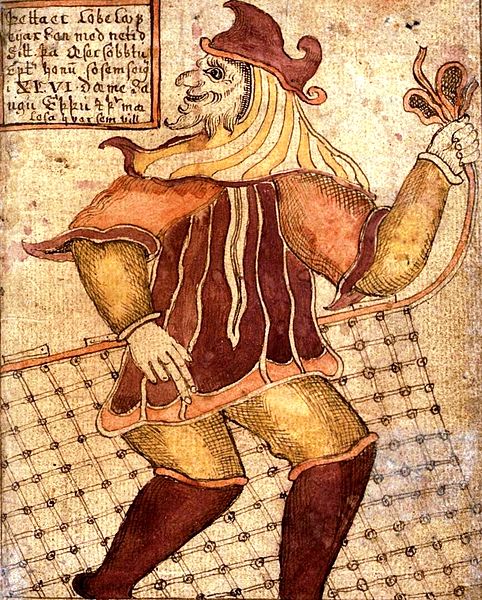
The dominant archetype for this day is, of course, the Trickster. The Trickster figure exists in nearly every oral and mythological tradition, and is popular to this day. The Trickster is cunning and intelligent, sometimes an animal, usually (but not always!) male, typically of a smaller or weaker or disenfranchised class. The Trickster appears as amoral, operating outside the rules of the contextual society, but even though the Trickster’s actions can be mischievous or even vengeful and nasty, their effect on society tends to be beneficent (except, perhaps, for those in power). Tricksters from myth and oral tradition include Anansi in African folklore, Br’er Rabbit among African American peoples, Coyote in the Native American tradition, Loki of the Norse pantheon, Hermes / Mercury of the Greco-Roman gods. Tricksters in drama and books include Puss in Boots, Till Eulenspiegel, Rabelais’ Panurge, and Shakespeare’s Puck. Contemporary fictional Tricksters include Bugs Bunny, Bart Simpson, and Captain Jack Sparrow.
The role of the Trickster is especially significant in the traditions and tales of subjugated peoples. As Trudier Harris points out, in “The Trickster in African American Literature”:
People of African descent who found themselves enslaved in the New World, and specifically on United States soil, were not brought to the West to create poems, plays, short stories, essays, and novels. They were brought for the bodies, their physical labor. Denied access to literacy by law and custom, anything they wanted to retain in the way of cultural creation had to be passed down by word of mouth, or, in terms of crafts, by demonstration and imitation. After long hours of work in cotton and tobacco fields, therefore, blacks would occasionally gather in the evenings for storytelling. Tales they shared during slavery were initially believed to focus almost exclusively on animals. However, as more and more researchers became interested in African American culture after slavery and in the early twentieth century, they discovered a strand of tales that focused on human actors. It is generally believed that enslaved persons did not share with prying researchers the tales containing human characters because the protagonists were primarily tricksters, and the tales showcased actions that allowed those tricksters to get the best of their so-called masters.
At a time when it seems as though the power is entirely in the hands of those who will use it to no good purpose, there is something especially satisfying about messing with the narrative. Keeping one’s sense of humor even in the bleakest of times is a necessity, not only because it cheers one to laugh, but because there is a unique power in the telling of stories, one that They (you know who They are) can’t take away from us. Trickery, jokes, and story-telling are also a powerful weapon against the tyrant, who tells dreary “noble” lies to oppress us. The very pointlessness of the jokes of the Trickster are an affront to a utilitarian society. The unwillingness to be solemn is an affront to those who need to be taken seriously (tyrants always do). This is especially the case when the mockery is directed, especially, against those in power. There’s a reason why comedians get a kick out of mocking Nazis. Nazis just can’t take it.
James Joyce’s character Stephen Dedalus, early in Ulysses, makes the statement that “history is a nightmare from which I am trying to awaken.”
Th elogic of history has an illogic about it that can be sometimes invigorating, sometimes horrifying. The wheels of history roll senselessly on. Some fairly awful things are a fact right now, but that doesn’t mean we don’t get to duck out from under the wheels of history, off to the side, telling a separate tale with a secret joke to it, paint an imaginary village, let the raiders go off and knock it down, the solemn fools, while we laugh slyly up in our tree-forts.
image credit: https://commons.wikimedia.org/wiki/File:Processed_SAM_loki.jpg
Next Post

April 4, 2017 don't like all the negativity in the blogosphere? there's a cure for that
Browse Our Archives
Select a Category abortion anti-semitism art Atwood Betrothed church clergy abuse coronavirus culture economics education environmentalism ethics faith family feminism gardening gun violence immigration Judaism literature MaddAddam New Pro Life Movement news pandemic personalism poem politics politics blue Pope Francis racism religion salvation sexuality social justice spirituality Station eleven Stephen King The Stand Trump Uncategorized war World Health Organization
Select a Month March 2021 February 2021 January 2021 December 2020 November 2020 October 2020 September 2020 August 2020 July 2020 June 2020 May 2020 April 2020 March 2020 February 2020 January 2020 December 2019 November 2019 October 2019 September 2019 August 2019 July 2019 June 2019 May 2019 April 2019 March 2019 February 2019 January 2019 December 2018 November 2018 October 2018 September 2018 August 2018 July 2018 June 2018 May 2018 April 2018 March 2018 February 2018 January 2018 December 2017 November 2017 October 2017 September 2017 August 2017 July 2017 June 2017 May 2017 April 2017 March 2017 February 2017 January 2017 December 2016 November 2016 October 2016 September 2016 August 2016 July 2016 June 2016 May 2016 April 2016 March 2016 February 2016
Follow Us!
TAKE THE
Religious Wisdom Quiz
What animal spoke to Balaam?
Select your answer to see how you score.
A donkey A dove A lion A lamb
Support this
Column


Related posts from suspended in her jar

Immigrants: They Need Us, and We Need Them

Four Takeaways from Oprah’s Interview with the Duke...

Rush Limbaugh Would Never Have Succeeded In an...

We Need to Be Honest When We Talk...
TRENDING AT PATHEOS Catholic

The Parable Of The Sower And The Word...
One of Christ’s most famous parables is that of the sower who...

Rejecting Doom: Christian Hope And Human Action
Christianity is a religion of hope. We are to have hope and...

Why I Choose the Eucharist Over the Sermon
Choose the Eucharist, Not the Sermon What are we supposed to get...

5 Design Elements Found in Spiritually Rooted Homes
Putting Spirituality Into Home Decor Our homes are more than our living...

Credo: A Story of God Told with the...
About 10 years ago, I began to imagine a personal "Credo" that...

The Anatomy of Divine Revelation in Catholic Thought
The claim that God has made Himself known to human beings is...
view all Catholic blogs
Ad-Free & Subscriber Log-In Subscription Support
- About Us
- 2026 Calendar
- Videos
- Podcasts
- Library of World Religions
- Faith In Media Tracker
- Advertise With Us
- Write for Us
- Privacy Policy
- Terms of Service
- Do Not Sell My Data
- Contact Us
- Radiant Digital
- Manage Newsletter Subscriptions
- Unsubscribe From Notifications
- Sitemap
Copyright 2008-2026, Patheos. All rights reserved.
Subscription Support Ad-Free & Subscriber Log-In
Follow Patheos