
BuddhistCatholicContemplativeEvangelicalGeneral ChristianHinduJewishLatter-day SaintMuslimNew VisionsProgressive Christian
Beliefs
- Buddhist
- Catholic
- Contemplative
- Evangelical
- General Christian
- Hindu
- Jewish
- Latter-day Saint
- More Voices
- Muslim
- New Visions
- Pagan
- Progressive Christian
Topics
- Religion News
- Food and Religion
- Sports and Religion
- Religious Art
- Religious Music and Entertainment
- Religious Events
- History and Religion
- Style and Religion
- Politics and Religion
- Women in Religion
- Recreation Outdoors and Religion
- Business Finance and Religion
- Careers Workplace and Religion
- Education and Religion
- Family Parenting and Religion
- Health Fitness and Religion
- Home and Religion
- Relationships and Religion
- Technology and Religion
- Travel and Religion
Columnists
- Buddhist Columnists
- Business Finance and Religion Columnists
- Careers Workplace and Religion Columnists
- Catholic Columnists
- Contemplative Columnists
- Education and Religion Columnists
- Evangelists Columnists
- Family Parenting and Religion Columnists
- General Christian Columnists
- Health Fitness and Religion Columnists
- Hindu Columnists
- History and Religion Columnists
- Home and Religion Columnists
- Jewish Columnists
- More Voices Columnists
- Latter Day Columnists
- Muslim Columnists
- New Visions Columnists
- Nonreligious Columnists
- Pagan Columnists
- Politics and Religion Columnists
- Progressive Columnists
- Recreation Outdoors and Religion Columnists
- Relationships and Religion Columnists
- Religion News Columnists
- Religious Art Columnists
- Religious Events Columnists
- Religious Music and Entertainment Columnists
- Sports and Religion Columnists
- Style and Religion Columnists
- Technology and Religion Columnists
- Travel and Religion Columnists
- Women in Religion Columnists
Resource Library
- 2026 Calendar
- Library of World Religions
- The 100 Most Holy Places on Earth
- Patheos Answers
- Podcasts
- Videos
- Faith Leaders Database
- Anglican Episcopalian
- Bahai
- Baptist
- Buddhism
- Christianity
- Confucianism
- Eastern Orthodoxy
- Hinduism
- Holiness and Pentecostal
- ISKCON
- Islam
- Judaism
- Lutheran
- Methodist
- The Church of Jesus Christ of Latter-day Saints
- New Age
- Paganism
- Presbytarian and Reformed
- Protestantism
- Religion Behind the Scenes
- Roman Catholic
- Scientology
- Shia Islam
- Sikhism
- Sufism
- Sunni Islam
- Taoism
- Zen
- See all religions
Research Tools
 Ad-Free & Subscriber Log-In Subscription Support
Ad-Free & Subscriber Log-In Subscription Support
Follow Patheos 

- Trending:
- Forgiveness
- |
- Marriage
- |
- Consciousness
- |
- Death Penalty
- |
- Election
- |
- Halloween
 suspended in her jar
- Home
- Catholic
- things not to say, if you actually respect women
things not to say, if you actually respect women
Last updated on: March 8, 2017 at 11:32 pm by Rebecca Bratten Weiss
things not to say, if you actually respect women 2017-03-08T23:32:15-04:00 Rebecca Bratten Weiss
Patheos Explore the world's faith through different perspectives on religion and spirituality! Patheos has the views of the prevalent religions and spiritualities of the world.
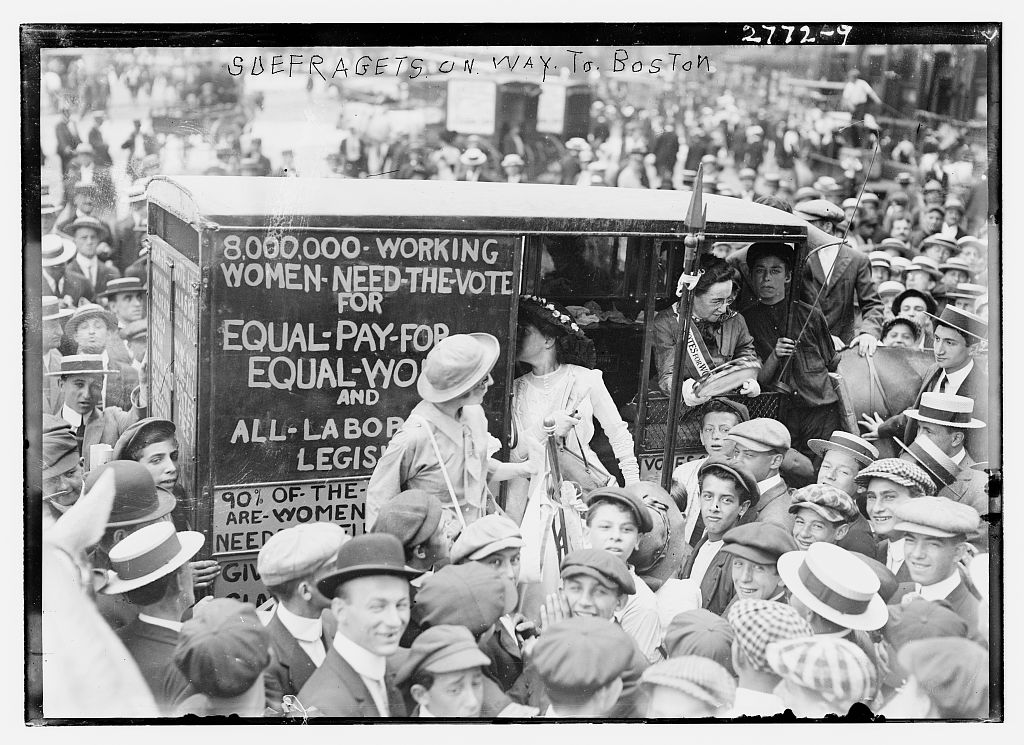
So, today – March 8 – was International Woman’s Day. It was originally celebrated as International Working Woman’s Day, and has a complex history, associated with both labor movements and women’s rights movements. It was on this day, in London, in 1914, that famed suffragist activist Sylvia Pankhurst was arrested while taking part in a march for women’s voting rights. ” Now, over one hundred years later, many are of the opinion that the goals of feminism have been met, and that women who protest today are just “whining” or “seeking attention.”
“I would have stood with the suffragettes” they say, “but the suffragettes would have nothing to do with this crowd!”
Well, I am not so sure. I suspect that if you are of a mindset that regularly mocks and dismisses social justice movements today, you would have done likewise in the past. If you gloat over the prospect of running over BLM protesters who block traffic, I expect you would have supported the imprisonment of Dr. King in the Civil Rights days. If you’re passing around memes mocking contemporary feminists, you are the type who would have applauded the arrest of Pankhurst in 1914.
This is not to say that there aren’t criticisms to be made of various women’s movements today. It is often feminists themselves making these criticisms, actually: in my case, I am deeply critical of the idea that abortion is a valid or just solution to the problems women face. I think this is a case of a deferred scapegoating, a passing of the buck of injustice, and it is especially problematic because of the invisibility of the victims. And I am not the only feminist to think this way. Pro-life feminism is real – and, typically, a lot more pro-life than its non-feminist counterpart.
I am critical of white, liberal, capitalist feminism that privileges the desires of the comfortably well-off over the responsibility to the most vulnerable. Imagining women’s equality in terms of corporate or political power often means buying into imperialist models that depend for their existence on environmental degradation or colonial exploitation.
I am critical of forms of feminism that leave no room for religious expression, because for me my Christianity and my feminism go hand in hand, and for many women of different cultures, religious and spiritual traditions are a rich part of who they are, and how they understand their womanhood.
I am even critical of the women’s strike that took place today, and not because I think feminism’s goals have been met, or that women don’t face injustice. While I am sympathetic with the goals of the strike (with some contingency on how one interprets the phrase “reproductive rights”), I am not sure that it ultimately serves the purpose of altering the conditions of women in situations of profound injustice. If a few corporate women succeed in breaking the glass ceiling, how much difference can that really make for a woman who faces a crisis pregnancy, or is forced into sex work?
But what does it mean for women to go on strike in 2017? In an earlier era of highly segregated career paths, a “women’s strike” had a specific, tangible effect: It made invisible work visible. No women meant no food on the table, no mysteriously emptied trashcans, no one to change diapers or type letters. No women meant no sex. (Yes, going Lysistrata is a real thing—and it occasionally works.) Forcing men to handle “women’s work” was the only way to get those men to admit that it existed.
In a response to Doyle, Magally A. Miranda Alcazar and Kate D. Griffiths write, in The Nation:
Last September, brave women in multiple facilities participated in prison strikes through the Incarcerated Workers Organizing Committee . The Standing Rock Water Protectors have dramatically fought the invasion of the Dakota Access Pipeline into indigenous lands, and are led by women. On February 13, as many as 10,000 immigrants rallied in Milwaukee—a demonstration led by women—walked off the job for a local “Day Without Latinxs, Immigrants, and Refugees,” which was followed by striking workers and students across the country on the February 16 “Day Without Immigrants.” These demonstrations hark back to the General Strikes of 2006, where hundreds of thousands of women participated in that year’s Day Without Immigrants, one of the largest strike actions in US history. A large number of those strikers were women working in precarious jobs and with few legal protections.
So, okay, perhaps my criticism of the stike itself comes from a position of relative privilege: the privilege of a woman who has something to lose. It often is the most disenfranchised who lead the way in reform, and often in past movements they have made common cause with those in leadership who have visibility and resources. But still: a “Day without Women” is intended to increase the visibility of the work that we do on every level of society, but will this make any difference for those who were invisible before, and will remain invisible after?
I think this is a good conversation to have, among feminists, and with those who do not identify as feminist. It’s also valuable to converse about the extent to which differences on the abortion issue create an unbridgeable gap between different activists, or whether there are ways we can find common ground for ending the injustices that drive women to seek abortion.
That being said, there are a few things many of us are tired of hearing, every single time women band together in any form of activism. These remarks are especially eyeroll-inducing when they come from people who claim to respect women, or be in favor of women’s rights.
“Real women don’t….(fill in the blank with whatever it is that feminists are doing).” Just enough with the “real women” stuff, okay? Over the course of history real live women, authentically female women, have done a remarkable variety of things. And not always the things that you imagine “real women” do. You can talk about virtuous women, intelligent women, practical women, responsible women, courageous women, but drop the “real” nonsense. You can drop the “real men” nonsense, too, while you’re at it.
“What women really want…(something about what you imagine traditional gender roles to have been).” Yes, some women like staying at home, being domestic goddesses. Some women love having lots of babies. Other women hate housework, prefer to have someone else cook for them, and don’t feel especially maternal. Some women are called to the religious life. Other women are driven especially to work in the world, as doctors, reformers, teachers, artists – or as cooks, decorators, caregivers, or other traditionally “feminine” jobs. Many women are a mishmash of all of the above. Some women experience illness or disability, or rampant social injustice, and face the reality that they may not ever get what they desire. Some women prefer men who are more in touch with their feminine side; other women prefer men who know how to cut down trees and rope cattle. But when a woman says she prefers a man to boss her around, the term “Stockholm Syndrome” crosses my mind. Consent, after all, is not the only requirement for an act to be moral.
“Women are losing their uniqueness by pretending to be men.” Slow down there a minute. First of all, we really are not pretending to be men. Wearing trousers, competing in the workplace, having opinions: these are all things we can do AS WOMEN, believe it or not. There is no fundamental male claim on these activities. If you mean “have babies” – well, not all women have babies. Are these women mysteriously less unique? Secondly, “losing their uniqueness” impies that personal uniqueness is some kind of mask or accessory, that can be lost. That’s not how it works with the whole personhood thing.
“Feminazis.” Yes, because wanting equal pay and not to be raped is totally like committing genocide. Next?
“No man would want to f** you.”* Tell that to the many women marching who have children. Anyway, dudes, it’s entirely possible that you and your rutting are not actually this amazing prize-for-being female that any woman wants. There’s a pretty good chance that we’re relieved that you’re not lusting after us. But thanks for demonstrating where your priorities lie.
Of course, there’s no moral obligation to support every women’s movement, or refrain from criticism. But if your response is a variation on the above – or an attack on the appearance of the women involved – or a suggestion that feminist activists must be anti-home-and-family – don’t expect to be taken seriously when you say “oh, yes, I respect women!” What you mean is “I respect women so long as they act in accordance with a very narrow modern western ideal romanticized on TV and irrelevant for most of the history of civilization.” Which, incidentally, is not the kind of approach to the person – male or female – that Christ modeled.
image credit: https://commons.wikimedia.org/wiki/File:Suffragettes_EnRoute_To_Boston_3820613246.jpg
Previous Post

March 5, 2017
shocking material in fairy tales - or, nothing new under the sun
Next Post

March 10, 2017 H.R. 1313: part of the trend of eugenics
Browse Our Archives
Select a Category abortion anti-semitism art Atwood Betrothed church clergy abuse coronavirus culture economics education environmentalism ethics faith family feminism gardening gun violence immigration Judaism literature MaddAddam New Pro Life Movement news pandemic personalism poem politics politics blue Pope Francis racism religion salvation sexuality social justice spirituality Station eleven Stephen King The Stand Trump Uncategorized war World Health Organization
Select a Month March 2021 February 2021 January 2021 December 2020 November 2020 October 2020 September 2020 August 2020 July 2020 June 2020 May 2020 April 2020 March 2020 February 2020 January 2020 December 2019 November 2019 October 2019 September 2019 August 2019 July 2019 June 2019 May 2019 April 2019 March 2019 February 2019 January 2019 December 2018 November 2018 October 2018 September 2018 August 2018 July 2018 June 2018 May 2018 April 2018 March 2018 February 2018 January 2018 December 2017 November 2017 October 2017 September 2017 August 2017 July 2017 June 2017 May 2017 April 2017 March 2017 February 2017 January 2017 December 2016 November 2016 October 2016 September 2016 August 2016 July 2016 June 2016 May 2016 April 2016 March 2016 February 2016
Follow Us!
TAKE THE
Religious Wisdom Quiz
True or False: Matthew's Gospel begins with a genealogy tracing Jesus' lineage back to King David.
Select your answer to see how you score.
FALSE TRUE
Support this
Column


Related posts from suspended in her jar

Immigrants: They Need Us, and We Need Them

Four Takeaways from Oprah’s Interview with the Duke...

Catholics Are De-Toxing From their Experiences With Traumatic...

How Has the Pandemic Changed Us? Has It...
TRENDING AT PATHEOS Catholic

Rejecting Doom: Christian Hope And Human Action
Christianity is a religion of hope. We are to have hope and...

It’s What Comes From Within Which Matters
One of the most difficult things for us to understand is why...

Why I Choose the Eucharist Over the Sermon
Choose the Eucharist, Not the Sermon What are we supposed to get...

5 Design Elements Found in Spiritually Rooted Homes
Putting Spirituality Into Home Decor Our homes are more than our living...

Credo: A Story of God Told with the...
About 10 years ago, I began to imagine a personal "Credo" that...

The Anatomy of Divine Revelation in Catholic Thought
The claim that God has made Himself known to human beings is...
view all Catholic blogs
Ad-Free & Subscriber Log-In Subscription Support
- About Us
- 2026 Calendar
- Videos
- Podcasts
- Library of World Religions
- Faith In Media Tracker
- Advertise With Us
- Write for Us
- Privacy Policy
- Terms of Service
- Do Not Sell My Data
- Contact Us
- Radiant Digital
- Manage Newsletter Subscriptions
- Unsubscribe From Notifications
- Sitemap
Copyright 2008-2026, Patheos. All rights reserved.
Subscription Support Ad-Free & Subscriber Log-In
Follow Patheos