
BuddhistCatholicContemplativeEvangelicalGeneral ChristianHinduJewishLatter-day SaintMuslimNew VisionsProgressive Christian
Beliefs
- Buddhist
- Catholic
- Contemplative
- Evangelical
- General Christian
- Hindu
- Jewish
- Latter-day Saint
- More Voices
- Muslim
- New Visions
- Pagan
- Progressive Christian
Topics
- Religion News
- Food and Religion
- Sports and Religion
- Religious Art
- Religious Music and Entertainment
- Religious Events
- History and Religion
- Style and Religion
- Politics and Religion
- Women in Religion
- Recreation Outdoors and Religion
- Business Finance and Religion
- Careers Workplace and Religion
- Education and Religion
- Family Parenting and Religion
- Health Fitness and Religion
- Home and Religion
- Relationships and Religion
- Technology and Religion
- Travel and Religion
Columnists
- Buddhist Columnists
- Business Finance and Religion Columnists
- Careers Workplace and Religion Columnists
- Catholic Columnists
- Contemplative Columnists
- Education and Religion Columnists
- Evangelists Columnists
- Family Parenting and Religion Columnists
- General Christian Columnists
- Health Fitness and Religion Columnists
- Hindu Columnists
- History and Religion Columnists
- Home and Religion Columnists
- Jewish Columnists
- More Voices Columnists
- Latter Day Columnists
- Muslim Columnists
- New Visions Columnists
- Nonreligious Columnists
- Pagan Columnists
- Politics and Religion Columnists
- Progressive Columnists
- Recreation Outdoors and Religion Columnists
- Relationships and Religion Columnists
- Religion News Columnists
- Religious Art Columnists
- Religious Events Columnists
- Religious Music and Entertainment Columnists
- Sports and Religion Columnists
- Style and Religion Columnists
- Technology and Religion Columnists
- Travel and Religion Columnists
- Women in Religion Columnists
Resource Library
- 2026 Calendar
- Library of World Religions
- The 100 Most Holy Places on Earth
- Patheos Answers
- Podcasts
- Videos
- Faith Leaders Database
- Anglican Episcopalian
- Bahai
- Baptist
- Buddhism
- Christianity
- Confucianism
- Eastern Orthodoxy
- Hinduism
- Holiness and Pentecostal
- ISKCON
- Islam
- Judaism
- Lutheran
- Methodist
- The Church of Jesus Christ of Latter-day Saints
- New Age
- Paganism
- Presbytarian and Reformed
- Protestantism
- Religion Behind the Scenes
- Roman Catholic
- Scientology
- Shia Islam
- Sikhism
- Sufism
- Sunni Islam
- Taoism
- Zen
- See all religions
Research Tools
 Ad-Free & Subscriber Log-In Subscription Support
Ad-Free & Subscriber Log-In Subscription Support
Follow Patheos 

- Trending:
- Forgiveness
- |
- Marriage
- |
- Consciousness
- |
- Death Penalty
- |
- Election
- |
- Halloween
 suspended in her jar
- Home
- Catholic
- talking to my child about privilege
talking to my child about privilege
Last updated on: February 27, 2017 at 2:42 pm by Rebecca Bratten Weiss
talking to my child about privilege 2017-02-27T14:42:41-04:00 Rebecca Bratten Weiss
Patheos Explore the world's faith through different perspectives on religion and spirituality! Patheos has the views of the prevalent religions and spiritualities of the world.
I keep going back to the question of whether racism and sexism are learned – either overtly, from prejudiced elders, or subtly, from cultural cues – or whether they’re tied simply to original sin, as sure a sign of the blight on our collective soul as the pointless crying of infants cynically referenced by Augustine. It does seem to be the case that on a fundamental level, before culture teaches them prejudice, children are basically inclined to empathy – at least, when it doesn’t interfere with their pleasures, or threaten their little tribalisms. My children are always quick to recognize when an injustice has been done, and not only to themselves. Reading stories and siding with the oppressed (Cinderella scrubbing floors, Harry Potter in his tiny cupboard – the plight of slave children, orphans, and beggars) comes naturally to them.
Understanding privilege is a harder thing, though. Because latent in the idea of privilege is the nagging sense of guilt. It’s easy to see the poor or the disenfranchised or the less fortunate and know that charity and justice are owed to them. It’s harder when this becomes connected somehow with something in oneself one has to “check.”
Talking to my children about empathy and equality is always easy. But last week, with my son, the topic of privilege came up. He was invited to participate in an event that involved dressing up as Native Americans. Our schedule didn’t allow for him to participate, but I added: “I don’t really want you doing any activities that involve you dressing up as Native peoples.”
“Why?” he asked.
“It isn’t respectful,” I said.
“But they’re always really respectful about Native Americans. We’re always told to be respectful of their traditions.”
Here’s the other hard part of teaching this stuff: it easily comes across as criticism of groups or persons who are basically decent, even if not “woke.” I don’t want my son thinking I’m saying his friends who do this are bad guys. “I’m sure they mean to be respectful, and that’s great,” I said. “But think about it. Imagine if you belonged to a group of people who had lost almost everything you had, and been slaughtered, and herded up, and taken advantage of – and now these same people are dressing up as you.”
My son, usually very relaxed about conversations on topics of justice, rolled his eyes. “But mom, I didn’t do any of those things! I think it was awful that those things happened, but it was a long time ago, and it wasn’t me! So why are you saying I’m supposed to feel guilty about it.”
I’ve heard essentially this same complaint, similarly worded, from people twice and three and fourth times my son’s age. And it’s understandable. To us, the woes of others can seem so remote. Terrible, yes, even tear-worthy, but still just events in history books, or dramatized in movies. We know they were tragedies, but we don’t think they have anything to do with us, today, and the fun we look forward to having – harmless fun, dressing up in head-dresses, painting our faces. We forget that just as much of what we have was given, so similarly much of what others lack was taken.
I tried to come up with some way to make it tangible, and remembered the arrowhead he found once, turned up in the soil of my tomato garden. “Do you remember what you found on our land once?” I asked him.
I explained that the arrowhead meant that native peoples once had lived where we live today, hunted there, relied on this land for their food. No, we didn’t take it from them, and neither did the people we bought this land from, or the ones before them. But somewhere back there in the skein of time, the reason we have this land today hinged upon some white European pushing out or taking away from those who had been here first.
It’s not our fault.
But we only have what we have because of someone’s fault.
Because we are Jewish, I added: “what if there was some family in Germany that was stinking rich, because their grandparents stole lots of treasures from Jews they sent to concentration camps? Should they have that wealth?”
That’s a sharp, obvious instance of a case in which people have wealth precisely because of the sins of their fathers, and the wealth should, justly, be given up in reparation. The case of our family – descended from recent immigrants on one side, but from white European colonists on the other – and where we live – and the plight of Native peoples – may be more complicated. But the privilege, still, is clear.
“Personally, in this case,” I told my son. “You have nothing to feel guilty about. You, personally, did nothing wrong, and you shouldn’t feel guilty for being white, or whatever. What you do need to realize, though, is that you have a lot of good things that can only be yours because things were taken from others. So it’s important to be especially respectful towards the people whose ancestors lost so much. If they say they would rather not see people dressing up and pretending to be them, you need to take that seriously. It’s the least you can do. It’s not about guilt. It’s about responsibility.”
I wrote recently about the way we think about who we are, and so easily forget that much we have has nothing to do with our own choice. It’s given to us, the bad and the good. Thinking about privilege means thinking beyond simply “what I have” and considering, also “what was I given?” – and “was this giving a good thing?”
It’s easy to see that what we have been given is negative if we are given hereditary disease. But if what we have been given makes our lives easier (wealth, beauty, health) why would we want to question its goodness? This would seem nihilistic.
Recognizing privilege means looking beyond material things as “blessings.” If a material good has been “given” us, because of a prior injustice, can we really consider this a blessing? The early church fathers recognized this not only on a historical level, but on the level of the immediate responsibilities to the needs of the community:
The bread in your cupboard belongs to the hungry man; the coat hanging in your closet belongs to the man who needs it; the shoes rotting in your closet belong to the man who has no shoes; the money which you put into the bank belongs to the poor. You do wrong to everyone you could help but fail to help.
Basil of CaesareaThe rich are in possession of the goods of the poor, even if they have acquired them honestly or inherited them legally.
John ChrysostomYou are not making a gift of your possession to the poor person. You are handing over to him what is his.
Ambrose of Milan
If this is true even about wealth honestly acquired, then how can we refuse to recognize that our privilege may exist due to loss or suffering on the part of another, even if we in no way intended or willed it – even if we truly recognize that what was done to the other was tragic, horrible, and unjust? Perhaps this is part of what is meant, by the statement that “blessed are the poor in spirit” – that to hoard up riches for ourselves, even honestly, can blind us to the greater, more enduring goods of justice, peace, and kindness, the true blessings God has promised us? That to be poor in spirit means detachment from thinking that material goods are “blessings” from God, given to us because of our just deserts? Material wealth, Jesus always tells, us, is dangerous.
What the church fathers propose is, quite honestly, terrifying to me. I may be only barely above the poverty line by American standards, but I am rich by global standards. And insofar as I benefit mindlessly from being American I am “part of the problem” – the problem of global depletion of resources, the problem of poverty in the developing world, the problem of refugees displaced from their homes, the problem of the disenfranchisement of native peoples.
Compared with what the saints and fathers of the church are telling us, simply admitting “I have privilege” and “I owe something back” and “I probably can’t understand how much harder it is for others” and “maybe I need to change my life” doesn’t seem so extreme, after all. It’s just basic human decency.
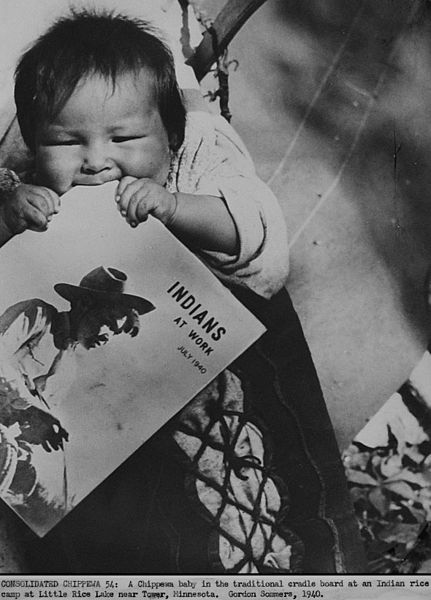
image credit: https://commons.wikimedia.org/wiki/File:1940_govt_photo_minnesota_farming_scene_chippewa_baby_teething_on_magazine_indians_at_work.jpg

Next Post

February 28, 2017 Carnivale and Social Justice
Browse Our Archives
Select a Category abortion anti-semitism art Atwood Betrothed church clergy abuse coronavirus culture economics education environmentalism ethics faith family feminism gardening gun violence immigration Judaism literature MaddAddam New Pro Life Movement news pandemic personalism poem politics politics blue Pope Francis racism religion salvation sexuality social justice spirituality Station eleven Stephen King The Stand Trump Uncategorized war World Health Organization
Select a Month March 2021 February 2021 January 2021 December 2020 November 2020 October 2020 September 2020 August 2020 July 2020 June 2020 May 2020 April 2020 March 2020 February 2020 January 2020 December 2019 November 2019 October 2019 September 2019 August 2019 July 2019 June 2019 May 2019 April 2019 March 2019 February 2019 January 2019 December 2018 November 2018 October 2018 September 2018 August 2018 July 2018 June 2018 May 2018 April 2018 March 2018 February 2018 January 2018 December 2017 November 2017 October 2017 September 2017 August 2017 July 2017 June 2017 May 2017 April 2017 March 2017 February 2017 January 2017 December 2016 November 2016 October 2016 September 2016 August 2016 July 2016 June 2016 May 2016 April 2016 March 2016 February 2016
Follow Us!
TAKE THE
Religious Wisdom Quiz
What was the purpose of the Ark of the Covenant?
Select your answer to see how you score.
To store sacrifices To hold the Ten Commandments To serve as a throne for Moses To be carried in battle
Support this
Column


Related posts from suspended in her jar

Immigrants: They Need Us, and We Need Them

Four Takeaways from Oprah’s Interview with the Duke...

Catholics Are De-Toxing From their Experiences With Traumatic...

How Has the Pandemic Changed Us? Has It...
TRENDING AT PATHEOS Catholic

Rejecting Doom: Christian Hope And Human Action
Christianity is a religion of hope. We are to have hope and...

It’s What Comes From Within Which Matters
One of the most difficult things for us to understand is why...

Why I Choose the Eucharist Over the Sermon
Choose the Eucharist, Not the Sermon What are we supposed to get...

5 Design Elements Found in Spiritually Rooted Homes
Putting Spirituality Into Home Decor Our homes are more than our living...

Credo: A Story of God Told with the...
About 10 years ago, I began to imagine a personal "Credo" that...

The Anatomy of Divine Revelation in Catholic Thought
The claim that God has made Himself known to human beings is...
view all Catholic blogs
Ad-Free & Subscriber Log-In Subscription Support
- About Us
- 2026 Calendar
- Videos
- Podcasts
- Library of World Religions
- Faith In Media Tracker
- Advertise With Us
- Write for Us
- Privacy Policy
- Terms of Service
- Do Not Sell My Data
- Contact Us
- Radiant Digital
- Manage Newsletter Subscriptions
- Unsubscribe From Notifications
- Sitemap
Copyright 2008-2026, Patheos. All rights reserved.
Subscription Support Ad-Free & Subscriber Log-In
Follow Patheos