
BuddhistCatholicContemplativeEvangelicalGeneral ChristianHinduJewishLatter-day SaintMuslimNew VisionsProgressive Christian
Beliefs
- Buddhist
- Catholic
- Contemplative
- Evangelical
- General Christian
- Hindu
- Jewish
- Latter-day Saint
- More Voices
- Muslim
- New Visions
- Pagan
- Progressive Christian
Topics
- Religion News
- Food and Religion
- Sports and Religion
- Religious Art
- Religious Music and Entertainment
- Religious Events
- History and Religion
- Style and Religion
- Politics and Religion
- Women in Religion
- Recreation Outdoors and Religion
- Business Finance and Religion
- Careers Workplace and Religion
- Education and Religion
- Family Parenting and Religion
- Health Fitness and Religion
- Home and Religion
- Relationships and Religion
- Technology and Religion
- Travel and Religion
Columnists
- Buddhist Columnists
- Business Finance and Religion Columnists
- Careers Workplace and Religion Columnists
- Catholic Columnists
- Contemplative Columnists
- Education and Religion Columnists
- Evangelists Columnists
- Family Parenting and Religion Columnists
- General Christian Columnists
- Health Fitness and Religion Columnists
- Hindu Columnists
- History and Religion Columnists
- Home and Religion Columnists
- Jewish Columnists
- More Voices Columnists
- Latter Day Columnists
- Muslim Columnists
- New Visions Columnists
- Nonreligious Columnists
- Pagan Columnists
- Politics and Religion Columnists
- Progressive Columnists
- Recreation Outdoors and Religion Columnists
- Relationships and Religion Columnists
- Religion News Columnists
- Religious Art Columnists
- Religious Events Columnists
- Religious Music and Entertainment Columnists
- Sports and Religion Columnists
- Style and Religion Columnists
- Technology and Religion Columnists
- Travel and Religion Columnists
- Women in Religion Columnists
Resource Library
- 2026 Calendar
- Library of World Religions
- The 100 Most Holy Places on Earth
- Patheos Answers
- Podcasts
- Videos
- Faith Leaders Database
- Anglican Episcopalian
- Bahai
- Baptist
- Buddhism
- Christianity
- Confucianism
- Eastern Orthodoxy
- Hinduism
- Holiness and Pentecostal
- ISKCON
- Islam
- Judaism
- Lutheran
- Methodist
- The Church of Jesus Christ of Latter-day Saints
- New Age
- Paganism
- Presbytarian and Reformed
- Protestantism
- Religion Behind the Scenes
- Roman Catholic
- Scientology
- Shia Islam
- Sikhism
- Sufism
- Sunni Islam
- Taoism
- Zen
- See all religions
Research Tools
 Ad-Free & Subscriber Log-In Subscription Support
Ad-Free & Subscriber Log-In Subscription Support
Follow Patheos 

- Trending:
- Forgiveness
- |
- Marriage
- |
- Consciousness
- |
- Death Penalty
- |
- Election
- |
- Halloween
 suspended in her jar
- Home
- Catholic
- catholicity is what we receive
catholicity is what we receive
Last updated on: August 23, 2016 at 11:06 am by Guest Contributor
catholicity is what we receive 2016-08-23T11:06:05-04:00 Guest Contributor
Patheos Explore the world's faith through different perspectives on religion and spirituality! Patheos has the views of the prevalent religions and spiritualities of the world.
By guest contributor Lillian Vogl
This post is a part of the Patheos Catholic Channel series, “Catholicity: Identity and Its Discontents.” Read more here.
I am a Catholic, not due to the way I act, the things I believe, who I am, who I am not, my perception of myself or others’ perception of me, or the people with whom I am close friends. I am a Catholic due to one simple thing: what I receive.
A Catholic in full is a person who has received at least four sacraments, two of them frequently. These sacraments that mystically incorporate us into the divine Body of Christ are the essence of Catholic identity. I am grateful beyond all telling to be a Catholic and receive these infinite gifts.
The first sacrament, Baptism, I received when I was two weeks old. I fully believe in the mystical efficacy of this “one Baptism,” because nothing else explains to me how I, baptized in a Presbyterian church and raised to believe that we are sinners in the hands of an angry God—a strict disciplinarian Father—had such a deep personal affection for Jesus since my earliest memories, and instinctively knew that the theology I was being taught and the example I was being given was in many ways flawed. I was still a baby catholic, as I had received divine adoption into the mystical universal Church.
This grace that gave me a love of God but also the restlessness of a heart that still had not found rest in Him, led me to do a lot of spiritual hunting in my teens. Some hunting was intellectual, but I also hunted for that sense of the Holy Spirit’s indwelling. I went to Evangelical churches, Pentecostal, Reformed, Baptist, and even skeptically sat through Lutheran confirmation classes as an 8th grader in a somewhat-alien parochial school. None of it eased the unease; it only led to more.
When I was 20 I first encountered Catholics who actually knew much about their faith and could give an intelligent defense. Heretofore I knew plenty of Catholics, but it seemed to me that their identity as Catholics was simply something they were born into. They could scarcely explain what it was to be a Catholic or why they were one, except to shrug and say “it’s expected of me.” But I started reading the Catholic Catechism, and was given a couple other books explaining the rationale for the Catholic belief in the magisterium, as well as a recapitulation of the covenant theology I had been taught in college but now with Mary and the Eucharist revealed. Finally an intellectual explanation clicked, and I decided I should lay hold of it, despite the “community” aspect of the Body of Christ appearing rather weak to me in Catholic parishes.
Coming into the Catholic Church, I thought that being Catholic was primarily about what I believed, and most particularly, an intellectual obedience to the magisterium. Obviously actions were supposed to follow this intellectual asset, though as a practical matter we’re all still sinners, and confession is there to take care of shortfalls. I didn’t expect that a sense of belonging would be part of it. There were so many factions I saw, from the apathetic uncatechized Catholics I knew in childhood, to the anti-abortion activists who appalled me with their aggressive tactics, to the Pentecostal Catholics, to the Opus Dei crowd who was trying to pull me in to more than the daily Masses I attended at one of their chapels. Again, none of them seemed to fit me, but I told myself I didn’t really care as long as I could say I was following “official” Church teaching.
On Easter Vigil 1998, I first discovered that being a Catholic was something I received. Receiving the sacred chrism of Confirmation and Holy Communion for the first time, I sensed the mystical indwelling of the Presence in a way that cannot be adequately described. Great joy and peace filled my soul, not because of anything I had done, or anyone else had done, but because of what I had received. I wanted to hold on to that sense forever, so I set about trying to take hold of more of it. I turned to my old habits of trying to apprehend more intellectually by reading Catholic authors ancient and contemporary. I tried to make more Catholic friends as well. Both tended to distract me from simply going to Mass as frequently as possible and receiving the Word made Flesh with an open heart.
Even as the initial euphoria wore off, I was still a Catholic. Even as I questioned this or that thing that supposedly was “official” Church teaching, I was still a Catholic. Even as I walked into and out of a marriage that manifested no sacramental graces, I was still a Catholic. Even as I was snubbed or lectured by other parishioners for being a working mother and not able to construct a perfect Catholic household, I was still a Catholic. Even as I kept receiving Holy Communion at least weekly but often with a distracted or downcast heart, I was still a Catholic. I kept receiving something, and it was impossible for me to negate what I had already received.
As some point, probably having received intercession from the Communion of Saints, I began to be conscious of this. I let go of my white-knuckled determination to hold on to my Catholicism by following “the rules.” I began to go to Mass more frequently again, simply consciously receiving the divine indwelling and giving thanks for that gift. Gradually I began to see all these things added unto me. A greater awareness of the Holy Spirit in my life. Greater charity. Greater trust and joy regardless of circumstances. Greater graces from more frequent confession. Greater graces in my marriage and family life. Greater understanding of Scripture and the essentials of the Catholic faith. Eventually even a parish community where I feel accepted by and connected to my fellow parishioners and well-pastored by our priests.
But I was always a Catholic. Once I had received the sacraments of initiation, I could never be anything else. I understand better now my childhood Catholic friends and acquaintances who were “just born into it.” So was I, born of the Spirit, just a few years older than most of them, without any family members who “expected it” of me. I am no more or less Catholic than they are.
I do not discount them as “cafeteria Catholics” anymore. In a cafeteria we reach out and grab the food we want, and we pay for it. The Catholic Church is no cafeteria—it is a banquet table set with infinitely more graces than we can ever consume, so of course we will not be able to take in everything that is there and incorporate it into our bodily life. The more we go to the banquet, and the emptier our stomachs are when we go, the more we can consume, but receiving it all will take an eternity. Knowing this, I am in no place to judge another’s Catholicity by what they haven’t consumed yet. They have been invited to the banquet, and I wish to encourage them to come and receive more graces than they already have. In doing so, it is important to emphasize that unlike a cafeteria, they do not need to pay for what they get; what they receive will be purely gratuitous. God only asks that, having received, we give thanks and do not vomit it out or hoard it away from others, unconsumed and unnourishing.
It is the “manna hoarders” who grieve me more now, not the Catholics who are afraid to gather it up because they are insufficiently catechized in its benefits and fear they will have to pay for it. I believe Christ’s greatest agony is caused by the lay teachers and leaders, and most of all the priests, who block or scare away others from approaching the feast He has set out in the great hall of the Catholic Church. Certainly His harshest words in the Gospel were directed toward the Pharisees and other religious leaders who lay burdens on others, while the bruised reeds like the woman caught in adultery and the thief on the cross He did not break. Any definition of Catholic that refers to what a person possesses, or what a person has done, rather than what a person receives, is manifestly a false one. I would go so far as to call it demonic.
To the leaders of the Catholic Church, Jesus says “As you go, make this proclamation: ‘The kingdom of heaven is at hand.’ Cure the sick, raise the dead, cleanse lepers, drive out demons. Without cost you have received; without cost you are to give.” (Mt. 10:7-8) And for all Catholics, “from His fullness we have all received, grace in place of grace.” (Jn 1:16) The New Testament talks about faith, knowledge, grace, and salvation being “received” 167 times! Undoubtedly our Catholic identity is received; let us simply receive it with greater thanksgiving, and do not hinder the little ones from receiving it also.
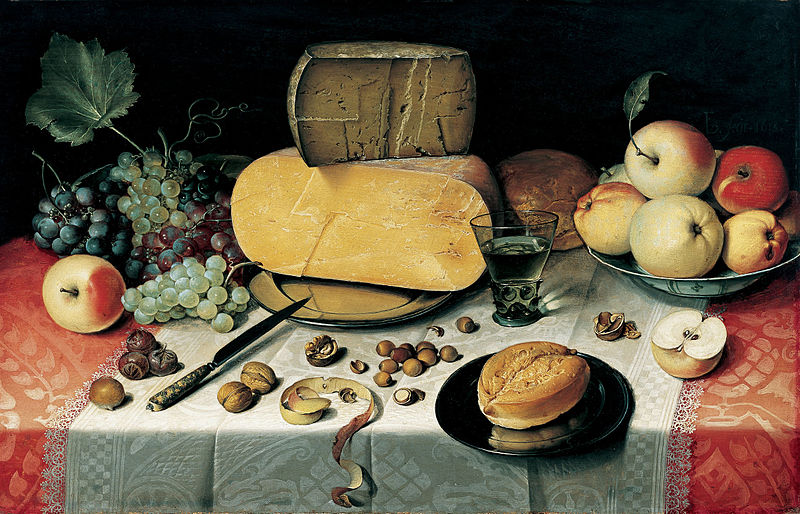
Image credit: https://commons.wikimedia.org/wiki/File:Floris_Claesz._van_Dyck_001.jpg. PD-US
Previous Post

August 21, 2016
catholic and feminist: identity, action, and faith
Next Post

August 23, 2016 vulgarity and double standards in political discourse
Browse Our Archives
Select a Category abortion anti-semitism art Atwood Betrothed church clergy abuse coronavirus culture economics education environmentalism ethics faith family feminism gardening gun violence immigration Judaism literature MaddAddam New Pro Life Movement news pandemic personalism poem politics politics blue Pope Francis racism religion salvation sexuality social justice spirituality Station eleven Stephen King The Stand Trump Uncategorized war World Health Organization
Select a Month March 2021 February 2021 January 2021 December 2020 November 2020 October 2020 September 2020 August 2020 July 2020 June 2020 May 2020 April 2020 March 2020 February 2020 January 2020 December 2019 November 2019 October 2019 September 2019 August 2019 July 2019 June 2019 May 2019 April 2019 March 2019 February 2019 January 2019 December 2018 November 2018 October 2018 September 2018 August 2018 July 2018 June 2018 May 2018 April 2018 March 2018 February 2018 January 2018 December 2017 November 2017 October 2017 September 2017 August 2017 July 2017 June 2017 May 2017 April 2017 March 2017 February 2017 January 2017 December 2016 November 2016 October 2016 September 2016 August 2016 July 2016 June 2016 May 2016 April 2016 March 2016 February 2016
Follow Us!
TAKE THE
Religious Wisdom Quiz
Who was the tax collector that Jesus called to follow Him?
Select your answer to see how you score.
Zacchaeus Nicodemus Levi Matthew
Support this
Column


Related posts from suspended in her jar

Immigrants: They Need Us, and We Need Them

Four Takeaways from Oprah’s Interview with the Duke...

Catholics Are De-Toxing From their Experiences With Traumatic...

How Has the Pandemic Changed Us? Has It...
TRENDING AT PATHEOS Catholic

Rejecting Doom: Christian Hope And Human Action
Christianity is a religion of hope. We are to have hope and...

It’s What Comes From Within Which Matters
One of the most difficult things for us to understand is why...

Why I Choose the Eucharist Over the Sermon
Choose the Eucharist, Not the Sermon What are we supposed to get...

5 Design Elements Found in Spiritually Rooted Homes
Putting Spirituality Into Home Decor Our homes are more than our living...

Credo: A Story of God Told with the...
About 10 years ago, I began to imagine a personal "Credo" that...

The Anatomy of Divine Revelation in Catholic Thought
The claim that God has made Himself known to human beings is...
view all Catholic blogs
Ad-Free & Subscriber Log-In Subscription Support
- About Us
- 2026 Calendar
- Videos
- Podcasts
- Library of World Religions
- Faith In Media Tracker
- Advertise With Us
- Write for Us
- Privacy Policy
- Terms of Service
- Do Not Sell My Data
- Contact Us
- Radiant Digital
- Manage Newsletter Subscriptions
- Unsubscribe From Notifications
- Sitemap
Copyright 2008-2026, Patheos. All rights reserved.
Subscription Support Ad-Free & Subscriber Log-In
Follow Patheos