
BuddhistCatholicContemplativeEvangelicalGeneral ChristianHinduJewishLatter-day SaintMuslimNew VisionsProgressive Christian
Beliefs
- Buddhist
- Catholic
- Contemplative
- Evangelical
- General Christian
- Hindu
- Jewish
- Latter-day Saint
- More Voices
- Muslim
- New Visions
- Pagan
- Progressive Christian
Topics
- Religion News
- Food and Religion
- Sports and Religion
- Religious Art
- Religious Music and Entertainment
- Religious Events
- History and Religion
- Style and Religion
- Politics and Religion
- Women in Religion
- Recreation Outdoors and Religion
- Business Finance and Religion
- Careers Workplace and Religion
- Education and Religion
- Family Parenting and Religion
- Health Fitness and Religion
- Home and Religion
- Relationships and Religion
- Technology and Religion
- Travel and Religion
Columnists
- Buddhist Columnists
- Business Finance and Religion Columnists
- Careers Workplace and Religion Columnists
- Catholic Columnists
- Contemplative Columnists
- Education and Religion Columnists
- Evangelists Columnists
- Family Parenting and Religion Columnists
- General Christian Columnists
- Health Fitness and Religion Columnists
- Hindu Columnists
- History and Religion Columnists
- Home and Religion Columnists
- Jewish Columnists
- More Voices Columnists
- Latter Day Columnists
- Muslim Columnists
- New Visions Columnists
- Nonreligious Columnists
- Pagan Columnists
- Politics and Religion Columnists
- Progressive Columnists
- Recreation Outdoors and Religion Columnists
- Relationships and Religion Columnists
- Religion News Columnists
- Religious Art Columnists
- Religious Events Columnists
- Religious Music and Entertainment Columnists
- Sports and Religion Columnists
- Style and Religion Columnists
- Technology and Religion Columnists
- Travel and Religion Columnists
- Women in Religion Columnists
Resource Library
- 2026 Calendar
- Library of World Religions
- The 100 Most Holy Places on Earth
- Patheos Answers
- Podcasts
- Videos
- Faith Leaders Database
- Anglican Episcopalian
- Bahai
- Baptist
- Buddhism
- Christianity
- Confucianism
- Eastern Orthodoxy
- Hinduism
- Holiness and Pentecostal
- ISKCON
- Islam
- Judaism
- Lutheran
- Methodist
- The Church of Jesus Christ of Latter-day Saints
- New Age
- Paganism
- Presbytarian and Reformed
- Protestantism
- Religion Behind the Scenes
- Roman Catholic
- Scientology
- Shia Islam
- Sikhism
- Sufism
- Sunni Islam
- Taoism
- Zen
- See all religions
Research Tools
 Ad-Free & Subscriber Log-In Subscription Support
Ad-Free & Subscriber Log-In Subscription Support
Follow Patheos 

- Trending:
- Forgiveness
- |
- Marriage
- |
- Consciousness
- |
- Death Penalty
- |
- Election
- |
- Halloween
 suspended in her jar
- Home
- Catholic
- ostentatious baby-hating is no better than racism
ostentatious baby-hating is no better than racism
Last updated on: July 21, 2016 at 11:27 pm by Rebecca Bratten Weiss
ostentatious baby-hating is no better than racism 2016-07-21T23:27:50-04:00 Rebecca Bratten Weiss
Patheos Explore the world's faith through different perspectives on religion and spirituality! Patheos has the views of the prevalent religions and spiritualities of the world.
Thanks to a friend’s commentary, I happened upon Alanna Weissman’s piece in Salon from last October, “I hate your kids. And I’m not sorry.” Though I am a feminist, and not especially nurturing – and though I have often criticized a culture that reduces female-ness to motherhood – and though I think there’s a danger of treating adults as a means to the end of reproduction – I could not be impressed with the strident baby-hating.
In fact, I was appalled.
And that is not because I think children are universally adorable, or because I want to spend all my time with them. I don’t. Children, like all humans, are a varied lot, and I like some of them, while others irritate me. Obviously, I love my own children, but I still look forward to having time to myself – and, I don’t think it would be good for their development if I leeched upon them wholly for my own “identity.” My son is not reducible to “son of Rebecca” – so it would be a little off-base if I were reducible to “mother of my son.” It’s not because I think children are perfect and innocent: there are times when I completely agree with St. Augustine when he identified the mark or original sin in a baby’s cry.
No, I was appalled first of all because I am very wary of any attitude that accepts the radical dehumanization of any demographic. This includes racism, sexism, xenophobia, and any ideology that justifies hatred toward a class of humans. I would go even further and say that I oppose any ideology that justifies hatred against any living thing. Babies might not be to your taste, but this is a case in which your taste does not give you the right to be nasty. The right of another human to respect is more important than your petty dislike.
Take this statement from the piece:
I can’t remember a time when I felt anything more positive than contempt for children, even when I was a child myself. From (quite literally) the time I could talk, I announced my intent that I never wanted children, and as a little girl, I never had even the slightest inclination towards baby dolls. As an only child of older parents, I spent much of my time around middle-aged adults, and found I far preferred their company to that of my agemates.
Now, replace the word “children” with “black people” or “Muslims” or “the handicapped.” Is this a hatred of which anyone could be proud? Is it even remotely acceptable? If it’s not okay to hate one group of people, why would it be at all okay to hate another – especially a group that is especially vulnerable, and to which each of us once belonged.
Or take this passage:
My baby-hating doesn’t come from a place of malice. I don’t wish children ill; I just want them to stay the hell away from me. I’m not a situational baby-hater, either; though a child behaving badly might cause me to shoot some side-eye or make a snarky comment, my inherent dislike of children does not significantly lessen when a kid behaves well, even if I do find them slightly more tolerable. (As Kate Christensen writes of her boyfriend in her essay in “Selfish, Shallow, and Self-Absorbed” and which I can wholeheartedly relate to, “Seeing other people with their kids, no matter how cute they are, only reinforces his knowledge that he doesn’t want them.”) I can count on one hand all the children I’ve seen in my life that have struck me as cute. On the subway, if I see even a well-behaved child heading for the empty seat next to mine, I will move across the train car, all the while raising the volume on my music. On a recent outing to the Bronx Zoo, a small child mistakenly grabbed my hand instead of her mother’s, and I instinctively recoiled as if the toddler’s touch had sent 10,000 volts of electricity coursing through my body.
I’ve heard similar statements from people who “don’t wish black people ill” but simply want to stay far away from them. I’m not inclined to give them leeway for their immature and poorly formed affections, nor will I do so for baby-haters.
I recognize that not everyone is cut out for parenthood, and that there are many other valuable and noble things both men and women can do, beyond reproduction and / or childcare. Women in particular need to be freed from a mindset that values us only for our reproductive powers. However, the lack of a vocation to parenthood should not be taken as an excuse to dehumanize and denigrate a whole huge chunk of the populace. If all you can think about when you see another human is “I’m glad I don’t have them” – this sure sounds like narcissism to me. There’s far more to any person than the question of how you could use, or not use, or enjoy, or not enjoy them.
Also, the way in which children are treated by adults, even casually and in passing, influences the kind of adults they become. If you want to build a world with more peace and friendship, less violence and prejudice, treat children kindly. I don’t care whether you enjoy it or not.
And that’s the second reason why I am appalled: because prejudice against children is prejudice directed against humans at their most malleable, their most sensitive. How you treat children has a lasting effect on them, so you need to think very carefully about the moral implications of how you regard them, whether you get your kicks out of it or not.
Three more speculative points I’d like to add:
- Some might be inclined to think baby-hating is a new phenomenon, connected with a pro-abortive anti-life attitude. I want to note that most pro-choice persons I know do not hate babies, and many have children of their own whom they love. Also, that baby-hating is in fact a very old phenomenon – and this is why I find it so appalling, because it’s not some new invention of a free-thinking woman, it’s an ancient prejudice of a violent civilization. When the baby was considered only a miniature potential adult, the practice of exposing deformed or unwanted infants was normal. The casual disposal of unwanted children by adults is one reason why there are so many ghastly stories about witches eating children, stepmothers killing children – and, in fact, in the original version of many stories, it wasn’t stepmothers, but mothers: the details were changed in order not to overwhelm the sensibilities of a rising middle class reading public.
- This same rising middle class would end up yielding what has sometimes been referred to as the Victorian invention of childhood. Ironically, at the same time that middle and upper class Victorian children were either vigorously disciplined or coddled and idealized or both (while usually being raised by a whole staff of professionals, rarely by their parents), pauper and orphan children were treated as the dregs of society, grist for the mills of the industrial revolution. In some cases, orphan children were even experimented on, in the controversial practice of vivisection. While aristocratic and middle-class families required a moderate number of children for the security of inheritance (not too many, though, because splitting an estate was undesirable – and preferably a minimum of girls, because of the expense of their dowries), poor families did not, as a rule, look at children as a blessing. The significant exception would be farm families, in which everyone (father, mother, children, retainers) was expected to work for a living. The 1950s familial ideal of dad working, while mom simply raises the children was only a brief blip in the history of family life. Returning to that an ideal is not a fix for the problem of baby-hating, especially since at that time the “family values” enjoyed by the white middle class were denied black families. We need to consider the extent to which we regularly dehumanize any group of people who inconveniences us: children, the handicapped, the poor, the elderly, the immigrants.
- Contemporary baby-hating of the sort seen in Weissman’s piece seems especially vile because its the subject of such narcissistic preening. However, I wonder whether this is just the other side of the coin of the fetishization of children and motherhood, in which the baby becomes a kind of accessory – or, a way for a woman to prove her “identity” as mother – or, worst of all, a weapon specially bred for the culture war. Occasionally I have heard religious people talking about the importance of having big families so that we can, essentially, out-breed the secular humanists. How is this not using a child as a means to an end? Fellow Christians and pro-lifers, if we insist on treating children as objects (even treasured objects) we have less ground to stand on, when we oppose those who treat them as unwanted or unpleasant objects.
On a lighter note, is it terrible that I am amusing myself with the image of my youngest – aka, the Viking – going all Rage of Achilles on some smug baby-hater? Probably. Still. I can just see him, chasing her down the garden path, with his Hammer of Thor. It’s kind of beautiful. Sorry (I think).
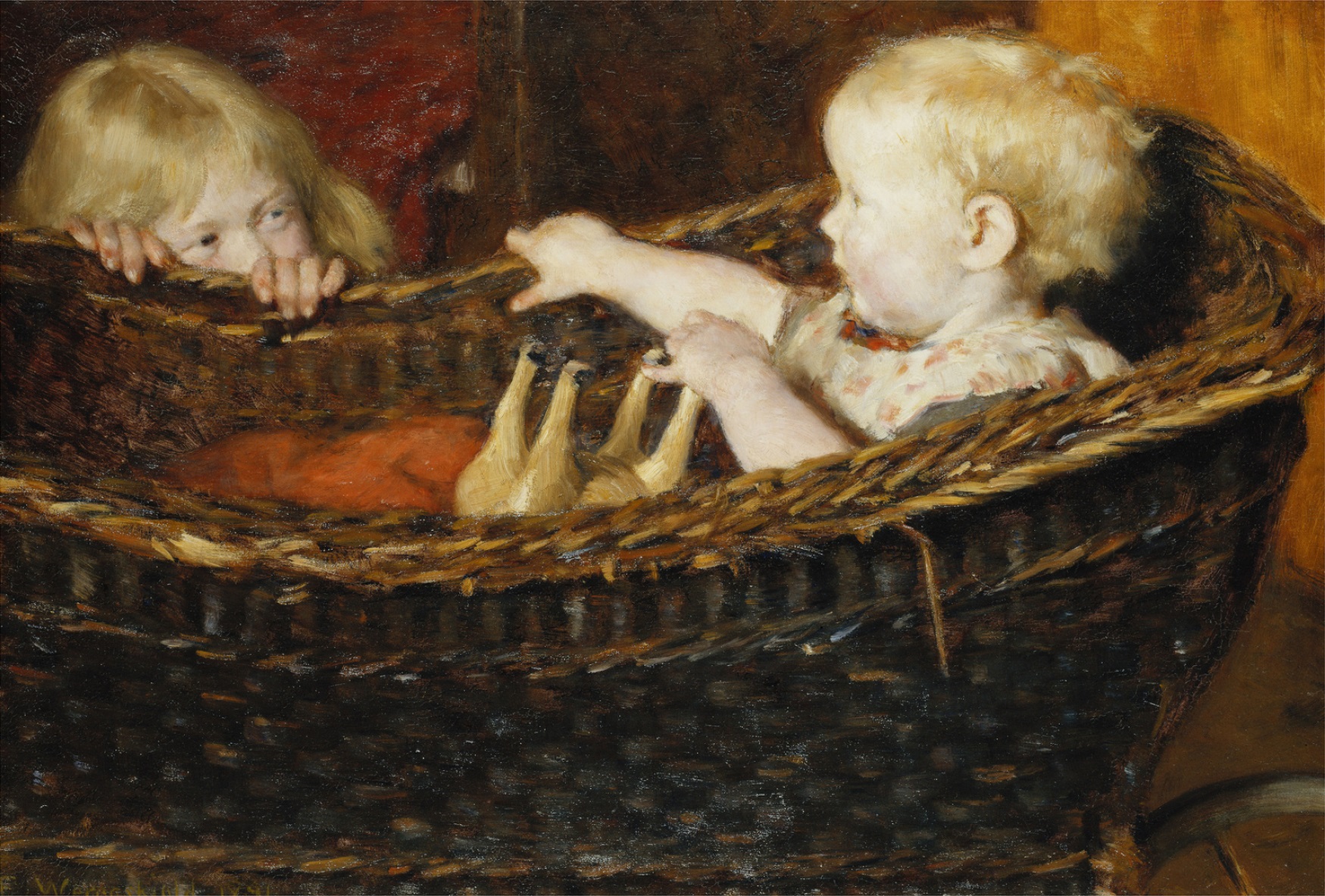
image credit: https://commons.wikimedia.org/wiki/File:Erik_Theodor_Werenskiold_-_Children_playing_(1891).jpg. public domain
Previous Post

July 19, 2016
the republican national convention is a triumph of anti-intellectualism
Next Post

July 28, 2016 natural fertility management: one feminist perspective
Browse Our Archives
Select a Category abortion anti-semitism art Atwood Betrothed church clergy abuse coronavirus culture economics education environmentalism ethics faith family feminism gardening gun violence immigration Judaism literature MaddAddam New Pro Life Movement news pandemic personalism poem politics politics blue Pope Francis racism religion salvation sexuality social justice spirituality Station eleven Stephen King The Stand Trump Uncategorized war World Health Organization
Select a Month March 2021 February 2021 January 2021 December 2020 November 2020 October 2020 September 2020 August 2020 July 2020 June 2020 May 2020 April 2020 March 2020 February 2020 January 2020 December 2019 November 2019 October 2019 September 2019 August 2019 July 2019 June 2019 May 2019 April 2019 March 2019 February 2019 January 2019 December 2018 November 2018 October 2018 September 2018 August 2018 July 2018 June 2018 May 2018 April 2018 March 2018 February 2018 January 2018 December 2017 November 2017 October 2017 September 2017 August 2017 July 2017 June 2017 May 2017 April 2017 March 2017 February 2017 January 2017 December 2016 November 2016 October 2016 September 2016 August 2016 July 2016 June 2016 May 2016 April 2016 March 2016 February 2016
Follow Us!
TAKE THE
Religious Wisdom Quiz
Why was Daniel thrown into the lion’s den?
Select your answer to see how you score.
He prayed to God He stole from the treasury He spoke against the king He refused to bow to the king
Support this
Column


Related posts from suspended in her jar

Immigrants: They Need Us, and We Need Them

Four Takeaways from Oprah’s Interview with the Duke...

Catholics Are De-Toxing From their Experiences With Traumatic...

Rush Limbaugh Would Never Have Succeeded In an...
TRENDING AT PATHEOS Catholic

The Parable Of The Sower And The Word...
One of Christ’s most famous parables is that of the sower who...

Rejecting Doom: Christian Hope And Human Action
Christianity is a religion of hope. We are to have hope and...

Why I Choose the Eucharist Over the Sermon
Choose the Eucharist, Not the Sermon What are we supposed to get...

5 Design Elements Found in Spiritually Rooted Homes
Putting Spirituality Into Home Decor Our homes are more than our living...

Credo: A Story of God Told with the...
About 10 years ago, I began to imagine a personal "Credo" that...

The Anatomy of Divine Revelation in Catholic Thought
The claim that God has made Himself known to human beings is...
view all Catholic blogs
Ad-Free & Subscriber Log-In Subscription Support
- About Us
- 2026 Calendar
- Videos
- Podcasts
- Library of World Religions
- Faith In Media Tracker
- Advertise With Us
- Write for Us
- Privacy Policy
- Terms of Service
- Do Not Sell My Data
- Contact Us
- Radiant Digital
- Manage Newsletter Subscriptions
- Unsubscribe From Notifications
- Sitemap
Copyright 2008-2026, Patheos. All rights reserved.
Subscription Support Ad-Free & Subscriber Log-In
Follow Patheos