
BuddhistCatholicContemplativeEvangelicalGeneral ChristianHinduJewishLatter-day SaintMuslimNew VisionsProgressive Christian
Beliefs
- Buddhist
- Catholic
- Contemplative
- Evangelical
- General Christian
- Hindu
- Jewish
- Latter-day Saint
- More Voices
- Muslim
- New Visions
- Pagan
- Progressive Christian
Topics
- Religion News
- Food and Religion
- Sports and Religion
- Religious Art
- Religious Music and Entertainment
- Religious Events
- History and Religion
- Style and Religion
- Politics and Religion
- Women in Religion
- Recreation Outdoors and Religion
- Business Finance and Religion
- Careers Workplace and Religion
- Education and Religion
- Family Parenting and Religion
- Health Fitness and Religion
- Home and Religion
- Relationships and Religion
- Technology and Religion
- Travel and Religion
Columnists
- Buddhist Columnists
- Business Finance and Religion Columnists
- Careers Workplace and Religion Columnists
- Catholic Columnists
- Contemplative Columnists
- Education and Religion Columnists
- Evangelists Columnists
- Family Parenting and Religion Columnists
- General Christian Columnists
- Health Fitness and Religion Columnists
- Hindu Columnists
- History and Religion Columnists
- Home and Religion Columnists
- Jewish Columnists
- More Voices Columnists
- Latter Day Columnists
- Muslim Columnists
- New Visions Columnists
- Nonreligious Columnists
- Pagan Columnists
- Politics and Religion Columnists
- Progressive Columnists
- Recreation Outdoors and Religion Columnists
- Relationships and Religion Columnists
- Religion News Columnists
- Religious Art Columnists
- Religious Events Columnists
- Religious Music and Entertainment Columnists
- Sports and Religion Columnists
- Style and Religion Columnists
- Technology and Religion Columnists
- Travel and Religion Columnists
- Women in Religion Columnists
Resource Library
- 2026 Calendar
- Library of World Religions
- The 100 Most Holy Places on Earth
- Patheos Answers
- Podcasts
- Videos
- Faith Leaders Database
- Anglican Episcopalian
- Bahai
- Baptist
- Buddhism
- Christianity
- Confucianism
- Eastern Orthodoxy
- Hinduism
- Holiness and Pentecostal
- ISKCON
- Islam
- Judaism
- Lutheran
- Methodist
- The Church of Jesus Christ of Latter-day Saints
- New Age
- Paganism
- Presbytarian and Reformed
- Protestantism
- Religion Behind the Scenes
- Roman Catholic
- Scientology
- Shia Islam
- Sikhism
- Sufism
- Sunni Islam
- Taoism
- Zen
- See all religions
Research Tools
 Ad-Free & Subscriber Log-In Subscription Support
Ad-Free & Subscriber Log-In Subscription Support
Follow Patheos 

- Trending:
- Forgiveness
- |
- Marriage
- |
- Consciousness
- |
- Death Penalty
- |
- Election
- |
- Halloween
 suspended in her jar
- Home
- Catholic
- family values should not be a first-world privilege
family values should not be a first-world privilege
Last updated on: May 9, 2016 at 11:09 am by Rebecca Bratten Weiss
family values should not be a first-world privilege 2016-05-09T11:09:20-04:00 Rebecca Bratten Weiss
Patheos Explore the world's faith through different perspectives on religion and spirituality! Patheos has the views of the prevalent religions and spiritualities of the world.
This Mother’s Day, at Friendship Park, the only federally established meeting place along the US and Mexican border, mothers and their children separated by the border fence had an opportunity to meet and embrace one another. It was a special occasion, since for a rare and brief time the gate was scheduled to be opened so that separated families could actually communicate and touch one another with no metal boundary between them. Those waiting pressed hands and faces against the mesh, leaning in to kiss one another, often tearfully, through the fence that divided them. Usually, such a tentative encounter, hands pressed against metal, is the most these separated families can hope for (read more here).
One mother interviewed stated: “It means a lot because even though we are separated from our children, the ones that are left, on the other side, we still find a way. There is no border, the love of the mom, between moms and children, we don’t know no fences, we don’t know no borders,” said volunteer and mother, Ixchel Solano, according to this report from San Diego 6.
This history of political upheaval is always the history of divided families – thus it has been from ancient times until today. Anyone educated in the classical tradition has had a chance to weep over the sorrow of Aeneas separated from his wife in the sack of Troy, to mourn with King David at his family torn apart through his sons’ civil war. We see the extent to which the destruction of Troy and the self-immolation of the Davidic dynasty were the result of choices made by the powerful men involved, but we grieve all the same, because this is what tragedy is about.
Unfortunately, a large segment of the contemporary populace is either unversed in the classical tradition, or unwilling to pull an Arthur Miller and extend the pathos of tragedy to those who are not ancient warlike kings, and whose choices had to do not with a desire to steal someone else’s wife, but simply to find safety for one’s children. The comments section on news and photos of the Mother’s Day event reiterated the same tired refrain: they made their own choice – what part of illegal do they not understand? – “just more BS propaganda to make you feel sorry for them.” Never mind that these are self-proclaimed libertarians who disdain government intervention, and ought to question the whole association of legality with morality; never mind that these are the same people who proclaim the gospel of family values; never mind that it’s an actual news item, a story of real human lives, not some fabricated propaganda. And that’s not even bringing in the Christian reality that we have a deep scriptural and moral tradition admonishing us to accept the foreigner, to invite the alien into our homes, for we too once were strangers in a strange land. I would venture to say, even, that to be a Christian is always to be a stranger in a strange land. It is to know no borders.
What I found reading the story of the Mother’s Day event, and perusing the comments, was part of a larger motif of disdain for the concerns of families that are not conventionally white, western, middle class, and “respectable.” I have written elsewhere of the church’s obligation to acknowledge the needs of what, for the sake of brevity, I term “unconventional families.” Unconventional families don’t fit neatly into the perfect paradigm of “good Catholic family” which is frequently put on a pedestal. Perhaps no family does, but some at least play the part well, and are rewarded for it in Catholic circles: “let’s help this good Catholic family in hard times,” we say, but what about all the other families that don’t fit the poster-perfect bill? How about bad Catholic families, or families that aren’t Catholic, or families that are kind of smelly and weird?
We see this repeatedly when it comes to disregard for black families separated due to unjust incarceration, Muslim families separated through forced immigration, even poor white families separated by CPS because they failed to live up to our contemporary bourgeois standards of tidy respectability. Yes, some families are toxic, and sometimes separation, and even divorce, are a blessing. CPS often does great and heroic work. But too often the culture in general lacks a fundamental respect for the security and sanctity of the domestic space, a respect that is due even if it’s a small space, a mobile space, a messy space, a poor space, a space different from ours, a strange space, a space occupied by people who don’t match up with our modern notions of “family” as “ nuclear family.”
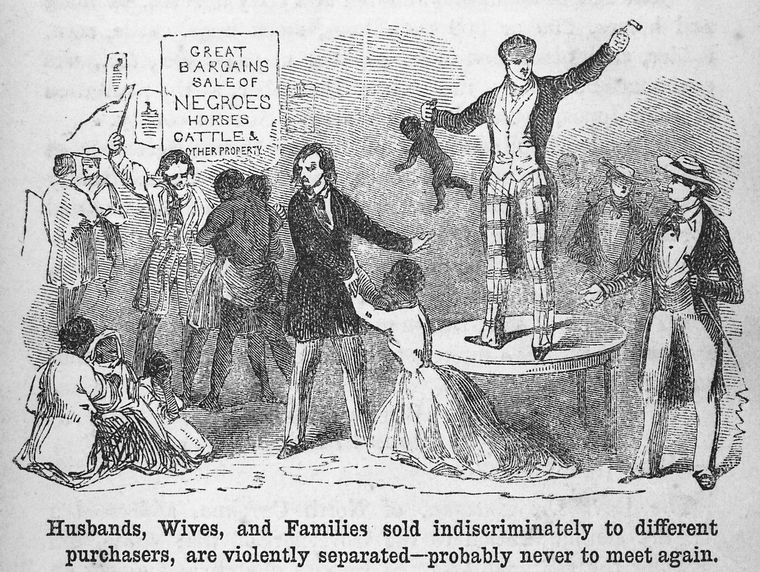
When we dismiss young men especially, suggesting that the fathers, husbands, and sons of immigrant families be forcibly sent back to fight terrorists, we reveal just how little we value men unless they are the kind of men approved in this fetishized western white family ideal. This is a form of militarist misandry that is problematic across the board, and revealed in our tolerance of a draft for our sons, but just as misogyny is accentuated when directed at non-white women, so also this disregard for male lives becomes pronounced when discussing brown or black men, even poor men. The systematic dehumanization of the black male has been a problem repeated over generations, from the times of slavery until today, and while we laud the value of fathers in respectable bourgeois households, we ignore the reality that depersonalizing and disenfranchising black men in a capitalist culture has a fracturing effect on families, and that this fracturing carries on from one generation to the next. Studies have shown just how much personal trauma is passed on from parents to children (something else we ought to learn from classical tragedy) – but when it comes to poor or racially other or immigrant families, we somehow imagine that bad choices or toxic domestic situations were created in some kind of social vacuum. The same man who is in a bad mood and drinks too much microbrew on a Friday night, because his boss didn’t respect him at work today, may well turn around and deride the bad decisions of other men who are repeatedly, often violently disrespected, their entire lives.
We elevate images of motherhood in perfect white middle-class homes, and even those of us who are white and middle-class are exhausted – or, sarcastically amused, depending on our mood – by this reiteration of images of what motherhood ought to be. But what about mothers who are poor, what about mothers who are racially other, or immigrant?
And, of course, though it may be a cliche: what about the children?
In novels and histories we admire parents who make hard decisions, even illegal decisions, for the sake of family safety. We like stories of border escapes, smuggling, espionage, trickery, when it’s for the sake of saving lives. We even like stories of completely amoral illegal attempts made by criminal groups interested solely in gain. If we can root for the bandit – if we can pity the man-slaughtering adulterous King David for the disintegration of his regime and the loss of his Absalom – why can we not extend the same pity to poor women weeping for their children, when the only “bad choice” they made was their one, difficult, heart-rending opportunity to provide a life of health, safety, and security for their children? “Family values” should not be a first-world privilege.
Image credit: New York Public Library, “Five hundred thousand strokes for freedom ; a series of anti-slavery tracts, of which half a million are now first issued by the friends of the Negro.” by Armistead, Wilson, 1819?-1868 and “Picture of slavery in the United States of America. ” by Bourne, George, 1780-1845This work is in the public domain in the United States because it was published (or registered with the U.S. Copyright Office) before January 1, 1923. https://commons.wikimedia.org/wiki/File:Slavery19.jpg
Previous Post

May 4, 2016
what will republican catholics do now?

Browse Our Archives
Select a Category abortion anti-semitism art Atwood Betrothed church clergy abuse coronavirus culture economics education environmentalism ethics faith family feminism gardening gun violence immigration Judaism literature MaddAddam New Pro Life Movement news pandemic personalism poem politics politics blue Pope Francis racism religion salvation sexuality social justice spirituality Station eleven Stephen King The Stand Trump Uncategorized war World Health Organization
Select a Month March 2021 February 2021 January 2021 December 2020 November 2020 October 2020 September 2020 August 2020 July 2020 June 2020 May 2020 April 2020 March 2020 February 2020 January 2020 December 2019 November 2019 October 2019 September 2019 August 2019 July 2019 June 2019 May 2019 April 2019 March 2019 February 2019 January 2019 December 2018 November 2018 October 2018 September 2018 August 2018 July 2018 June 2018 May 2018 April 2018 March 2018 February 2018 January 2018 December 2017 November 2017 October 2017 September 2017 August 2017 July 2017 June 2017 May 2017 April 2017 March 2017 February 2017 January 2017 December 2016 November 2016 October 2016 September 2016 August 2016 July 2016 June 2016 May 2016 April 2016 March 2016 February 2016
Follow Us!
TAKE THE
Religious Wisdom Quiz
Where in the Bible can we find the phrase "a time to be born and a time to die"?
Select your answer to see how you score.
Matthew Genesis Job Ecclesiastes
Support this
Column


Related posts from suspended in her jar

Immigrants: They Need Us, and We Need Them

Four Takeaways from Oprah’s Interview with the Duke...

Catholics Are De-Toxing From their Experiences With Traumatic...

How Has the Pandemic Changed Us? Has It...
TRENDING AT PATHEOS Catholic

Rejecting Doom: Christian Hope And Human Action
Christianity is a religion of hope. We are to have hope and...

It’s What Comes From Within Which Matters
One of the most difficult things for us to understand is why...

Why I Choose the Eucharist Over the Sermon
Choose the Eucharist, Not the Sermon What are we supposed to get...

5 Design Elements Found in Spiritually Rooted Homes
Putting Spirituality Into Home Decor Our homes are more than our living...

Credo: A Story of God Told with the...
About 10 years ago, I began to imagine a personal "Credo" that...

The Anatomy of Divine Revelation in Catholic Thought
The claim that God has made Himself known to human beings is...
view all Catholic blogs
Ad-Free & Subscriber Log-In Subscription Support
- About Us
- 2026 Calendar
- Videos
- Podcasts
- Library of World Religions
- Faith In Media Tracker
- Advertise With Us
- Write for Us
- Privacy Policy
- Terms of Service
- Do Not Sell My Data
- Contact Us
- Radiant Digital
- Manage Newsletter Subscriptions
- Unsubscribe From Notifications
- Sitemap
Copyright 2008-2026, Patheos. All rights reserved.
Subscription Support Ad-Free & Subscriber Log-In
Follow Patheos