
BuddhistCatholicContemplativeEvangelicalGeneral ChristianHinduJewishLatter-day SaintMuslimNew VisionsProgressive Christian
Beliefs
- Buddhist
- Catholic
- Contemplative
- Evangelical
- General Christian
- Hindu
- Jewish
- Latter-day Saint
- More Voices
- Muslim
- New Visions
- Pagan
- Progressive Christian
Topics
- Religion News
- Food and Religion
- Sports and Religion
- Religious Art
- Religious Music and Entertainment
- Religious Events
- History and Religion
- Style and Religion
- Politics and Religion
- Women in Religion
- Recreation Outdoors and Religion
- Business Finance and Religion
- Careers Workplace and Religion
- Education and Religion
- Family Parenting and Religion
- Health Fitness and Religion
- Home and Religion
- Relationships and Religion
- Technology and Religion
- Travel and Religion
Columnists
- Buddhist Columnists
- Business Finance and Religion Columnists
- Careers Workplace and Religion Columnists
- Catholic Columnists
- Contemplative Columnists
- Education and Religion Columnists
- Evangelists Columnists
- Family Parenting and Religion Columnists
- General Christian Columnists
- Health Fitness and Religion Columnists
- Hindu Columnists
- History and Religion Columnists
- Home and Religion Columnists
- Jewish Columnists
- More Voices Columnists
- Latter Day Columnists
- Muslim Columnists
- New Visions Columnists
- Nonreligious Columnists
- Pagan Columnists
- Politics and Religion Columnists
- Progressive Columnists
- Recreation Outdoors and Religion Columnists
- Relationships and Religion Columnists
- Religion News Columnists
- Religious Art Columnists
- Religious Events Columnists
- Religious Music and Entertainment Columnists
- Sports and Religion Columnists
- Style and Religion Columnists
- Technology and Religion Columnists
- Travel and Religion Columnists
- Women in Religion Columnists
Resource Library
- 2026 Calendar
- Library of World Religions
- The 100 Most Holy Places on Earth
- Patheos Answers
- Podcasts
- Videos
- Faith Leaders Database
- Anglican Episcopalian
- Bahai
- Baptist
- Buddhism
- Christianity
- Confucianism
- Eastern Orthodoxy
- Hinduism
- Holiness and Pentecostal
- ISKCON
- Islam
- Judaism
- Lutheran
- Methodist
- The Church of Jesus Christ of Latter-day Saints
- New Age
- Paganism
- Presbytarian and Reformed
- Protestantism
- Religion Behind the Scenes
- Roman Catholic
- Scientology
- Shia Islam
- Sikhism
- Sufism
- Sunni Islam
- Taoism
- Zen
- See all religions
Research Tools
 Ad-Free & Subscriber Log-In Subscription Support
Ad-Free & Subscriber Log-In Subscription Support
Follow Patheos 

- Trending:
- Forgiveness
- |
- Marriage
- |
- Consciousness
- |
- Death Penalty
- |
- Election
- |
- Halloween
 suspended in her jar
- Home
- Catholic
- an alternative to the fantasy of domination: eco gardening as religious devotion
an alternative to the fantasy of domination: eco gardening as religious devotion
Last updated on: May 10, 2016 at 12:49 pm by Rebecca Bratten Weiss
an alternative to the fantasy of domination: eco gardening as religious devotion 2016-05-10T12:49:54-04:00 Rebecca Bratten Weiss
Patheos Explore the world's faith through different perspectives on religion and spirituality! Patheos has the views of the prevalent religions and spiritualities of the world.
From Francis Bacon’s schemes for universal knowledge to the genetic modifications and artificial intelligences of today, the modern age has been consumed by dreams of absolute dominion over nature. We may be post-modern in our art, in our religion, and our philosophy, but the industries that shape our destiny recapitulate the Baconian mandate to take possession of nature:
“For you have but to hound nature in her wanderings, and you will be able when you like to lead and drive her afterwards to the same place again. Neither ought a man to make scruple of entering and penetrating into those holes and corners when the inquisition of truth is his whole object” (Bacon, De Augmentis).
I try to avoid blaming thinkers for material and cultural outcomes of their thought, because it’s a mistake to posit causality amidst the myriad waves of choice and interpretation reverberating from a text or ideological starting point – but, I can’t help but find some schadenfreude in contemplating the fact that Bacon died as a result of his attempts to freeze a chicken in the snow. It would be a mistake, also, to speak of “nature having her revenge.” Such poetic personifications are also attempts to dominate nature, to tame it or put a face on it. Calling nature a “she” suits the penetrative fantasies of the Baconian intellect, but also the masochistic fantasies of the romanticist. The reality is that nature is not so easily dominated.
It’s no accident that the space exploration of the twentieth century ended up being linked to Cold War shenanigans, as the desire to escape from earth’s muddy confines and swing free in the empty reaches of clean space is linked with the desire to achieve ideological domination through supreme military force. And this desire for ideological domination arises from a long tradition of neo-Platonic and Cartesian disdain for bodily being, for gross matter, the icky stuff. That nature is termed “she” is no accident, then, as traditionally the intellect was allied to the masculine persona, the superior intellectual power, while women were seen as stupider, more grossly fleshy. The contemporary problem of female self-hatred, loathing of one’s own burgeoning flesh, is tied in with a culture that whispers that the female body is disgusting, that it’s better for there to be less of it, that those elements specifically connected with fecundity are the grossest of all.
Travel into space: a Cartesian trip, a technological escape of the mind (real or artificial) from all this nasty muck. Meet extra-terrestrial intelligences. They will, invariably, be smarter than we are, as they are not rooted in the murky earth. Everything is clean, spare, white, futuristic.
Curiously, one task of good sci-fi has been to undermine the pretensions of this fantasy: in the Dune chronicles, the training of superior intelligence and absolute control over bodily functions does not excuse one from the necessity of ecology; the hero ends up not orbiting in space communing with disembodied intelligences, but burrowing in the earth, entering into communion with the strange creatures of the sand, even, eventually, becoming one. In Star Wars, the journeys through space lead one repeatedly into immersion in local societies, primitive groups, tangled in vines, eaten by space-slugs. Your X-Wing gets stuck in the mud.
Anthony Burgess, in A Clockwork Orange, C.S. Lewis, in That Hideous Strength, and Aldous Huxley, in Brave New World, all show the dangerous outcomes of this modernist drive for absolute control, whether over the personal psyche or over society as a whole. But do we listen to our poets? No – and our market disdain for the arts mirrors this. Our money is poured into financing technology; poets have to pay to publish their own work, and the task of teaching literature is relegated increasingly to underpaid adjuncts.
Even our agriculture is affected by this. Those rippling fields of corn you see out here in the heartland are genetically modified, which means the farmer relies heavily on seed produced in labs, on fertilizer derived from petroleum, on pesticides and fungicides and herbicides that blast everything in their path, so that the soil is dead. Massive and expensive machinery is needed for spraying, planting, and harvesting. Oh, and everyone is in debt, but this helps lock agriculture into the system. Agricultural techniques sweep away all living things in the path of that solitary stalk of modified corn, and the political-corporate complex keeps the farmer a cog in the wheel.
Even organic farming has been infected by this need for control. This is evident in the amount of bureaucratic red tape necessary for a grower to be certified organic, and the levels of middle-men incorporated into the system for the proliferation of this mass-produced, corporate-stamped “natural food.”
This is where eco gardening becomes a necessary escape, an escape into both freedom and submission, as one releases oneself from the tyranny of the capitalist market and enters instead into a relation with the ecosystems in which one grows. The basic principles of eco farming are as follows:
- Food sovereignty– Producers and consumers, not corporations, should control the food chain and determine how food is produced.
- Rewarding rural livelihoods– Eco-agriculture is instrumental in rural development, food security and fighting poverty.
- Smarter food production and yields– Eco-agriculture can create higher yields to help feed the world.
- Biodiversity– Promoting diversity in crops, instead of monocultures like corn and soy, is essential to protecting nature.
- Sustainable soil– Soil fertility can improve using eco-farming methods and refraining from chemical fertilizers and inputs.
- Ecological pest protection– Farmers can control pest damage and weeds effectively through natural means instead of chemical pesticides.
- Food Resilience– Diverse and resilient agriculture, not monoculture crops, is the best way to protect communities from shocks from climate and food prices.(http://www.greenpeace.org/international/en/campaigns/agriculture/solution-ecological-farming/)
Gardening guru Eliot Coleman remarked that too much of our language in gardening is borrowed from military rhetoric: we fight the weeds, wage war against insects, even arm ourselves to do battle, with sprayers that look like some form of simplified chemical weaponry. Eco farming means rejecting the military metaphors. The weeds and the insects are part of this eco-system; we are not marching into destroy them and gain dominance, but instead working within pre-existing patterns, to establish a subgenre of order that will allow one’s cabbage and tomatoes to grow at peace. We use companion planting, crop rotation, and above all soil building, to allow the plans to utilize their own defense systems. The development of complex carbohydrates in a healthy plant makes it less desirable to hungry insects and larvae; a plant can even release enzymes that attract predatory insects to eat or utilize the insects that are devouring it. The food chain itself dictates the ordering, and the human farmer is trying, not to dominate this food chain, but enter into it.
Note that the food chain is not without violence and pain. “The natural” is not equivalent with “the good.” But the violence of nature is not like that of war; it has to do with the need to eat, to mate, to lay one’s eggs. War is unnatural. It is a product of the fantasy of control.
While the bureaucratic controls over organic growing are necessary when one’s lettuce and cucumbers travel a thousand miles from some remote farm, changing hands a dozen times, eco gardening focuses on community and sustainability. The trust in the product is the result of an established relationship between customer and grower. If in doubt, come see the farm, and see that there are no poisons or chemicals used.
Eco gardening requires discipline and patience, because our instinct is to seize absolute control, to kill what gets in our way, and here instead one has to educate oneself in the intricacies of soil and plant science, taking time to build up a working relationship with everything surrounding one. While the modernist dreams of conquest involve jetting off away from the earth and communing with alien beings, here instead one is in relation with the soil, dirty, grubbing about, but gently, with no Baconian penetration. Down on the ground level one meets, not bodiless aliens in shimmering suits, but countless other intelligences, the spiders and worms and insects that go about their busy way. The modernist hubris has cut us off from them: we are the rational animals, after all. But in many ways the tiny red velvet mite, doing its little dance and building its bower of love, is better off than we. There is a kind of religious devotion, a respect for the intricacy of creation, in getting to know these little creatures. One grows to be more at peace, also, with one’s gross bodily self.
While elements of disdain for the body have crept into our Christian tradition from many directions, fundamentally ours is not a religion that despises the body. Nor, in spite of what culture warriors imagine, is it a religion that elevates power or control. Eco-gardening is a path out of a paradigm that reiterates prejudices against the earth, nature, the body, women – a path out of the diabolical temptation to seize power, to overcome by destroying. To enter into the cycles of nature, not only in ritual and feast, but in the very way in which we derive the food that will become our flesh, can be an act of piety and prayer.
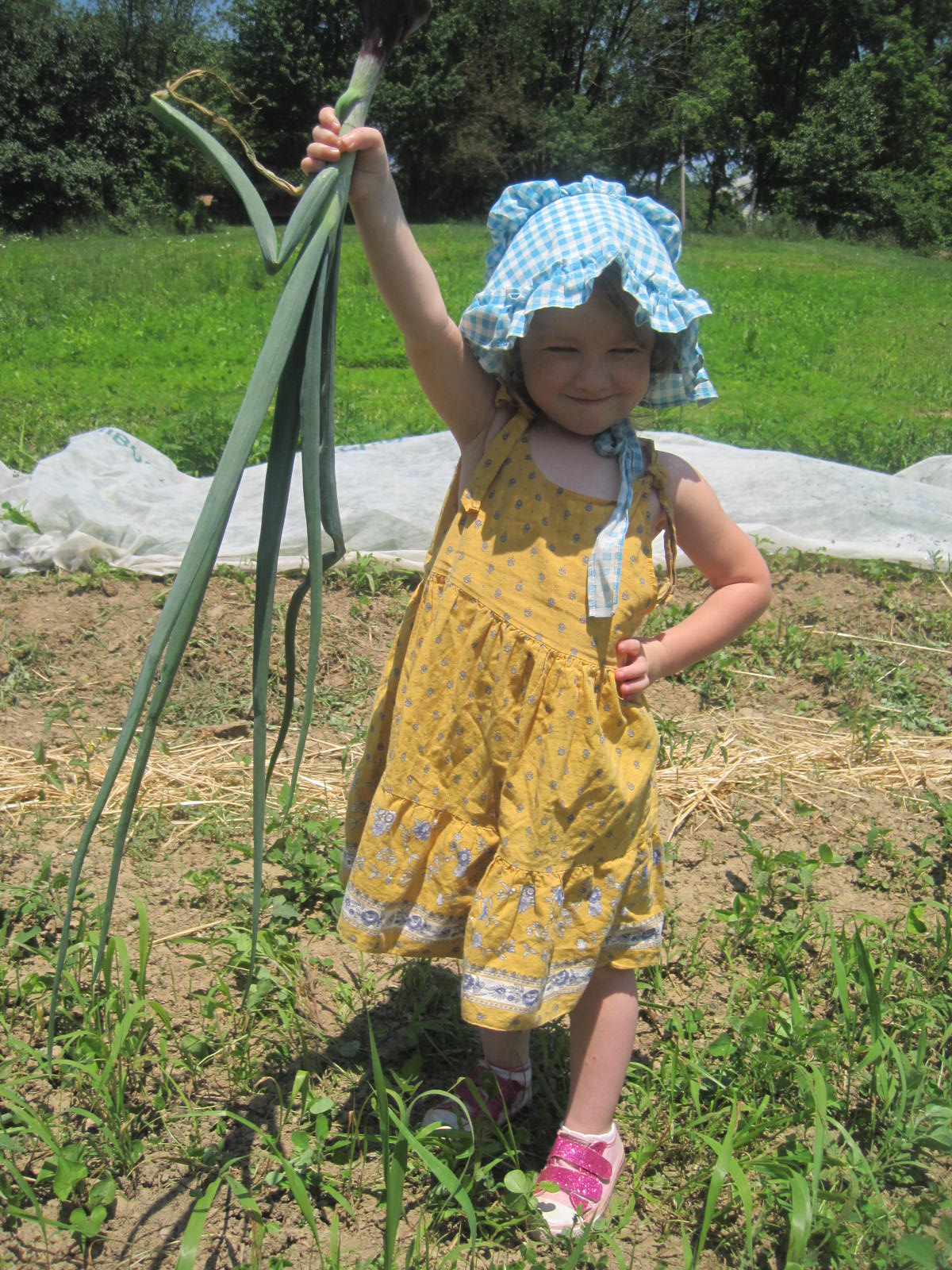
Image credit: “Avila and onion” – from the author’s collection
Previous Post

May 9, 2016
family values should not be a first-world privilege
Next Post

May 12, 2016 now is the time to be whole life
Browse Our Archives
Select a Category abortion anti-semitism art Atwood Betrothed church clergy abuse coronavirus culture economics education environmentalism ethics faith family feminism gardening gun violence immigration Judaism literature MaddAddam New Pro Life Movement news pandemic personalism poem politics politics blue Pope Francis racism religion salvation sexuality social justice spirituality Station eleven Stephen King The Stand Trump Uncategorized war World Health Organization
Select a Month March 2021 February 2021 January 2021 December 2020 November 2020 October 2020 September 2020 August 2020 July 2020 June 2020 May 2020 April 2020 March 2020 February 2020 January 2020 December 2019 November 2019 October 2019 September 2019 August 2019 July 2019 June 2019 May 2019 April 2019 March 2019 February 2019 January 2019 December 2018 November 2018 October 2018 September 2018 August 2018 July 2018 June 2018 May 2018 April 2018 March 2018 February 2018 January 2018 December 2017 November 2017 October 2017 September 2017 August 2017 July 2017 June 2017 May 2017 April 2017 March 2017 February 2017 January 2017 December 2016 November 2016 October 2016 September 2016 August 2016 July 2016 June 2016 May 2016 April 2016 March 2016 February 2016
Follow Us!
TAKE THE
Religious Wisdom Quiz
What famous cathedral is in Paris, known for its flying buttresses and rose windows?
Select your answer to see how you score.
Notre Dame St. Paul's St. Peter's Canterbury
Support this
Column


Related posts from suspended in her jar

Immigrants: They Need Us, and We Need Them

Four Takeaways from Oprah’s Interview with the Duke...

Rush Limbaugh Would Never Have Succeeded In an...

We Need to Be Honest When We Talk...
TRENDING AT PATHEOS Catholic

Creation, Preservation, and Teleology in Catholic Theology
As I write this, it is very early Monday morning. Like millions...

The Parable Of The Sower And The Word...
One of Christ’s most famous parables is that of the sower who...

Rejecting Doom: Christian Hope And Human Action
Christianity is a religion of hope. We are to have hope and...

Why I Choose the Eucharist Over the Sermon
Choose the Eucharist, Not the Sermon What are we supposed to get...

5 Design Elements Found in Spiritually Rooted Homes
Putting Spirituality Into Home Decor Our homes are more than our living...

Credo: A Story of God Told with the...
About 10 years ago, I began to imagine a personal "Credo" that...
view all Catholic blogs
Ad-Free & Subscriber Log-In Subscription Support
- About Us
- 2026 Calendar
- Videos
- Podcasts
- Library of World Religions
- Faith In Media Tracker
- Advertise With Us
- Write for Us
- Privacy Policy
- Terms of Service
- Do Not Sell My Data
- Contact Us
- Radiant Digital
- Manage Newsletter Subscriptions
- Unsubscribe From Notifications
- Sitemap
Copyright 2008-2026, Patheos. All rights reserved.
Subscription Support Ad-Free & Subscriber Log-In
Follow Patheos