
BuddhistCatholicContemplativeEvangelicalGeneral ChristianHinduJewishLatter-day SaintMuslimNew VisionsProgressive Christian
Beliefs
- Buddhist
- Catholic
- Contemplative
- Evangelical
- General Christian
- Hindu
- Jewish
- Latter-day Saint
- More Voices
- Muslim
- New Visions
- Pagan
- Progressive Christian
Topics
- Religion News
- Food and Religion
- Sports and Religion
- Religious Art
- Religious Music and Entertainment
- Religious Events
- History and Religion
- Style and Religion
- Politics and Religion
- Women in Religion
- Recreation Outdoors and Religion
- Business Finance and Religion
- Careers Workplace and Religion
- Education and Religion
- Family Parenting and Religion
- Health Fitness and Religion
- Home and Religion
- Relationships and Religion
- Technology and Religion
- Travel and Religion
Columnists
- Buddhist Columnists
- Business Finance and Religion Columnists
- Careers Workplace and Religion Columnists
- Catholic Columnists
- Contemplative Columnists
- Education and Religion Columnists
- Evangelists Columnists
- Family Parenting and Religion Columnists
- General Christian Columnists
- Health Fitness and Religion Columnists
- Hindu Columnists
- History and Religion Columnists
- Home and Religion Columnists
- Jewish Columnists
- More Voices Columnists
- Latter Day Columnists
- Muslim Columnists
- New Visions Columnists
- Nonreligious Columnists
- Pagan Columnists
- Politics and Religion Columnists
- Progressive Columnists
- Recreation Outdoors and Religion Columnists
- Relationships and Religion Columnists
- Religion News Columnists
- Religious Art Columnists
- Religious Events Columnists
- Religious Music and Entertainment Columnists
- Sports and Religion Columnists
- Style and Religion Columnists
- Technology and Religion Columnists
- Travel and Religion Columnists
- Women in Religion Columnists
Resource Library
- 2026 Calendar
- Library of World Religions
- The 100 Most Holy Places on Earth
- Patheos Answers
- Podcasts
- Videos
- Faith Leaders Database
- Anglican Episcopalian
- Bahai
- Baptist
- Buddhism
- Christianity
- Confucianism
- Eastern Orthodoxy
- Hinduism
- Holiness and Pentecostal
- ISKCON
- Islam
- Judaism
- Lutheran
- Methodist
- The Church of Jesus Christ of Latter-day Saints
- New Age
- Paganism
- Presbytarian and Reformed
- Protestantism
- Religion Behind the Scenes
- Roman Catholic
- Scientology
- Shia Islam
- Sikhism
- Sufism
- Sunni Islam
- Taoism
- Zen
- See all religions
Research Tools
 Ad-Free & Subscriber Log-In Subscription Support
Ad-Free & Subscriber Log-In Subscription Support
Follow Patheos 

- Trending:
- Forgiveness
- |
- Marriage
- |
- Consciousness
- |
- Death Penalty
- |
- Election
- |
- Halloween
 suspended in her jar
- Home
- Catholic
- we need a theology of the body broken and violated
we need a theology of the body broken and violated
Last updated on: April 11, 2016 at 9:52 am by Rebecca Bratten Weiss
we need a theology of the body broken and violated 2016-04-11T09:52:33-04:00 Rebecca Bratten Weiss
Patheos Explore the world's faith through different perspectives on religion and spirituality! Patheos has the views of the prevalent religions and spiritualities of the world.
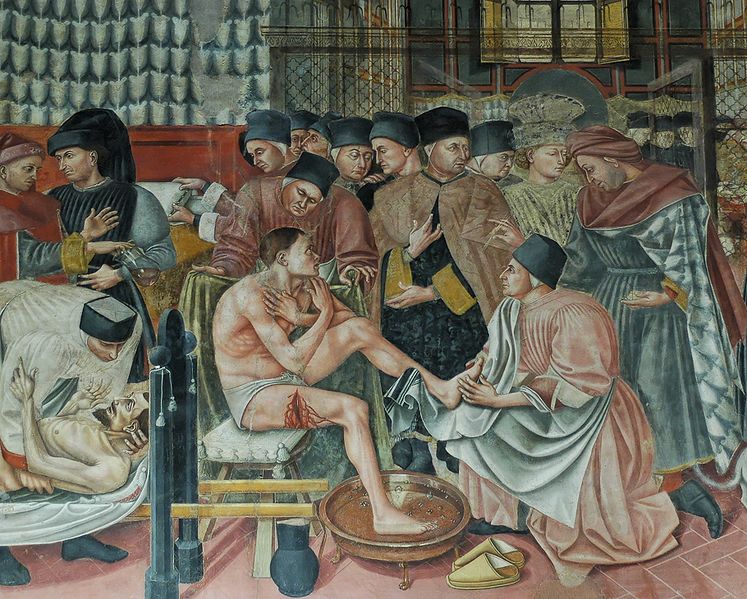
The queen mother is having a feast, and I am invited to attend.
Naturally, I shave my legs and tint my hair and choose my finest outfit (elegant and understated); I put on a touch of make-up, enough to make me look interesting but not freakish. Everything entailed in necessary bodily adornment, I perform. I know that I can’t expect high honors at this feast, since I am not powerful or prestigious, but I hope that by means of wit and elegance I can attract attention. Power and prestige don’t matter to the queen mother very much, after all. But they do seem to matter at feasts, and I like feasts. I hope there will be wine. The media will be there, so perhaps I can win a little attention, advance my sluggish career.
Here we are in the banquet hall, and the usual honorary guests are seated in places of renown, though the queen mother herself is nowhere to be seen. Several significant dignitaries seem to have charge of the affair, people I know casually, and don’t like very much, though one must pretend to find them delightful.
The speakers are speechifying. They use the correct language: encounter, liturgy, sacrament. (Or, if it’s a slightly different kind of event: hegemony, identity, her-story).
The speakers:
- A slender blond young woman with a degree in art history, newly married, who blogs about the joys of family life, with a few harsh realities thrown in to keep things real.
- A jovial priest, who gives great homilies and sometimes writes amusing articles.
- A man in an Italian suit who has won several awards for his work in defending something from something (with the pen, not the sword, obviously. All swords here are metaphorical).
- A grey-haired delicate older woman known for her work on the Feminine Something.
- Another priest, this one less jovial and more academic, but very eloquent on ecclesiology.
- A businessman who has donated a lot to make this event possible.
Several guests who appear not to fit in have been seated far to the back: there is a woman in sweat pants, a man with tattoos covering his face. One guest has sores covering her face, like those of a meth addict. Another has bandaged wrists. As I look around, I realize that, while the event coordinators and the guests of honor and their families look appropriately elegant, more and more guests on the fringes of the event do not fit in with the image expected.
Someone seated near me, someone also elegantly clad (though not particularly artistic, I note – not as interesting as I am!), whispers a sarcastic question: what is this, a banquet or a hospital? Or perhaps a homeless shelter or rehab facility?
Well, which is it? Banquet, or hospital?
We do speak often of the church as a hospital, of God as the divine physician. So never mind, I was mistaken. I came expecting a banquet, and found myself in a hospital. Those event coordinators have it wrong. This is not a place for the guests of honor in their fine clothes, preparing for their book-signings, but for the sick, the depressed, the poor, the addicted. Perhaps I can somehow donate money to this cause.
But then I remember, that when I prepared for the banquet I was careful, in my ritual of bodily adornment, to hide my own bodily scars. I used make-up to disguise the dark rings around my eyes, the testimony of anxiety-ridden sleepless nights and too much alcohol. My artistic adornment is there not to reveal, but to conceal. I have done theatrical work. I am good at costuming, and good at acting. I was invited to the hospital, too – and these guests of honor, these respectable ones, these speakers, are as sick as I am, perhaps not with the same illnesses, but sick all the same, even if they don’t yet know it. We were all invited together to this banquet, this hospital. It is for us all.
I sit there, pondering this fact. And I consider that if I write about this, in just the right language, I too might someday get to be a speaker up there with the others. No one could really object to what I’d have to say.
But that’s a matter of language, too, language used to dress up and disguise reality, to hide wounds instead of healing them. The man with the bandaged wrists could object well enough; he could stand up and say: this is all a load of shit; no one is being healed here.
Then someone would call the security guards, and hustle him out. He said the wrong thing; he shattered the illusion.
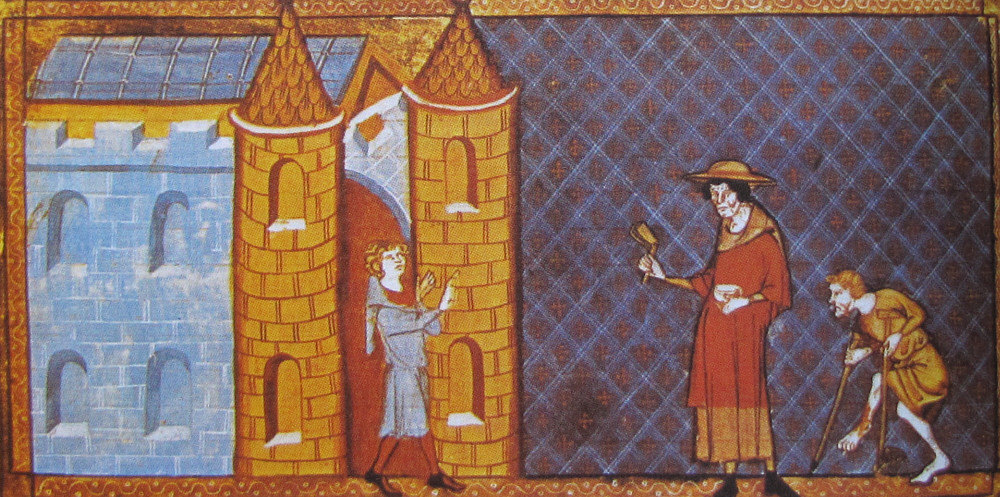
Two pieces I read, recently, highlighted for me the inadequacy of our language and our theology: Mary Pezzulo’s “Faith Comes by Hearing”and Anne Carpenter’s “Sorrow at the Joy of Love”. In the first, the author writes of how a priest forbade her even to speak of her experiences of abuse. In the second, the author describes how, as a victim of abuse, the celebrations over Amoris Laetitia – the literal joy of love – can not seem real.
What if a lot of what we are doing here, we outwardly joyous Catholics, is not real? Maybe we are all good at costuming, good at acting.
What if the right language is the wrong language?
Because, as soon as I draw on the language that beautifies, I am pretending that wounds aren’t real, that suffering is all in the past, or, worse, that suffering is actually a blessing, because without suffering this or that rich happy person wouldn’t be rich and happy today. I am now one of the dignitaries, no longer one of the sick. Except that the dignitaries are sick, too, but not in the way they pretend. The dignitaries can appropriate the language of the sick (we’re all sinners, haha!) while subtly drawing a line between acceptable sickness, acceptable ways of being a bad Catholic….and the sins that we don’t really want to forgive, types of bad Catholic we don’t want among us.
We have a beautiful image of what we believe in and wish the world to see, when they see us, so what to do with those fragments of being that do not fit nicely into the gorgeous mosaic we construct?
Kick them out. Don’t let them speak. What they say will disturb us. We might not be able to be quite so happy, after we hear what they have to say, those fragments. The church is hte body beautiful. Cut off the limbs that don’t live up to the ideal.
So on the topic of war we have just war theory, civilian casualties, collateral damage, friendly fire – we have glory, patriotism, freedom, and honor. Don’t look at the bodies. There are no bodies.
Let’s not talk about mental illness. At least, not our own. It’s always the Other who is sick.
On the topic of sex we speak of relation, mutuality, spousal embrace, marital act, intimacy. But there’s a whole panoply of other words out there for sex, words we can’t speak because then we’d have to admit of the realities of violence or transgression. We name only some of our body parts, or pretend we’re not talking about body parts at all. We imagine a realm of beauty and unity and fecundity where, in fact, there is often pain and degradation.
When it comes to homosexuality, we speak of “same sex attraction” – because even to let gay persons name themselves would be to give them too much reality, and we are afraid of them (that’s another one of the sicknesses the dignitaries don’t want to admit). We speak of the “homosexual lifestyle” to disguise the fact that we are fixating on the various mechanisms of gay sexual expression, prying indecently into the lives of others, projecting a whole burden of disgustingness, violence, and pain onto the world of gay experience rather than admitting that there is disgustingness, violence, and pain everywhere.
I’m admitting to my sickness, and I consider myself thus more enlightened than the dignitaries: I broke, and the light streamed in.
And in thinking this, I am sick in a way I myself don’t want to confess.
There’s a lot I’d like to say about what’s missing in Theology of the Body. Why is it so often the youthful, happy, healthy body we speak of? What about wounded bodies, anorexic bodies, self-mutilated bodies, sick bodies, drunk bodies, addicted bodies, suicidal bodies, raped bodies, deformed bodies, bodies in which we do not feel at home, bodies no one loves or wishes to embrace, bodies that have disappointed us, are betraying us even now?
What about the bodies of those who have done acts of violence, bodies of murderers and rapists and abusers and pedophiles? How can a theology of mutuality and love begin to speak to people for whom the entire bodily relation to other human bodies is a disaster?
Our use of language is supposed to communicate, but in communicating reality we shape it to fit our needs. If we need to make the church look beautiful, we use beautiful language, and those realities that can’t be spoken of are re-named, or else left nameless, hidden. So much of what we contemplate, when we speak of religion and relation, depends upon the convenient veiling of those aspects that do not fit neatly into our vision. Language itself determines this, as we choose a set tone, register, and vocabulary to fit the subject matter. To speak of holy things in unholy language is considered sacrilege and blasphemy, but maybe we need to draw on the language of desecration to make sense of Christ’s entry into a violent world, to give voices to those who are silenced. We have what we need to speak of this, if we dare: the real wounds of Christ. But we must not refuse to hear of the wounds of the wounded, who have not yet healed.
The body of Christ was pierced and broken; the bodies of men and women are broken and violated. We need a language and a theology to speak of the body in its brokenness.
image credit:
1) Healing the sick, fresco by Domenico di Bartolo. Sala del Pellegrinaio (hall of the pilgrim), Hospital Santa Maria della Scala, Siena. Public Domain. https://en.m.wikipedia.org/wiki/File:Pellegrinaio_Santa_Maria_della_Scala_n5.jpg
2) Two lepers denied entrance to town, 14th century. Public domain in the US (PD – US). https://commons.wikimedia.org/wiki/File:Leprosorium.jpg
Previous Post

April 9, 2016
How Feminism Strengthened My Christianity
Next Post
April 12, 2016 the rad trad approach is neither rad nor trad
Browse Our Archives
Select a Category abortion anti-semitism art Atwood Betrothed church clergy abuse coronavirus culture economics education environmentalism ethics faith family feminism gardening gun violence immigration Judaism literature MaddAddam New Pro Life Movement news pandemic personalism poem politics politics blue Pope Francis racism religion salvation sexuality social justice spirituality Station eleven Stephen King The Stand Trump Uncategorized war World Health Organization
Select a Month March 2021 February 2021 January 2021 December 2020 November 2020 October 2020 September 2020 August 2020 July 2020 June 2020 May 2020 April 2020 March 2020 February 2020 January 2020 December 2019 November 2019 October 2019 September 2019 August 2019 July 2019 June 2019 May 2019 April 2019 March 2019 February 2019 January 2019 December 2018 November 2018 October 2018 September 2018 August 2018 July 2018 June 2018 May 2018 April 2018 March 2018 February 2018 January 2018 December 2017 November 2017 October 2017 September 2017 August 2017 July 2017 June 2017 May 2017 April 2017 March 2017 February 2017 January 2017 December 2016 November 2016 October 2016 September 2016 August 2016 July 2016 June 2016 May 2016 April 2016 March 2016 February 2016
Follow Us!
TAKE THE
Religious Wisdom Quiz
In 2 Timothy, what did Paul leave with Carpus at Troas?
Select your answer to see how you score.
His cloak and scrolls His letters His money His tent-making tools
Support this
Column


Related posts from suspended in her jar

Four Takeaways from Oprah’s Interview with the Duke...

Catholics Are De-Toxing From their Experiences With Traumatic...

How Has the Pandemic Changed Us? Has It...

Rush Limbaugh Would Never Have Succeeded In an...
TRENDING AT PATHEOS Catholic

Creation, Preservation, and Teleology in Catholic Theology
As I write this, it is very early Monday morning. Like millions...

The Parable Of The Sower And The Word...
One of Christ’s most famous parables is that of the sower who...

Rejecting Doom: Christian Hope And Human Action
Christianity is a religion of hope. We are to have hope and...

Why I Choose the Eucharist Over the Sermon
Choose the Eucharist, Not the Sermon What are we supposed to get...

5 Design Elements Found in Spiritually Rooted Homes
Putting Spirituality Into Home Decor Our homes are more than our living...

Credo: A Story of God Told with the...
About 10 years ago, I began to imagine a personal "Credo" that...
view all Catholic blogs
Ad-Free & Subscriber Log-In Subscription Support
- About Us
- 2026 Calendar
- Videos
- Podcasts
- Library of World Religions
- Faith In Media Tracker
- Advertise With Us
- Write for Us
- Privacy Policy
- Terms of Service
- Do Not Sell My Data
- Contact Us
- Radiant Digital
- Manage Newsletter Subscriptions
- Unsubscribe From Notifications
- Sitemap
Copyright 2008-2026, Patheos. All rights reserved.
Subscription Support Ad-Free & Subscriber Log-In
Follow Patheos