
BuddhistCatholicContemplativeEvangelicalGeneral ChristianHinduJewishLatter-day SaintMuslimNew VisionsProgressive Christian
Beliefs
- Buddhist
- Catholic
- Contemplative
- Evangelical
- General Christian
- Hindu
- Jewish
- Latter-day Saint
- More Voices
- Muslim
- New Visions
- Pagan
- Progressive Christian
Topics
- Religion News
- Food and Religion
- Sports and Religion
- Religious Art
- Religious Music and Entertainment
- Religious Events
- History and Religion
- Style and Religion
- Politics and Religion
- Women in Religion
- Recreation Outdoors and Religion
- Business Finance and Religion
- Careers Workplace and Religion
- Education and Religion
- Family Parenting and Religion
- Health Fitness and Religion
- Home and Religion
- Relationships and Religion
- Technology and Religion
- Travel and Religion
Columnists
- Buddhist Columnists
- Business Finance and Religion Columnists
- Careers Workplace and Religion Columnists
- Catholic Columnists
- Contemplative Columnists
- Education and Religion Columnists
- Evangelists Columnists
- Family Parenting and Religion Columnists
- General Christian Columnists
- Health Fitness and Religion Columnists
- Hindu Columnists
- History and Religion Columnists
- Home and Religion Columnists
- Jewish Columnists
- More Voices Columnists
- Latter Day Columnists
- Muslim Columnists
- New Visions Columnists
- Nonreligious Columnists
- Pagan Columnists
- Politics and Religion Columnists
- Progressive Columnists
- Recreation Outdoors and Religion Columnists
- Relationships and Religion Columnists
- Religion News Columnists
- Religious Art Columnists
- Religious Events Columnists
- Religious Music and Entertainment Columnists
- Sports and Religion Columnists
- Style and Religion Columnists
- Technology and Religion Columnists
- Travel and Religion Columnists
- Women in Religion Columnists
Resource Library
- 2026 Calendar
- Library of World Religions
- The 100 Most Holy Places on Earth
- Patheos Answers
- Podcasts
- Videos
- Faith Leaders Database
- Anglican Episcopalian
- Bahai
- Baptist
- Buddhism
- Christianity
- Confucianism
- Eastern Orthodoxy
- Hinduism
- Holiness and Pentecostal
- ISKCON
- Islam
- Judaism
- Lutheran
- Methodist
- The Church of Jesus Christ of Latter-day Saints
- New Age
- Paganism
- Presbytarian and Reformed
- Protestantism
- Religion Behind the Scenes
- Roman Catholic
- Scientology
- Shia Islam
- Sikhism
- Sufism
- Sunni Islam
- Taoism
- Zen
- See all religions
Research Tools
 Ad-Free & Subscriber Log-In Subscription Support
Ad-Free & Subscriber Log-In Subscription Support
Follow Patheos 

- Trending:
- Forgiveness
- |
- Marriage
- |
- Consciousness
- |
- Death Penalty
- |
- Election
- |
- Halloween
 suspended in her jar
- Home
- Catholic
- the rad trad approach is neither rad nor trad
the rad trad approach is neither rad nor trad
Last updated on: April 12, 2016 at 12:09 pm by Rebecca Bratten Weiss
the rad trad approach is neither rad nor trad 2016-04-12T12:09:23-04:00 Rebecca Bratten Weiss
Patheos Explore the world's faith through different perspectives on religion and spirituality! Patheos has the views of the prevalent religions and spiritualities of the world.
I am not a theologian, nor do I play one on the internet.
I am a person who enjoys words, however, and when you spend time enough with words in a religious space, you can not avoid confrontations. In this case, I have in mind the confrontations between those of us who love Pope Francis, and the “rad trads” who can’t stand him.
But before I get to that, let’s look at another inevitable confrontation: between desire for understanding, and the inadequacy of human language for dealing with eternal things. This inadequacy is due not only to the fact that God transcends any mere mortal idea of divinity, but to the very nature of language. What does language do, anyway? Does it communicate meaning? What is meaning? Is it inherent in the semantic elements of a sentence, or is it found in minds, or in an ideal realm apart from language? Does language function through reference? Do the relations between words in sentences reflect a relation between things or events in the world? On what basis, can we assert that this or that proposition is true or false? Does language change reality? Does language function in terms of use?
If I refer to “Homer” as the author of two major Greek epics, does this name have significance even though we believe there probably never was any one person named “Homer”? Does “Homer” refer to a collective of poets and scribes, or to a convenient mythic figure, or to nothing at all?
Is “the morning star” interchangeable, in terms of meaning, with “the evening star,” given that they both refer to the same thing, the planet Venus?
If I cay “the cat is on the mat” – does this sentence convey meaning because of a shared understanding of the idea “cat”? Or a habitual use of “cat” to refer to a class of objects? Is it possible to communicate to a listener the exact idea I have of a cat being on a mat? If I have a particular cat and mat in mind, and the listener another particular cat and mat, have I communicated anything meaningfully?
There is no one “Catholic” answer to these questions, which means geeky Catholics get to have hours of good clean fun arguing about them, but the fundamental inadequacy of any human language to convey, perfectly, even the simplest truth, should be a reminder to go humbly. Human language remains a human construct; we use our own building-blocks not only to create edifices of meaning, interpretation, art, and communication, but also, we believe, to achieve a sort of connection with reality. But this connection with reality (whatever “reality” means – whatever I mean by asking what “reality” means) is incomplete. There is much in our knowing that eludes us, even about a cat on a mat. So when we use an inadequate human language to speak of divine things, that which eludes us is infinite.
We know, or ought to know, the inadequacy of any of our names for God, of our words for the attributes of God, the analogous nature of our speaking – though there may be theological or epistemological disagreement on just what “analogy” entails.
Consider that any sentence, even in a divinely inspired or infallible text, is still couched in vague human words (“vague human words” being actually a redundancy) – and that our understanding of these words alters over time. When we translate a text it becomes even less determined, but it would be an error to think that the original human text is logically identical with divine truth as understood by God. Otherwise we would not be unpacking and mulling over these sentences for centuries.
How does this square with our belief that Catholics have access to the fullness of revealed truth?
First: “revealed truth” does not necessarily mean “all the truths that ever have been.” If it did, we would be able to mine our faith tradition to find answers to scientific questions, or even to find out what the winning lottery number is (if God is outside time, and knows all, then God knows the winning lottery number. A truth, alas, withheld from me).
Second: the fullness of revealed truth is best understood not as residing in a set of written texts in human language, even if these texts are divinely inspired. The fullness of revealed truth is found in the Logos, the Word: “In Jesus Christ, the whole of God’s truth has been made manifest. Full of grace and truth, he came as the light of the world, he is the Truth. “Whoever believes in me may not remain in darkness”” (CCC, 2466).
This is why I value philosophies of deconstruction. There is a kind of Christian piety, I believe, in our recognition of the inadequacy of our own inventions, the incompleteness of any human system. To deconstruct a system of human meaning is not to deny the absolute, but to bow our heads before the absolute. Even the most profound theological statement about a revealed truth remains insufficient to convey to even one person alone the fullness of what is.
Thus, to be committed to the tradition of our faith is to be committed ultimately, not to a set of written principles, but to the presence of the divine Word, and to the work of the Spirit who continues to unfold to us the divine intention of these principles. Otherwise, it would be the case that the most educated theologian – one with a photographic memory of, and intellectual commitment to, every single authoritative statement of revealed truth – would be a more perfect Christian than an illiterate peasant who receives the sacraments and loves the Lord her God with all her heart, mind, and soul. She might not be able to define transubstantiation, but she receives it with love.
This is not to discount the intellectual aspect of our faith tradition, because we are indeed rational animals, and we hunger to know, and our hunger for knowledge is connected to our need for God. But in our intellectual life our commitment must be to an ongoing, living tradition made manifest to use through the continued presence of Christ in the church. We can not set aside the past in the favor of some orgiastic future, as some progressives imagine, but nor can we draw a line in the sand and say “tradition stops here.”
Commitment to an ongoing, living tradition is difficult intellectually, because it means trying to understand how it all fits together. There are moments of confusion and doubt, especially because some formulations in some texts appear to contradict other formulations in other texts. Our task then is to find the paradox, to find what transcendent truth arises from two propositions which appear, in human apprehension, to contradict one another. We need to be wary of confusing the human intention behind sacred texts with the divine intention.
Awareness of levels of teaching authority is, in fact, important. This was a point I made for years, whenever someone tried to beat me into submission with a random quotation from any old papal speech, and while I find it amusing that these same people have now, apparently, discovered that there are levels of teaching authority, in their haste to make us disregard everything Pope Francis does, I can’t get on board with some of my fellow Francis-fans who seem inclined on occasion to discount the levels of authority. It is actually fine to disagree with a statement made by a pope on a plane. My affection for Pope Francis is because of the kind of pope he is, and I am willing to give him the benefit of the doubt, on that account, even when he says things with which I disagree.
Having difficulty with certain verbal formulations of magisterial teaching is also, I believe, acceptable, because even if one gives formal assent to a teaching that doesn’t magically make one’s doubt go away. I have difficulty with a number of verbal formulations of magisterial teaching, though I am not going to confess, here, which ones, because I believe that commitment to a tradition means remaining within that tradition, trying to work it out, not hastily jettisoning all the bits one doesn’t like.
The radical traditionalists claim to be defending a tradition that has been abandoned and rejected. Steven Skojec at One Peter Five writes of “[T]he re-establishment of long-discarded tradition that once made the Church strong, and can do so again.” At Rorate Caeli, Antonio Socci writes that “little by little for months now, we have been witnessing the continuous demolition of Catholic doctrine. Each day a new blow.” Statements like this reveal a fundamental lack of faith in the power of the spirit to remain present in our teaching. I am sympathetic to distress over disagreement, but when this distress is vocalized in this way, when a personal inability to find the paradox becomes a formal statement of dissent, and when those who are committed to the developing tradition end up being called heretics, something is very amiss. There’s a weird view of development of doctrine here, too, since the Francis-haters seem to give primacy to medieval forms of Christianity as though they alone were perpetually intended by God, forgetting just how much these forms departed from early Church traditions. Did our tradition develop up to a point, and then just sort of calcify?
I am inclined to say “this is not the way to be Catholic.” But, well, there are a lot of ways of being Catholic, even if some look very sad or strange.
It is definitely not, however, the way to be a radical traditionalist. The word “radical” is funny, because it comes from the word “radix” or “root” – so it can refer to a rootedness, as well as a commitment to utter and total change. This word, with its oxymoronic implications, refers well to what we as Christians should be, committed to the roots of our faith in the presence of Christ, and committed to radical, fundamental transformation of our mere human endeavors. To be a “radical traditionalist,” then, should entail a complete and personal dedication to a tradition that we believe has the deepest possible roots, in eternal truths made manifest in Christ, but also to the possibilities of transformation. It means we enter into communion with a rich ongoing tradition even when at times we are confused or troubled, or even angry. We do not reject those parts of the tradition that do not suit us, but we also realize that on a human level we haven’t figured it all out yet.
In spite of my doubts, my theological stupidity, my sinfulness, my confusion, my dark nights, and my rage, I am going to stay rooted in this living tradition because here it is that I find the love and grace of Christ. Call me bad Catholic if you like, or call me a crappy amateur theologian, but you can also call me a radical traditionalist.
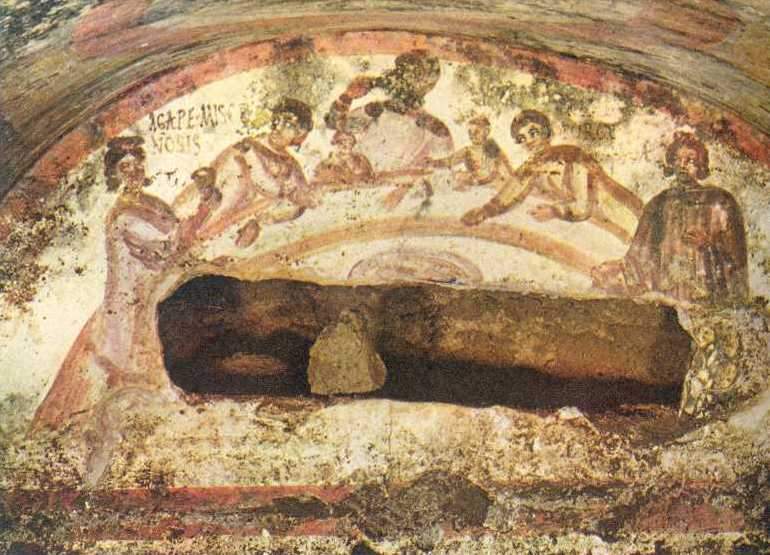
image credit: Fresco of a female figure holding a chalice at an early Christian Agape feast. Catacomb of Saints Marcellinus and Peter, Via Labicana, Rome. Public Domain in the Us (PD – US). https://en.wikipedia.org/wiki/Chalice#/media/File:Agape_feast_03.jpg
Previous Post
April 11, 2016
we need a theology of the body broken and violated
Next Post

April 14, 2016 the immodest consequences of modesty policing
Browse Our Archives
Select a Category abortion anti-semitism art Atwood Betrothed church clergy abuse coronavirus culture economics education environmentalism ethics faith family feminism gardening gun violence immigration Judaism literature MaddAddam New Pro Life Movement news pandemic personalism poem politics politics blue Pope Francis racism religion salvation sexuality social justice spirituality Station eleven Stephen King The Stand Trump Uncategorized war World Health Organization
Select a Month March 2021 February 2021 January 2021 December 2020 November 2020 October 2020 September 2020 August 2020 July 2020 June 2020 May 2020 April 2020 March 2020 February 2020 January 2020 December 2019 November 2019 October 2019 September 2019 August 2019 July 2019 June 2019 May 2019 April 2019 March 2019 February 2019 January 2019 December 2018 November 2018 October 2018 September 2018 August 2018 July 2018 June 2018 May 2018 April 2018 March 2018 February 2018 January 2018 December 2017 November 2017 October 2017 September 2017 August 2017 July 2017 June 2017 May 2017 April 2017 March 2017 February 2017 January 2017 December 2016 November 2016 October 2016 September 2016 August 2016 July 2016 June 2016 May 2016 April 2016 March 2016 February 2016
Follow Us!
TAKE THE
Religious Wisdom Quiz
In Philippians, Paul mentions two women who need to be of the same mind. Who are they?
Select your answer to see how you score.
Lydia and Chloe Mary and Martha Phoebe and Priscilla Euodia and Syntyche
Support this
Column


Related posts from suspended in her jar

Immigrants: They Need Us, and We Need Them

Four Takeaways from Oprah’s Interview with the Duke...

Catholics Are De-Toxing From their Experiences With Traumatic...

How Has the Pandemic Changed Us? Has It...
TRENDING AT PATHEOS Catholic

Creation, Preservation, and Teleology in Catholic Theology
As I write this, it is very early Monday morning. Like millions...

The Parable Of The Sower And The Word...
One of Christ’s most famous parables is that of the sower who...

Rejecting Doom: Christian Hope And Human Action
Christianity is a religion of hope. We are to have hope and...

Why I Choose the Eucharist Over the Sermon
Choose the Eucharist, Not the Sermon What are we supposed to get...

5 Design Elements Found in Spiritually Rooted Homes
Putting Spirituality Into Home Decor Our homes are more than our living...

Credo: A Story of God Told with the...
About 10 years ago, I began to imagine a personal "Credo" that...
view all Catholic blogs
Ad-Free & Subscriber Log-In Subscription Support
- About Us
- 2026 Calendar
- Videos
- Podcasts
- Library of World Religions
- Faith In Media Tracker
- Advertise With Us
- Write for Us
- Privacy Policy
- Terms of Service
- Do Not Sell My Data
- Contact Us
- Radiant Digital
- Manage Newsletter Subscriptions
- Unsubscribe From Notifications
- Sitemap
Copyright 2008-2026, Patheos. All rights reserved.
Subscription Support Ad-Free & Subscriber Log-In
Follow Patheos