
BuddhistCatholicContemplativeEvangelicalGeneral ChristianHinduJewishLatter-day SaintMuslimNew VisionsProgressive Christian
Beliefs
- Buddhist
- Catholic
- Contemplative
- Evangelical
- General Christian
- Hindu
- Jewish
- Latter-day Saint
- More Voices
- Muslim
- New Visions
- Pagan
- Progressive Christian
Topics
- Religion News
- Food and Religion
- Sports and Religion
- Religious Art
- Religious Music and Entertainment
- Religious Events
- History and Religion
- Style and Religion
- Politics and Religion
- Women in Religion
- Recreation Outdoors and Religion
- Business Finance and Religion
- Careers Workplace and Religion
- Education and Religion
- Family Parenting and Religion
- Health Fitness and Religion
- Home and Religion
- Relationships and Religion
- Technology and Religion
- Travel and Religion
Columnists
- Buddhist Columnists
- Business Finance and Religion Columnists
- Careers Workplace and Religion Columnists
- Catholic Columnists
- Contemplative Columnists
- Education and Religion Columnists
- Evangelists Columnists
- Family Parenting and Religion Columnists
- General Christian Columnists
- Health Fitness and Religion Columnists
- Hindu Columnists
- History and Religion Columnists
- Home and Religion Columnists
- Jewish Columnists
- More Voices Columnists
- Latter Day Columnists
- Muslim Columnists
- New Visions Columnists
- Nonreligious Columnists
- Pagan Columnists
- Politics and Religion Columnists
- Progressive Columnists
- Recreation Outdoors and Religion Columnists
- Relationships and Religion Columnists
- Religion News Columnists
- Religious Art Columnists
- Religious Events Columnists
- Religious Music and Entertainment Columnists
- Sports and Religion Columnists
- Style and Religion Columnists
- Technology and Religion Columnists
- Travel and Religion Columnists
- Women in Religion Columnists
Resource Library
- 2026 Calendar
- Library of World Religions
- The 100 Most Holy Places on Earth
- Patheos Answers
- Podcasts
- Videos
- Faith Leaders Database
- Anglican Episcopalian
- Bahai
- Baptist
- Buddhism
- Christianity
- Confucianism
- Eastern Orthodoxy
- Hinduism
- Holiness and Pentecostal
- ISKCON
- Islam
- Judaism
- Lutheran
- Methodist
- The Church of Jesus Christ of Latter-day Saints
- New Age
- Paganism
- Presbytarian and Reformed
- Protestantism
- Religion Behind the Scenes
- Roman Catholic
- Scientology
- Shia Islam
- Sikhism
- Sufism
- Sunni Islam
- Taoism
- Zen
- See all religions
Research Tools
 Ad-Free & Subscriber Log-In Subscription Support
Ad-Free & Subscriber Log-In Subscription Support
Follow Patheos 

- Trending:
- Forgiveness
- |
- Marriage
- |
- Consciousness
- |
- Death Penalty
- |
- Election
- |
- Halloween
 suspended in her jar
- Home
- Catholic
- the immodest consequences of modesty policing
the immodest consequences of modesty policing
Last updated on: April 14, 2016 at 12:34 pm by Rebecca Bratten Weiss
the immodest consequences of modesty policing 2016-04-14T12:34:34-04:00 Rebecca Bratten Weiss
Patheos Explore the world's faith through different perspectives on religion and spirituality! Patheos has the views of the prevalent religions and spiritualities of the world.
My friend Iris* is fifty years old, beautiful and brilliant, with silver hair that I envy, and a casual bohemian style. She teaches a catechism class in the town where I work, and I am trying to figure out how to get my son into her classes, because I am pretty picky about who provides my children with religious education, and Iris is one of few I trust.
A few weeks ago, Iris was teaching on the Liturgy of Light to her usual class for 6-9 year olds, as well as a visiting group of 10-12 year olds. A significant percentage of her class is made up of homeschoolers like ourselves; the rest are public school children. After the class was over and the students had left, she found that someone had left a note for her: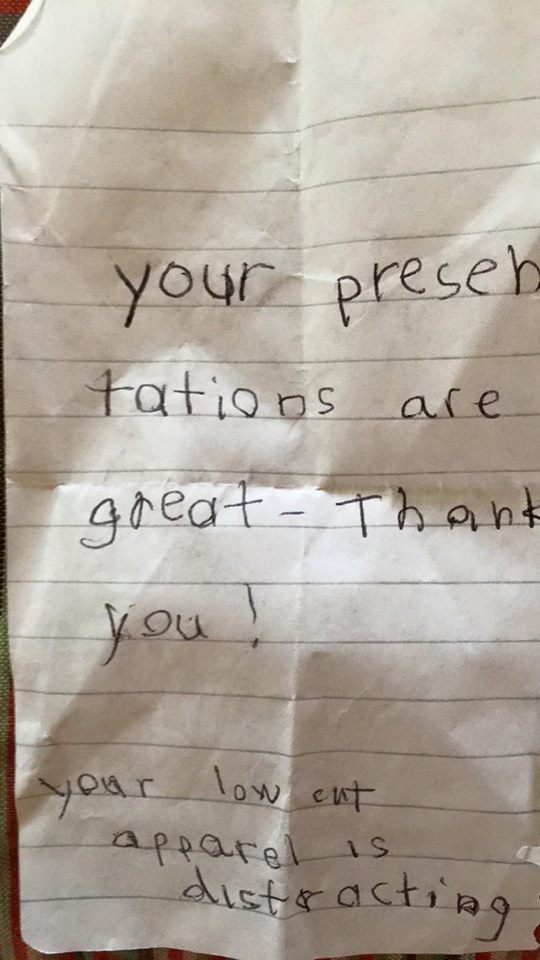
“Your presentations are great – thank you! your low cut apparel is distracting”
Allow me to point out that Iris does not wear low cut apparel, at least not as I understand it. In many Catholic homeschool groups you’ll find the occasional woman who delights in flouting the stereotypical regulations of the self-appointed modesty police, but Iris is not that type. She just dresses comfortably.
But even if she did actually wear low cut apparel, there is something seriously wrong with an ideology that would encourage a child to send such a note to a catechism teacher. Or, for that matter, to anyone. The note is disrespectful, immodest, and offensive. One can speculate about whether it was sent by a boy or a girl, or what age the sender was. One can speculate about whether the child opted to write the note independently, or was prompted to do so by a parent – and, honestly, I am not sure which option disturbs me more. A child between the age of six and nine is not likely to be distracted by a non-turtleneck unless he or she were already trained to do so. And any adequate education in manners should teach children that it is rude to send notes to people with critical commentaries on their appearance, and education in morality means taking responsibility for one’s own feelings of discomfort or distraction, not blaming them on another.
Curiosity about bodies not one’s own is a normal and healthy aspect of human development, and I always answer my children’s questions by giving matter of fact explanations of how bodies work, and the different possible functions for different parts. I also use these questions as an opportunity to remind them that a person’s body is his or her own, that it is rude to comment on people’s bodies, and that we should never touch the bodies of others without their consent, that every body is unique and deserving of respect because a human body is never just a body. A human body is a human person. I remind them that some people might not be happy in their bodies, so it is especially important never to offer unseemly commentary that might add to their distress (“fat” is a food, not a descriptor of persons).
I can’t imagine any of my children ever being distracted by low cut apparel unless the person were exposing some kind of crazy dinosaur tattoo on her decolletage. This is not because of my amazing parenting, or my children’s amazing powers of concentration, but because they have seen me and other moms nursing babies often enough. On such occasions, the baby is usually more interesting to them than the objects on which the babies suckle.
Recently I addressed the problem of stressing “custody of the eyes” as a protection against sexual sin (“custody of the eyes, and the danger of nihilistic despair”) – and this is a perfect instance of how damaging this approach to modesty is. With all the complaints that are made – justifiably- about the hyper-sexualization of the female body by secular media, we need to consider the harmful way in which the elevation of this false idea of modesty hyper-sexualizes women, and teaches children to regard bodies as objects instead of persons. If we take seriously the idea that lust is a sin, we should be thinking about how to mitigate it, how to reduce the instances in which it is likely to occur, and teaching our children to regard basic elements of female anatomy as dangerous sexual weapons that need to be concealed is not going to help in this regard.
I feel bad for children who are brought up to be so fearful of seeing even a clothed female body; it will be very difficult for them to maneuver in a pluralistic culture, or to take any job in which seeing a person’s body is part of the ordinary business. I can not blame the child who sent the note to my friend, but I can certainly blame the moral education and cultural milieu that would train a child to consider such behavior acceptable.
Modesty is a virtue, and to be found in human action, not in human clothing. We need to teach our children to behave with modesty. Making indecent commentaries on a woman’s appearance is not modest.
*Name has been changed
Image credits
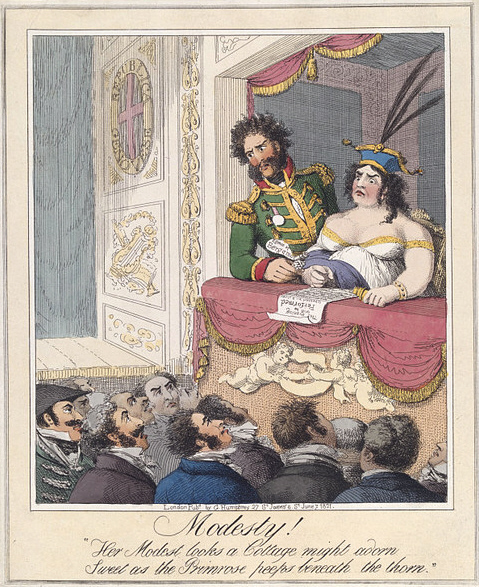
1) Modesty!, etching, published by G. Humphrey , London, 7th June 1821, (Caroline of Brunswick, wife of King George IV, at a theatre in Genoa, with her secretary and constant companion Bartolomeo Pergami). Public domain in the US (PD_US)> Victoria and Albert Museum, London, Museum number: S.51-2008https://commons.wikimedia.org/wiki/File:Modesty_1821.jpg
2) From the author’s photo collection
Previous Post
April 12, 2016
the rad trad approach is neither rad nor trad
Next Post

April 18, 2016 the unbearable boringness of promiscuity
Browse Our Archives
Select a Category abortion anti-semitism art Atwood Betrothed church clergy abuse coronavirus culture economics education environmentalism ethics faith family feminism gardening gun violence immigration Judaism literature MaddAddam New Pro Life Movement news pandemic personalism poem politics politics blue Pope Francis racism religion salvation sexuality social justice spirituality Station eleven Stephen King The Stand Trump Uncategorized war World Health Organization
Select a Month March 2021 February 2021 January 2021 December 2020 November 2020 October 2020 September 2020 August 2020 July 2020 June 2020 May 2020 April 2020 March 2020 February 2020 January 2020 December 2019 November 2019 October 2019 September 2019 August 2019 July 2019 June 2019 May 2019 April 2019 March 2019 February 2019 January 2019 December 2018 November 2018 October 2018 September 2018 August 2018 July 2018 June 2018 May 2018 April 2018 March 2018 February 2018 January 2018 December 2017 November 2017 October 2017 September 2017 August 2017 July 2017 June 2017 May 2017 April 2017 March 2017 February 2017 January 2017 December 2016 November 2016 October 2016 September 2016 August 2016 July 2016 June 2016 May 2016 April 2016 March 2016 February 2016
Follow Us!
TAKE THE
Religious Wisdom Quiz
Who did God give the Ten Commandments to?
Select your answer to see how you score.
Abraham Noah Moses Joshua
Support this
Column


Related posts from suspended in her jar

Immigrants: They Need Us, and We Need Them

Four Takeaways from Oprah’s Interview with the Duke...

Catholics Are De-Toxing From their Experiences With Traumatic...

How Has the Pandemic Changed Us? Has It...
TRENDING AT PATHEOS Catholic

Rejecting Doom: Christian Hope And Human Action
Christianity is a religion of hope. We are to have hope and...

It’s What Comes From Within Which Matters
One of the most difficult things for us to understand is why...

Why I Choose the Eucharist Over the Sermon
Choose the Eucharist, Not the Sermon What are we supposed to get...

5 Design Elements Found in Spiritually Rooted Homes
Putting Spirituality Into Home Decor Our homes are more than our living...

Credo: A Story of God Told with the...
About 10 years ago, I began to imagine a personal "Credo" that...

The Anatomy of Divine Revelation in Catholic Thought
The claim that God has made Himself known to human beings is...
view all Catholic blogs
Ad-Free & Subscriber Log-In Subscription Support
- About Us
- 2026 Calendar
- Videos
- Podcasts
- Library of World Religions
- Faith In Media Tracker
- Advertise With Us
- Write for Us
- Privacy Policy
- Terms of Service
- Do Not Sell My Data
- Contact Us
- Radiant Digital
- Manage Newsletter Subscriptions
- Unsubscribe From Notifications
- Sitemap
Copyright 2008-2026, Patheos. All rights reserved.
Subscription Support Ad-Free & Subscriber Log-In
Follow Patheos