
BuddhistCatholicContemplativeEvangelicalGeneral ChristianHinduJewishLatter-day SaintMuslimNew VisionsProgressive Christian
Beliefs
- Buddhist
- Catholic
- Contemplative
- Evangelical
- General Christian
- Hindu
- Jewish
- Latter-day Saint
- More Voices
- Muslim
- New Visions
- Pagan
- Progressive Christian
Topics
- Religion News
- Food and Religion
- Sports and Religion
- Religious Art
- Religious Music and Entertainment
- Religious Events
- History and Religion
- Style and Religion
- Politics and Religion
- Women in Religion
- Recreation Outdoors and Religion
- Business Finance and Religion
- Careers Workplace and Religion
- Education and Religion
- Family Parenting and Religion
- Health Fitness and Religion
- Home and Religion
- Relationships and Religion
- Technology and Religion
- Travel and Religion
Columnists
- Buddhist Columnists
- Business Finance and Religion Columnists
- Careers Workplace and Religion Columnists
- Catholic Columnists
- Contemplative Columnists
- Education and Religion Columnists
- Evangelists Columnists
- Family Parenting and Religion Columnists
- General Christian Columnists
- Health Fitness and Religion Columnists
- Hindu Columnists
- History and Religion Columnists
- Home and Religion Columnists
- Jewish Columnists
- More Voices Columnists
- Latter Day Columnists
- Muslim Columnists
- New Visions Columnists
- Nonreligious Columnists
- Pagan Columnists
- Politics and Religion Columnists
- Progressive Columnists
- Recreation Outdoors and Religion Columnists
- Relationships and Religion Columnists
- Religion News Columnists
- Religious Art Columnists
- Religious Events Columnists
- Religious Music and Entertainment Columnists
- Sports and Religion Columnists
- Style and Religion Columnists
- Technology and Religion Columnists
- Travel and Religion Columnists
- Women in Religion Columnists
Resource Library
- 2026 Calendar
- Library of World Religions
- The 100 Most Holy Places on Earth
- Patheos Answers
- Podcasts
- Videos
- Faith Leaders Database
- Anglican Episcopalian
- Bahai
- Baptist
- Buddhism
- Christianity
- Confucianism
- Eastern Orthodoxy
- Hinduism
- Holiness and Pentecostal
- ISKCON
- Islam
- Judaism
- Lutheran
- Methodist
- The Church of Jesus Christ of Latter-day Saints
- New Age
- Paganism
- Presbytarian and Reformed
- Protestantism
- Religion Behind the Scenes
- Roman Catholic
- Scientology
- Shia Islam
- Sikhism
- Sufism
- Sunni Islam
- Taoism
- Zen
- See all religions
Research Tools
 Ad-Free & Subscriber Log-In Subscription Support
Ad-Free & Subscriber Log-In Subscription Support
Follow Patheos 

- Trending:
- Forgiveness
- |
- Marriage
- |
- Consciousness
- |
- Death Penalty
- |
- Election
- |
- Halloween
 suspended in her jar
- Home
- Catholic
- on being the Easter people, and what this means for our view of Islam
on being the Easter people, and what this means for our view of Islam
Last updated on: March 28, 2016 at 11:49 am by Rebecca Bratten Weiss
on being the Easter people, and what this means for our view of Islam 2016-03-28T11:49:42-04:00 Rebecca Bratten Weiss
Patheos Explore the world's faith through different perspectives on religion and spirituality! Patheos has the views of the prevalent religions and spiritualities of the world.
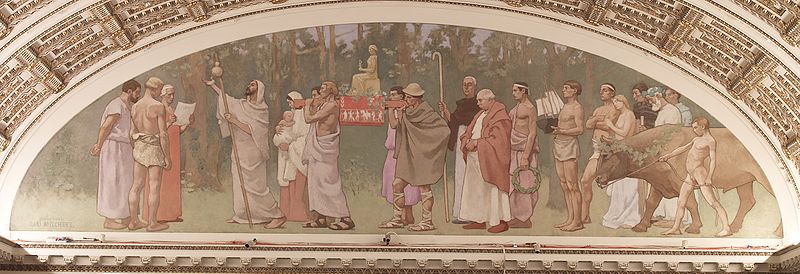
Remember these words of John Paul II: “Do not abandon yourselves to despair. We are the Easter people and hallelujah is our song.”
Almost all of Jesus’ closest male disciples abandoned him at the cross. After arguing over who would be the greatest in the kingdom, after blustering avowals of endurance, they broke and fled. But later on we see these same arrogant, cowardly braggarts transformed into wise and gentle leaders, and finally into martyrs going peacefully to their terrible deaths.
Personally, I have no desire to be a martyr unless it’s at the age of 103, and I can stand up against a wall and have a final smoke, and shout something epic before the firing squad takes me out, quickly. Being killed seems incredibly impractical. However, we belong to a church that venerates martyrs in spite of the extreme impracticality of letting your enemies kill you instead of killing them yourself.
This phenomenon of martyrdom has become less of an abstraction in the popular imagination, recently, thanks to the rise of extremist groups globally. I could say a good bit about the role of western nations, especially during the Cold War era, in creating a fertile situation for the breeding of extremist groups. But that’s not the point of this post. What I want to ask here is: if we are the Easter people, what does this mean about how we regard Muslims?
Did you notice that in the above paragraph I referred, not to Muslims, nor even to Muslim extremists, but simply to extremists? That’s because I am honoring the perspective of the many Muslims who have pointed to the atrocities committed by extremist groups, and said: this is not my religion.” Do you imagine that Muslims are not denouncing these acts? Do you think that they are silent? They’re not, even if some media outlets won’t report this.
I also take seriously what the catechism has to say: “The plan of salvation also includes those who acknowledge the Creator, in the first place amongst whom are the Muslims; these profess to hold the faith of Abraham, and together with us they adore the one, merciful God, mankind’s judge on the last day” (CCC 841). While there has been much scrambling on the part of some apologists to explain that actually the catechism doesn’t mean what the catechism says (take notes for whenever you feel like disagreeing with the catechism! It’s not hard) – I think a more intelligent, philosophically and theologically consistent response to this question is laid out here by Francis J. Beckwith, and here here by Edward Feser (a little philosophy of language goes a long way).
As Jewish Catholic, I am double linked with my Muslim brothers and sisters, in worship and tradition, even if we don’t agree on everything. As noted in the linked articles, not even Christians agree on everything Feser suggests that actually the Mormon idea of God is further from ours than the Islam idea.
As a pacifist Catholic, I have sometimes provoked criticism for saying of events such as the Crusades, or the killing of heretics: “these were not the acts of Christians.” Possibly I am guilty of hyperbole here, since, as mentioned in an earlier post, every person is a creature of her time, and most of us are blundering in folly. Perhaps it would be more correct to say that when people did these things they were not acting as Christians, no matter how many crosses they plastered on their shields, or how many times they said “Lord, Lord.”
To those Muslims who say “this is not my religion” some are quick to point to passages in the Quran that clearly advocate violence, to cast doubt on the claim that Islam is a “Religion of peace”:
Anyone arrogant enough to reject the verdict of the [holy man] who represents God must be put to death. Such evil must be purged.
Make ready to slaughter [the infidel’s] sons for the guilt of their fathers; Lest they rise and posses the earth, and fill the breadth of the world with tyrants.
Then I heard God say to the other men, “Follow him through the city and kill everyone whose forehead is not marked. Show no mercy; have no pity! Kill them all – old and young, girls and women and little children
Now therefore kill every male among the little ones, and kill every woman that hath known man by lying with him. But all the women children, that have not known a man by lying with him, keep alive for yourselves.
A [holy man’s] daughter who loses her honor by committing fornication and thereby dishonors her father also, shall be burned to death.
Oh, oops. Those are actually passages from the Old Testament (Deuteronomy 17:12, Isaiah 14:21, Ezekiel 9:5, Numbers 31: 17-18, Leviticus 21:9). Now, most Christians and Jews, of course, have elaborate explanations as to why these verses do not accurately represent our beliefs. And I believe that developing elaborate explanations as to why we do not live out these commands is an act of piety. It’s frustrating to have these verses held up by atheist humanists, and to be told that our efforts to distance ourselves from the human element of violence are mere sophistry, that we’re somehow being dishonest about our religious identity. So I imagine Muslims must feel the same way.
Yes, Muhammad did some dreadful things, if the tales are correct. So, alas, did my beloved King David.
Now, dear amateur inquisitors who lurk in comboxes, back off with your little metaphorical heretic-burning fires, because I am not positing equivalency between Christianity and Islam. I am a Catholic Christian because I have found the most richness of truth here, in the midst of the messes made by the human element in the church. But I do think that all humans have a religious impulse, so there is an integrity to every religion when practiced with faithfulness and love. I think even atheists, when going about their atheism seriously, are taking a religious stance, and I believe with Max Scheler that this capacity for turning towards the infinite, for asking questions of “ultimate concern”, that most distinguishes us from other animals. Religion is, of course, extremely impractical (like martyrdom). And sometimes, as Rene Girard so brilliantly explains in his works, the religious impulse is connected with violence. But the response to religious violence must be religious peace.
Søren Kierkegaard distinguished between the “objective truth” and the “subjective truth” of a religious belief. That is, there’s the correctness of what one believes, in relation to objective truth, and there is the correctness of one’s internal subjective disposition about what one believes to be true. In this sense, a Christian who believes that Jesus preached the Beatitudes, died, and rose again, and initiated the Church, and gave us the sacraments, but lives in a big home and ignores his poorer neighbors or pays her employees starvation wages or is just generally mean or thinks that racism is acceptable because of tribal impulses is less “right” than someone who worships a giant turtle that carries the earth on its back, and does so with ecstatic wonderment, and is driven by love for the giant turtle to spread peace and joy.
While I am not sure I entirely agree with Kierkegaard’s giving pride of place to subjective truth, I do think it is important when we think about our mission as the Easter people. Sent forth into the world and told to “be not afraid,” we should remember that the gifts of the Spirit are always gifts of unity and communication. The “speaking in tongues” of contemporary charismatic groups is all about individual emotion, and conveys nothing to anyone but nonsense, and I have no time for it, but when the disciples received the gift of tongues it enabled them to communicate, to enter into unity with others.
I’m not comfortable with the idea of drawing lines in the sand, and my desire to live out in the middle of nowhere is motivated more by temperament than by any belief in the validity of the mis-named “Benedict option.” We are supposed to love our enemies, do good to those who harm us, turn the other cheek, lay down our lives for our friends.
Well, actually – maybe I live out in the middle of nowhere so I never have to do this. It sounds incredibly difficult. Better just not to see too many annoying people too often. Easier to love the enemy in the abstract. Better to hope that you can occasionally meet a friend for drinks and not have to die for her while you’re at it.
Still: if we are going to draw any lines in the sand, it should not be between Christians and Muslims. We Christians should stand in solidarity with Muslims who are also, overwhelmingly, the victims of extremism (http://www.independent.co.uk/news/world/europe/paris-attacks-isis-responsible-for-more-muslim-victims-than-western-deaths-a6737326.html), and overwhelmingly dismayed by the appropriation of their religion. Because violent extremists are recruited largely from groups of people who have been disenfranchised and convinced that the West is against them, it’s important to stop drawing those lines in the wrong places, committing violence against the innocent out of fear that somehow we will come to harm. Note, by the way, that if you advocate violence against the innocent in order to prevent some theoretical future harm, you are using precisely the same argument as many abortion advocates – with the bonus on their side that they don’t actually believe that the fetus is fully human, while those who advocate violence against civilians presumably are not, ideologically , denying their humanity.
During this Easter season, I implore my fellow Christians to extend hands in friendship to Muslims in our communities – geographic or virtual – who are, often, living in fear due to escalating Islamophobia. Let’s remember to lay the blame for violence not on “Muslims” but on the actual groups guilty of doing the deeds. Even if this whole Christian pacifist thing sounds too hippie dippy to suit your fancy, remember: this may be our only hope to subdue the rising surge of extremist violence, so it is, unlike martyrdom, rather practical.
Image credit: Public domain in the US. Mural artist is Gari Melchers (1862–1932). Photographed in 2007 by Carol Highsmith (1946–), who explicitly placed the photograph in the public domain. https://commons.wikimedia.org/wiki/File:Gari-Melchers-Peace-Highsmith.jpeg
Previous Post
March 26, 2016
risen, and not undead (or, why Jesus is not a zombie)
Next Post

March 28, 2016 Yes, We Can Dare Hope That All Will Be Saved
Browse Our Archives
Select a Category abortion anti-semitism art Atwood Betrothed church clergy abuse coronavirus culture economics education environmentalism ethics faith family feminism gardening gun violence immigration Judaism literature MaddAddam New Pro Life Movement news pandemic personalism poem politics politics blue Pope Francis racism religion salvation sexuality social justice spirituality Station eleven Stephen King The Stand Trump Uncategorized war World Health Organization
Select a Month March 2021 February 2021 January 2021 December 2020 November 2020 October 2020 September 2020 August 2020 July 2020 June 2020 May 2020 April 2020 March 2020 February 2020 January 2020 December 2019 November 2019 October 2019 September 2019 August 2019 July 2019 June 2019 May 2019 April 2019 March 2019 February 2019 January 2019 December 2018 November 2018 October 2018 September 2018 August 2018 July 2018 June 2018 May 2018 April 2018 March 2018 February 2018 January 2018 December 2017 November 2017 October 2017 September 2017 August 2017 July 2017 June 2017 May 2017 April 2017 March 2017 February 2017 January 2017 December 2016 November 2016 October 2016 September 2016 August 2016 July 2016 June 2016 May 2016 April 2016 March 2016 February 2016
Follow Us!
TAKE THE
Religious Wisdom Quiz
From a rooftop, I was seen bathing, and this led to adultery, murder, and the death of a child. Who am I?
Select your answer to see how you score.
Bathsheba Tamar Michal Abigail
Support this
Column


Related posts from suspended in her jar

Immigrants: They Need Us, and We Need Them

Four Takeaways from Oprah’s Interview with the Duke...

Catholics Are De-Toxing From their Experiences With Traumatic...

How Has the Pandemic Changed Us? Has It...
TRENDING AT PATHEOS Catholic

Creation, Preservation, and Teleology in Catholic Theology
As I write this, it is very early Monday morning. Like millions...

The Parable Of The Sower And The Word...
One of Christ’s most famous parables is that of the sower who...

Rejecting Doom: Christian Hope And Human Action
Christianity is a religion of hope. We are to have hope and...

Why I Choose the Eucharist Over the Sermon
Choose the Eucharist, Not the Sermon What are we supposed to get...

5 Design Elements Found in Spiritually Rooted Homes
Putting Spirituality Into Home Decor Our homes are more than our living...

Credo: A Story of God Told with the...
About 10 years ago, I began to imagine a personal "Credo" that...
view all Catholic blogs
Ad-Free & Subscriber Log-In Subscription Support
- About Us
- 2026 Calendar
- Videos
- Podcasts
- Library of World Religions
- Faith In Media Tracker
- Advertise With Us
- Write for Us
- Privacy Policy
- Terms of Service
- Do Not Sell My Data
- Contact Us
- Radiant Digital
- Manage Newsletter Subscriptions
- Unsubscribe From Notifications
- Sitemap
Copyright 2008-2026, Patheos. All rights reserved.
Subscription Support Ad-Free & Subscriber Log-In
Follow Patheos